Egg cartons have become a test of grocery-store patience. Cage-free, free-range, pasture-raised, organic, brown, vegetarian-fed, omega-3: each phrase suggests a better egg, yet several describe different things. Housing is one issue. Feed is another. Food safety starts in your kitchen. Protein stays tied to the egg itself.
For most lifters, the first buying decision is simple. Buy eggs you can afford, keep them cold, cook them safely, and use the money you save on the rest of your protein intake. Pay more for a housing claim when that claim matches your welfare priorities and the carton gives you a standard you can inspect. A dark orange yolk alone is not proof that one egg will build more muscle.
The carton decision matrix
| Carton claim | What it says about housing | What it does not settle | Best reason to pay more |
|---|---|---|---|
| Cage-free | For USDA grademarked cartons, hens can move vertically and horizontally inside a house with food, water, nests, perches, and scratch areas. | Outdoor access, a universal space allowance, pasture, nutrition, or food safety. | You want to avoid conventional cages but have a tight budget. |
| Free-range | For USDA grademarked cartons, it adds continuous outdoor access during the laying cycle, with predator protection. | How much time each hen spends outside, the size or quality of the range, or a nutrition advantage. | Outdoor access matters to you and the carton also names a credible certification. |
| Pasture-raised | The phrase alone does not give shoppers one federal space or grazing rule. Its meaning depends on the producer and any certification seal. | That every hen had a particular number of square feet, ate a particular diet, or produced a superior nutrient profile. | You can verify a rigorous third-party pasture standard and accept the price. |
That distinction prevents the biggest label mistake: treating the three terms as a nutrition ladder. They are housing claims first. USDA Economic Research Service describes USDA Agricultural Marketing Service definitions that make cage-free an indoor roaming system and free-range a similar system with continuous outdoor access. Its report also notes that USDA definitions for pasture-raised are largely similar to free-range on outdoor access, while shoppers usually read “pasture-raised” as more outdoor-oriented. That gap is why the seal matters as much as the phrase.
Cage-free means no cages, not necessarily outdoors
Cage-free is the cleanest budget upgrade if your goal is to avoid conventional cages. Under the USDA grademark guidance, hens can roam vertically and horizontally in an indoor house, have fresh food and water, and get enrichments such as nests, perches, and scratch areas. That is useful information. It does not tell you that hens went outside, how much room each bird received, or what the farm’s feed contained.
Look for the exact combination of claims instead of filling in the blanks yourself. “Cage-free” plus a third-party welfare seal gives you more information than “cage-free” alone. “Cage-free” plus a rolling-pasture picture does not prove outdoor access. Skip a premium cage-free carton if the sole reason is better macros. A standard large egg still gives roughly 6 grams of protein, and protein content comes from egg size and composition rather than the housing phrase on the front of the box.
Free-range adds outdoor access, but details still matter
For USDA grademarked shell eggs, free-range means cage-free-style indoor roaming plus continuous outdoor access during the hens’ laying cycle. That is a real difference from cage-free. It is also the point where the label stops answering the questions most shoppers picture: How large is the outdoor area? Is it vegetated? Can all birds reach it easily? How many hours do they spend there?
A verified certification can make the claim easier to use. Humane Farm Animal Care’s Certified Humane standard, for example, calls a system “free-range” when hens can choose indoors or outdoors during the day and have at least 2 square feet of range area per bird. Its standard also addresses exits, vegetation, drainage, shelter, overhead cover, and parasite control. Those are program rules, not a universal definition of every free-range carton.
Choose free-range when outdoor access is a meaningful personal priority, the price does not crowd out the rest of your grocery plan, and the carton names the standard behind the claim. Skip the upgrade when you are chasing protein or a safety edge. The label does not deliver either one by itself.
Pasture-raised needs a certification check
“Pasture-raised” sounds precise because the word paints a precise picture. On its own, it is not a universal federal guarantee of pasture acreage, time outdoors, vegetation, or feed. Treat it as a prompt to turn the carton over.
One useful benchmark comes from Certified Humane. Its range requirements call a system pasture-raised when birds are primarily managed on range and require 2.5 acres per 1,000 birds, which works out to about 108 square feet per bird. The organization also requires range management, shelter, cover, and controls for parasite or pathogen buildup. A Certified Humane pasture-raised seal therefore makes a stronger, checkable welfare claim than the words “pasture-raised” alone.
That still is a welfare and production-system decision. The housing term alone does not guarantee more protein, fewer calories, or lower Salmonella risk. Pasture can change what hens encounter and eat. It cannot replace a nutrition label, a laboratory analysis, refrigeration, or thorough cooking.
Which claims are regulated, certified, or mostly marketing?
| Claim or mark | What to verify | Useful shopping interpretation |
|---|---|---|
| USDA grademark plus cage-free or free-range | The USDA AMS shell-egg labeling guidance and the precise claim. | A federal marketing definition applies to that grademarked product. Read it as a housing claim. |
| USDA Organic seal | The USDA organic seal, not only the word “organic.” | USDA Organic is a separate certified production claim with feed and management requirements. It is not interchangeable with pasture-raised. |
| Certified Humane or another named welfare certification | The program name, current seal, and its public laying-hen standard. | Useful when the program adds measurable space, access, enrichment, or audit rules that match your priorities. |
| Pasture-raised with no named standard | Producer details on outdoor space, access, and audits. | Potentially meaningful, but insufficient on its own for a specific welfare claim. |
| Brown shell | Nothing beyond egg color and price. | Shell color reflects hen breed. Brown does not equal healthier. |
| Vegetarian-fed | Feed claim only. | It does not mean a hen had outdoor access. Treat it as a feed claim, not a housing or nutrition guarantee. |
| Omega-3 | The Nutrition Facts panel and the stated omega-3 amount. | Compare the actual omega-3 amount instead of assuming a housing claim proves it. |
USDA oversight can vary with the claim and product program. A careful shopper should avoid a blanket statement that every egg-carton phrase is federally “regulated” in the same way. The practical rule holds: a named certification with public standards gives you a better basis for a welfare purchase than a pastoral illustration or a broad adjective.
Nutrition for lifters: the label is not the macro
Eggs earn their place in a lifting diet because they are a convenient protein food that works at breakfast, in a rice bowl, or beside a late shift meal. USDA FoodData Central lists one large raw whole egg at about 72 calories and 6.3 grams of protein before cooking fat. Three eggs give you roughly 19 grams of protein. Add a cup of cottage cheese, Greek yogurt, or lean meat when you need a breakfast that clears 30 grams instead of asking eggs to carry the whole meal.
The housing label does not let you estimate that protein total. Feed can affect some egg components, and individual studies have found differences in fatty acids, carotenoids, or minerals across production systems. Those results vary with diet, hen genetics, season, sampling, and the system studied. They do not support a universal rule that pasture-raised, free-range, or cage-free eggs deliver better muscle-building nutrition. Compare the Nutrition Facts label when a carton makes a nutrient claim.
Use eggs as one part of your daily protein plan. FitnessVolt’s high-protein foods guide can help you rotate eggs with dairy, meat, fish, legumes, and tofu. If breakfast is your weak spot, the 30-gram protein breakfast ideas show how to build a fuller meal around eggs. Set the meal inside your calorie target with the FitnessVolt TDEE calculator; an expensive carton does not compensate for a diet that misses total protein and energy needs.

Yolk and shell color answer different questions
Brown and white shells come from genetics. The Academy of Nutrition and Dietetics notes that shell color relates to hen breed, while the nutrition in brown and white eggs is the same. Pay a brown-egg premium only if you prefer the brand, the size, the welfare standard, or the price works for you.
Yolk color has a different cause. Carotenoids in a hen’s feed influence yolk pigmentation, so a deeper yellow or orange yolk can reflect diet. It is not a standalone score for welfare, freshness, protein, or safety. Feed additives can also alter color. A pale yolk does not make an egg weak, and a vivid yolk does not turn a six-gram egg into a higher-protein food.
Food safety: handle every carton with the same care
Food safety does not follow the welfare ladder. A 2015 review in the International Journal of Environmental Research and Public Health found no consensus that caged, barn, or free-range production changes Salmonella contamination of eggs. That uncertainty makes the kitchen rules more important than the marketing language.
- Buy eggs from a refrigerated case and leave cracked shells behind.
- Store them in their original carton in a refrigerator at 40°F or below.
- Cook whole eggs until the white and yolk are firm. Cook casseroles and other egg dishes to 160°F.
- Use pasteurized eggs or pasteurized egg products for recipes served raw or undercooked, such as some homemade dressings, eggnog, and ice cream.
- Keep cooked eggs and egg dishes out of the refrigerator for no more than 2 hours, or 1 hour above 90°F.
People who are pregnant, older, very young, or immunocompromised have more reason to choose pasteurized egg products for raw or lightly cooked preparations. Skip runny eggs for a high-risk guest unless the eggs have been treated to destroy Salmonella. The carton’s cage-free, free-range, pasture-raised, organic, or brown-shell label does not change that call.
How to shop without wasting your food budget
Start at the shelf tag, then make one decision at a time. If your priority is price and protein, buy the clean, uncracked refrigerated eggs that fit your budget. If avoiding cages matters, choose cage-free. If outdoor access matters, look for free-range with a named certification or clear producer details. If meaningful pasture access matters, choose pasture-raised only after confirming the certification and standard.
Do a simple per-egg calculation before making a weekly habit expensive. Divide the carton price by 12, 18, or 24. A $7.20 dozen costs 60 cents per egg; a $3.60 dozen costs 30 cents. At three eggs per day, that difference reaches about $27 per month. Spend that premium because you value the verified production standard, not because the carton implies double the protein.
A budget-friendly compromise can work well: buy the certified welfare carton when it is on sale, then use lower-cost eggs for batch breakfasts and put the savings toward other protein staples. Skip this approach if your household has a specific allergy, clinician-directed dietary restriction, or food-safety need. In that case, follow the individual guidance first.
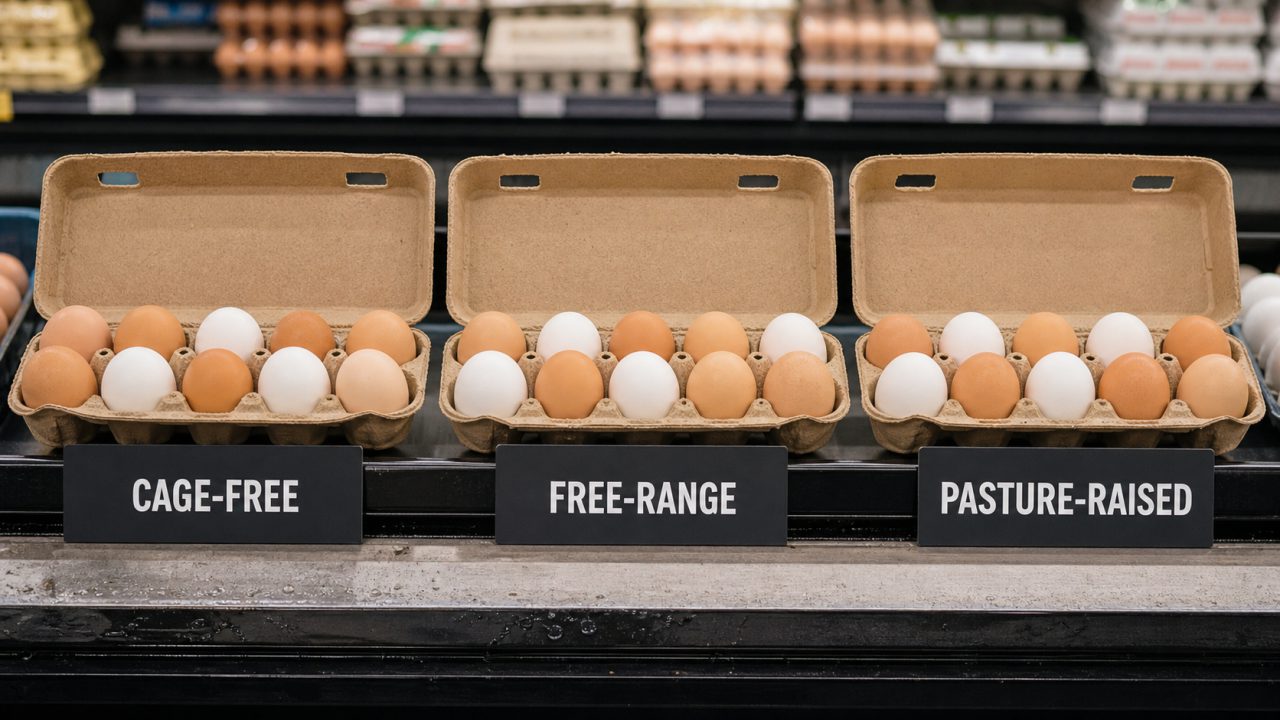
At your next grocery trip, compare two cartons in this order: price per egg, the exact housing claim, the named certification, and any nutrient amount printed on the Nutrition Facts panel. Ignore shell color and pastoral artwork. That 30-second check separates a verifiable production standard from a premium story, while keeping enough of the food budget for the protein, produce, and staples that shape the rest of the week.
Bottom line
Cage-free tells you hens were not kept in conventional cages. Free-range adds outdoor access under USDA grademark guidance. Pasture-raised needs a named standard before it tells you much about space or time outdoors. None of those phrases guarantees extra protein, better yolk nutrition, or safer handling. Choose the label that matches your welfare priorities, verify the certification, and let your total diet do the muscle-building work. Keep the carton in perspective: a reliable breakfast habit beats a premium label chosen on assumptions.
Sources
- Ufer, D. J. (2025). Animal Welfare and Treatment Label Claims in U.S. Table Eggs: Trends in Retail Premiums and Policy Impacts, 2008–18. USDA Economic Research Service, ERR-343. Accessed July 27, 2026.
- USDA Agricultural Marketing Service. (n.d.). Shell Eggs. Accessed July 27, 2026.
- Humane Farm Animal Care. (n.d.). Range Requirements. Certified Humane. Accessed July 27, 2026.
- U.S. Food and Drug Administration. (n.d.). What You Need to Know About Egg Safety. Accessed July 27, 2026.
- USDA Agricultural Marketing Service. (n.d.). Organic Standards. Accessed July 27, 2026.
- USDA Agricultural Research Service. (n.d.). FoodData Central: Egg, whole, raw, fresh. Accessed July 27, 2026.
- Gantois, I., et al. (2009). Mechanisms of egg contamination by Salmonella Enteritidis. FEMS Microbiology Reviews, 33(4), 718-738. https://doi.org/10.1111/j.1574-6976.2008.00161.x
- Whiley, H., & Ross, K. (2015). Salmonella and eggs: from production to plate. International Journal of Environmental Research and Public Health, 12(3), 2543-2556. https://doi.org/10.3390/ijerph120302543
- Academy of Nutrition and Dietetics. (2026). Understanding Egg Labels. Accessed July 27, 2026.
- Abuelo, A., et al. (2023). Carotenoid enrichment in eggs: From biochemistry perspective. Food Chemistry, 416, 135736. https://doi.org/10.1016/j.foodchem.2023.135736