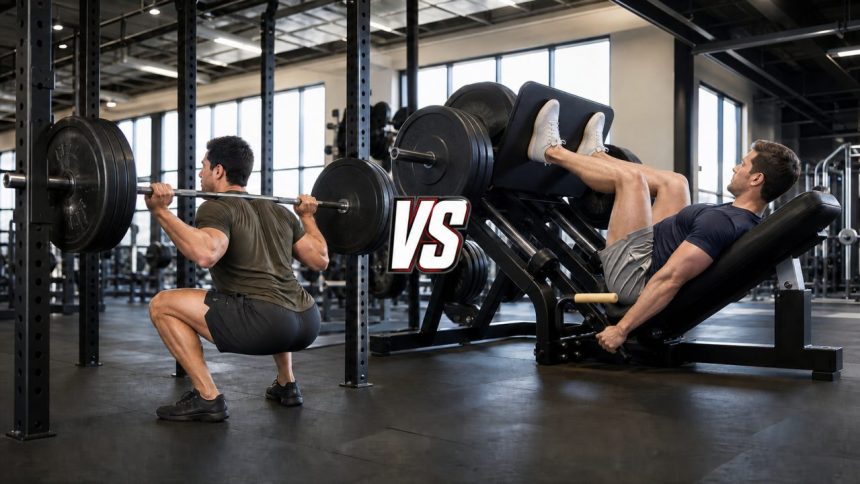
For larger legs, either lift can work if you use a productive range of motion, enough hard sets, and progressive overload. For a bigger barbell squat, you need to squat. For quad volume with less balance and upper-body demand, the leg press is hard to beat. Most lifters do best by treating this as a programming choice, not a loyalty test.
The old debate gets messy because people compare plate numbers across different machines, then use a single set to decide which exercise is “better.” That misses the point. A 45-degree sled, a horizontal press, and a plate-loaded squat do not share a useful pound-for-pound scorecard. Your target muscle, range of motion, setup, and the load you can recover from matter more.
We reviewed direct squat-versus-leg-press biomechanics research, broader resistance-training evidence, and FitnessVolt’s existing squat and leg-press coverage. The useful answer is conditional: squat for squat-specific strength and a whole-body bracing challenge; use the leg press when you want stable, repeatable lower-body volume; combine them if both fit your recovery.
The decision matrix
| Your main goal | Start with | Why | Main tradeoff |
|---|---|---|---|
| Raise your barbell squat 1RM | Back squat | Strength gains are specific to the movement you practice. | Technique and bracing can limit the set before your quads do. |
| Add quad training volume | Leg press | Back support and fixed path make it easier to repeat hard sets without balance becoming the limiter. | Machine geometry changes the feel and the load number means little outside that machine. |
| Build general lower-body muscle | Either, then add a second pattern if needed | Both train knee extension and hip extension; full, controlled reps and adequate effort drive the result. | Neither replaces hamstring work. |
| Train around a cranky back or knee | The option you can perform pain-free after assessment | Support or a different stance may help, but no machine receives an automatic safety pass. | New, severe, or persistent symptoms need a qualified clinician, not a tougher set. |
| Long femurs or a tall build | Test both | Anthropometry changes torso angle and comfort, not your ability to build legs. | You may need heel elevation, stance changes, or a different squat variation. |
What each exercise actually asks from you
A back squat moves your body and the bar through space. Your quadriceps extend the knees, while the glutes and adductors help extend the hips. Your trunk and upper back keep the bar in position. A leg press fixes your torso against a pad and guides the sled or seat. Your legs still work through knee and hip extension, but the machine removes much of the balance and bracing demand.
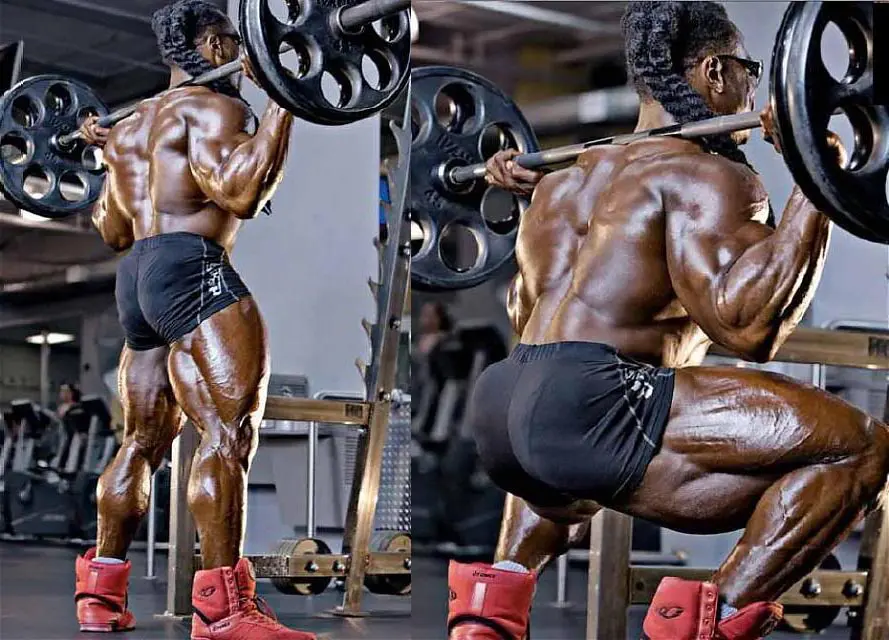
That difference matters for training, yet it does not create a muscle-building hierarchy. A small 2021 study comparing flywheel versions found similar quadriceps activity between squat and leg press, while participants used a deeper knee angle on the leg press. It was a biomechanics study of nine trained adults, not a long-term hypertrophy trial. Treat it as a clue about the movement, not a verdict on which lift grows more thigh muscle.
Depth deserves more attention than the logo on the machine. A systematic review and meta-analysis of range-of-motion research found that full-range resistance training generally produced better lower-body strength and muscle-growth results than partial-range training. “Full range” means the deepest controlled range your joints, equipment, and current mobility allow. On a leg press, stop before your pelvis rolls off the pad and your low back rounds. On a squat, use a depth you can own without the bar drifting or your feet losing pressure.
For practical setup details, see FitnessVolt’s squat biomechanics guide and our leg press exercise guide. They solve the how-to question. This article solves the programming choice.
Muscle growth: the evidence does not crown a winner
Direct long-term studies that match squat and leg-press training volume, effort, range, and participants are limited. That is the evidence limit behind most confident internet claims. The two exercises both train the quads, glutes, and adductors, but the exact contribution shifts with stance, depth, machine design, and your proportions.
For hypertrophy, the most defensible rule is simple: choose the movement that lets you accumulate challenging, controlled sets with a stable technique. The leg press can make that easier when a lifter’s squat turns into a balance or bracing contest. The squat can be the better choice if it gives you a comfortable deep pattern and you want to train the skill at the same time.
Do not rely on a huge sled number as proof of superior overload. A 45-degree sled uses a different resistance path than a horizontal press, and machines vary in carriage weight, friction, leverage, and depth. Track progress on the same machine with the same seat setting, foot position, and rep standard. Three sets of 10 with a fixed pelvis and a deeper controlled range beat a record that turns into a short-range hip tuck.
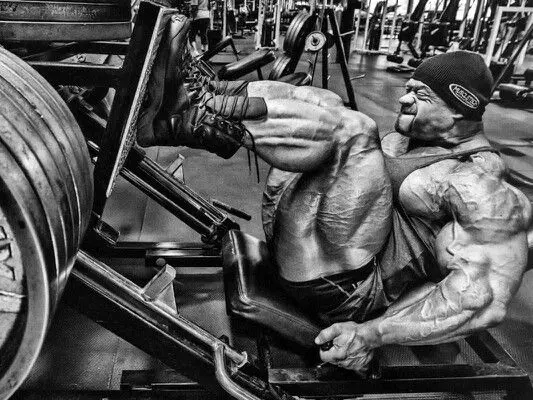
Hard sets need effort, but failure is optional. A 2023 systematic review and meta-analysis found no clear hypertrophy advantage for momentary muscular failure over non-failure training. Many lifters use non-failure squat sets to manage technique and fatigue. The evidence does not require either exercise to reach momentary failure, so end the set when your technique no longer matches the rep standard you chose.
Strength: specify the test before you name the winner
If “strength” means a heavier barbell squat, the squat wins because it practices the exact test. Strong legs help, but a squat also demands timing, balance, trunk stiffness, and confidence under a bar. The leg press can build useful lower-body capacity without replacing that practice.
If your goal is stronger legs for general gym training, either lift can add strength. Use a repeatable load, record the reps and range, and progress one variable at a time. You can estimate a training max with FitnessVolt’s one-rep max calculator, but do not convert a leg-press estimate into a squat target. They are different tests.
For athletes, transfer depends on the sport and the rest of the program. A squat may fit a plan that needs a free-standing, axial-loaded pattern. A leg press may add leg volume after sprinting, jumping, or field work without asking for more heavy barbell practice. Neither exercise gives an automatic athletic advantage.
How your build changes the exercise choice
Body proportions can change which squat stance, bar position, and depth feel repeatable. They do not prove that you are built wrong for squatting or that the leg press will grow your quads better. Test the movements instead of assigning yourself to one exercise from a limb-length rule.
Run a practical test for four weeks. Try a slightly wider stance, a modest toe-out, or heeled lifting shoes. Film a light set from the side, then compare a high-bar or front-squat variation with the leg press. Keep the option that gives you a stable bottom position, a repeatable range, and no symptom flare-up. FitnessVolt’s back squat versus front squat comparison can help if a front-loaded variation feels more upright.
Skip the “force your anatomy into a textbook” approach. A squat stance is personal. A leg-press seat angle and footplate are personal too. Your knees can travel forward if your heels stay planted and the movement remains controlled. On either lift, reduce the load if you need to cut depth, shift your feet, or rush the descent to finish the set.
How to compare your own response
As a practical self-monitoring example, compare the lifts for four to six weeks. Keep weekly hard quad sets close to the same number, use one main movement for three or four work sets, and leave hamstring and calf work unchanged. Track load, reps, rest time, range standard, and how your knees and back feel the next day. A tape measure can help only when you use the same landmark, time of day, and relaxed posture. Two weeks of a good pump cannot prove new muscle.
Use performance markers that match the lift. For the squat, record the heaviest clean set of five, your depth, and whether the bar stayed over the midfoot. For the leg press, record the exact machine, seat notch, foot position, and the deepest rep that kept your pelvis on the pad. Two extra reps at the same setup means progress at that movement. It does not need to change your squat number to count.
Count recovery too. If four hard squat sets make the rest of your session sloppy, two squat sets plus two leg-press sets may create more useful weekly work. If the leg press leaves your hips stiff because you fold into the bottom, reduce the range slightly and add a squat or split-squat pattern elsewhere. Let your logbook decide the split.
Three mistakes that ruin the comparison
Comparing plate totals: a leg-press sled can make a large number look dramatic without telling you the resistance at the footplate. Compare your own sessions on the same equipment. Changing everything at once: swapping stance, rep range, depth, and exercise order in the same week makes the result useless. Change one variable and log it. Calling a weak link a muscle verdict: a squat may stop because your upper back loses position, while a leg press may stop because your low back leaves the pad. Fix the limiter or select the exercise that lets the target muscles work.
Back and knee considerations without the fake safety claims
A supported torso can make the leg press more tolerable for some people with back sensitivity. It can also put you in a poor position if you chase depth until your pelvis lifts from the pad. A barbell squat loads the trunk, but loading alone does not diagnose a bad exercise. Pain, history, technique, exercise dose, and the person in front of the bar all matter.
Use discomfort as a reason to adjust the session, not as a diagnosis. Do not train through pain that changes how you move. Lower the load, trim a set, or choose a variation that stays comfortable, and discuss ongoing symptoms with a qualified clinician. FitnessVolt’s knee-friendly leg-day guide offers options for building a session around joint tolerance.
Neither lift should become a “knee saver” slogan. Both require the knees to extend under load. Neither needs a universal ban on deep knee flexion. The better depth is the deepest controlled position you can repeat without unwanted pelvic movement or symptoms.
Two leg-day plans you can use
Plan A: squat strength with extra quad volume
Use this if your priority is a bigger squat and you recover well from barbell work. Start with the squat while you are fresh. Rest two to four minutes on the first movement and 90 to 150 seconds on the assistance work.
- Back squat: 4 sets of 4 to 6 reps, stop with 1 to 3 reps in reserve.
- Leg press: 3 sets of 8 to 12 reps, same seat and foot position each week.
- Romanian deadlift: 3 sets of 6 to 10 reps.
- Leg curl: 2 to 3 sets of 10 to 15 reps.
- Calf raise: 3 sets of 8 to 15 reps.
Add one rep per set before adding load. If your squat technique fades on the fourth set, keep the load and add the rep next week. Skip this setup if the barbell squat repeatedly aggravates symptoms or leaves too little recovery for your sport.
Plan B: quad growth with a leg-press priority
Use this if you want more stable hard sets, your gym has a good sled, or you are taking a break from heavy barbell squatting. Do not turn it into a short-range plate-count contest.
- Leg press: 4 sets of 8 to 15 reps, finish most sets with 1 to 2 reps in reserve.
- Bulgarian split squat: 3 sets of 8 to 12 reps per leg.
- Hip hinge of choice: 3 sets of 6 to 10 reps.
- Leg curl: 3 sets of 10 to 15 reps.
- Optional goblet squat: 2 sets of 10 to 15 reps if you want to maintain squat-pattern practice.
If the leg press causes your low back to round before you hit your target reps, shorten the range a little or adjust the seat before you add plates. If you have no leg press, FitnessVolt’s no-squats leg-building alternatives can help you build a machine-free plan.
The practical verdict
Squat when you want to become a better squatter, enjoy the movement, or need a free-standing strength pattern in your program. Leg press when you want high-quality leg volume with less balance and upper-body demand. Use both when the second lift gives you useful work that the first did not cover.
Do not choose squats for a mythical hormone boost. Do not choose the leg press because it is automatically safer. Pick the option you can perform through a controlled range, train hard, progress over months, and recover from. That is how either lift earns a place in your leg day.
Sources
- Hansen EA, et al. (2021). Comparison of Joint and Muscle Biomechanics in Maximal Flywheel Squat and Leg Press. Frontiers in Sports and Active Living. PMID: 34423289.
- Schoenfeld BJ, Grgic J. (2020). Effects of range of motion on muscle development during resistance training interventions. SAGE Open Medicine. doi:10.1177/2050312120901559.
- Almeida MO, et al. (2021). Effects of range of motion on resistance training adaptations: a systematic review and meta-analysis. Sports Medicine. PMID: 34170576.
- Refalo MC, et al. (2023). Influence of Resistance Training Proximity-to-Failure on Skeletal Muscle Hypertrophy: A Systematic Review with Meta-analysis. Sports Medicine, 53(3), 649-665. doi:10.1007/s40279-022-01784-y.
- Lacio ML, et al. (2021). Effects of resistance training performed to repetition failure or non-failure on muscular strength and hypertrophy. Journal of Sport and Health Science. PMID: 33497853.