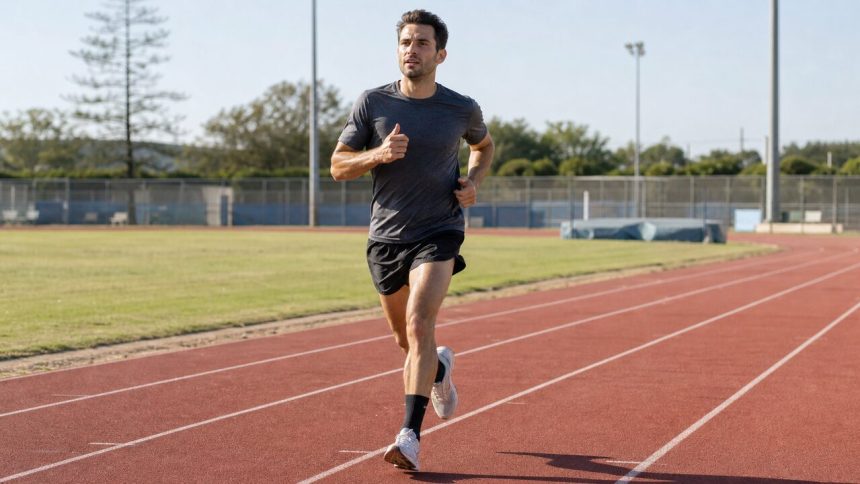
After a few weeks of regular cardio, the same pace usually starts to feel easier. Your heart can send more blood with each beat. Your working muscles build more tiny blood vessels and become better at using oxygen. You also improve your pacing and waste less energy with every step, stroke, or pedal turn.
Those changes are endurance training adaptations. They do not arrive at the same time. Watch for three practical signs. Your heart rate drops at the same easy pace, your speed rises at the same effort, or you recover faster after a hard interval.
Some beginners notice easier pacing or recovery within the first few weeks, but the timing varies. Trained runners and cyclists usually need longer and more targeted work to see the same jump.
How quickly does your body adapt?
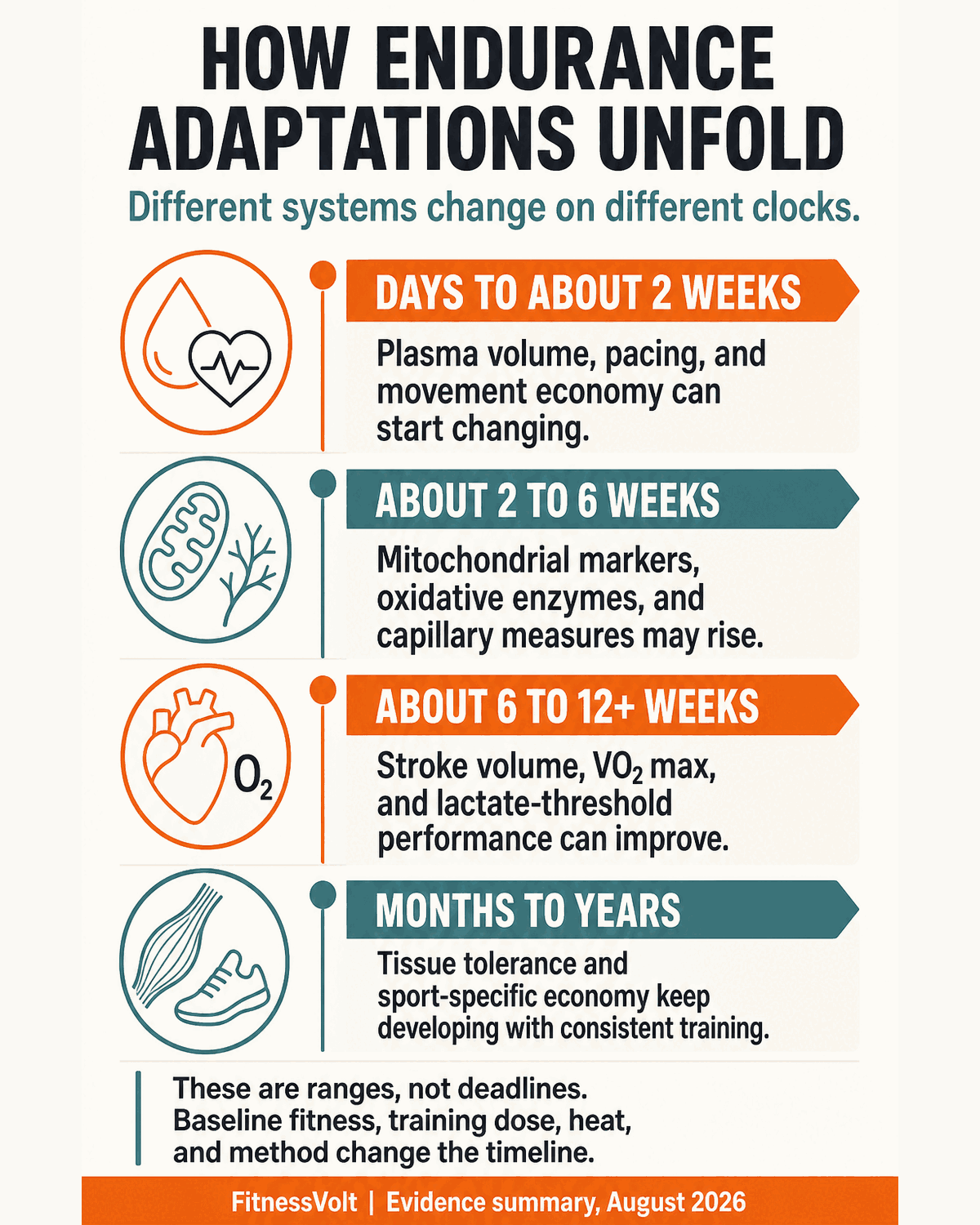
Your first gains often come from better pacing and smoother movement. Over the next several weeks, your body increases blood volume and helps your muscles use oxygen more effectively. Tendons and bones need months to catch up.
| Training time | What you may notice | What not to expect |
|---|---|---|
| First 1 to 2 weeks | Better pacing, smoother technique, and an early increase in plasma volume in some programs | A complete fitness transformation after three workouts |
| About 3 to 8 weeks | Your heart rate may drop at the same easy pace, and your legs may recover faster between sessions | Every workout to feel easy or every test number to rise together |
| About 8 to 12 weeks | You may hold a faster pace at the same effort, recover better between intervals, and improve your VO2 max.1 | The exact percentages reported in one study |
| Several months and beyond | You become better at your chosen sport, your legs tolerate more training, and further gains require a more focused plan | A fixed point where your body stops adapting forever |
Your heart pumps more blood with each beat
During exercise, your muscles need oxygen. Your heart meets that demand by beating faster and by pushing more blood with each beat. The amount sent with one beat is called stroke volume.
Endurance training can increase stroke volume. That means your heart may not need to beat as often to deliver the same amount of blood during an easy run or ride. In 631 previously sedentary adults, 20 weeks of cycling increased stroke volume at two fixed workloads. Cardiac output fell at the easiest workload and rose at the harder one.2
This is why a familiar easy pace may produce a lower heart rate after several weeks. It does not mean a low resting heart rate is always better. Heat, dehydration, poor sleep, illness, caffeine, and stress can move heart rate from one day to the next.
Blood volume can rise early
Plasma is the liquid part of your blood. Some training programs increase plasma volume within the first few weeks.3,4 More plasma helps the heart fill between beats and can support temperature control during long or hot sessions.
Extra plasma can dilute the blood enough to lower a hematocrit reading, even in a fit athlete. Do not interpret that number on your own. See a clinician if it comes with unusual fatigue, shortness of breath, or signs of iron deficiency.
Your muscles get better at using oxygen
Delivering oxygen is only half the job. The working muscles must receive it and turn it into usable energy. Regular endurance training improves both steps.
You build more capillaries around muscle fibers
Capillaries are tiny blood vessels. More capillaries give oxygen a shorter trip from the blood to the working muscle. A large 2025 review found early capillary gains mainly in untrained to moderately trained participants, often within the first four weeks.5
You do not feel a new capillary appear. You notice the result when a pace that once made your legs burn becomes manageable, or when you recover faster before the next interval.
Your muscles make aerobic energy more efficiently
Mitochondria are the parts of your muscle cells that use oxygen to make energy. Endurance training helps them grow and work better. After adjustment, a 2025 review estimated a 23% increase in mitochondrial content with continuous endurance training. Individual results varied.5
You may ride at the same speed with easier breathing and less burning in your legs.6 A steady 30-minute ride may still require effort, but it should stop feeling like a test every time.
You handle fuel and lactate better
At the same easy or moderate workload, trained muscle often burns more fat and saves some stored carbohydrate. In six lean women, a 12-week cycling program increased whole-body fat oxidation by 25% at the tested workload.7 This does not mean your body flips from carbohydrates to fat. Both fuels contribute, and carbohydrate use rises as the effort gets harder.
Lactate is not waste that poisons the muscle. Your body can move it between tissues and use it as fuel. In a small study of six trained and six untrained men, the trained men oxidized more lactate during exercise.8 The study compared groups at one point in time, so it cannot tell us how quickly that ability changes with training.
Easy cardio and intervals build fitness in different ways
| Training type | How it should feel | Main use | Common mistake |
|---|---|---|---|
| Easy cardio | You can speak in full sentences | Build repeatable volume with manageable fatigue | Going too hard and turning every session into a race |
| Moderate work | Talking takes effort, but the pace stays controlled | Improve sustained pace or power | Adding too much on top of hard lifting or interval days |
| Hard intervals | You can manage only a few words during each hard interval | Raise high-end aerobic power and practice hard pacing | Using more intervals than you can recover from |
Easy work is not wasted time. It lets you build minutes and movement practice without the recovery cost of repeated hard intervals. Intervals are useful, but they work best as a small part of a plan that you can repeat week after week. FitnessVolt’s Zone 2 training guide explains how to use the talk test and heart rate for easy sessions.
A simple three-session week for beginners
This example works for running, cycling, rowing, swimming, or an elliptical. Choose the mode your joints tolerate and your schedule allows.
- Session 1: 30 minutes easy. Keep a conversational pace from start to finish.
- Session 2: six 1-minute hard efforts. Recover for 2 minutes at an easy pace after each effort. Include a 10-minute warm-up and cool-down.
- Session 3: 40 minutes easy. Add 5 minutes every one or two weeks if your recovery and joints feel normal.
Do not add time and intensity in the same week. If your knees, shins, Achilles tendons, or feet stay sore, reduce the impact. Use cycling or rowing while you build fitness. FitnessVolt’s guide to improving endurance without running gives you lower-impact options.
What adapts more slowly?
Tendons and bones need patience
Your breathing can improve faster than your legs can tolerate running. One tendon review included programs lasting at least eight weeks. Longer studies tended to show larger stiffness changes, but the researchers could not name a precise minimum.13 A new runner can therefore feel ready for more mileage before the calves, feet, or Achilles tendons are ready.
Running loads the bones in your legs, while swimming adds much less impact. A study of young male runners and swimmers found different bone-density patterns between the groups.15 The study did not include cyclists.
Running does not come with a simple arthritis cutoff
A large observational study compared people who had chosen to run with people who had never run. The runners did not have a higher rate of symptomatic knee osteoarthritis.14 Every running plan still needs a sensible workload. Prior injury, sudden mileage jumps, poor recovery, and persistent pain matter.
How lifters can add cardio without ruining strength work
Cardio will not automatically burn muscle or erase your strength. Trouble usually starts when hard cardio piles onto hard leg training and recovery falls behind. Across 59 studies, combined training slightly reduced lower-body strength gains in men but not women. The researchers did not have enough muscle-growth data for a firm conclusion.12
- Protect the main lift. Squat or deadlift before hard cardio when strength is the priority.
- Start with two easy sessions. Twenty to 30 minutes is enough to learn how your legs recover.
- Use a lower-impact mode when needed. Cycling or rowing can build fitness with less pounding than running.
- Separate hard leg work. Put hard intervals and high-volume leg training on different days when possible.
- Eat for the added work. A larger training load needs enough calories, carbohydrate, protein, and sleep.
For a complete schedule, see FitnessVolt’s 45-Day Hybrid Athlete Workout Plan.
How fast do you lose endurance after a break?
Three rest days do not erase your fitness. A deload week may help you recover and return stronger. After two to four weeks with no training, blood volume can fall and familiar paces may start to feel harder.10,11
After a short break, restart below your previous weekly volume and rebuild gradually. A long illness or injury needs a slower return than a planned vacation.
How to tell whether your endurance is improving
Repeat one simple test under similar conditions every two to four weeks. Use the same route, machine, temperature when possible, and time of day.
- Record your heart rate at the same easy pace or power.
- Record the pace or power you can hold at the same conversational effort.
- Track how quickly your breathing settles during a fixed recovery period.
- Note whether the next day’s strength session feels normal.
FitnessVolt’s VO2 max calculator can estimate one part of aerobic fitness. Treat it as a trend, not a laboratory measurement. Pace, power, heart rate, recovery, and event performance give you a more complete picture.
What regular endurance training changes
With steady cardio, your heart pumps more blood per beat and your muscles make better use of oxygen. Within weeks, the same route or machine setting should feel more controlled. Tendons, bones, and sport-specific skill improve more slowly, so your legs may need extra time even when your breathing feels ready.
Pick a mode you can repeat, keep most sessions easy, add a small amount of hard work, and track one consistent test. The best sign of progress is simple: a pace that used to feel hard starts to feel controlled.
Sources
- Faricier, R., Paterson, D. H., & Murias, J. M. (2025). Physiological determinants of VO2max increase with endurance training. Medicine & Science in Sports & Exercise, 57(8), 1790-1798. DOI: 10.1249/MSS.0000000000003707. PMID: 40173327.
- Wilmore, J. H., et al. (2001). Cardiac output and stroke volume changes with endurance training. Medicine & Science in Sports & Exercise, 33(1), 99-106. PMID: 11194119.
- Montero, D., et al. (2017). Erythropoiesis with endurance training: dynamics and mechanisms. American Journal of Physiology, 312(6), R894-R902. PMID: 28381454.
- Zouhal, H., et al. (2023). The effects of exercise training on plasma volume variations. International Journal of Sports Medicine, 44(6), 406-419. PMID: 34638157.
- Mølmen, K. S., Almquist, N. W., & Skattebo, Ø. (2025). Effects of exercise training on mitochondrial and capillary growth in human skeletal muscle. Sports Medicine, 55(1), 115-144. PMID: 39390310.
- Holloszy, J. O., & Coyle, E. F. (1984). Adaptations of skeletal muscle to endurance exercise and their metabolic consequences. Journal of Applied Physiology, 56(4), 831-838. PMID: 6373687.
- Horowitz, J. F., et al. (2000). Effect of endurance training on lipid metabolism in women. American Journal of Physiology, 279(2), E348-E355. PMID: 10913035.
- Emhoff, C. A. W., et al. (2013). Direct and indirect lactate oxidation in trained and untrained men. Journal of Applied Physiology, 115(6), 829-838. PMID: 23788576.
- Coyle, E. F., et al. (1984). Time course of loss of adaptations after stopping prolonged intense endurance training. Journal of Applied Physiology, 57(6), 1857-1864. PMID: 6511559.
- Coyle, E. F., Hemmert, M. K., & Coggan, A. R. (1986). Effects of detraining on cardiovascular responses to exercise. Journal of Applied Physiology, 60(1), 95-99. PMID: 3944049.
- Huiberts, R. O., Wüst, R. C. I., & van der Zwaard, S. (2024). Concurrent strength and endurance training. Sports Medicine, 54(2), 485-503. PMID: 37847373.
- Bohm, S., Mersmann, F., & Arampatzis, A. (2015). Human tendon adaptation in response to mechanical loading. Sports Medicine – Open, 1, 7. PMID: 27747846.
- Lo, G. H., et al. (2017). Is there an association between a history of running and symptomatic knee osteoarthritis? Arthritis Care & Research, 69(2), 183-191. PMID: 27333572.
- Magkos, F., et al. (2007). The type and intensity of exercise have independent and additive effects on bone mineral density. International Journal of Sports Medicine, 28(9), 773-779. PMID: 17455122.