Choose a seated overhead press when you want stable, shoulder-focused sets. Choose a standing overhead press when you want to improve your strict press and train your whole body to brace under the weight. Neither version is automatically better for every goal.
For most lifters, the seated dumbbell press is the easiest option for adding shoulder volume. The bench removes the balance problem, and each arm can move through a comfortable path. The standing barbell press is the better choice when the goal is a stronger standing press. Your legs stay straight, but your glutes, abs, and upper back must keep your body from bending as the bar moves overhead.
If balance or lower-back fatigue cuts your sets short, sit down. If you want a stronger standing press, keep the standing version in your program.
Seated vs. standing overhead press at a glance
| Variation | Best for | Main benefit | Main drawback |
|---|---|---|---|
| Seated barbell press | Heavy, supported pressing | The bench reduces balance demands, so you can focus on moving the bar | It does less to improve a standing strict press |
| Standing barbell press | Strict-press strength and whole-body bracing | You practice the exact skill of pressing a bar while standing | Balance or lower-back position may end the set before your shoulders are tired |
| Seated dumbbell press | Shoulder size and controlled volume | Each arm can find a comfortable path while the bench supports your torso | Getting heavy dumbbells into position can be awkward |
| Standing dumbbell press | Independent arm control and lighter full-body work | Each shoulder works on its own while your body controls two moving weights | You will usually use less weight than in the other three versions |
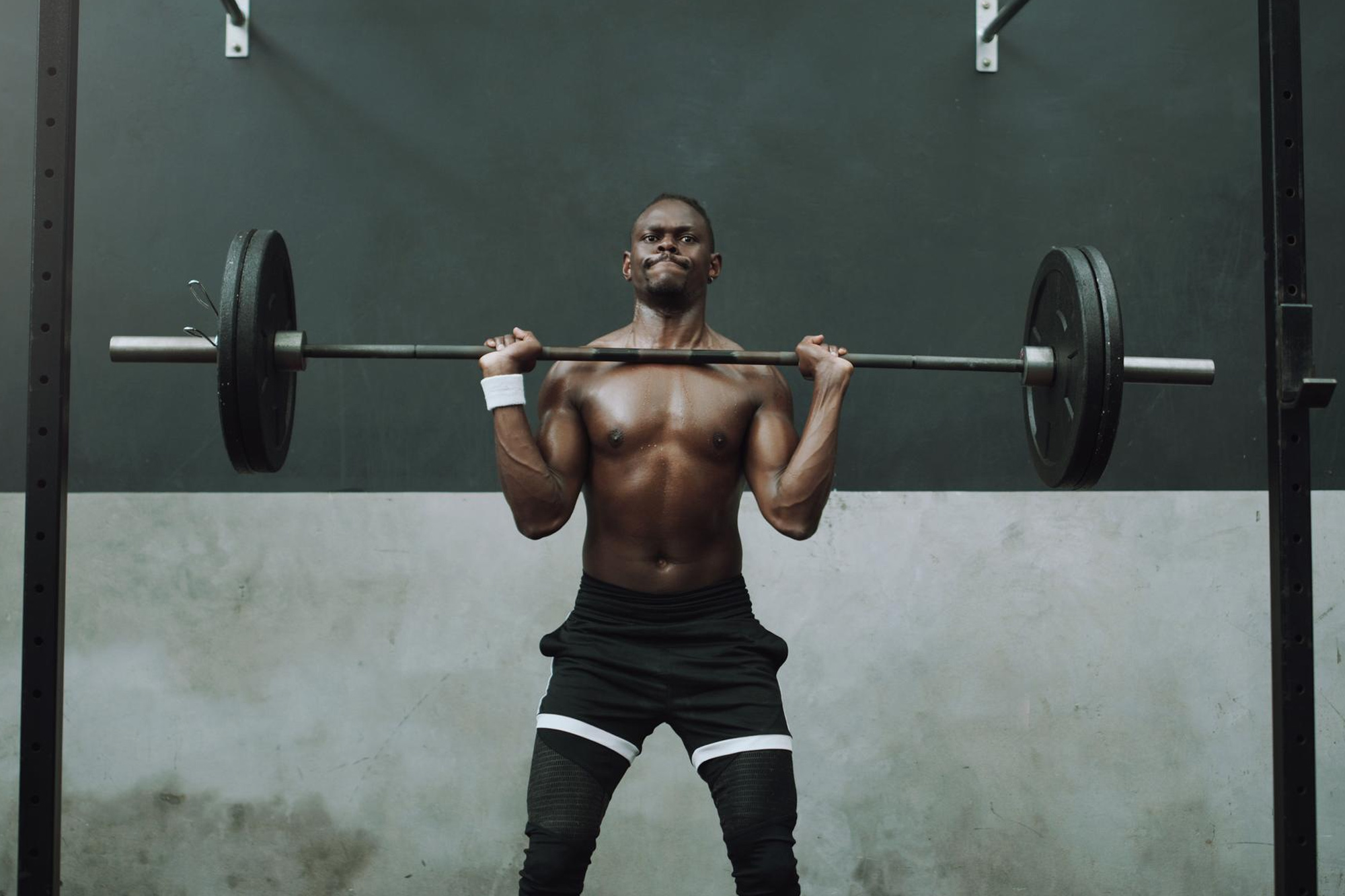
What changes when you sit down?
A bench gives your torso a stable surface. That makes it easier to keep your balance and repeat the same bar or dumbbell path. You still have to brace, but your feet, hips, and abdominal muscles do less work than they do during a strict standing press.
That extra support can help when your goal is shoulder volume. If your lower back starts arching on rep eight of a standing set, your shoulders may still have more work left in them. Sitting down can remove that weak link and let you finish the set with cleaner reps.
Standing changes the job. Your feet push into the floor, your glutes keep your hips from drifting forward, and your abs stop your ribs from flaring. In a 15-man dumbbell-press study, standing increased abdominal and external-oblique activity. Lower-back muscle activity did not differ from the seated press.2 Standing therefore adds a bracing challenge, but it does not turn the press into a complete core workout.
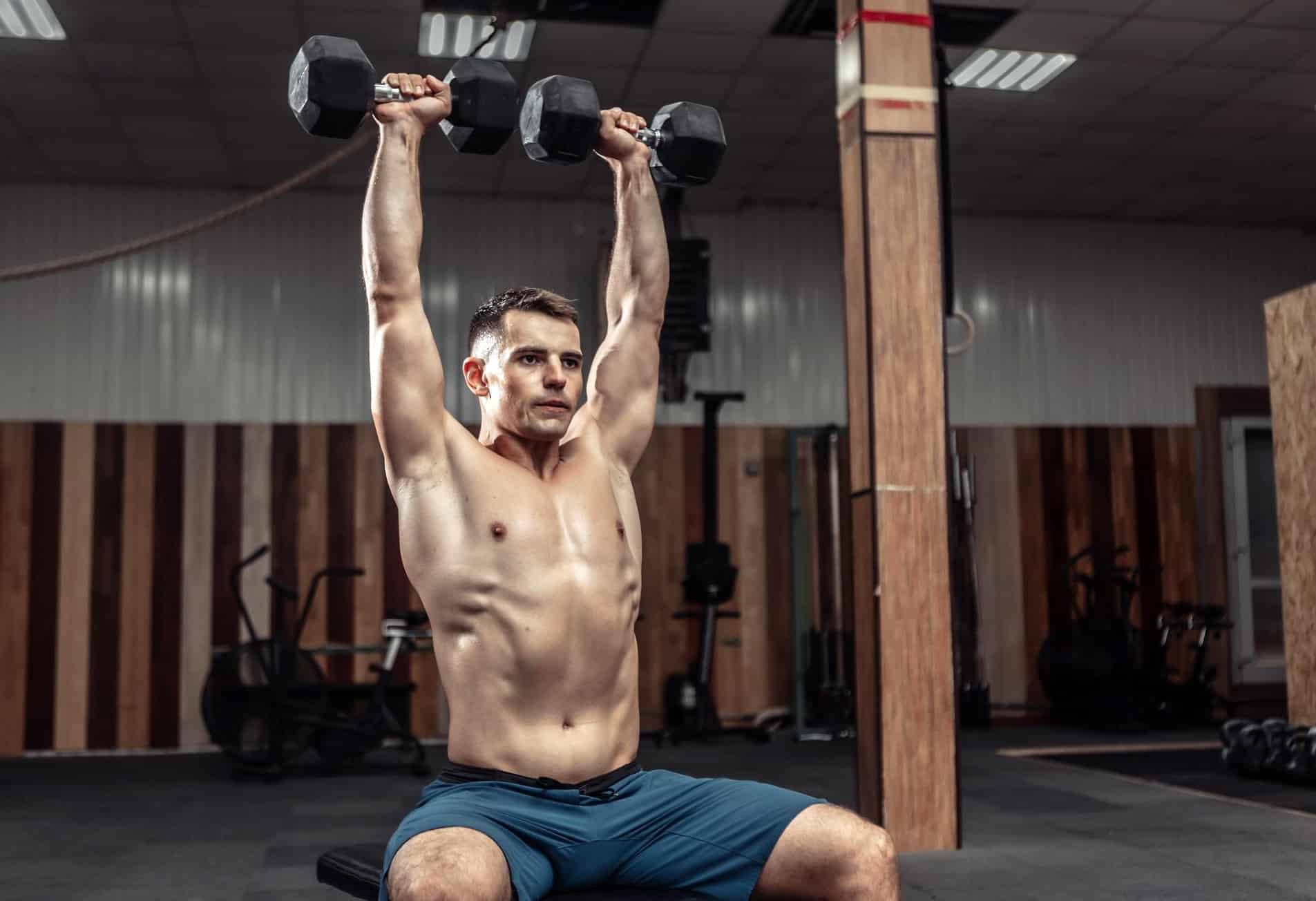
Which press is better for building shoulder muscle?
The seated dumbbell press is the most practical starting choice for shoulder growth. The bench supports your torso, the dumbbells let each arm move freely, and sets of 8 to 15 reps are easy to control. That combination makes it simple to add hard shoulder work without balance becoming the main challenge.
The standing press can build muscle too. Your shoulders and triceps still move the weight. The problem is that your balance, bracing, or lower back may fail first. If you can keep your body still and take the set close to failure, the standing version remains a good muscle-building exercise.
Do not choose a press from one EMG number. EMG measures the electrical signal reaching a muscle during a set. Acute EMG cannot determine which press will produce more growth over months.3,4
A simple shoulder-growth setup is 3 to 4 sets of 8 to 12 seated dumbbell presses, stopping with 1 to 2 good reps left. Add weight after you can complete every set without shortening the range or slamming the dumbbells together. Skip heavy overhead work for the day if pressing causes sharp shoulder pain rather than normal muscle fatigue.
Which press is better for strength?
Train the version you want to improve. Strength is specific. If your goal is a stronger standing barbell press, the standing barbell press needs to appear in your program. A seated press can build the shoulders and triceps that support it. It cannot teach the full skill of bracing and moving a bar while standing.6,7
If your sport or test uses a seated press, practice seated. Otherwise, use the version you can train hard without pain. Your technique should also remain steady from the first rep to the last.
For strength, start with 2 to 3 work sets of 3 to 6 reps. Rest until you can repeat the same brace and bar path.8 Keep the same bench angle, grip, and range of motion for at least four weeks so your numbers mean something. FitnessVolt’s overhead-press 1RM calculator can estimate your max from a clean set, but compare standing numbers with standing numbers and seated numbers with seated numbers.
Barbell or dumbbells?
A barbell lets both arms drive the same weight, so most lifters can press more and follow a repeatable path. Dumbbells require each arm to control its own weight, which usually lowers the load but gives your shoulders more freedom to choose a comfortable path.
In one test of 15 healthy men, lifters pressed the most weight with a seated barbell and the least with standing dumbbells. The standing dumbbell press also produced high muscle activity, but that single workout cannot tell us which version builds the most muscle.1
Use a barbell when adding small amounts of weight and building a specific press matters most. Use dumbbells when you prefer independent arms, have a side-to-side difference, or find a fixed bar path uncomfortable. Choose by comfort and training goal, not by which version looks more “functional.”
Choose the version that fits your goal
- For bigger shoulders: start with a seated dumbbell or machine press. Use 3 to 4 sets of 8 to 15 controlled reps.
- For a stronger strict press: use the standing barbell press first in the workout. Practice 3 to 5 sets of 3 to 6 reps.
- For strongman or overhead sport: train the standing implement and rules used in competition. Add seated work afterward for extra shoulder and triceps volume.
- For a tired lower back: use a supported seated press until you can train overhead without turning every rep into a backbend.
- For low ceilings: choose a seated press or half-kneeling landmine press instead of shortening the standing range.
Compare your result with the strength standard for the exact version you use: standing barbell, seated barbell, seated dumbbell, or standing dumbbell.
Four setup checks that matter
- Keep your ribs over your hips. If your chest points toward the ceiling, you have turned the press into a steep incline press.
- Start with your forearms close to vertical. A grip that is too wide can make the bottom position weak and uncomfortable.
- Move your head out of the bar’s path, then bring it through. Do not swing the bar around your face.
- Stop the set when your position changes. A hard rep is useful. A rep that needs a large backbend is a different exercise.
For a full seated-dumbbell setup, see FitnessVolt’s seated dumbbell shoulder-press guide.
Two simple ways to program both
When strength is the priority
Perform the standing barbell press for 4 sets of 4 to 6 reps. Follow it with 3 sets of 8 to 12 seated dumbbell presses. This keeps the skill you want to improve first and uses the supported press to add shoulder volume.
When shoulder size is the priority
Perform the seated dumbbell press for 4 sets of 8 to 12 reps. Later in the week, use the standing barbell press for 3 sets of 5 to 8 clean reps. Leave at least 48 hours between hard pressing sessions if your shoulders or triceps still feel tired.
Mistakes that ruin the comparison
- Comparing different tools: a seated barbell max and a standing dumbbell max are different lifts.
- Using leg drive in the standing press: bending the knees turns a strict press into a push press.
- Setting the bench too low: a heavily reclined bench shifts more work toward the upper chest.
- Judging growth from EMG alone: one high electrical reading does not predict long-term muscle gain.
- Keeping a painful variation: use a neutral grip, dumbbells, a landmine press, or a shorter pain-free range while you address the cause.
Which one should you do?
Use the seated press for stable shoulder work. Use the standing press for standing strength and bracing practice. Most lifters who want both size and strength should use one standing barbell day and one seated dumbbell day. Put the lift you care about first and track it for at least four weeks. Change it only when pain, available equipment, or a new goal gives you a clear reason.
Sources
- Saeterbakken, A. H., & Fimland, M. S. (2013). Effects of body position and loading modality on muscle activity and strength in shoulder presses. Journal of Strength and Conditioning Research, 27(7), 1824-1831. DOI: 10.1519/JSC.0b013e318276b873. PMID: 23096062.
- Saeterbakken, A. H., & Fimland, M. S. (2012). Muscle activity of the core during bilateral, unilateral, seated and standing resistance exercise. European Journal of Applied Physiology, 112(5), 1671-1678. DOI: 10.1007/s00421-011-2141-7. PMID: 21877146.
- Vigotsky, A. D., Halperin, I., Lehman, G. J., Trajano, G. S., & Vieira, T. M. (2018). Interpreting signal amplitudes in surface electromyography studies in sport and rehabilitation sciences. Frontiers in Physiology, 8, 985. DOI: 10.3389/fphys.2017.00985. PMID: 29354060.
- Vigotsky, A. D., Halperin, I., Trajano, G. S., & Vieira, T. M. (2022). Acutely measured surface EMG amplitude is not a validated predictor of muscle hypertrophy. Sports Medicine, 52(2), 193-199. DOI: 10.1007/s40279-021-01619-2. PMID: 35006527.
- Folland, J. P., & Williams, A. G. (2007). The adaptations to strength training. Sports Medicine, 37(2), 145-168. DOI: 10.2165/00007256-200737020-00004. PMID: 17241104.
- Morrissey, M. C., Harman, E. A., & Johnson, M. J. (1995). Resistance training modes: specificity and effectiveness. Medicine & Science in Sports & Exercise, 27(5), 648-660. DOI: 10.1249/00005768-199505000-00006. PMID: 7674868.
- American College of Sports Medicine. (2026). Resistance training prescription for muscle function, hypertrophy, and physical performance in healthy adults. Medicine & Science in Sports & Exercise. PMID: 41843416.