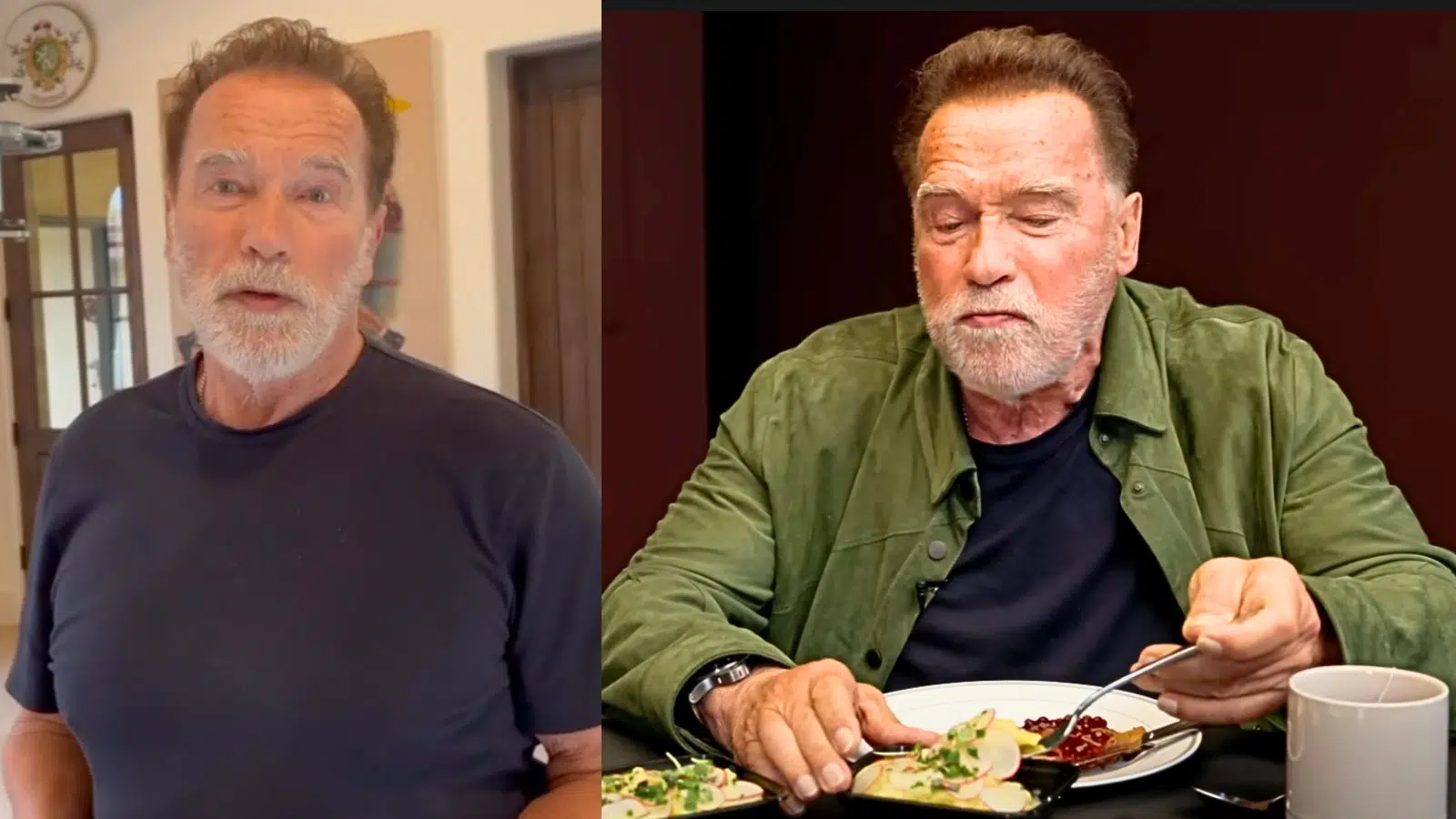
Calorie deficits are crucial for fat loss, but could there be a tipping point when they do more harm than good? In Arnold’s Pump Club newsletter released on September 2, 2025, Arnold Schwarzenegger tackled this question, revealing whether calorie restriction will make you vulnerable to injury, illness, and poor recovery.
Proper dieting laid the groundwork for Arnold Schwarzenegger‘s ascent in bodybuilding. Coupled with intense training, he proved himself on the Mr. Olympia stage, securing seven titles throughout the 1970s and early 80s. Though training and nutrition no longer look the same for the bodybuilding icon, that hasn’t stopped him from relaying wisdom he picked up throughout his tenure in the sport.
Arnold Schwarzenegger Examines New Science Behind Calorie Restriction Risks
In the newsletter, Schwarzenegger confirmed that there’s a “tipping point” in research where scientists discovered that calorie restriction can do more harm than good.
“When “Less” Becomes a Liability: The New Science Of Calorie Restriction Risks
We’ve all heard that eating less can help you live longer. But new research shows there’s a tipping point — and going too far may do more harm than good.”
While calorie restriction can help with fat loss, in extreme cases, it will weaken your immune system and increase injury risk.
“Extreme calorie restriction may impair healing, weaken your immune system, and increase injury risk — even if it helps with fat loss.”
Schwarzenegger pointed to researchers who explored the lesser-known downsides of calorie restriction. He explained that the body pulls back on immune defense and tissue repair over long periods of low calories. This can leave you feeling vulnerable to illness, injury, and poor recovery.
“Scientists recently examined the lesser-known downsides of calorie restriction.
Pulling from decades of studies, the authors found that when you eat too few calories — especially over long periods — your body begins making tough trade-offs. Vital functions like immune defense and tissue repair get deprioritized, leaving you more vulnerable to illness, injury, and poor recovery.”
Furthermore, he noted that in extreme cases, infection risk spiked, bone density declined, and cognitive performance sometimes suffered.
“Specifically, when hitting an extreme calorie restriction (think about 40 percent), infection risk increased, bone density decreased (especially when protein and nutrient intake didn’t meet needs), and cognitive performance sometimes declined.”
“The researchers believe these effects stem from an energy-conservation response. When energy is scarce, your body shifts resources away from maintenance tasks like rebuilding muscle, fighting illness, or recovering from workouts — and instead focuses on survival.”
He emphasized that calorie restriction shouldn’t be demonized — it can still help you drop fat, but pushing too far can backfire.
“This doesn’t mean calorie restriction is always bad. In controlled, moderate amounts — and with sufficient protein, vitamins, and recovery — it can still be useful for fat loss or improving health markers. But the “more is better” mindset doesn’t work here. Pushing too far, for too long, can backfire.”
As a safe rule of thumb, scientists recommend avoiding diets under 1,200 calories without medical supervision.
“The scientists recommend avoiding diets under 1,200 calories unless supervised, and to pay close attention to fatigue, cravings, or recurring illness.”
For those over 40 or recovering from injury, Schwarzenegger said to be especially careful when navigating a calorie deficit:
“If you’re over 40, training intensely, or recovering from injury, make sure your deficit doesn’t derail healing. And that means when on a fat loss plan, prioritizing nutrient density, especially protein, iron, calcium, and essential fats.”
“No matter what, remember that sustainable fat loss isn’t about suffering — it’s about consistency.”
Schwarzenegger has been open about the challenges of calorie-restricting diets. He believes fat loss is achievable with a ‘little more freedom.’ He unpacked a study that showed those who stuck with more lax diets found more success than others adhering to stricter programs.
Having maintained an impressive physique for decades, Schwarzenegger says the secret to his success is consistency. He believes a sustainable plan is more likely to give results than a stringent one.