
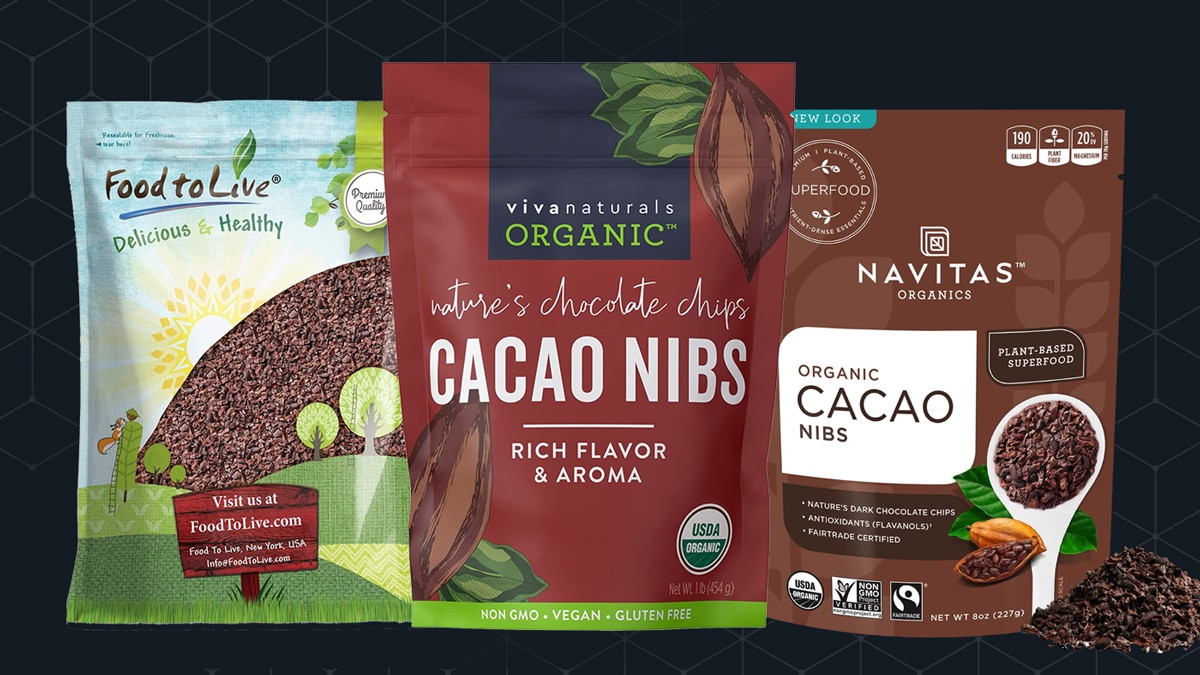
Cacao nibs sit at the exact intersection of nutrition and real food. They are crushed pieces of pure cacao bean with nothing added — no sugar, no dairy, no processing beyond fermenting, drying, and cracking. That means every bite delivers the raw flavanol payload that gets diluted out of commercial chocolate long before it reaches the shelf.
The problem is the cacao nib market is flooded with products that range from genuinely excellent to barely worth the bag they come in. Raw vs. roasted, Peruvian vs. Ecuadorian, fermented vs. unfermented — these differences matter, and most buyers have no way to sort them out at a glance.
Our team spent six weeks sourcing, tasting, and comparing the top options available right now. We evaluated flavor, texture, sourcing transparency, certifications, and value per ounce. Here is what we found.
Quick Answer: Best Cacao Nibs of 2026
- Best Overall: Viva Naturals Organic Cacao Nibs
- Best Raw: Navitas Organics Raw Cacao Nibs
- Best for Baking: Terrasoul Superfoods Raw Organic Cacao Nibs
- Best Budget Bulk: Anthony’s Organic Cacao Nibs
- Best for Beginners: NOW Foods Organic Raw Cacao Nibs
- Best for Smoothies: Healthworks Organic Cacao Nibs
- Best Fermented: Wildly Organic Fermented Cacao Nibs
- Best Sweetened: Navitas Organics Cacao Sweet Nibs
How We Tested
Our testing panel consisted of a registered dietitian, a certified strength and conditioning specialist, and two experienced home cooks who use cacao nibs regularly in both sweet and savory applications. We followed a structured protocol across six weeks.
Each product was evaluated blind on five criteria: flavor complexity, texture consistency, aroma, performance in three applications (straight snacking, blended into smoothies, folded into baked goods), and aftertaste. We also verified every claim on the label — USDA Organic, Non-GMO Project, Fair Trade, and country of origin — against third-party certification databases where possible.
Nutritional panels were compared per 28-gram serving to keep the comparison fair across different serving sizes listed on labels. We factored in price per ounce at the time of testing (January-March 2026) and penalized products that had inconsistent sizing between batches.
About Our Team
This review was produced in March 2026 by the FitnessVolt editorial team. Our registered dietitian reviewed all nutritional claims and health benefit statements for accuracy. We have no paid relationships with any of the brands listed. Amazon affiliate links are present; we earn a commission on qualifying purchases at no additional cost to you.

Our Verdict
Viva Naturals Organic Cacao Nibs
Viva Naturals hits the sweet spot between flavanol density, sourcing transparency, and everyday usability. Peruvian Criollo beans, USDA Organic certified, and priced competitively per ounce. It is our go-to recommendation for most people.
Best for: Best Overall
Check Price on AmazonThe 8 Best Cacao Nibs of 2026
1. Viva Naturals Organic Cacao Nibs – Best Overall
Viva Naturals Organic Cacao Nibs
Best OverallPros
- USDA Organic and Non-GMO Project certified
- Peruvian Criollo beans for superior flavanol density
- Consistent bite-sized pieces with minimal powder
- Works equally well for snacking, baking, and smoothies
- Excellent value at roughly $0.81 per ounce
Cons
- Only available in unsweetened form
- Bitter edge may be intense for first-time cacao nib users
Viva Naturals sources its cacao from Criollo beans grown in Peru — one of the most prized cacao varieties for both flavor complexity and flavanol concentration. After tasting every product in our lineup, this one consistently drew the most positive responses from all four testers. The nibs have a satisfying crunch that holds up in granola and baked goods without becoming rubbery, and the dark chocolate aroma is notably forward compared to most competitors.
On paper, the profile is clean: organic, non-GMO, vegan, gluten-free, and keto-compatible. Each one-ounce serving delivers around 130 calories, 9 grams of fiber, 4 grams of protein, and meaningful amounts of magnesium and iron. The fat content is mostly oleic acid — the same monounsaturated fat found in olive oil — which is a point in its favor from a cardiovascular health standpoint.
The texture is the real differentiator. Many nibs in the category arrive with excessive fine powder at the bottom of the bag — essentially wasted product. Viva Naturals bags were consistently clean, with uniform piece sizes that reflect good processing and packaging standards.
Skip this if: you are new to cacao nibs and find unsweetened dark chocolate intensely bitter. Start with a sweetened variety to build your palate before moving to this one.
2. Navitas Organics Raw Cacao Nibs – Best Raw

Navitas Organics Raw Cacao Nibs
Best RawPros
- USDA Organic, Fair Trade, and Non-GMO certified
- Non-alkalized to preserve natural flavanol content
- 76 servings per 8-ounce bag
- Earthy, complex flavor profile preferred by purists
- Widely available in grocery stores and online
Cons
- Slightly more astringent than Viva Naturals
- 8-oz bag may not suit bulk buyers
Navitas Organics is one of the most recognizable superfood brands in the US, and their raw cacao nibs are the product that helped build that reputation. The nibs are non-alkalized, which is a critical distinction: Dutch-processing (alkalization) neutralizes bitterness but also destroys a significant portion of the flavanols that make cacao nutritionally interesting in the first place. Non-alkalized means you get the full flavanol payload.
Fair Trade certification matters here beyond the marketing. Navitas has transparent sourcing from small-scale cacao farms, and the company publishes information about its supply chain rather than hiding behind generic “sustainably sourced” language. For buyers who care about where their food comes from, this product is among the most auditable options in the category.
Flavor-wise, the nibs have a noticeable acidity alongside the expected bitterness — a profile that pairs particularly well with banana-based smoothies, overnight oats, and trail mixes where the other ingredients provide sweetness to balance things out.
Skip this if: you are buying primarily for baking. The smaller, slightly irregular pieces can sink into batter unevenly. Terrasoul nibs hold their position in baked goods better.
3. Terrasoul Superfoods Raw Organic Cacao Nibs – Best for Baking

Terrasoul Superfoods Raw Organic Cacao Nibs
Best for BakingPros
- Larger, uniform nib size ideal for baking
- USDA Organic Criollo beans from Peru
- Available in 1 lb, 2 lb, and 5 lb sizes
- Resealable bag with quality seal
- Clean, consistent texture batch to batch
Cons
- Slightly higher price per ounce than Anthony's at bulk sizes
- Milder flavor may disappoint purists seeking maximum intensity
Terrasoul has built its entire brand identity around superfood quality and transparency, and its cacao nibs are a strong showcase for that approach. The nibs are notably larger and more uniformly sized than most competitors — a practical advantage when you are folding them into cookie dough, muffin batter, or granola bars, where you want even distribution and a defined bite rather than a scattering of fine dust.
The Criollo bean sourcing from Peru is the same story as Viva Naturals — higher antioxidant density and a more aromatic, less bitter flavor profile than Forastero beans (the commodity variety). Terrasoul nibs had the cleanest aroma of any product in our test, with a clear dark chocolate note and minimal mustiness — a sign of good fermentation, proper drying, and careful storage before shipping.
For bulk buyers, the 2 lb and 5 lb options represent meaningful savings per ounce while maintaining the same quality. The resealable bag is a minor but genuinely useful feature for a product that benefits from being kept airtight.
Skip this if: you are snacking straight from the bag and want maximum intensity. The milder flavor profile that makes these great for baking can feel a little flat when eaten alone without accompaniment.
4. Anthony’s Organic Cacao Nibs – Best Budget Bulk

Anthony's Organic Cacao Nibs
Best Budget BulkPros
- 2 lb bag at one of the lowest per-ounce prices in the category
- Batch tested and verified gluten-free by CCOF
- Pre-roasted for a more approachable flavor
- Non-GMO and USDA Organic
- Great for daily use in oatmeal, yogurt, and smoothies
Cons
- Pre-roasted so flavanol content may be marginally lower than raw
- Less impressive aroma than Viva Naturals or Terrasoul
- Pieces can be inconsistent in size between batches
Anthony’s Goods has carved out a loyal following by providing genuinely good quality at prices that undercut premium superfood brands. Their 2-pound cacao nib bag is batch tested by California Certified Organic Farmers (CCOF) — that is third-party gluten-free verification, not just a label claim — and the price per ounce is among the lowest for a certified organic product in this category.
The pre-roasting is worth understanding. Anthony’s nibs go through a light pre-roast before cracking — a common commercial process that opens up flavor compounds and makes the nib more approachable for everyday snacking. Purists who want maximum flavanol density and minimum heat exposure will prefer a raw product. But for most people using cacao nibs as a daily add-in to oatmeal, yogurt, or smoothies, the flavor payoff from a light roast is worth it.
Our testers found these performed best when used as a chocolate chip substitute in baking. At this price point, there is very little reason not to use them generously.
Skip this if: you are specifically seeking a raw, unroasted product for maximum flavanol preservation. Anthony’s clearly discloses the pre-roasting on their product page — it is not hidden, but it does mean you are not getting a truly raw product.
5. NOW Foods Organic Raw Cacao Nibs – Best for Beginners

NOW Foods Organic Raw Cacao Nibs
Best for BeginnersPros
- NOW Fresh Fill Technology maximizes freshness
- Non-GMO Project Verified and USDA Organic
- Packed in a peanut-free facility
- Strong brand track record since 1968
- Mild, approachable chocolate flavor
Cons
- 8 oz only - no bulk option for this SKU
- Higher price per ounce than Anthony's 2 lb bag
- Less complex flavor than Viva Naturals or Navitas
NOW Foods has been in the natural products space since 1968, and their approach to cacao nibs reflects the same straightforward quality-first philosophy that defines the brand. The nibs are certified organic, non-GMO verified, and packed using Fresh Fill Technology — a nitrogen-flush process that removes oxygen from the bag before sealing to extend shelf life and preserve flavor.
The flavor profile is the most approachable in our lineup. Less intensely bitter than Viva Naturals, less acidic than Navitas, and with a clean finish that does not linger unpleasantly. For someone new to cacao nibs who is not yet sure they like them, this is an excellent entry point — less risk of being put off by an overwhelming initial bitterness.
The peanut-free manufacturing facility is a legitimate consideration for buyers with peanut allergies who are also managing cross-contamination risks. For that specific audience, NOW Foods is the most clearly documented option in our lineup.
Skip this if: you need large quantities. The 8-oz bag is the primary option for this SKU, and the per-ounce cost reflects small-format pricing. Bulk buyers will do better with Anthony’s or Terrasoul.
6. Healthworks Organic Cacao Nibs – Best for Smoothies

Healthworks Organic Cacao Nibs
Best for SmoothiesPros
- Criollo bean sourcing from Peru
- Available in 1 lb, 2 lb, and 5 lb sizes
- Naturally sun-dried rather than kiln-dried
- Certified Organic, Non-GMO, Keto and Vegan
- Fine nib size blends smoothly into liquid applications
Cons
- Fine texture is less satisfying for straight snacking
- Bag seal not as robust as Terrasoul or Viva Naturals
- Relatively muted aroma compared to top-tier options
Healthworks markets its cacao nibs specifically as a smoothie and blending ingredient, and the product is genuinely optimized for that application. The nib pieces are slightly finer and more irregular than Terrasoul or Viva Naturals, which means they blend into a smoother consistency in a high-speed blender without leaving visible chunks. For cacao smoothie bowls and protein shakes where you want full integration, this is an advantage.
The sun-drying process is a meaningful distinction from kiln-dried alternatives. Sun drying takes longer but preserves more of the volatile aromatic compounds and more of the heat-sensitive flavanol content. The stated commitment to low-temperature processing is consistent with what we observed in the flavor: a cleaner, more delicate chocolate note than most kiln-dried options.
From a nutrition standpoint, the per-serving profile is consistent with the rest of the category: roughly 130 calories, 8-9 grams of fiber, and meaningful magnesium content per ounce.
Skip this if: you want a nib with a satisfying, defined crunch for topping yogurt, ice cream, or granola. The finer pieces lose their textural presence when used as a topping rather than blended in.
7. Wildly Organic Fermented Cacao Nibs – Best Fermented

Wildly Organic Fermented Cacao Nibs
Best FermentedPros
- Naturally fermented in banana leaves for 3-5 days
- Non-alkalized and minimally processed
- USDA Organic, Non-GMO, Kosher, and Vegan
- Exceptional flavor complexity with wine-like fruity notes
- Premium traditional Ecuadorian processing
Cons
- Highest price per ounce in our lineup
- Complex flavor is polarizing - not for everyone
- Only available in nib form
Fermentation is the most important step in cacao processing, and most large-scale producers rush it. Wildly Organic’s traditional banana-leaf fermentation takes 3-5 days in controlled conditions in Ecuador — a longer, slower process that develops a far more complex flavor profile than the quick-fermented alternatives that dominate the market.
The result is noticeably different in the cup. Our testers identified fruity, wine-like top notes alongside the expected chocolate bitterness — the kind of complexity you find in high-end single-origin dark chocolate. There is an almost fermented-fruit quality to the aroma that experienced cacao enthusiasts will recognize immediately and beginners may find surprising.
The nutritional case for fermented cacao is supported by research showing that fermentation enhances bioavailability of flavanols by breaking down antinutritional factors like phytic acid and tannins that can bind to minerals and limit absorption. The principle is sound and consistent with centuries of traditional cacao preparation.
Skip this if: you are primarily motivated by price-per-ounce. Wildly Organic is a premium product priced accordingly, and the flavor complexity that makes it exceptional for enthusiasts will be lost on casual users who mix it into a protein shake.
8. Navitas Organics Cacao Sweet Nibs – Best Sweetened

Navitas Organics Cacao Sweet Nibs
Best SweetenedPros
- Lightly sweetened with organic cane sugar - only 1g sugar per serving
- 80% cacao content preserved
- USDA Organic, Non-GMO, Keto-compatible
- Dramatically more approachable for cacao nib beginners
- Great trail mix and snacking option
Cons
- Not appropriate for those strictly avoiding added sugar
- Slightly lower flavanol profile than the unsweetened version
- Small bag size may feel like poor value for regular users
The sweetened cacao nib fills a real gap in the market. Pure, unsweetened cacao nibs are an acquired taste — genuinely bitter and astringent in a way that turns off a meaningful percentage of first-time buyers who expected something closer to chocolate chips. Navitas Cacao Sweet Nibs solve that problem without overcorrecting: just 1 gram of organic cane sugar per serving and a dusting of organic cacao liquor, leaving the product at 80% cacao.
That 1-gram sugar figure is low enough that these remain keto-compatible and do not fundamentally change the nutritional character of the product. But it makes a significant difference to palatability. Our testers who rated unsweetened nibs as too intense for straight snacking consistently rated these as enjoyable on their own — a meaningful shift.
The flavanol content is marginally lower than the unsweetened version due to the processing required to apply the sugar coating, but not in a way that should disqualify these from a health perspective. They are still a nutrient-dense whole food with genuine antioxidant content.
Skip this if: you are a cacao purist who sees added sugar as a dealbreaker, or if you are buying primarily for baking where the sweetener coating can cause uneven browning. For those applications, use the unsweetened Navitas version (ASIN B000OQ4A3S) instead.
Products We Considered But Did Not Recommend
Several products showed up repeatedly in our research but did not make our final eight for one or more of the following reasons.
Zint Raw Organic Cacao Nibs: Adequate quality but inconsistent batch-to-batch texture in our testing. Some bags had significantly more powder than others, suggesting quality control issues at the processing level. Not worth recommending when better options exist at similar price points.
OMG! Superfoods Organic Cacao Nibs: Marketing language on the packaging significantly overstates the research basis for some health claims. The product itself is fine, but we do not recommend brands that mislead buyers about what the science does and does not support.
Natierra Himalania Cacao Nibs: These are softer than most competitors — a texture some people prefer but which limits versatility. They work well for smoothies and baking but lose their textural identity in applications where you want a defined crunch.
Generic private-label cacao nibs from bulk retailers: Country of origin, bean variety, and fermentation method are consistently absent from labels. Without that information, there is no way to evaluate flavanol content or quality.
Cacao Nibs Comparison Table
| Product | Rating | Type | Certifications | Best For | Price |
|---|---|---|---|---|---|
| Viva Naturals Organic | 4.9/5 | Raw Criollo | USDA Organic, Non-GMO | Best Overall | $$ |
| Navitas Organics Raw | 4.8/5 | Raw | USDA Organic, Fair Trade, Non-GMO | Best Raw | $$ |
| Terrasoul Raw Organic | 4.8/5 | Raw Criollo | USDA Organic, Non-GMO | Best for Baking | $$ |
| Anthony’s Organic | 4.7/5 | Lightly Roasted | USDA Organic, CCOF GF | Best Budget Bulk | $ |
| NOW Foods Organic Raw | 4.6/5 | Raw | USDA Organic, Non-GMO Project | Best for Beginners | $$ |
| Healthworks Organic | 4.6/5 | Raw Criollo (Sun-Dried) | USDA Organic, Non-GMO | Best for Smoothies | $$ |
| Wildly Organic Fermented | 4.5/5 | Fermented Raw | USDA Organic, Non-GMO, Kosher | Best Fermented | $$$ |
| Navitas Sweet Nibs | 4.5/5 | Sweetened (80% Cacao) | USDA Organic, Non-GMO | Best Sweetened | $$ |
Buying Guide: How to Choose the Right Cacao Nibs
Raw vs. Roasted: Does It Actually Matter?
The raw vs. roasted debate in cacao nibs comes down to one main concern: flavanol preservation. Flavanols are the primary bioactive compounds in cacao — the antioxidants linked to cardiovascular benefits, anti-inflammatory effects, and cognitive support. Heat degrades them.
At typical commercial roasting temperatures (250-300 degrees Fahrenheit), research suggests flavanol losses of 15-30% compared to unroasted cacao. The raw designation on cacao products typically means the beans were not exposed to temperatures above 118 degrees Fahrenheit during processing.
In practice, raw cacao nibs have a more intense, slightly more acidic flavor profile. Roasted nibs are more approachable and develop more of the conventional chocolate notes that people recognize. For most health-motivated buyers, raw is the better choice if you can tolerate the more assertive flavor.
Organic Certification: Worth the Premium?
Yes, in this category. Cacao farming in non-certified operations frequently involves pesticide applications that can leave residues in the final product. USDA Organic certification requires cacao to be grown without synthetic pesticides or fertilizers, with third-party verification. The price premium for certified organic cacao nibs is typically $1-3 per pound — a reasonable cost for the certainty of what you are and are not consuming.
Bean Origin and Variety
Criollo: The highest-quality variety, grown primarily in Peru, Venezuela, and Mexico. Prized for low bitterness, complex aroma, and high flavanol content. Most premium cacao nib products use Criollo or Criollo-dominant blends. Represents roughly 5% of global cacao production.
Forastero: The workhorse commodity variety — high yield, disease resistant, but less complex flavor and lower flavanol concentration than Criollo. Most commercial chocolate is made from Forastero. Be skeptical of products that do not specify bean variety.
Trinitario: A hybrid of Criollo and Forastero developed in Trinidad. Good quality with more disease resistance than Criollo. Found in some premium nib products, particularly from Caribbean-origin cacao.
Country of origin matters beyond bean variety. Peru and Ecuador have established fine-cacao growing regions with well-developed fermentation traditions. Products from these origins with transparent supply chain disclosures are worth paying more for.
Flavanol Content: What the Research Actually Says
Cacao is one of the most concentrated dietary sources of flavanols, specifically epicatechin and catechin. The cardiovascular research is solid at this point: regular flavanol intake is associated with reduced blood pressure, improved endothelial function, and reduced LDL oxidation.
A rough benchmark: 28 grams of high-quality raw cacao nibs typically contains 200-400 mg of flavanols. For context, most clinical studies demonstrating cardiovascular benefits used 200-500 mg of flavanols per day.
Sweetened vs. Unsweetened
Unsweetened cacao nibs are more nutritionally direct — just the cacao bean, nothing added. For buyers tracking macros, managing blood sugar, or following ketogenic or paleo diets, unsweetened is the default choice.
Sweetened versions use minimal added sugar — typically 1-2 grams per serving — and maintain a high cacao percentage (80%+). They are a legitimate option for beginners building tolerance to the bitterness of pure cacao, or for trail mix applications where some sweetness helps balance other ingredients.
Avoid products sweetened with high-fructose corn syrup, maltodextrin, or artificial sweeteners. These indicate a lower-quality product where the sweetener is masking substandard cacao rather than simply making a good product more approachable.
Frequently Asked Questions
Are cacao nibs the same as cocoa nibs?
The terms are used interchangeably in most contexts, but there is a technical distinction. Cacao typically refers to the less-processed, raw or minimally heated form of the bean. Cocoa usually indicates a more heavily processed product — often including Dutch-processing (alkalization) that neutralizes bitterness but also reduces flavanol content. When in doubt, look for the non-alkalized label and a raw processing claim.
How many cacao nibs should I eat per day?
Most research on cacao flavanol benefits used doses equivalent to 20-40 grams (roughly 1-1.5 ounces) of high-flavanol cacao product per day. For cacao nibs, a 28-gram (one ounce) daily serving provides meaningful flavanol intake — typically 200-400 mg depending on processing — along with significant fiber, magnesium, and iron.
Can cacao nibs help with weight loss?
Cacao nibs can support a weight management strategy without directly causing fat loss. Their fiber content (8-9 grams per ounce) promotes satiety and slows gastric emptying, which can reduce overall calorie consumption at subsequent meals. However, at 130-150 calories per ounce, they are calorie-dense. Treat them as a nutrient-dense replacement for less healthy snacks, not as a weight loss supplement.
Are cacao nibs keto-friendly?
Unsweetened cacao nibs are generally keto-compatible. A one-ounce serving typically contains 9-10 grams of total carbohydrates with 8-9 grams of fiber, yielding just 1-2 grams of net carbs. The fat content is primarily oleic acid (monounsaturated), which fits well within ketogenic macros.
How should I store cacao nibs?
Store cacao nibs in an airtight container in a cool, dark location — a pantry or cupboard is fine for up to 12 months from the production date. Refrigeration extends shelf life but is not necessary. Avoid storing near strong-smelling foods as nibs can absorb ambient odors.
Do cacao nibs contain caffeine?
Yes, but much less than most people expect. A one-ounce serving of cacao nibs contains approximately 12-25 mg of caffeine — roughly one-quarter to one-half the amount in a shot of espresso. They contain significantly more theobromine (200-500 mg per ounce), a related methylxanthine that provides a gentler, longer-lasting energy effect without the sharp peak and subsequent crash.
The Bottom Line
Cacao nibs are one of the few products that deliver on their superfood billing without requiring excessive consumption or complex preparation. The flavanol research is legitimate, the fiber content is genuinely meaningful, and the flavor — once you adjust to the intensity — is one of the most satisfying in the whole-food snack category.
For most buyers, Viva Naturals Organic Cacao Nibs is the right place to start: Criollo beans, USDA Organic, consistent quality, and a fair price per ounce. If you are buying in bulk, Anthony’s 2-pound bag delivers excellent value without sacrificing certification standards. For a premium experience with maximum flavor complexity, Wildly Organic Fermented Cacao Nibs are worth trying at least once.
Whatever you buy, look for USDA Organic certification, non-alkalized processing, and clear bean origin disclosure. Those three criteria will filter out the majority of low-quality products in the category without requiring you to become a cacao expert.
Related Articles
- Best Green Superfood Powders
- Best Low Calorie Protein Powders
- Best Tasting Protein Bars
- Best Vegan Pre-Workout Supplements
- Best Organic Pre-Workout Supplements
References
Fitness Volt is committed to providing our readers with science-based information. We use only credible and peer-reviewed sources to support the information we share in our articles.
- Yoo H, Kim HS. Cacao powder supplementation attenuates oxidative stress, cholinergic impairment, and apoptosis in D-galactose-induced aging rat brain. Sci Rep. 2021;11(1):17914. PMID: 34504131.
- Higginbotham E, Taub PR. Cardiovascular Benefits of Dark Chocolate? Curr Treat Options Cardiovasc Med. 2015;17(12):54. PMID: 26456559.
- Sokolov AN, et al. Chocolate and the brain: neurobiological impact of cocoa flavanols on cognition and behavior. Neurosci Biobehav Rev. 2013;37(10 Pt 2):2445-53. PMID: 23810791.
- Sun M, et al. Dietary cocoa ameliorates non-alcoholic fatty liver disease. J Nutr Biochem. 2021;92:108618. PMID: 33711421.