

Choose a method, enter your measurements and the calculator gives your body fat percentage, your fat and lean mass, the method’s typical error and where you sit on the American Council on Exercise chart.
The calculator opens on the US Navy tape method. The YMCA formula, three Jackson-Pollock skinfold methods and a BMI estimate are in the Method menu.
Example: man, 30, 142 lb
15.5% body fat
About 15.5% body fat by the US Navy tape method, in ACE's Fitness range.
This method's typical error is 3.5 points: a lab test would usually land within about 12.0% to 19.0%, and sometimes outside it. Enter your own measurements above to replace this example.
Fat mass
22.0 lb
15.5% of your weight
Lean mass
120.0 lb
Everything else: muscle, bone, organs and water
Typical error
±3.5 points
Hodgdon and Beckett 1984, US Naval Health Research Center
American Council on Exercise body fat norms for men. The bands are the same at every age.
| ACE category | Men |
|---|---|
| Below essential fat | under 2% |
| Essential fat | 2 to 5.9% |
| Athletes | 6 to 13.9% |
| FitnessYou: 15.5% | 14 to 17.9% |
| Acceptable | 18 to 24.9% |
| Obesity | 25% and over |
| Method | Typical error | Body fat |
|---|---|---|
| US Navy tape methodThe method you chose | ±3.5 | 15.5% |
| YMCA tape method | not published | 16.0% |
| BMI method (Deurenberg 1991) | ±4.1 | 15.1% |
The US Navy method uses your height, waist and neck to estimate your body density. Fat is less dense than muscle and bone, so the lower your density, the more fat you carry; we convert it to a body fat percentage. Brozek's conversion, another standard way to turn the same density into body fat, gives 15.5%. The categories are the American Council on Exercise's.
Sources: Hodgdon and Beckett 1984, US Naval Health Research Center; Brozek and colleagues 1963 (the Brozek conversion); American Council on Exercise (categories)
Next steps
This body fat calculator can do nearly all calculations (Body composition calculations and estimations) except for the physical and mental aspect of achieving your ideal body composition.
Now, each person will have to find the method of measurement which works for them, considering we all have different shapes and sizes. But… learning your Body Mass Index, lean mass and fat mass percentages will help you get to a healthy size and weight if you’re not quite there yet.
It’s always good to have the edge when it comes to achieving your ideal physique, and the simplicity of a calculator at your fingertips makes this entirely possible…
How Does the Body Fat Calculator Work?
The Body Fat calculator can be used in so many ways depending on how you decide to measure your body Fat (Tools or no tools). Also, you can either choose US units (inches, pounds) or metric (centimeters, kilograms) for your measurements. Skinfolds are entered in millimeters with either setting.
There are six methods of measurement which you can use for the body fat calculator.
These six methods are:
- BMI Method
- US Navy Method
- YMCA Formula
- Jackson/Pollock 3-Site Caliper
- Jackson/Pollock 4-Site Caliper
- Jackson/Pollock 7-Site Caliper
The three options of measuring body fat are:
- Without any tools
- Measuring Tape
- Body Fat Caliper
Without tools (Tape, caliper) – The method used here is very simple, but it cannot tell muscle from fat, so treat the result as a rough guide. Your height, age, and weight are measured here to get an estimate of your body fat percentage.
Measuring Tape – If you use a tape measure, you have two methods to choose from: the US Navy Method and the YMCA Formula.
Body Fat Caliper – The three methods to measure with a caliper are: Jackson/Pollock 3-Site Caliper, Jackson/Pollock 4-Site Caliper, and Jackson/Pollock 7-Site Caliper.
Body Fat Percentage Chart
| Women (% fat) | Men (% fat) |
|
| Essential Fat | 10-13% | 2-5% |
| Athletes | 14-20% | 6-13% |
| Fitness | 21-24% | 14-17% |
| Acceptable | 25-31% | 18-24% |
| Obesity | 32% and over | 25% and over |
Note: For people with active lifestyle such as professional athletes have a particular minimum percentage of body fat as the training goal.
How do the 6 different Methods of Measurement work?
Each method requires a different way of measuring body fat (Various body parts). Gender, height, age, and weight are required by default for all methods.
Without tools
BMI Method – Gender, height, age, and weight
Measuring Tape
US Navy method – Waist and neck for men; waist at its narrowest point, neck, and hips for women
YMCA – Waist
Body Fat Caliper
Jackson/Pollock 3-Site Caliper – Chest, abdominal, and thigh for men; tricep, suprailiac, and thigh for women
Jackson/Pollock 4-Site Caliper – Thigh, abdominal, tricep and Suprailiac
Jackson/Pollock 7-Site Caliper – Thigh, chest, abdominal, tricep, subscapular, suprailiac and axilla.
What Is the Best Time to Take Your Measurements?
For the very reasons we weigh ourselves in the morning; taking measurements in a similar manner would only make sense. This way your stomach is empty and the measurements will be more consistent due to less chance of weight fluctuation.
How to Take Your Measurements
Without a Tool
Ok, so obviously if you don’t have any tools, you’ll just weight yourself, measure your height, then simply punch the numbers in. You’ll then get an estimate of your body fat percentage, along with your fat mass and lean mass in pounds or kilograms, the method’s typical error, and your category on the American Council on Exercise (ACE) chart.
Tape Measure
Depending on whether you’re male or female, the calculator will give you the required measurements site/s, (Waist, neck, and hips). Use a cloth measuring tape (Not an elastic one) because it will properly form to the circumference of each body part.
- For example: To measure your waist, simply wrap the tape around your stomach at the belly button. Women using the US Navy method measure the waist at its narrowest point instead.
- Measure your neck just below the Adam’s apple and your hips at the widest point. It may be easier to have someone do it for you to be as accurate as possible (Recommended).
Caliper
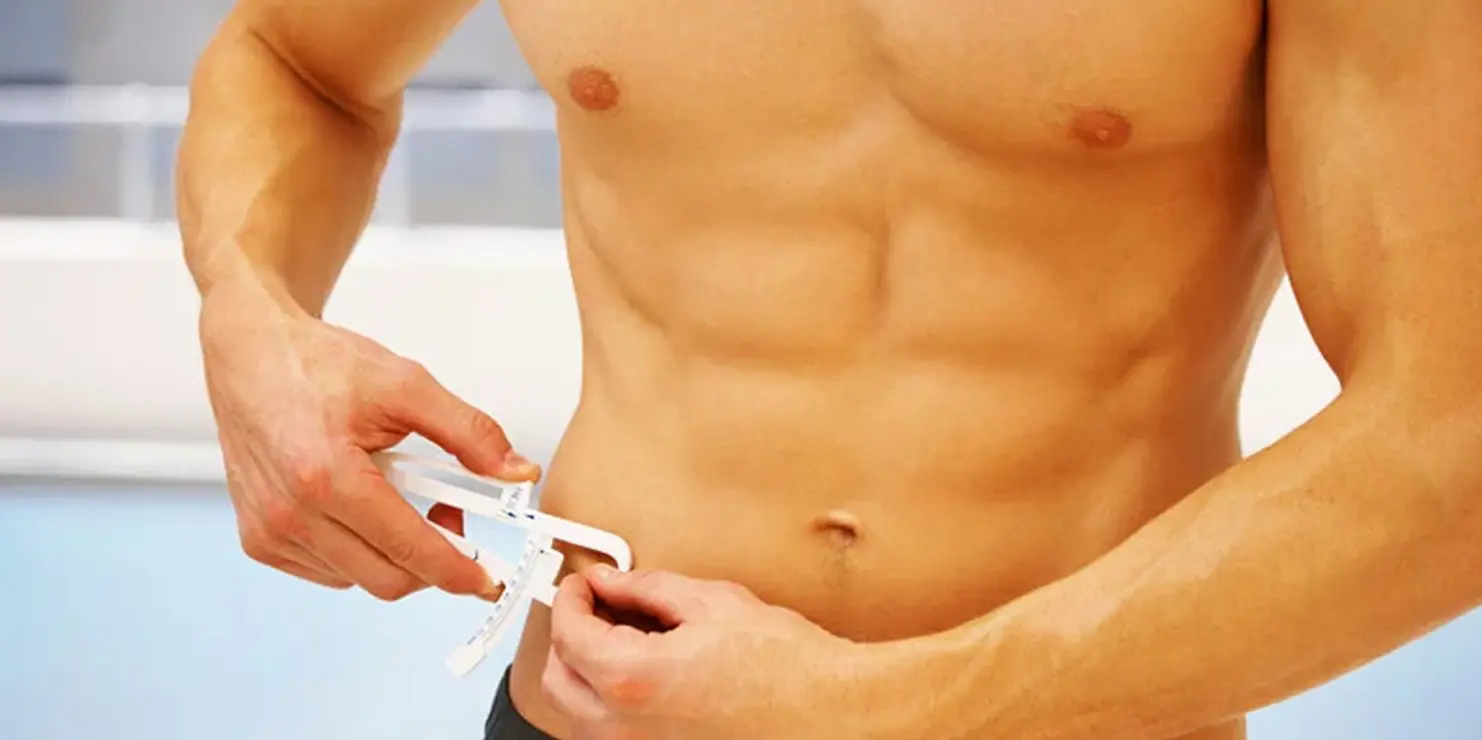
You pinch folds of skin with the caliper and enter the measurements into the calculator, which generates an estimated body fat percentage. For women, the 3 and 7 site skinfold equations have a typical error of 3.8 to 3.9 points, against 4.5 for the US Navy tape method. For men, they are close: 3.4 points for the 3 and 7 site skinfolds and 3.5 for the Navy tape.
Now, it’s best to have someone who knows how to use a caliper, do the measuring to get the most accurate results.
You’ll simply choose your method of measurement (either one of the Jackson/Pollock site methods), measure your skin folds, and then enter the numbers. Then you’ll get your body fat, LBM, FBM, and ACE category, plus the typical error for the 3 and 7 site methods. We found no published typical error for the 4 site method, so the calculator shows Not published there.
How to Best Use the Caliper for measuring the body fat of each required area of the body?
Since tape measurements are pretty simple and straightforward, we will move on to describe the best way to pinch folds of skin with a caliper (Might be a little uncomfortable). Have a professional do this if possible for best accuracy.
Using a caliper can be challenging for some people due to different body types and skin elasticity (Yes, these are factors which vary from each individual).
So, here are a few examples of how to find and pinch the ideal folds of skin for accuracy during measurement taking.
Chest – Pinch a diagonal fold of skin between your right nipple and where your armpit starts (Diagonally) and measure with the caliper this way.
Thigh – Pinch a vertical fold of skin on your quadriceps between your hip and knee then use the caliper to measure.
Abdominal – Pinch a vertical fold of skin a few inches to the right of your belly button for a good abdominal measurement.
Suprailiac – Pinch a diagonal fold of skin above the Iliac Crest (Hip bones) to measure with the caliper.
Tricep – Choose the meatiest part of the Tricep to measure
Hopefully, the person helping you measure your body fat will have experience with finding the best possible areas for precise measurements. However, if you decide to do it yourself, make sure you are aware of how to use your caliper since there are several different types.
Why Should You Know Your Body Fat Percentage?
Your specific reason for calculating your body fat percentage may be different from the next person; however, the end result applies to everyone, whether you have too much body fat or too little. The body fat calculator is a tool which helps you to make adjustments to your body composition effectively.
Risk factors
Obesity comes with the potential issues of heart disease, sleep apnea, diabetes etc. but your body shape and family history may contribute to your chances of developing one of these problems. (1)
If you’ve got too little body fat, the health concerns are just as serious because you can suffer from nutrient deficiencies, fluid imbalance, illnesses, and not to mention every bodily function will be at severe risk of improper functioning. (2)
The American Council on Exercise chart above shows where the Fitness and Acceptable ranges sit for men and for women, and the calculator shows which one you are in.
This is stuff you want to know if you desire longevity and/or you just want to look as aesthetically pleasing as possible…
What Is the Difference In Measuring Body Fat Between Men and Women?
Well, since the calculator tells you what body parts need to be measured based on gender, it’s not entirely important, however, there is a difference…
This is because men and women carry different amounts of body fat in certain areas (On average) when in comparison. (3)
The ACE chart above gives the ranges for men and women side by side.
It’s important to be in a healthy range but if you’re not, a lifestyle change will be necessary to bring you within a desirable range.
How to Get Within a Healthy Range of Body Fat…
Lose body fat
If you’re above a healthy body fat percentage, then the healthiest way to lose excess body fat is to exercise and focus on a healthy diet.
Combine resistance training and aerobic activity for best results
Resistance training combined with aerobic activity will result in more fat loss and a healthier BMI rather than just choosing one or the other. (4)
Build more muscle, which burns more fat…
Lean muscle burns more calories than body fat even at rest. This is a great reason to consider a hypertrophy training program. Join a gym or strength train at home if possible because you’d be missing out on all the great benefits by leaving out the resistance training (5).
Watch the number of calories you consume
Weight gain is caused by consuming excess calories. Be mindful of how much food you’re eating per day. If you’re gaining weight, cut down on your portions. This is where healthier, more natural foods are great choices because a lot of times they contain fewer calories than the typical “calorie-stuffed” processed foods.
Gain body fat
If you’re below a healthy body fat percentage, you’ll need to start eating more nutrient and calorically dense foods. This doesn’t mean you should eat junk food all day but calorically dense foods should be a part of your diet.
Nutritious and calorically dense foods include:
- Lean meats (beef, chicken, salmon)
- Oats
- Avocados
- Nuts
- Potatoes/sweet potatoes
- Protein shakes
- Beans
- Rice
- Low-fat yogurt
- Vegetables
- Oils (Coconut/Olive, etc.)
These are some of the foods you can eat more of, and more frequently, to put on some healthy weight. Too little body fat is not good for the human body to function, so aim to gain around one pound to one and a half pounds per week if you fall below a healthy body fat percentage range. There are some great calorie calculators you can use as well, which can help you consistently gain more body weight. It’s important to eat frequently so that you get enough nutrition throughout the day (Cannot be stressed enough). (6)
No more low-calorie foods!
What is Lean Body Mass?
Lean mass is calculated by your Weight – (Weight x body fat). Lean mass includes everything except body fat (Fat-free mass basically).
What Is Fat Body Mass?
Your fat mass is calculated by your weight x body fat percentage. Your body fat percentage is your fat mass as a share of your total weight.
Psychological Factors Which Can Affect Body fat levels
Chronic social stress, due to lifestyle factors like relationships, jobs, and low self-esteem, is associated with obesity and other illnesses. Excessive stress promotes fat storage within visceral depots, and this increases the risk of diseases like type 2 diabetes and cardiovascular disease. (7)
It’s very important to manage your stress levels to keep off the extra body fat which can accumulate over time and cause obesity.
You have to take control of your life and manage stress through lifestyle changes.
- Meditation
- Talking to someone about your issues
- Exercising
- Eating plant-rich foods
Making these lifestyle changes a habit will reduce your day to day stresses to help you get to a healthy Body Mass Index (BMI) and become healthier overall. (8)
Simplify How You Measure Your Body Fat
The accuracy of your body fat percentage will depend on the method you choose. Using no tools takes the least effort, but the BMI method cannot tell muscle from fat, so treat its estimate as a rough guide. Using a measuring tape can be inaccurate due to each person’s amount of muscle mass (Muscle can make body parts larger without carrying extra body fat).
Like mentioned previously, the 3 and 7 site caliper methods are a little more accurate than the US Navy tape for women and about the same for men. A caliper can also be difficult to do by yourself, which is why choosing to have a professional take your measurements is a good idea.
So the question is… how accurate do you want to be?
If you’re within a healthy body fat percentage range, then a good job so far. However, if you’re too low, follow the points mentioned about diet choices. If you’ve gained too much body fat, then follow a healthy, reduced-calorie diet and start to incorporate resistance training with aerobic activity.
Well, there you have it… you can calculate your body fat percentage and get an idea of your fat/lean mass with the use of our “Body Fat Calculator”.
Frequently Asked Questions:
What should my body fat percentage be?
It depends on your sex. The American Council on Exercise chart above gives the ranges for men and women, and the calculator shows which band you are in.
Can you have 0% body fat?
No, you wouldn’t be alive. Men need a minimum of 2-5% fat while women need 10-13% fat to maintain basic health functions.
Can a fat person get abs?
The short answer is yes, they can get abs but they’re less likely to see their abs than someone with less body fat. For visible abs, men should ideally be between 6%-18% body fat while women may need to have 14%-24%.
What body fat percentage is ideal for visible abs?
Typically, women should have 14% to 24% body fat and men should have 6% to 18% body fat for visible abs.



Most people don’t know their actual weight and even if they knew, they don’t know what is their ideal weight for their body. This is also happened to me. So I am very thankful for this post because it will give you a hint on what to do next. I will help you plan what to do in the future to have a good health.
Hi, this isnt working
Try now, working for me. Tom
This piece of writing will assist the internet users for setting up new
blog or even a weblog from start to end.