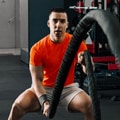
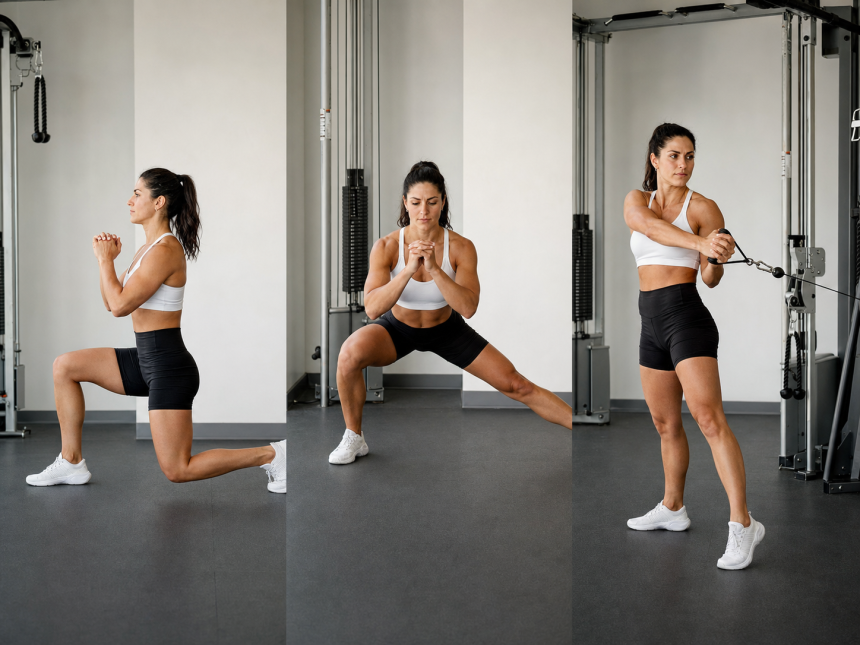
The three planes of movement are the sagittal, frontal, and transverse planes. Squats and curls occur mainly in the sagittal plane, lateral lunges and side raises in the frontal plane, and trunk rotations and horizontal chest flyes in the transverse plane. Most exercises still demand control in more than one plane.
That last point matters in the gym. A squat uses visible hip and knee motion in one plane, but your hips, knees, and trunk must resist unwanted motion in the other two. Learning the planes helps you describe an exercise, choose useful accessories, and spot directional gaps in a program. It does not require dividing your weekly sets into three equal piles.
What Are the Three Planes of Movement?
Planes of movement are imaginary two-dimensional surfaces that anatomists use to describe position and motion. The sagittal plane divides the body into right and left portions, the frontal plane divides front from back, and the transverse plane divides upper from lower. These definitions assume the body starts in anatomical position.
Why anatomical position matters
In anatomical position, you stand upright with your feet facing forward, arms at your sides, and palms facing forward. This common reference keeps movement terms consistent. For example, shoulder abduction means moving your arm away from your torso while you start from this position, even if an exercise begins with your arm somewhere else.
A plane describes the space in which a joint action occurs. It does not describe the exercise’s difficulty, training effect, or direction of travel by itself. A person can move forward while several joints act in different planes.
How Do Planes and Axes Work Together?
Movement in a plane occurs around an axis that sits perpendicular to it. Picture a wheel: the wheel turns within one plane while its axle points across that plane. Sagittal motion turns around a mediolateral axis, frontal motion around an anteroposterior axis, and transverse motion around a vertical axis.
| Plane | Divides the body into | Perpendicular axis | Common joint actions | Exercise examples |
|---|---|---|---|---|
| Sagittal | Right and left portions | Mediolateral, also called frontal | Flexion, extension, dorsiflexion, plantarflexion | Squat, deadlift, biceps curl, forward lunge |
| Frontal, or coronal | Front and back portions | Anteroposterior, also called sagittal | Abduction, adduction, lateral flexion, inversion, eversion | Lateral raise, lateral lunge, side bend, jumping jack |
| Transverse, or horizontal | Upper and lower portions | Longitudinal, or vertical | Internal and external rotation, horizontal abduction and adduction | Cable rotation, chest fly, rotational throw, golf swing |
Axis names can cause confusion because some texts call the mediolateral axis the frontal axis and the anteroposterior axis the sagittal axis. Focus on the perpendicular relationship: the plane and its axis cross at 90 degrees.
Which Exercises Fit Each Plane?
Classify an exercise by its main joint actions, not by the direction the athlete faces or travels. Flexion and extension point to the sagittal plane. Abduction, adduction, and side bending point to the frontal plane. Rotation and horizontal shoulder motion point to the transverse plane. Compound lifts may include actions from several rows.
Sagittal-plane exercises
Sagittal-plane exercises feature forward-and-back joint motion. During a squat, the hips and knees flex and extend, while the ankles dorsiflex and plantarflex. The same classification covers deadlifts, step-ups, calf raises, vertical jumps, biceps curls, and triceps extensions.
A squat may look simple from the side, but stance, bar position, and limb proportions change the joint demands. Our guide to squat biomechanics explains how those variables change the movement without changing its predominant plane.
Frontal-plane exercises
Frontal-plane exercises move the body or a limb side to side. Lateral lunges, lateral raises, hip abduction, side bends, and jumping jacks fit here. Skaters and lateral bounds also train force production and landing control across the frontal plane.
Do not classify an exercise from the camera angle. A lateral raise remains a frontal-plane shoulder action when someone films it from the side. The joint action, shoulder abduction, decides the classification.
Transverse-plane exercises
Transverse-plane exercises involve rotation around a vertical axis or horizontal motion at the shoulder. Cable chops, medicine-ball rotational throws, bat swings, and trunk rotations are clear examples. Chest flyes and reverse flyes also belong here because the upper arm moves through horizontal adduction or abduction.
Rotation should match the task and the joints that can supply it. Review these transverse-plane exercise options before adding loaded twisting to a program. Start with controlled ranges and choose a load that does not pull you out of position.
Are Exercises Ever Purely in One Plane?
Most gym exercises have a predominant plane rather than a perfectly isolated plane. The largest visible joint actions determine the label, while smaller motions and muscle actions control alignment in the other planes. Calling a squat sagittal is useful shorthand, but it does not mean the hips, knees, feet, and trunk ignore three-dimensional forces.
Human joints also have curved surfaces and axes that may shift during motion. The subtalar joint beneath the ankle uses an oblique axis, so pronation and supination combine motion from all three planes. Real movement rarely follows the clean edges of a textbook diagram.
Use “predominantly sagittal” or “mainly frontal” when describing a whole exercise. Reserve pure plane labels for a specific joint action, such as shoulder abduction, rather than claiming every part of the body stays inside one plane.
How Do Walking, Squatting, and Lunging Use All Three Planes?
Walking, squatting, and lunging combine visible motion with three-dimensional control. Walking relies on forward hip and knee motion while the pelvis shifts and rotates. A squat uses sagittal flexion and extension while the lower body manages side-to-side and rotational forces. A lunge changes its dominant plane with the step direction.
| Movement | Primary motion | Other plane demands |
|---|---|---|
| Walking | Hip and knee flexion and extension plus ankle dorsiflexion and plantarflexion in the sagittal plane | Pelvic obliquity in the frontal plane and pelvic rotation in the transverse plane |
| Barbell squat | Hip and knee flexion and extension plus ankle dorsiflexion and plantarflexion in the sagittal plane | Control of knee drift, pelvic shift, foot rotation, and trunk rotation |
| Lateral lunge | Sideways displacement and hip abduction or adduction in the frontal plane | Hip and knee flexion plus control of foot and femur rotation |
| Forward lunge with torso rotation | Sagittal lower-body motion plus transverse trunk rotation | Frontal-plane balance over a narrow base of support |
A 2017 review of pelvic mechanics during gait described pelvic tilt, obliquity, and rotation across all three planes. That does not make walking an equal three-plane exercise. It shows why a single movement can have one dominant direction and several supporting motions.
What Are Anti-Movement Exercises?
Anti-movement exercises load your ability to resist motion instead of producing a large visible movement. A suitcase carry challenges the trunk to resist lateral flexion in the frontal plane. A Pallof press challenges the trunk to resist rotation in the transverse plane. Both train plane-specific control while your torso stays close to neutral.
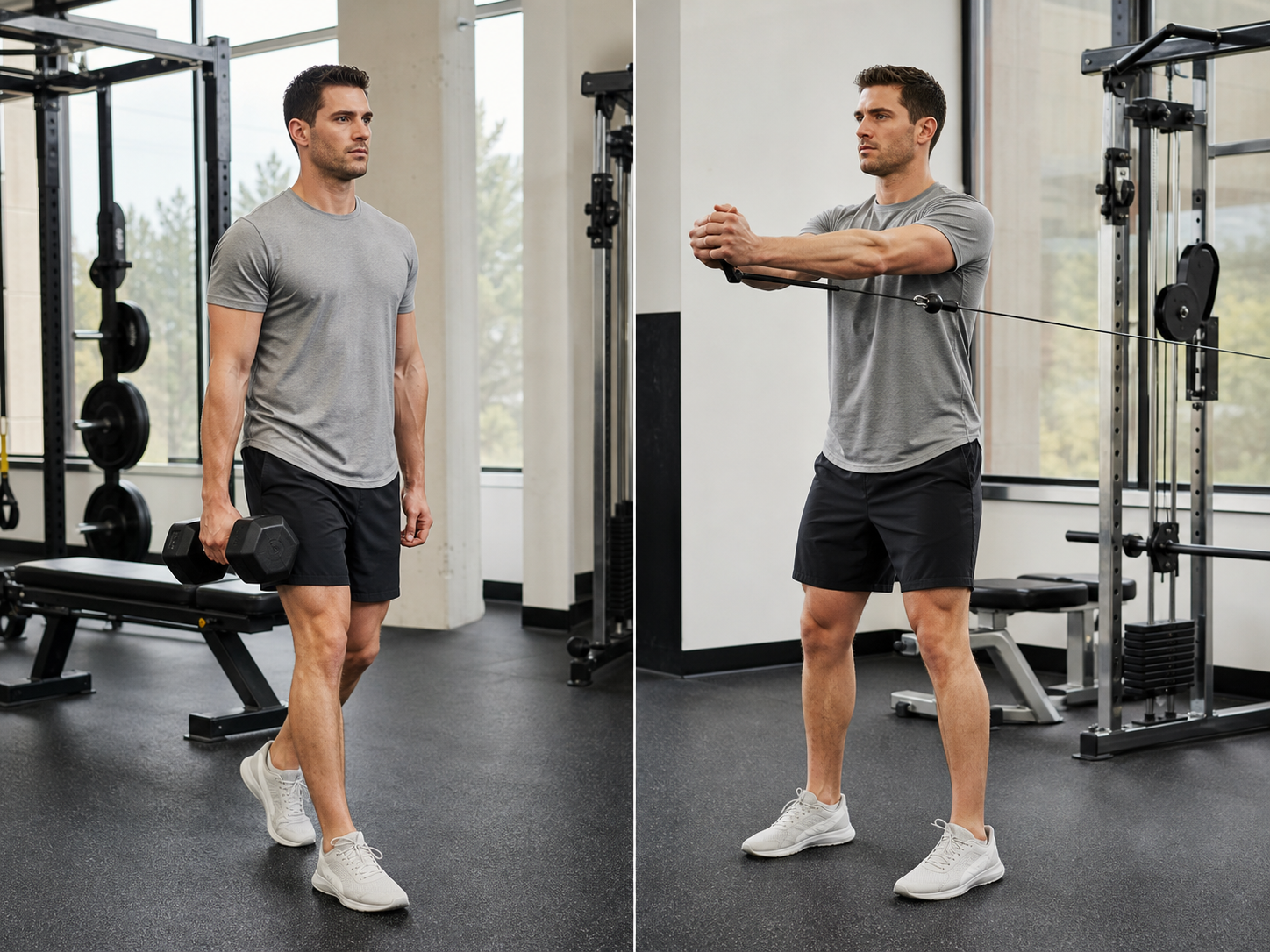
This distinction prevents a common programming error: counting only exercises that move through a plane. Carries, planks, and anti-rotation drills can create a meaningful demand without a large range of motion. Our guide to rotation and anti-rotation exercises separates the two training goals.
- Anti-extension: ab wheel rollouts and body-saw planks resist excessive spinal extension in the sagittal plane.
- Anti-lateral flexion: suitcase carries and offset front-rack carries resist side bending in the frontal plane.
- Anti-rotation: Pallof presses and uneven carries resist trunk rotation in the transverse plane.
How Should You Audit a Workout by Plane?
Use planes as a program audit, not a quota. List each exercise, identify its main joint actions, and note the stabilization demands. Keep the movements that serve your goal. Add lateral, rotational, or anti-rotational work only when your sport, daily life, or training history gives you a reason.
- Start with the goal. A powerlifter needs more squat, press, and deadlift practice than transverse-plane volume. A tennis player needs more lateral and rotational preparation.
- Classify the main actions. Write down the joints that move and the actions they perform. Do not classify an exercise by its name.
- Count stabilization demands. A split squat has frontal- and transverse-plane balance demands even though its main motion remains sagittal.
- Look for a relevant gap. Add one or two movements that match a missing task, such as lateral deceleration or trunk anti-rotation.
- Check the training dose. Also audit load, range, speed, sets, and weekly exposure; plane coverage alone does not define training dose.
A general strength session might include a squat, row, lateral lunge, and suitcase carry. That mix covers major strength work plus side-to-side motion and frontal-plane trunk control. Unilateral leg exercises can add balance demands, but you should choose them for a clear training purpose rather than for novelty.
Anatomical plane labels do not prescribe an equal one-third split of exercises or sets. A bodybuilding or powerlifting plan can stay sagittal-dominant and still work well. Plane analysis should reveal blind spots without displacing the lifts that drive your main result.
What Mistakes Make Plane-Based Training Less Useful?
Plane-based training loses value when the labels replace sound programming. The most common mistakes include forcing equal volume across all three planes, treating compound lifts as pure single-plane movements, and claiming that multidirectional training prevents injury. Exercise choice still has to match your goal, skill, recovery, and tolerance.
- Mistake: assigning a plane from travel direction. Fix: identify the main joint actions first.
- Mistake: forcing a one-third split. Fix: let the sport or training goal determine the weekly distribution.
- Mistake: adding loaded rotation without control. Fix: start with a stable stance, short range, and load you can stop at any point.
- Mistake: promising injury prevention. Fix: training in all three planes does not by itself establish injury prevention. Describe the task the exercise prepares you for without guaranteeing protection.
- Mistake: chasing variety at the expense of progress. Fix: keep key lifts long enough to track load, reps, range, and execution.
Frequently Asked Questions
Exercise labels often get messy because compound lifts involve several joints at once. These answers classify each movement by its dominant joint actions while naming the supporting demands that matter in practice. Use the labels to understand a lift, not to force it into a rigid category.
What plane of movement is a squat?
A squat occurs predominantly in the sagittal plane because hip and knee flexion and extension plus ankle dorsiflexion and plantarflexion create most of the movement. The knees, feet, pelvis, and trunk still manage frontal- and transverse-plane forces. “Sagittal-dominant” describes the full exercise more accurately than “sagittal-only.”
What plane of movement is a bench press?
A bench press is commonly classified in the transverse plane because the shoulders perform horizontal adduction as you press the bar away from your chest. The elbows also extend in the sagittal plane. The classification depends on the joint action you are discussing, which is why compound lifts can carry more than one label.
Is a lateral lunge a frontal-plane exercise?
A lateral lunge is predominantly a frontal-plane exercise because you step sideways and move through hip abduction and adduction. The working hip and knee also flex and extend in the sagittal plane, while the foot and femur control rotation. Step direction alone does not tell the full story.
Do I need to train all three planes every workout?
No. Your weekly program should match your goal and current demands. A field athlete may spread lateral and rotational work across several sessions, while a powerlifter may use one or two accessory slots each week. You do not need one exercise from every plane in every workout.
Does training in all three planes prevent injuries?
Training in all three planes does not by itself establish injury prevention. Use plane analysis to describe task preparation, not to guarantee protection.
Sources
- OpenStax. (n.d.). Anatomical Terminology. Anatomy and Physiology. Accessed July 17, 2026.
- Koldenhoven, R. M., and Behnke, R. S. (n.d.). Anatomical Planes and Axes of Movement. Human Kinetics. Accessed July 17, 2026.
- Brigham Young University. (n.d.). Joint Actions: Planes and Axes of Movement. Biomechanics Teaching Materials. Accessed July 17, 2026.
- Lewis, C. L., Laudicina, N. M., Khuu, A., and Loverro, K. L. (2017). The Human Pelvis: Variation in Structure and Function During Gait. The Anatomical Record, 300(4), 633-642. DOI: 10.1002/ar.23552. PMID: 28297184.
- National Library of Medicine. (n.d.). Medical Language Related to the Whole Body. NCBI Bookshelf. Accessed July 17, 2026.