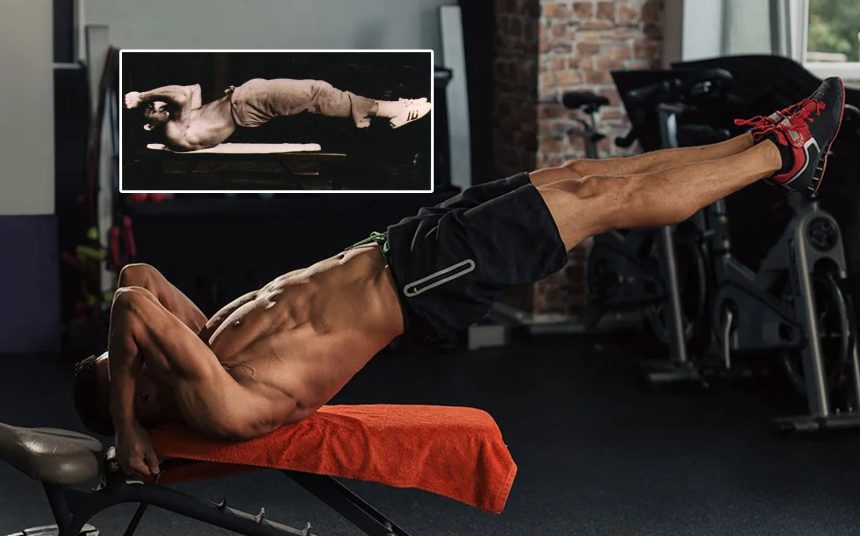
Bruce Lee trained his abs every day, and one line in his handwritten routines from around 1970 reads simply “Flag.” Today the move is called the dragon flag: you lie on a bench, hold on behind your head and raise and lower your whole body as one rigid plank, with only your shoulders touching the pad.
It is an advanced bodyweight exercise, and you don’t need a clean rep on day one. Below is a five-step progression that starts with a move most gym-goers can already do, plus the form for the full rep and the mistakes that strain the lower back.
What Bruce Lee’s notes show
Lee’s training records were published in 1998 in The Art of Expressing the Human Body, which reproduces his own handwritten routines. One, dated around 1970 to 1971, opens with “Stomach and waist (every day)” and lists six exercises: sit-up, side bend, leg raises, flag, twist and back bend.
That puts the flag in his daily ab work. The routines do not give a rep count or say who taught him the move. We cover the rest of that routine in our guide to Bruce Lee’s ab training.
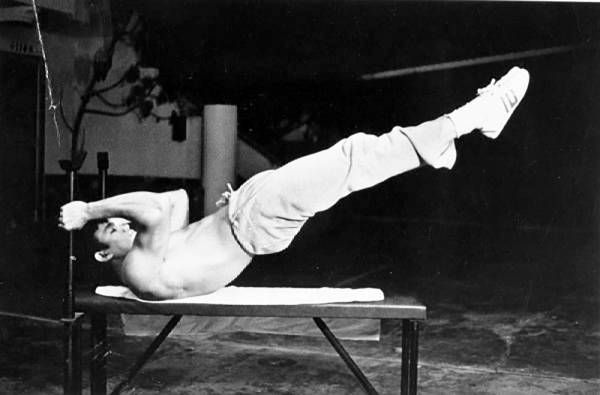
What the dragon flag works
In a crunch you curl your trunk. In a dragon flag your trunk does not bend at all. It rises and lowers with your legs while your spine and hips stay in line. Your body hangs in the air like a lever, and gravity tries to fold you at the waist and drop your legs. Three groups of muscles stop that from happening:
- Abs and obliques: they keep your ribs and pelvis locked together so your lower back cannot arch.
- Hip flexors and glutes: your hip flexors hold your legs up and your glutes stop your hips from folding. Neither rests until the set ends, which is how the move works your abs and hips at once.
- Lats, shoulders and arms: they anchor you to the bench.
No published study has measured what the dragon flag does to the abdominal muscles. The nearest evidence comes from other long-lever core exercises. In a lab study of 18 people, the Swiss ball roll-out and pike were the most effective of ten exercises at activating the upper and lower abs and the obliques, ahead of the crunch and the bent-knee sit-up. In a second study of 19 people, a plank with a longer lever raised ab activity compared with a standard plank. The dragon flag uses the same principle with a much longer lever.
Who can start the dragon flag, and who should skip it
Start at step 1 once you can do 15 clean lying leg raises. The move puts a large load on the trunk, the shoulders and the area around the neck, so leave it out in these cases:
- Lower-back pain: skip dragon flags and choose core moves that don’t make your symptoms worse. Get individual advice if the pain persists.
- Neck or shoulder problems: skip it. Your weight should rest on your upper back and shoulders, never on your neck, and your arms carry real load.
- Pain during any step: stop. Pain that stays or spreads is a reason to see a doctor or physical therapist.
The 5-step dragon flag progression
You need a flat bench that does not rock. Do three sets of your current step, resting 90 seconds between them. Stay on a step until you hit its target in two sessions in a row, then move to the next.
| Step | Move | Move on when you can do |
|---|---|---|
| 1 | Reverse crunch on the bench | 3 sets of 12 |
| 2 | Tuck dragon flag | 3 sets of 8 |
| 3 | One-leg dragon flag | 3 sets of 5 per leg |
| 4 | Straight-leg negative | 3 sets of 5, each lowered for 5 seconds |
| 5 | Full dragon flag | 3 sets of 5 |
Stop each set one rep before your form breaks. A dragon flag done with a bent middle trains the wrong thing, so three clean reps beat six loose ones. If a step feels like a wall, do one or two reps of the new step first, then finish your sets with the step you have already mastered.
The set-up for every step
Lie on the bench with your head near one end. Reach back and grip the sides of the bench beside your head, or its end behind your head, with your elbows bent. Pull your shoulders down into the pad. That grip and those shoulders are your anchor for every step.
From step 2 on, every rep bottoms out with your lower back about a hand’s width above the pad. Go only as low as your body stays straight.
Step 1: Reverse crunch on the bench
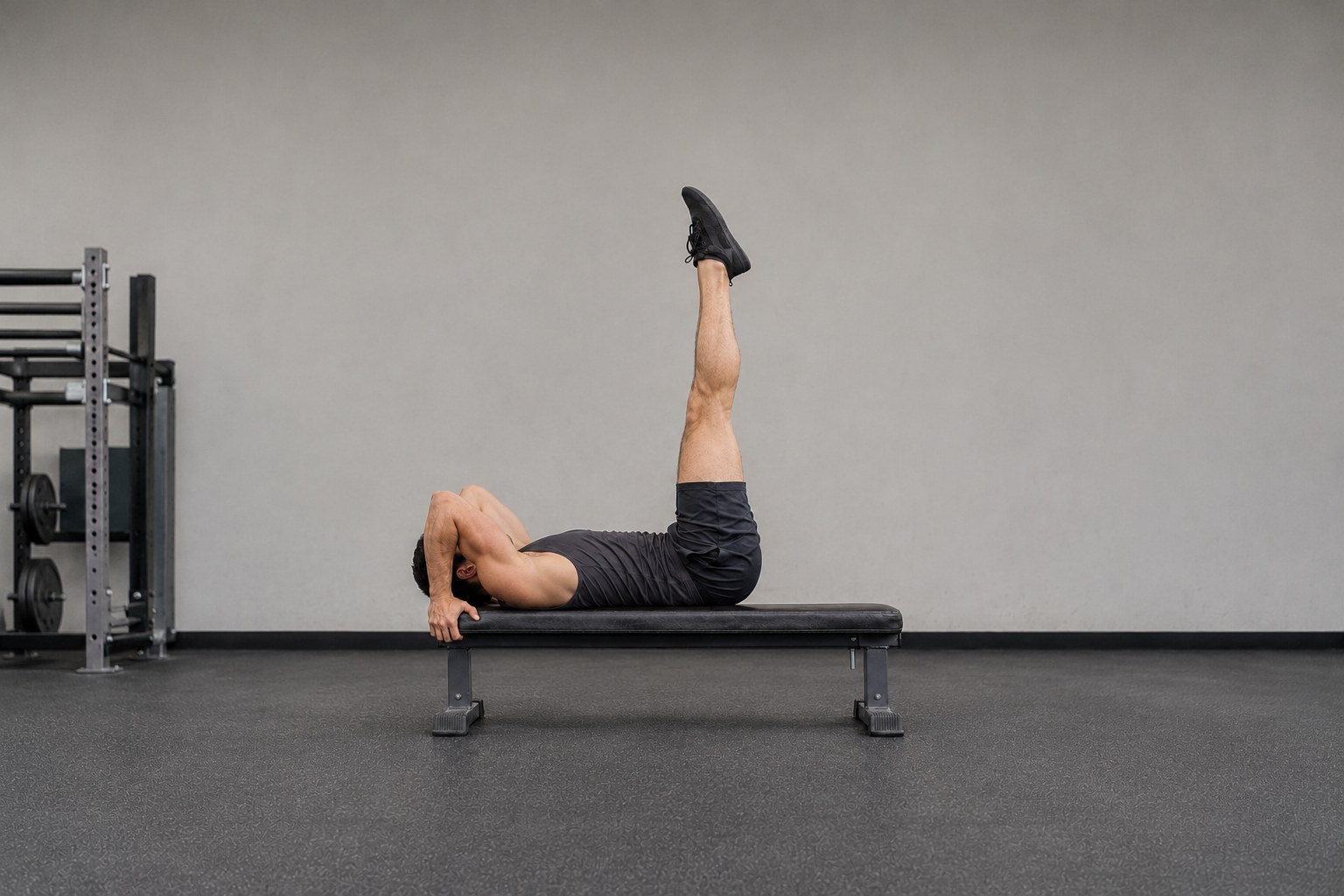
Bend your knees to 90 degrees. Curl your hips off the bench and bring your knees toward your chest, then lower your hips slowly until they touch the pad. This teaches you to lift with your abs. If you have to swing your legs to lift your hips, slow down. Our reverse crunch guide has the full form.
Step 2: Tuck dragon flag
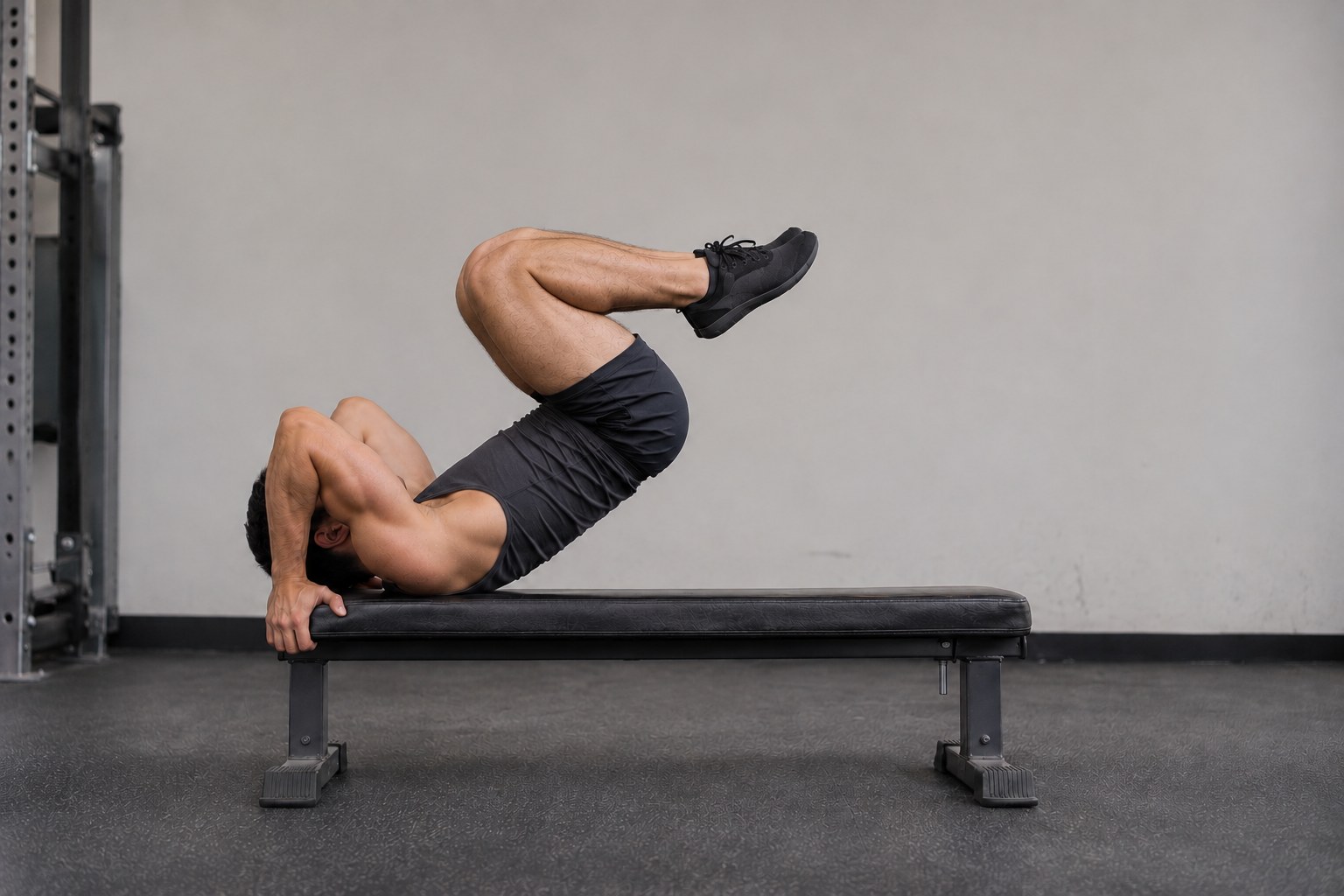
Start as in step 1, but keep going until your hips and lower back are off the bench and your weight is on your upper back. Stop there. Pressure on the back of your neck means you have rolled too far. Keep your knees tucked. Now lower your whole trunk as one piece until your lower back is just above the pad, and raise it again. Your trunk should stay straight from shoulders to hips.
Step 3: One-leg dragon flag
From the tuck position, straighten one leg so it lines up with your trunk and keep the other knee tucked. Lower and raise as in step 2. Do your reps with the right leg straight, then the same number with the left, without resting. That is one set. The straight leg makes the lever longer, so expect fewer reps than in step 2. If the straight leg drifts toward your face, your hips have bent.
Step 4: Straight-leg negative
Raise your hips with your knees tucked, then straighten both legs toward the ceiling so your body is one line. Lower that line as slowly as you can, aiming for five seconds, until you are just above the bench. At the bottom, pull your knees to your chest to lift your hips, then straighten your legs again. You are doing only the lowering half of the full rep. Count the seconds out loud. When you can no longer control the last third of the way down, the set is over.
Step 5: Full dragon flag
- Get to the top as in step 4: tuck, lift your hips, then straighten your legs toward the ceiling.
- Squeeze your glutes and brace your abs as if you were about to be punched.
- Lower your body slowly, in one straight line from shoulders to toes, until you are just above the bench. Your hips must not bend and your lower back must not arch.
- Without touching down, pull your body back up to the top in the same straight line.
Three mistakes that ruin the rep
- Bending at the hips: if your hips fold on the way up, the move has turned into a leg raise. Go back a step.
- Letting the lower back arch: a sagging middle shifts the load from your abs to your spine. End the set when it starts.
- Resting on your neck: keep the contact point on your upper back and shoulders. If you feel pressure on the back of your neck, lower your hips slightly.
How to fit it into your week
Train the progression on two or three days that are not back to back, for example Monday and Thursday, or Monday, Wednesday and Friday. Put it at the start of your workout while you are fresh. Lee’s notes list his stomach work as daily, but they do not say how hard each session was. For a move this demanding, a rest day between sessions lets you repeat good reps.
Two support moves round out the session. The hollow body hold trains the same straight, braced position on the floor, and the leg raise builds the hip and lower-ab strength the lever needs. The whole session takes about 15 minutes.
| Order | Exercise | Sets and reps |
|---|---|---|
| 1 | Your current progression step | 3 sets to the step’s target |
| 2 | Hollow body hold: on your back, lower back pressed to the floor, arms and legs held a few inches up | 3 holds of 20 to 30 seconds |
| 3 | Hanging knee raise or lying leg raise | 2 sets of 10 |
Once you own the full rep, keep it in your routine for three sets of up to five. For more lower-ab work on other days, hanging leg raises and the ab wheel roll-out train similar strength.
Common questions
Did Bruce Lee invent the dragon flag?
His notes do not say so. They show that an exercise he called the “flag” was part of his daily stomach routine around 1970 to 1971. The words “dragon flag” do not appear in them.
Can I do the dragon flag on the floor?
Yes, if you have a fixed anchor built to take your pulling load, such as wall-mounted stall bars. Furniture can slide or tip, so don’t use it.
The bottom line
The flag was a daily entry in Bruce Lee’s stomach routine. Start with reverse crunches on a bench and add one step at a time. Your first clean full rep is the milestone, and three sets of five is the target.
Sources
- Lee, B. (1998). The Art of Expressing the Human Body (J. Little, Ed.). Tuttle Publishing.
- Escamilla, R. F., Lewis, C., Bell, D., Bramblet, G., Daffron, J., Lambert, S., et al. (2010). Core muscle activation during Swiss ball and traditional abdominal exercises. Journal of Orthopaedic & Sports Physical Therapy, 40(5), 265-276. DOI: 10.2519/jospt.2010.3073. PMID: 20436242.
- Schoenfeld, B. J., Contreras, B., Tiryaki-Sonmez, G., Willardson, J. M., & Fontana, F. (2014). An electromyographic comparison of a modified version of the plank with a long lever and posterior tilt versus the traditional plank exercise. Sports Biomechanics, 13(3), 296-306. DOI: 10.1080/14763141.2014.942355. PMID: 25325773.