Dips train the chest, triceps, and front deltoids through a demanding bodyweight press. They can build pressing strength, muscle, and local muscular endurance when you use a range of motion you can control and make the exercise harder over time.
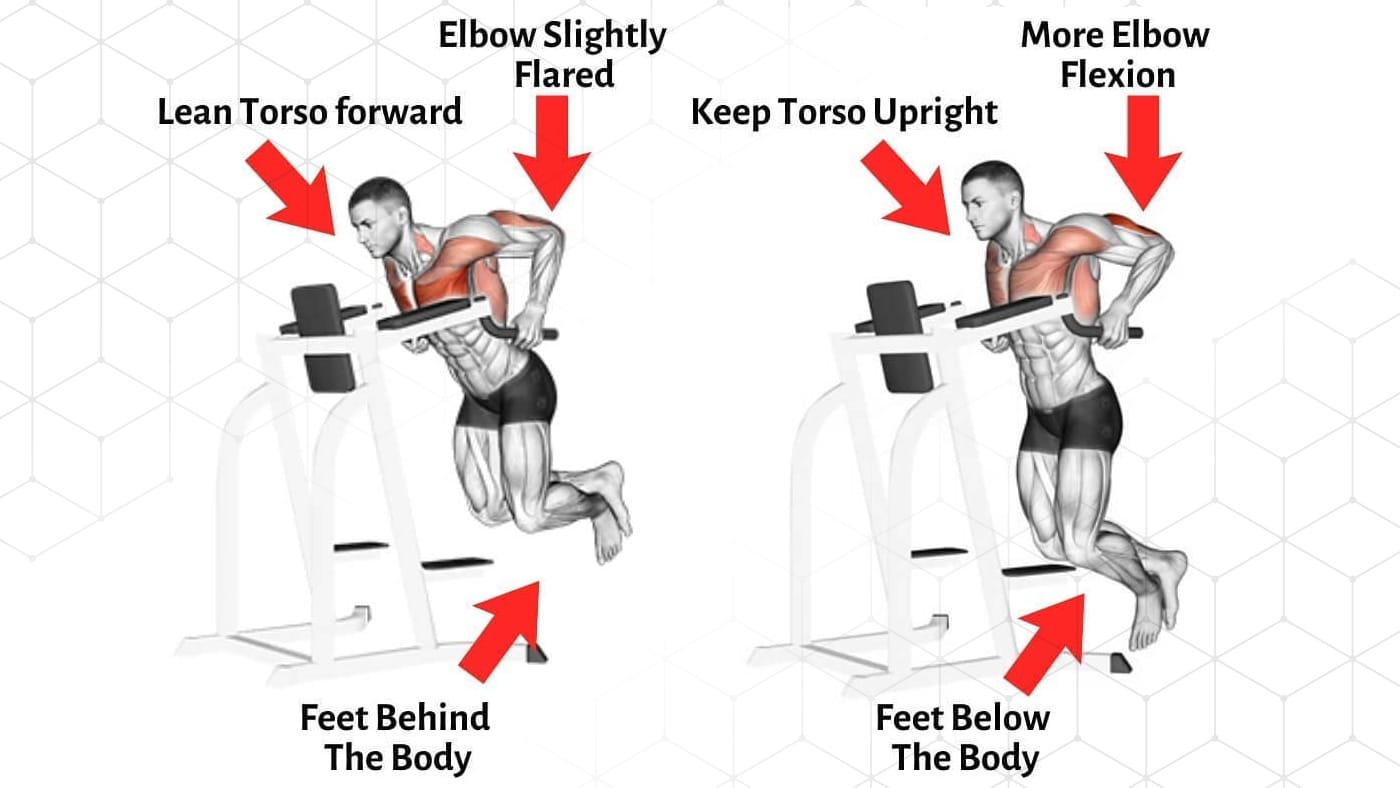
Chest and triceps dips use the same main muscles. Coaches often use a forward torso lean and a slightly wider elbow path to favor the pecs, while a more upright torso and closer elbow path aim to favor the triceps. Direct research comparing those two bar-dip setups remains limited, and neither version isolates one muscle or switches the other off.
Benefits of Dips
Dips earn their place in a program because one exercise can train several upper-body pushing muscles and scale from assisted repetitions to heavily weighted sets.
- Compound pressing strength: Your pecs, triceps, and anterior deltoids work together to lower and press your body.
- Simple progressive overload: An assistance machine or resistance band can reduce the load. A dip belt, weighted vest, or dumbbell can increase it.
- Muscle-building potential: Dips can provide challenging sets through a useful range of motion. Growth still depends on enough weekly training, recovery, and gradual progression.
- Bodyweight skill: You learn to control your shoulder blades, trunk, and legs while your arms support your body.
- Flexible programming: Heavy weighted dips can serve as a main press, while assisted or bodyweight dips can add moderate-to-high-repetition work.
Dips are not required for a strong chest or triceps. If the movement does not suit your shoulders or equipment, use one of these chest and triceps alternatives to dips.
Muscles Worked During Dips
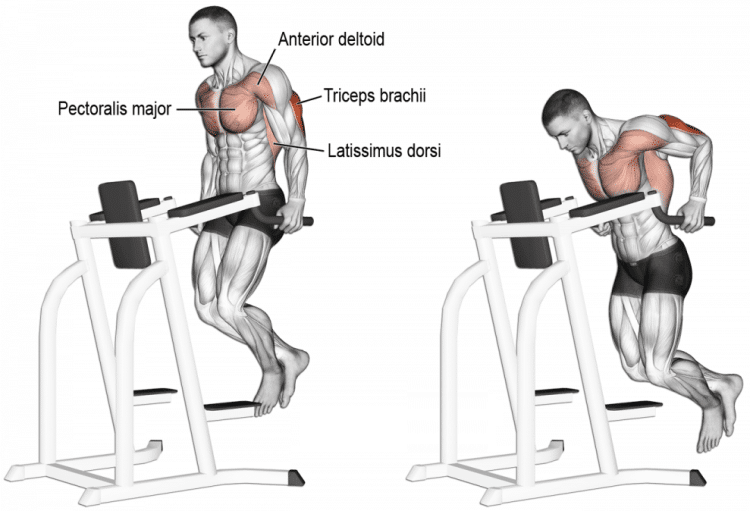
The shoulder and elbow both move during a dip, so several muscles share the work. Torso position changes their relative contribution, but the movement remains a compound press.
| Muscle or group | Role in the dip | How setup changes the demand |
|---|---|---|
| Pectoralis major | Helps bring the upper arm forward as you press out of the bottom | Coaches use a forward lean and modestly wider elbow path to favor chest contribution; direct comparative evidence is limited |
| Triceps brachii | Extends the elbow during the upward phase | Coaches use a more upright torso and closer elbow path to favor elbow-extension demand; the pecs remain active |
| Anterior deltoid | Assists shoulder flexion as the upper arm returns from behind the torso | More shoulder extension at the bottom can increase its demand |
| Scapular stabilizers | Help control the shoulder blades while the arms support the body | Rings add instability; parallel bars provide a more stable base |
| Abdominals, spinal erectors, and glutes | Hold the trunk and legs in the chosen position | A forward lean or added weight raises the need for whole-body control |
A 2022 laboratory study used motion capture and surface electromyography to compare bench, bar, and ring dips. Bar and ring dips produced higher peak activation in several measured muscles than bench dips, while bench dips used more shoulder extension. The study does not prove that one variation builds more muscle over time. It included only 13 healthy, dip-experienced men, each performing four bodyweight repetitions under low-fatigue conditions. Two participants were also excluded from the ring analysis because they lacked regular ring-dip experience. The study did not compare a forward-leaning chest dip with an upright triceps dip. Read PubMed 36293792.
Chest Dips vs. Triceps Dips
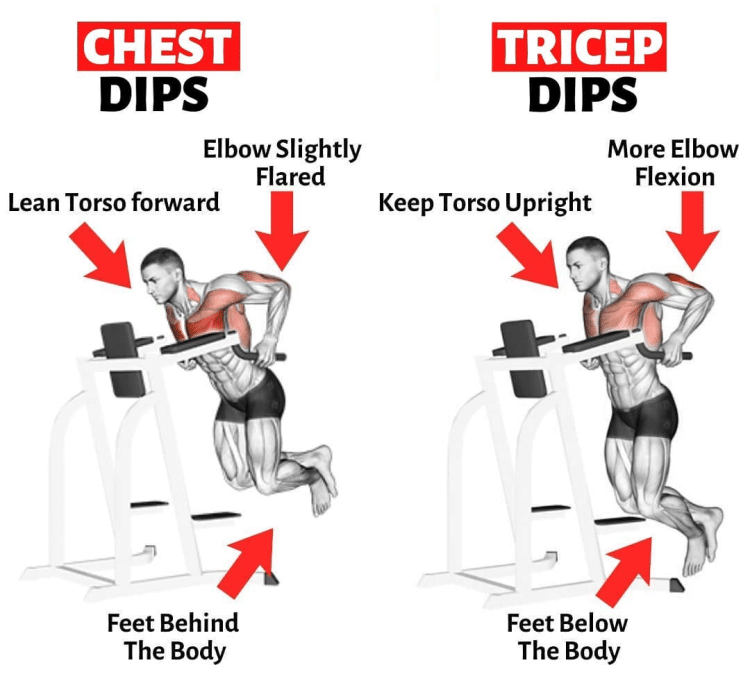
The best variation is the one that matches your training goal, equipment, strength, and comfortable range. The table summarizes common coaching conventions rather than a proven activation hierarchy. Use it as a starting point, then adjust within a controlled setup.
| Factor | Chest-focused dip | Triceps-focused dip |
|---|---|---|
| Torso angle | Lean forward while keeping the trunk braced | Stay more upright, allowing the small natural lean needed to balance |
| Elbow path | Let the elbows travel slightly outward without forcing a hard flare | Guide the elbows more toward the rear without pinning them against the ribs |
| Shoulder extension | Not determined by the label alone; depth, torso position, bar geometry, and individual technique all affect the range | Not determined by the label alone; control the depth and upper-arm travel that your shoulders tolerate |
| Chest emphasis | Traditional coaching setup intended to increase pec contribution; direct comparative evidence is limited | The pecs remain active even when the setup aims to favor the triceps |
| Triceps emphasis | The triceps still extend the elbows throughout the press | Traditional coaching setup intended to favor elbow-extension demand; the pecs remain active |
| Loading | Bodyweight, assistance, or added weight; progress only while the lean stays controlled | Bodyweight, assistance, or added weight; often useful for heavier, triceps-led sets |
| Common errors | Collapsing into the shoulders, forcing extreme depth, swinging the legs, or flaring the elbows hard | Turning the rep into a chest dip, shrugging, losing the upright trunk, or shortening every repetition |
Grip width depends partly on the bars. Choose a position that lets your wrists remain comfortable and your elbows track smoothly. Very wide handles do not guarantee more chest growth, and an extremely narrow grip does not remove the pecs.
How to Do Chest-Focused Dips
- Grip stable parallel bars and support yourself with straight arms. Keep your shoulders away from your ears without forcing them rigidly down.
- Brace your trunk, bend your knees if needed, and lean forward as one unit. Keep the head aligned with the torso.
- Begin the descent by bending your elbows. Let them travel slightly outward as your upper arms move behind your torso.
- Lower only as far as you can maintain control without shoulder pain or a sharp pinch. Your deepest useful position may change with bar width, load, and training history.
- Press the bars down and return to the top. Keep the forward lean until the repetition is complete.
- Reset your balance before the next repetition instead of bouncing out of the bottom.
Think of the forward lean as a chest-emphasis cue, not a contest to reach the deepest position. For a broader bodyweight comparison, see our guide to push-ups versus dips.
Chest-dip demonstration
Gironda-style dip context
Vince Gironda popularized an extra-wide, deep chest-dip style. The video below documents that historical method. No comparative trial shows it builds more chest muscle than a controlled parallel-bar dip, and its width and depth may exceed a comfortable range for some shoulders.
How to Do Triceps-Focused Dips
- Support yourself on parallel bars with your hands near shoulder width when the equipment allows it.
- Brace your trunk and keep your legs beneath or slightly behind you. Hold a mostly upright torso.
- Bend your elbows and guide them toward the rear. Let the shoulders move through a range you can control.
- Descend until you reach your comfortable limit. A roughly right-angle elbow bend is a useful reference, not a rule for every lifter.
- Extend your elbows and press back to the top without using a leg swing.
- Finish under control. Locking out is acceptable if it is comfortable and you do not slam into the joint.
Triceps-focused dips can sit beside other compound arm work. Our guide to compound triceps exercises shows where they fit among close-grip presses and bodyweight options.
Triceps-emphasis demonstration
Assistance and Progression
Start at the first level where you can control the lowering phase, hold your chosen torso angle, and complete each repetition without pain. Build repetitions before adding external load.
- Standing bar dip: Keep your feet on the floor and use your legs only as much as needed. This teaches the path while reducing the load.
- Assisted dip machine: Use enough counterweight to keep the repetition smooth. Reduce assistance in small steps.
- Band-assisted parallel-bar dip: Use a securely placed band and check it before every set. Bands provide the most help near the bottom.
- Slow negative: Step or jump to the top, lower for three to five seconds, and step down. Use this only if you can control the entire descent.
- Bodyweight dip: Add repetitions while keeping the same range and technique.
- Weighted dip: Add a small load with a belt or vest after bodyweight sets are repeatable. External load should not pull you into a deeper range than you can manage.
Progressive resistance training supports gains in strength and muscle, but the exact load and volume should match your goal and training status. The 2026 American College of Sports Medicine position stand emphasizes consistency, progressive resistance, and individualized programming rather than one mandatory loading scheme.
When to Choose Each Dip
- Choose chest-focused dips when you want a compound chest exercise, tolerate the forward-leaning position, and can keep the descent controlled.
- Choose triceps-focused dips when arm strength or triceps development is the priority and you can maintain a more upright torso.
- Use both if they serve separate sessions and you recover well. You do not need both versions in the same workout.
- Choose an assisted version when full bodyweight changes your technique or limits you to a few uncontrolled repetitions.
- Choose another press when dips cause pain, your equipment forces an awkward position, or you cannot find a controllable range.
If floor-based pressing suits you better, these push-up variations offer easier ways to change leverage and load.
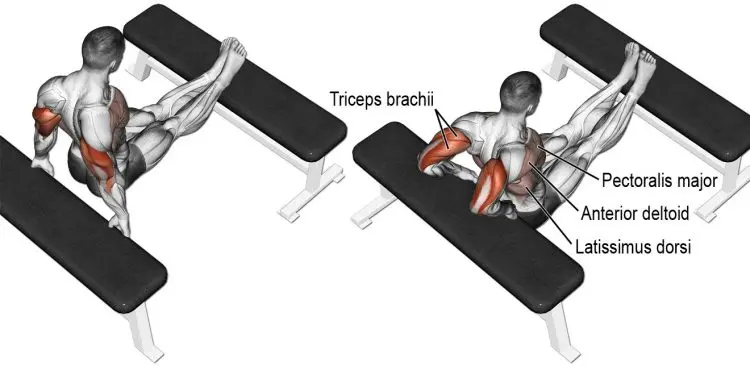
Bench-dip demonstration
Shoulder Comfort and Range of Motion
Dips place the upper arm behind the torso at the bottom, a position called shoulder extension. More depth creates more shoulder extension, but more is not automatically better. Your useful range depends on your anatomy, current capacity, bar setup, load, and training history.
The McKenzie study found greater shoulder extension during bench dips than bar or ring dips. That finding supports caution with deep bench dips, but it does not prove that bench dips injure everyone or that parallel-bar dips are safe for every shoulder. The participants were healthy, experienced men without a chest or upper-extremity injury in the previous 12 months.
Stop a set if you feel sharp pain, pinching, instability, numbness, or a sudden loss of strength. Shorten the range, reduce the load, or use another exercise. Persistent symptoms or symptoms after an injury warrant assessment by a qualified health professional. This guide cannot diagnose a shoulder problem.
Programming Dips
Place dips early in the session when you use them as a heavy compound press. Put them later when they serve as moderate-load chest or triceps volume. Two to four working sets is a practical starting point for many lifters, provided the total weekly workload fits their recovery.
A small 2022 study followed 15 healthy men through one bodyweight bar-dip set to exhaustion. Peak pectoralis major and triceps activity rose in the final repetitions, while the measured peak joint angles did not change. The result describes one fatiguing set, not a requirement to train every set to failure. Stop earlier when support, range, or repetition quality changes. Read PMID 36361276.
Use a repetition range that lets you maintain the same torso angle, elbow path, and depth from the first rep to the last. Increase repetitions, reduce assistance, or add a small amount of weight when every set remains controlled. Do not progress all three variables at once.
Chest and Triceps Both Work in Every Dip
Dips train the chest, triceps, front deltoids, and supporting trunk and shoulder muscles. Coaches use a forward lean to favor the pecs and a more upright setup to favor the triceps, but direct comparative evidence remains limited. Both muscles contribute in either setup. Choose the version you can control through a comfortable range, then progress it gradually.
Sources
- McKenzie A, Crowley-McHattan Z, Meir R, Whitting J, Volschenk W. (2022). Bench, Bar, and Ring Dips: Do Kinematics and Muscle Activity Differ? International Journal of Environmental Research and Public Health, 19(20), 13211. PMID: 36293792. DOI: 10.3390/ijerph192013211.
- McKenzie A, Crowley-McHattan Z, Meir R, Whitting J, Volschenk W. (2022). Fatigue Increases Muscle Activations but Does Not Change Maximal Joint Angles during the Bar Dip. International Journal of Environmental Research and Public Health, 19(21), 14390. PMID: 36361276. DOI: 10.3390/ijerph192114390.
- Currier BS, D’Souza AC, Fiatarone Singh MA, et al. (2026). American College of Sports Medicine Position Stand: Resistance Training Prescription for Muscle Function, Hypertrophy, and Physical Performance in Healthy Adults. Medicine & Science in Sports & Exercise, 58(4), 851-872. PMID: 41843416. DOI: 10.1249/MSS.0000000000003897.