

Nick Walker, the 2026 Mr. Olympia, said in an October 8 video that he stopped taking creatine because he never felt it did anything for him beyond making him feel watery.
Creatine is one of the most studied supplements in sports nutrition, and the muscle-biopsy research says his experience can be true. In the studies that measured how much creatine reached the muscle, a few people’s muscles took up almost none, and those people got no measurable benefit, in recovery or in strength. Researchers have a name for them: non-responders. The people who fit that label in the research shared a profile, and part of it you can check against your own diet.
What Nick Walker said about creatine
He made the comments in the same video in which he discussed his post-Olympia weight gain. Beyond saying creatine never did anything for him, he asked what he needed it for genetically, and when asked about his diet, he said he eats plenty of meat. Our report on why Nick Walker stopped creatine has his full comments.
He didn’t say creatine fails for everyone, and the research doesn’t say that either. What it does show is that the size of the benefit depends on how much creatine your muscles can take in, and that varies a lot from one person to the next.
What a creatine non-responder is
Creatine works by raising the amount of creatine and phosphocreatine stored in muscle. Phosphocreatine rebuilds your cells’ energy supply during short, hard efforts, so fuller stores can mean an extra rep or a faster recovery between sets. Muscle stores have a ceiling, and if yours are already near it there is little room left to fill.
A non-responder is someone whose stores barely rise during supplementation. A 2004 study drew the clearest line, defining responders as people whose muscle creatine rose by more than 20 mmol per kilogram of dry muscle during a five-day load, and non-responders as people whose stores rose by less than 10.

What the biopsy studies found
Three studies that measured muscle creatine directly point the same way.
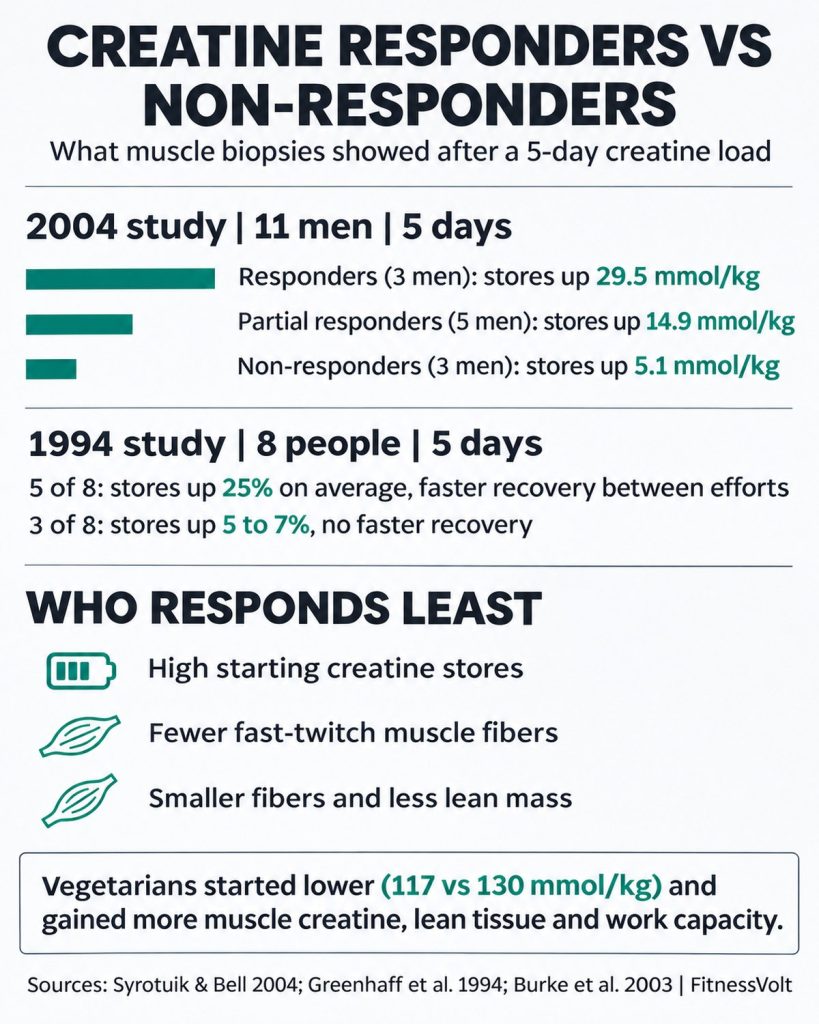
In a 1994 study, eight people took 20 grams a day for five days. In five of them, muscle creatine rose by an average of 25%, and their muscles rebuilt phosphocreatine faster after hard contractions. In the other three, creatine rose by only 5% to 7%, and recovery didn’t speed up at all.
The 2004 study put 11 young men through a five-day load at 0.3 grams per kilogram of body weight a day. Three were clear responders, with stores up by an average of 29.5 mmol per kilogram. Five were partial responders, up 14.9. Three were non-responders, up 5.1. The responders improved their one-rep max on the leg press after the five days. The non-responders improved on neither the bench press nor the leg press.
A 1992 study of 17 people points the same way: the lower someone’s starting level, the bigger the rise, with some stores climbing by as much as 50%, and the effect was to lift them toward the upper end of the normal range.
These were small studies, and the numbers come from short loading phases, not years of use. Together they show that “creatine works” is an average, and that the average includes people for whom it does very little.
Who responds least
The 2004 study compared the two groups before anyone took creatine. The non-responders started with higher muscle creatine, had a lower share of type II muscle fibers, the fast-twitch fibers used for heavy and explosive work, and had smaller fibers and less lean mass. The responders were the opposite on every count, though with three men in each group, nobody should treat that as a rule.
Fiber type may matter because fast-twitch fibers hold more phosphocreatine and use more of it. A 1989 study that separated the two fiber types found 82.7 mmol per kilogram of dry muscle at rest in fast-twitch fibers against 73.1 in slow-twitch fibers, and the fast-twitch fibers used up more of it during 30 maximal knee extensions. That may be one reason muscles with more fast-twitch fibers get more out of fuller stores.
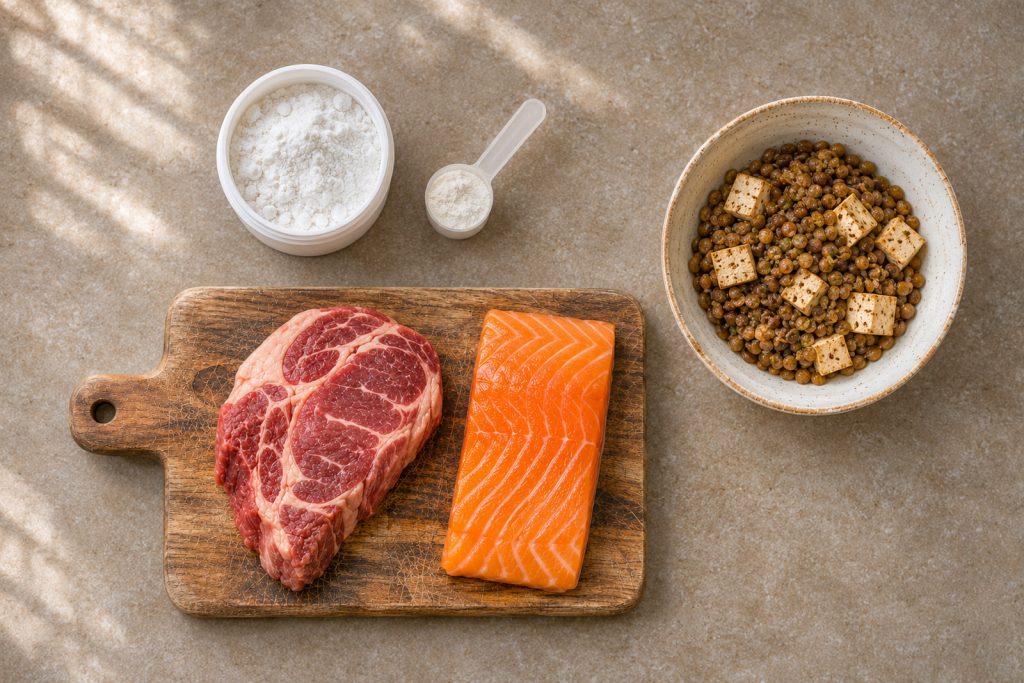
Diet is one thing that moves the starting level. Meat and fish are the main food sources of creatine, and a single 5-gram scoop holds about as much as 1.1 kilograms of raw steak, according to the 1992 study. When omnivorous men switched to a vegetarian diet for 21 days, their muscle creatine fell. When women switched for three months, their body creatine pool shrank too.
That shows up in how people respond. In a 2003 trial, vegetarians started with lower muscle creatine than meat-eaters, 117 against 130 mmol per kilogram. During eight weeks of creatine and strength training, the vegetarians gained more muscle creatine, more lean tissue and more work capacity than the meat-eaters who took the same supplement. The 2002 study adds a useful detail: after a five-day load, the vegetarian-diet group and the meat-eaters ended up with similar stores, 148.6 and 141.7 mmol per kilogram, so the diet moved the starting point and left the finish about the same.
Cutting out meat and fish lowers stores; whether eating a lot of it pushes them higher than an ordinary mixed diet has not been tested. Nothing in these studies tells us about Walker’s own muscle either.
The “watery” feeling
Feeling watery is a recognized effect in the research, though mainly an early one. A 2021 review of common creatine questions found that water retention in the first several days is the most common side effect, mostly inside the muscle cells, as creatine pulls water in with it. The same review pointed to several training studies lasting 5 to 10 weeks that found no increase in total body water, and concluded that creatine may not cause water retention over the longer term.
Bodybuilders are judged on how dry and detailed they look, so an early water shift that a recreational lifter would never notice can matter to them, even if the long-term research reads as neutral.
How big is the benefit for people who do respond?
The benefit is modest even in the people who respond. A 2023 meta-analysis pulled together 10 trials that measured muscle size directly with MRI, CT or ultrasound in people doing resistance training for at least six weeks. Creatine added a small amount of extra muscle thickness, about 0.10 to 0.16 cm in the upper and lower body, and the authors described the overall effect as very small. The benefit was a little larger in younger adults than older ones.
For a lifter who already carries a lot of muscle, has trained for years and, as Walker says he does, eats plenty of meat, the extra from creatine could be small enough to go unnoticed.
The responder scorecard
Use the table to see which way your own traits lean. The diet row you can check yourself. Nobody knows their fiber mix or their muscle creatine without a biopsy, so treat this as a guide to likelihood rather than a diagnosis.
| Factor | Leans toward a bigger response | Leans toward a smaller response |
|---|---|---|
| Diet | Vegetarian or little meat and fish | An ordinary or high meat and fish intake |
| Starting muscle creatine | Low | Already near the upper end |
| Muscle fibers | More fast-twitch (type II) fibers | Fewer fast-twitch fibers |
How to find out if creatine works for you
The clearest effect is on short, hard efforts that run on phosphocreatine, so that is where a change is easiest to see. The 2021 review notes creatine may also help endurance athletes with glycogen storage and recovery, so endurance work is not a reason to expect nothing.
- Pick two or three lifts you train every week and note the reps you get at a fixed weight.
- Take 3 to 5 grams of creatine monohydrate every day, including rest days. Our creatine calculator gives a figure for your body weight.
- Give it at least four weeks. In a 1996 study, 3 grams a day raised muscle creatine by about 20% over 28 days, the same rise a 20-gram loading week produced in six days. If you’d rather know sooner, our comparison of creatine loading vs. slow saturation explains both routes.
- Keep the rest of your training and diet steady, then compare the reps at the same weights. Judge it by those numbers or by repeated sprint times, not by how you feel after a dose.
- If nothing has moved after four weeks, or after six to eight if you want to be sure, you may be one of the lifters who gets little from it.
If you already take creatine, run the test the other way round. Note your reps at a fixed weight now, stop taking it, keep training and eating the same way, and compare after about a month. That is how long the 1996 study found muscle creatine took to return to its starting level after supplementation ended, so any effect should have faded by then. If your reps hold, creatine was doing little for you.

Should you stop taking creatine like Nick Walker?
If you’ve given it a fair trial and your training numbers didn’t change, stopping costs you little. If you eat little meat or fish, the odds tilt the other way: in the one trial here that compared them, vegetarians gained more from creatine than meat-eaters did.
For everyone in between, the case for creatine is a small, steady advantage at a low cost. Our guide to creatine pros and cons covers the wider picture, and if you take it in your morning drink, we’ve covered what hot coffee does to creatine.
Common questions
Is being a creatine non-responder genetic?
No study has tested that directly. The traits linked to a weak response in the 2004 study include one that is largely fixed, your mix of fiber types, and one you can change, how much meat and fish you eat.
Will a bigger dose help a non-responder?
No study has tested a bigger dose in non-responders. What the 1992 study shows is that muscle creatine rises toward an upper limit, and that three men taking 30 grams a day passed 40 to 68 percent of it in urine over the first three days. Past that limit, extra creatine has nowhere to go.
Would a different form of creatine work better?
Not on current evidence. A 2011 review of the newer forms on the market, including salts, esters and liquid versions, found little to no evidence that any of them is more effective or safer than creatine monohydrate. Our breakdown of creatine monohydrate vs. HCl compares the two most common choices.
Sources
- Syrotuik, D. G., & Bell, G. J. (2004). Acute creatine monohydrate supplementation: a descriptive physiological profile of responders vs. nonresponders. Journal of Strength and Conditioning Research, 18(3), 610-617. DOI: 10.1519/12392.1. PMID: 15320650.
- Greenhaff, P. L., Bodin, K., Söderlund, K., & Hultman, E. (1994). Effect of oral creatine supplementation on skeletal muscle phosphocreatine resynthesis. American Journal of Physiology, 266(5 Pt 1), E725-E730. DOI: 10.1152/ajpendo.1994.266.5.E725. PMID: 8203511.
- Harris, R. C., Söderlund, K., & Hultman, E. (1992). Elevation of creatine in resting and exercised muscle of normal subjects by creatine supplementation. Clinical Science, 83(3), 367-374. DOI: 10.1042/cs0830367. PMID: 1327657.
- Hultman, E., Söderlund, K., Timmons, J. A., Cederblad, G., & Greenhaff, P. L. (1996). Muscle creatine loading in men. Journal of Applied Physiology, 81(1), 232-237. DOI: 10.1152/jappl.1996.81.1.232. PMID: 8828669.
- Burke, D. G., Chilibeck, P. D., Parise, G., Candow, D. G., Mahoney, D., & Tarnopolsky, M. (2003). Effect of creatine and weight training on muscle creatine and performance in vegetarians. Medicine and Science in Sports and Exercise, 35(11), 1946-1955. DOI: 10.1249/01.MSS.0000093614.17517.79. PMID: 14600563.
- Lukaszuk, J. M., Robertson, R. J., Arch, J. E., Moore, G. E., Yaw, K. M., Kelley, D. E., et al. (2002). Effect of creatine supplementation and a lacto-ovo-vegetarian diet on muscle creatine concentration. International Journal of Sport Nutrition and Exercise Metabolism, 12(3), 336-348. DOI: 10.1123/ijsnem.12.3.336. PMID: 12432177.
- Blancquaert, L., Baguet, A., Bex, T., Volkaert, A., Everaert, I., Delanghe, J., et al. (2018). Changing to a vegetarian diet reduces the body creatine pool in omnivorous women, but appears not to affect carnitine and carnosine homeostasis: a randomised trial. British Journal of Nutrition, 119(7), 759-770. DOI: 10.1017/S000711451800017X. PMID: 29569535.
- Antonio, J., Candow, D. G., Forbes, S. C., Gualano, B., Jagim, A. R., Kreider, R. B., et al. (2021). Common questions and misconceptions about creatine supplementation: what does the scientific evidence really show? Journal of the International Society of Sports Nutrition, 18, 13. DOI: 10.1186/s12970-021-00412-w. PMID: 33557850.
- Tesch, P. A., Thorsson, A., & Fujitsuka, N. (1989). Creatine phosphate in fiber types of skeletal muscle before and after exhaustive exercise. Journal of Applied Physiology, 66(4), 1756-1759. DOI: 10.1152/jappl.1989.66.4.1756. PMID: 2732167.
- Jäger, R., Purpura, M., Shao, A., Inoue, T., & Kreider, R. B. (2011). Analysis of the efficacy, safety, and regulatory status of novel forms of creatine. Amino Acids, 40(5), 1369-1383. DOI: 10.1007/s00726-011-0874-6. PMID: 21424716.
- Burke, R., Piñero, A., Coleman, M., Mohan, A., Sapuppo, M., Augustin, F., et al. (2023). The effects of creatine supplementation combined with resistance training on regional measures of muscle hypertrophy: a systematic review with meta-analysis. Nutrients, 15(9), 2116. DOI: 10.3390/nu15092116. PMID: 37432300.