
Yes, you can stir creatine into hot coffee. Heat doesn’t ruin it, and a hot mug dissolves a 5-gram scoop far better than a glass of cold water does.
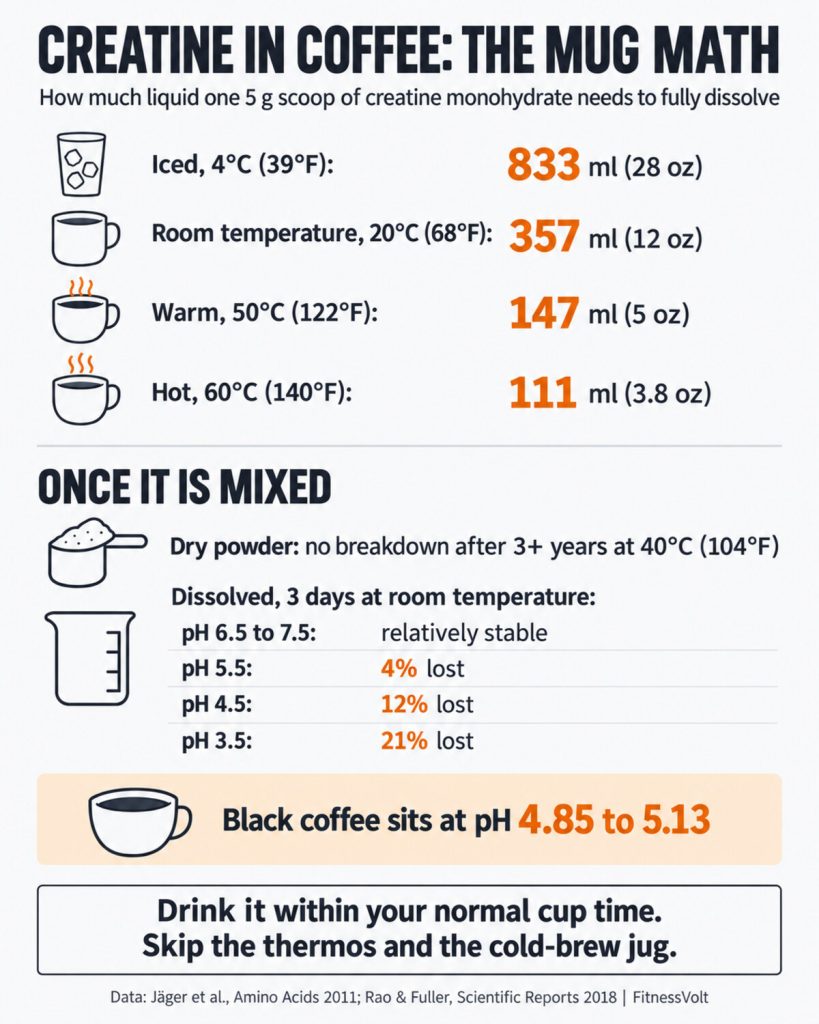
One scoop needs about 4 ounces of hot coffee to disappear completely. The same scoop needs 28 ounces of iced coffee. That gap explains most gritty-cup complaints. The caffeine question has a twist too: the study behind the “caffeine cancels creatine” warning used a daily creatine dose that works out to about 40 grams for an 80 kg lifter, eight times a standard 5-gram scoop.
Heat wrecking creatine in the cup is the usual worry, and the data gives it little weight. What decides whether your creatine coffee works is how long the drink sits before you finish it, whether the coffee is hot or iced when the powder goes in, and how much caffeine you stack during a loading phase.
What heat does to creatine

Creatine monohydrate powder shrugs off heat. Stability tests summarized in a 2011 review in Amino Acids found no measurable breakdown after more than three years at 40°C (104°F). Even stored at 60°C (140°F), the powder took 44 months to show a trace of creatinine.
Dissolved creatine behaves differently. In water, the molecule slowly closes into a ring and becomes creatinine, a breakdown product your muscles can’t use to make energy. Acid and heat both speed that reaction up. The lower the pH and the higher the temperature, the faster creatine converts. The amount you dissolve doesn’t change the rate.
Your tub can sit in a warm cupboard without a problem; the breakdown only begins once the powder is wet.
How long creatine lasts once it hits the coffee
The best data on creatine in liquid comes from storage tests at room temperature (25°C). Near neutral pH, around 6.5 to 7.5, creatine stays relatively stable. Lower the pH and the losses climb. After three days, creatine lost 4% at pH 5.5, 12% at pH 4.5 and 21% at pH 3.5.
Black coffee falls between pH 5.5 and 4.5. A 2018 study in Scientific Reports measured hot- and cold-brewed coffees at pH 4.85 to 5.13, and the cold brews came out in the same range as the hot ones. Cold brew removes the heat and brings back the solubility problem from the table in the next section.
No published study has timed creatine breakdown in a hot mug over the 10 or 20 minutes it takes to drink one, so the heat penalty in coffee is unmeasured. The storage data still gives you a sense of scale: three days in acid to lose 4% to 12%, against the quarter hour a mug lasts. A thermos you sip from 7 a.m. to 3 p.m. takes a far bigger bite, and holds the creatine at a temperature that makes things worse.
The 2011 review’s advice is simple: if you don’t drink dissolved creatine right away, keep it cold. For your coffee, that means stirring the scoop in and finishing the cup at your normal pace. The setup table further down covers the thermos, the travel mug and the pre-mixed cold brew jug.
The math is forgiving even in a bad case. If a slow-sipped mug cost you a tenth of a 5-gram dose, you’d still swallow 4.5 grams, inside the 3 to 5 grams a day that researchers use as a maintenance dose. Taking the scoop every day matters more than rescuing half a gram from one mug.
The mug math: how much coffee one scoop needs
Creatine monohydrate doesn’t dissolve easily, and its solubility climbs faster the warmer the liquid gets. One liter of water dissolves about 6 grams at fridge temperature, 14 grams at room temperature, 34 grams at 50°C and 45 grams at 60°C. For a single 5-gram scoop, that works out like this:
| Liquid temperature | Liquid a 5 g scoop needs | What that looks like |
|---|---|---|
| Iced, 4°C (39°F) | 833 ml (28 oz) | More than a large iced coffee holds |
| Room temperature, 20°C (68°F) | 357 ml (12 oz) | A full 12 oz glass, stirred hard |
| Warm, 50°C (122°F) | 147 ml (5 oz) | Half a standard cup |
| Hot, 60°C (140°F) | 111 ml (3.8 oz) | The first few sips of a fresh mug |
Coffee fresh from the pot runs hotter than 60°C, the top of that data, so a hot mug dissolves a full scoop with room to spare. If you’ve found powder at the bottom of a hot cup, the usual culprits are a quick stir or cold milk poured in before the creatine.
Room-temperature water is tighter than most people think. An 8-ounce glass can dissolve only about 3.3 grams, so a 5-gram scoop leaves grit however hard you stir.
Iced coffee is the real problem. A 16-ounce iced coffee at fridge temperature holds about 2.8 grams in solution and the rest sinks. Grit you swallow still counts as a dose; grit left in the bottom of the cup is a dose you missed.
Does caffeine cancel creatine? What the research found
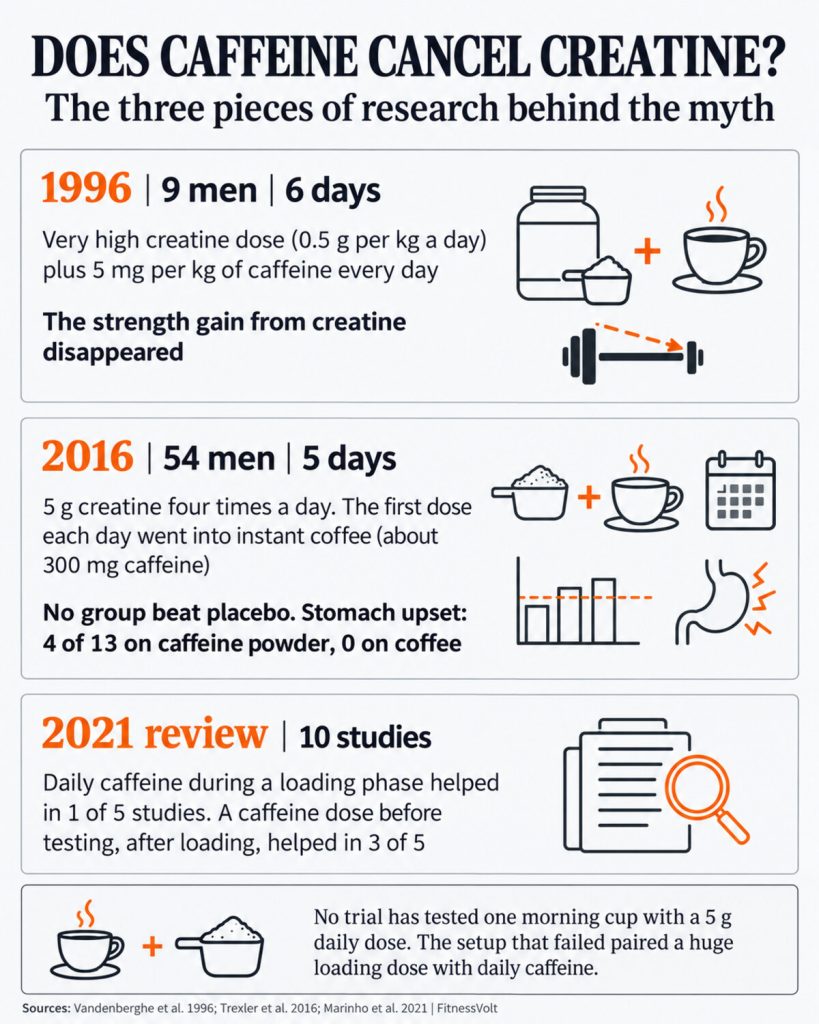
This myth has a real starting point. In 1996, researchers gave nine men a very high creatine dose for six days: 0.5 grams per kilogram of body weight a day, about 40 grams for an 80 kg lifter. Creatine alone raised dynamic torque in a knee-extension fatigue test by 10% to 23%. When the men also took 5 mg/kg of caffeine every day, that gain disappeared, even though their muscle phosphocreatine still rose by 4% to 6%.
Twenty years later, a team at the University of North Carolina put creatine in coffee and tested it. Fifty-four physically active men finished a five-day loading phase of 20 grams a day, split into four groups:
- creatine only
- creatine plus 300 mg of caffeine powder a day
- creatine with the first dose each day stirred into instant coffee, about 303 mg of caffeine
- placebo
Strength went up in every group, placebo included, and no group beat another on the strength or sprint tests. Caffeine didn’t blunt creatine. Five days of creatine didn’t beat placebo either, though, so the study had no room to catch a small penalty. It found no harm, and that’s the limit of what it can tell you.
A systematic review first published in 2021 pulled the research together. Across ten studies, daily caffeine taken during a creatine loading phase added a benefit in only one of five studies. A single caffeine dose of 5 to 7 mg/kg, taken about an hour before testing once loading was finished, added a benefit in three of five. The reviewers saw no apparent benefit to caffeine during loading, while a pre-workout dose after loading may help.
Researchers have offered a few explanations for the 1996 result, including a short washout between trials. The two physiological candidates are that creatine and caffeine push muscle relaxation time in opposite directions, and that the combination upsets the stomach. Nobody has confirmed either one.
The one study that showed caffeine erasing creatine’s effect paired a huge loading dose with daily caffeine. No trial has tested one morning coffee with a 3 to 5 gram daily dose. On a standard maintenance dose, nothing in the research says to keep creatine away from your coffee. During a 20-gram loading week, the cautious move is to take the extra doses with water and keep caffeine moderate. If you’re still deciding whether to load at all, our comparison of creatine loading vs. slow saturation covers both routes.
Coffee may sit better in your stomach than caffeine powder
The North Carolina study turned up one practical surprise. Four of the 13 men taking creatine with caffeine powder, about 31%, reported mild stomach upset. Nobody in the coffee group did, and nobody taking creatine alone or placebo did either.
One small study can’t settle this. Still, if creatine plus a caffeinated pre-workout leaves your stomach unhappy, swapping the powder for a cup of coffee costs nothing to try. The study’s authors made a similar point: lifters taking creatine should think about the source, dose and timing of their caffeine.
Your creatine coffee setup, rated
Find your usual cup in the first column. The last column says why it got its verdict and what to change, if anything.
| Setup | Verdict | Why, and the fix |
|---|---|---|
| Hot black coffee, finished at a normal pace | Go | A full scoop dissolves in the first 4 oz, and it spends little time in an acidic drink |
| Hot coffee with milk or creamer | Go, in the right order | Stir the creatine into the hot coffee first. Cold milk added first drops the temperature and the amount the cup can dissolve |
| Espresso or latte | Fixable | A double shot is only about 2 oz, roughly half the liquid a scoop needs at 60°C. Dissolve the scoop in 4 oz of hot water first, then add the shot and the milk |
| Protein coffee | Go | Dissolve the creatine in hot coffee, then build the rest of the drink. Our protein coffee recipe takes the scoop as written |
| Iced coffee or cold brew | Fixable | 16 oz of cold coffee holds only about 2.8 g. Dissolve the scoop in 4 to 5 oz of hot coffee or hot water, then pour it over ice |
| Thermos or all-day travel mug | Skip | Hours in a warm, acidic drink. Put the creatine in your first cup instead |
| Cold brew jug pre-mixed with creatine | Skip | Days in an acidic liquid. At coffee’s pH, three days at room temperature cost 4% to 12%, and the fridge only slows that loss |
| Loading phase (20 g a day) plus several coffees | Split it | The study where caffeine erased creatine’s effect paired heavy loading with daily caffeine. Take the extra doses with water |
| Afternoon or evening coffee | Move the creatine | Creatine doesn’t need the late cup, and the caffeine may cost you sleep |
How to make creatine coffee with no grit
- Put your scoop in the empty mug. The standard maintenance dose is 3 to 5 grams of creatine monohydrate a day, and our creatine calculator works out a figure from your body weight.
- Pour in about 4 ounces of fresh hot coffee and stir until no grains sit on the bottom.
- Top up with the rest of your coffee, then add milk, creamer or protein.
- Drink it at your normal pace. If a thin white film shows up near the end, swirl the cup and finish it.
For iced coffee, do steps 1 and 2 with hot coffee or hot water, then pour the mix over ice and drink it soon. As the drink cools, some creatine can come back out of solution, so give the cup a swirl before the last few sips.
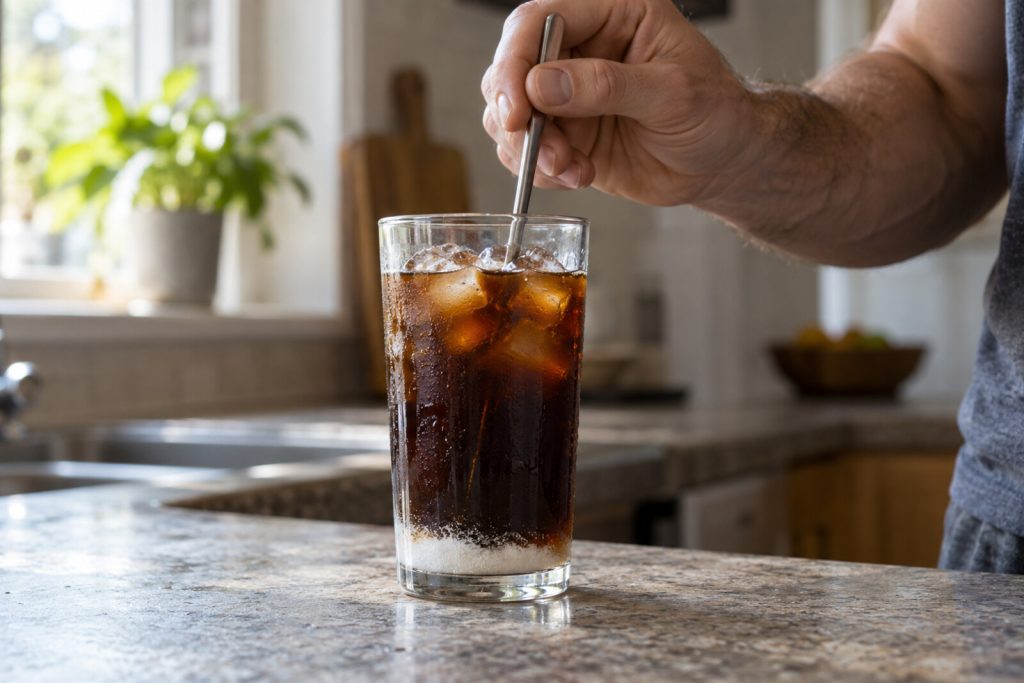
Stick with creatine monohydrate for this. Creatine salts, such as creatine citrate, lower the pH of the liquid you mix them into, and the 2011 review notes that this might make them less stable in solution than monohydrate. Our breakdown of creatine monohydrate vs. HCl covers how the two compare.
When to take creatine somewhere other than coffee
Coffee is a convenient way to take creatine, but you don’t need it. Take your scoop with water, a shake or a meal instead if one of these fits you:
- Your creatine rides in a late coffee. In a 2013 sleep study, 400 mg of caffeine taken six hours before bed still cut total sleep by more than an hour on a sleep monitor, and the sleepers themselves noticed only about 40 minutes of it.
- You already drink a lot of caffeine. The FDA cites 400 mg a day, about two to three 12-ounce cups of coffee, as an amount not generally linked to negative effects in most adults. If your coffee, pre-workout and energy drinks already pass that, don’t add another cup to carry your creatine. Our caffeine calculator adds up your daily intake.
- You’re pregnant, trying to get pregnant or breastfeeding. The FDA advises talking with your health care provider about whether you need to limit caffeine.
Common questions
Can you put creatine in hot tea?
Yes. Hot tea dissolves creatine the same way hot coffee does, so the same rules apply: stir it in while the tea is hot and finish the cup at a normal pace. The North Carolina team noted that earlier trials mixed creatine into caffeinated tea or coffee and still recorded performance gains.
Does coffee dehydrate you while you take creatine?
Not at normal intakes. The International Society of Sports Nutrition’s caffeine position stand concludes that caffeine at the recommended doses doesn’t appear to have a significant effect on hydration. Creatine itself pulls some water into muscle during the first days of a loading phase. Our guide to how much water to drink while taking creatine covers daily targets.
Will creatine change my blood test results?
It can raise one marker. In the North Carolina study, serum creatinine rose in every group taking creatine. Doctors use creatinine as a kidney marker on routine blood tests, and the researchers noted that creatine use can raise it even when the kidneys work normally. Tell your doctor you take creatine before anyone reads too much into a high number. If you already have a kidney condition, ask your doctor before you take creatine at all, in coffee or anything else.
Should you take creatine with coffee before a workout?
You can, and it lines up well. Creatine works by building up the stores in your muscles day after day, so a single dose before training isn’t what makes it work. Caffeine works on the day: the most common timing in the research is about 60 minutes before exercise, at 3 to 6 mg per kilogram of body weight. A coffee an hour before you lift, with your daily scoop stirred in, covers both.

The bottom line
Stir your creatine into hot coffee rather than iced, and finish the cup at your normal pace. Keep it out of thermoses and pre-made cold brew. If you’re loading at 20 grams a day, take the extra doses with water. On a normal 3 to 5 gram maintenance dose, keep the morning mug as it is, scoop included.
Sources
- Jäger, R., Purpura, M., Shao, A., Inoue, T., & Kreider, R. B. (2011). Analysis of the efficacy, safety, and regulatory status of novel forms of creatine. Amino Acids, 40(5), 1369-1383. DOI: 10.1007/s00726-011-0874-6. PMID: 21424716.
- Rao, N. Z., & Fuller, M. (2018). Acidity and antioxidant activity of cold brew coffee. Scientific Reports, 8, 16030. DOI: 10.1038/s41598-018-34392-w. PMID: 30375458.
- Vandenberghe, K., Gillis, N., Van Leemputte, M., Van Hecke, P., Vanstapel, F., & Hespel, P. (1996). Caffeine counteracts the ergogenic action of muscle creatine loading. Journal of Applied Physiology, 80(2), 452-457. DOI: 10.1152/jappl.1996.80.2.452. PMID: 8929583.
- Trexler, E. T., Smith-Ryan, A. E., Roelofs, E. J., Hirsch, K. R., Persky, A. M., & Mock, M. G. (2016). Effects of coffee and caffeine anhydrous intake during creatine loading. Journal of Strength and Conditioning Research, 30(5), 1438-1446. DOI: 10.1519/JSC.0000000000001223. PMID: 26439785.
- Marinho, A. H., Gonçalves, J. S., Araújo, P. K., Lima-Silva, A. E., Ataide-Silva, T., & de Araujo, G. G. (2023; online 2021). Effects of creatine and caffeine ingestion in combination on exercise performance: A systematic review. Critical Reviews in Food Science and Nutrition, 63(20), 4785-4798. DOI: 10.1080/10408398.2021.2007470. PMID: 34845944.
- Kreider, R. B., Kalman, D. S., Antonio, J., et al. (2017). International Society of Sports Nutrition position stand: safety and efficacy of creatine supplementation in exercise, sport, and medicine. Journal of the International Society of Sports Nutrition, 14, 18. DOI: 10.1186/s12970-017-0173-z. PMID: 28615996.
- Antonio, J., Candow, D. G., Forbes, S. C., et al. (2021). Common questions and misconceptions about creatine supplementation: what does the scientific evidence really show? Journal of the International Society of Sports Nutrition, 18, 13. DOI: 10.1186/s12970-021-00412-w. PMID: 33557850.
- Guest, N. S., VanDusseldorp, T. A., Nelson, M. T., et al. (2021). International society of sports nutrition position stand: caffeine and exercise performance. Journal of the International Society of Sports Nutrition, 18, 1. DOI: 10.1186/s12970-020-00383-4. PMID: 33388079.
- Drake, C., Roehrs, T., Shambroom, J., & Roth, T. (2013). Caffeine effects on sleep taken 0, 3, or 6 hours before going to bed. Journal of Clinical Sleep Medicine, 9(11), 1195-1200. DOI: 10.5664/jcsm.3170. PMID: 24235903.
- U.S. Food and Drug Administration. (2024, August 28). Spilling the beans: How much caffeine is too much? Accessed November 1, 2026.