
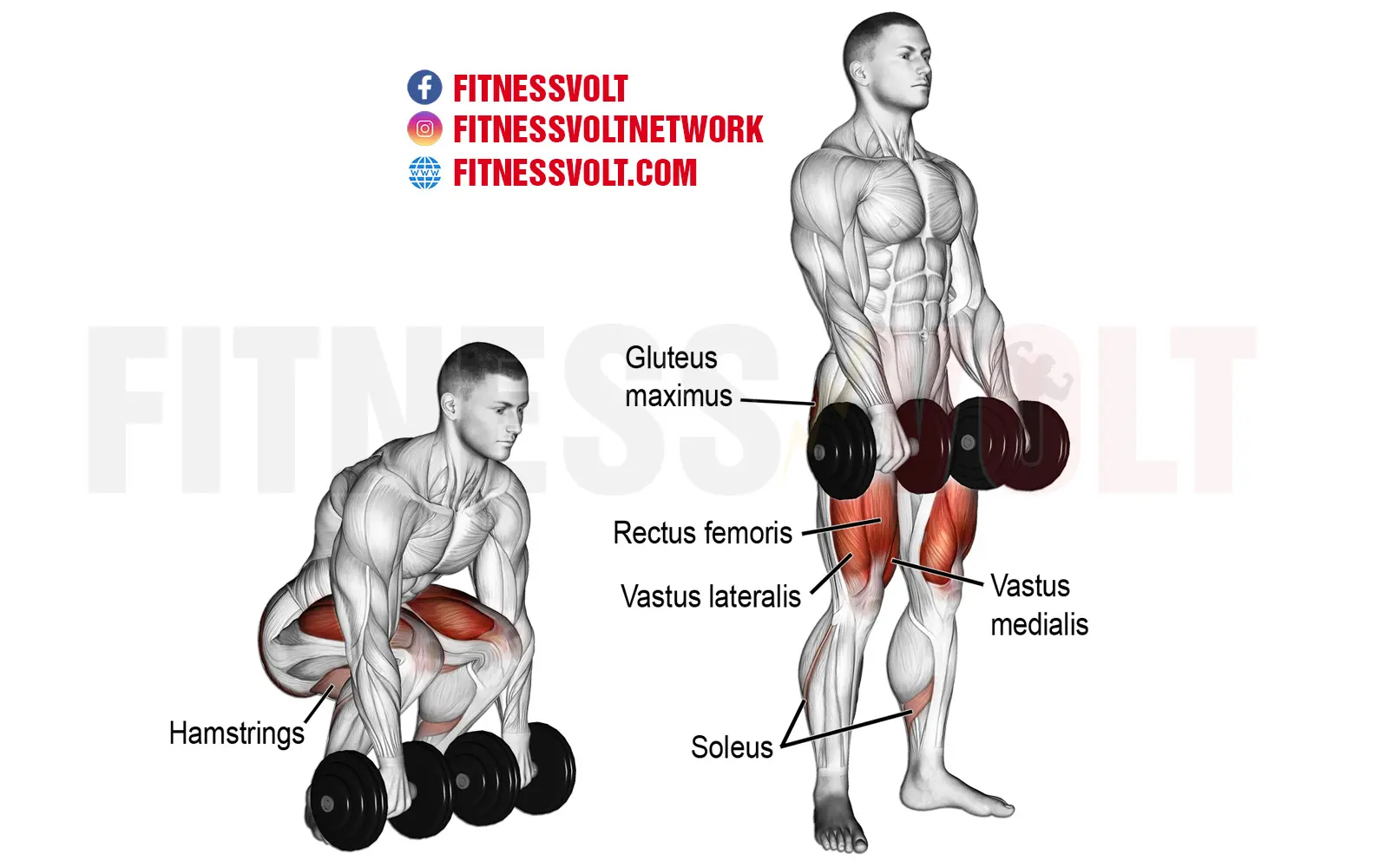
Many dumbbell deadlift instructions turn the exercise into a Romanian deadlift. The standard version starts with the weights on the floor, then uses coordinated hip and knee extension to reach a tall lockout. A dumbbell RDL starts from standing and reverses before the weights reach the floor.
That distinction changes your setup, the amount of knee bend, and how you reset each repetition. Dumbbell size matters too. If the handles sit too low for you to reach without losing your trunk position, raise both weights on stable blocks instead of forcing extra depth.
What Is a Standard Dumbbell Deadlift?
A standard dumbbell deadlift is a bilateral floor-start lift performed with one dumbbell in each hand. The hips and knees flex during the setup, then extend together as you stand. Each repetition returns to a controlled floor contact or dead stop before you brace again.
This guide uses the by-the-sides, or suitcase, setup as the default. It keeps each dumbbell close to your center of mass and gives your knees room to move. CrossFit’s official dumbbell training guide also recognizes outside-the-legs and inside-the-legs deadlift positions, using one or two dumbbells.[1]
Which Muscles Does the Dumbbell Deadlift Work?
The floor-start dumbbell deadlift trains the glutes, quadriceps, hamstrings, spinal erectors, trunk, upper back, and grip. These muscles do different jobs. Your hips and knees move the load, while your trunk and upper back help you hold position as the dumbbells leave the floor.
| Muscle group | Main job during the lift |
|---|---|
| Gluteus maximus | Extends the hips as you stand |
| Quadriceps | Extend the knees from the floor |
| Hamstrings | Assist hip extension and control the lowering phase |
| Spinal erectors and trunk | Resist unwanted torso movement under load |
| Lats and upper back | Help keep the dumbbells close and the shoulders controlled |
| Forearms and hands | Maintain your grip |
A 2018 laboratory study comparing conventional and Romanian barbell deadlifts found greater rectus femoris activity and knee-joint demand in the conventional version.[3] That supports the practical distinction between a floor-start pull with knee extension and an RDL with less knee movement. The study used barbells and 21 men, so it does not prove an exact dumbbell-specific muscle hierarchy.
Where Should You Position the Dumbbells?
Place one dumbbell outside each foot for the standard version. Set the handles close to midfoot, with enough space for your knees to follow your toes. Keep the weights beside your legs during the pull instead of letting them drift forward.
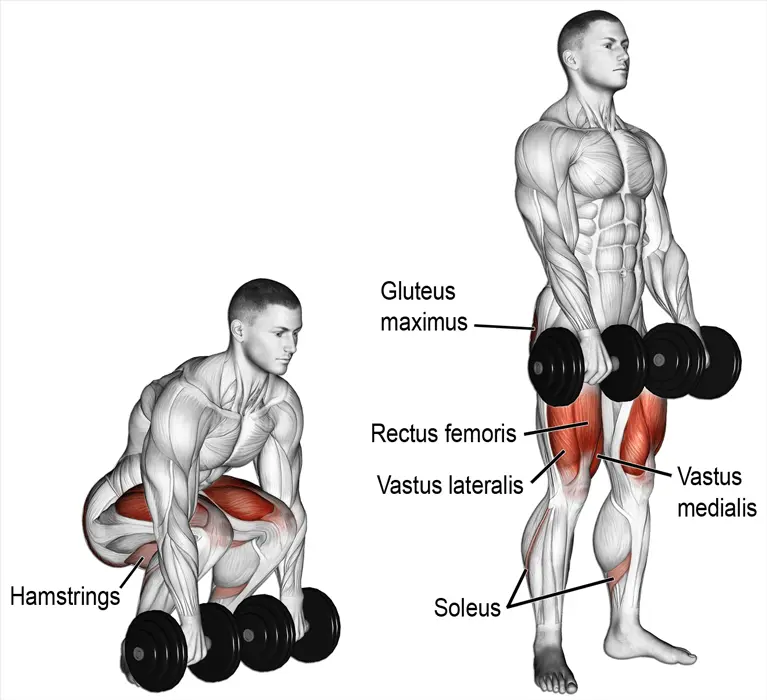
Illustration note: This image shows the between-the-feet, knee-forward option. It uses more knee flexion and a more upright torso than the standard by-the-sides floor-start setup taught in this guide. Treat it as a squat-like dumbbell pickup variation, not the default technique.
A single dumbbell between the feet can work when you want a narrower load and more knee bend. Holding both dumbbells in front of your thighs and starting from standing creates a dumbbell Romanian deadlift in most programs.
How Do You Set Up From the Floor?
Set your feet around hip-width apart, place the dumbbell handles near midfoot, and stand between the weights. Push your hips back, bend your knees, and grip the handles with straight arms. Your hip height will depend on your limb lengths and the dumbbell diameter.
- Place the weights: Set one dumbbell beside each foot with both handles parallel.
- Build your stance: Use a hip-width position that leaves room for your knees and dumbbells.
- Reach the handles: Move your hips back as your knees bend. Keep the load close to midfoot.
- Set your torso: Use a neutral, controlled spinal position and keep your arms long.
- Brace: Create pressure around your trunk before the dumbbells leave the floor.
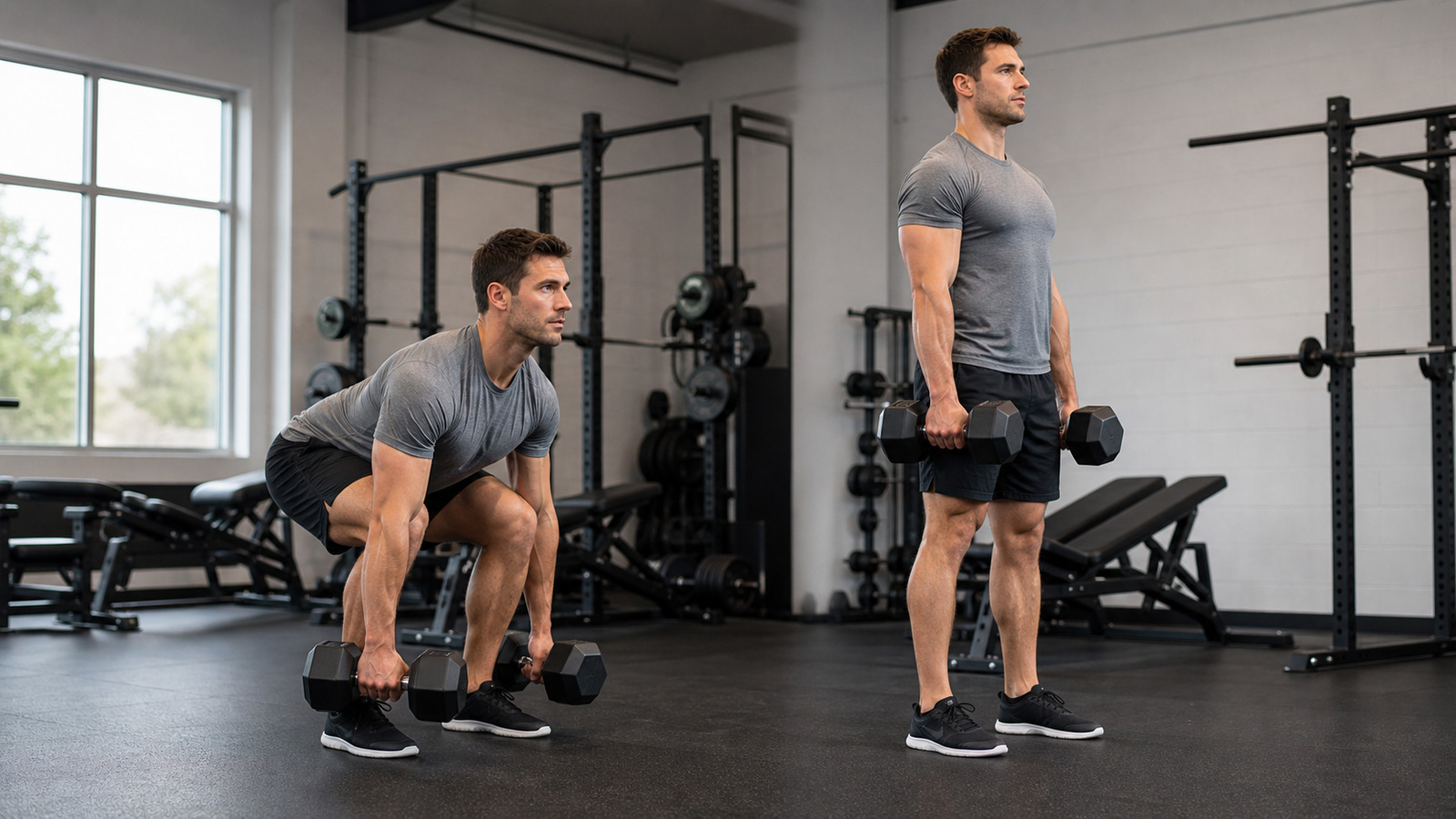
Do not chase a universal hip-height cue. Small dumbbells place the handles lower than full-size barbell plates, and body proportions change the bottom position. If you cannot grip the weights without rounding or collapsing, place both dumbbells on stable, equal-height risers.
How Should You Brace Before the Pull?
Brace before every floor-start repetition. Take a breath, create tension around the front, sides, and back of your trunk, then tighten your upper back enough to control the dumbbells. NSCA guidance describes increased intra-abdominal pressure as one contributor to lumbar stiffness under heavy lifting loads.[6]
Keep your arms straight and remove slack from your body without jerking the weights. Think about holding your torso shape while your legs push the floor away. Reset your breath and brace whenever you feel the dumbbells pulling you out of position.
How Do You Lift From the Floor to Lockout?
Push through your whole foot and extend your hips and knees together. Keep the dumbbells beside your legs as your torso rises. Finish standing tall with your ribs stacked over your pelvis. Do not lean back, shrug, or pull the dumbbells upward with bent elbows.
- Brace and create tension before the weights move.
- Drive the floor away while keeping the dumbbells near midfoot.
- Let your hips and shoulders rise together.
- Continue extending the hips and knees until you stand tall.
- Pause long enough to confirm control without leaning backward.
Watch for hips that shoot upward while the dumbbells remain on the floor. That error removes knee contribution and leaves you finishing the repetition from a weaker, more folded position. Reduce the load or raise the starting height if you cannot keep the lift coordinated.
How Should You Lower and Reset Each Rep?
Start the descent by moving your hips back. Bend your knees as the dumbbells pass them, then place both weights down under control. Keep the handles close to the same midfoot position you used at the start.
A floor touch does not mean a bounce. Let the weights settle, check your balance, rebuild your brace, and begin the next pull. Continuous touch-and-go repetitions can hide a drifting setup when fatigue makes one dumbbell land ahead of the other.
What Is the Difference Between a Dumbbell Deadlift and RDL?
The standard dumbbell deadlift starts on the floor and combines hip and knee extension. The RDL starts from standing, keeps a small amount of knee bend, and lowers only as far as the lifter can maintain the chosen trunk position. NSCA’s RDL guidance places the reversal around the upper shin or the point where neutral spinal position would be lost.[2]
| Feature | Standard dumbbell deadlift | Dumbbell RDL | Squat-like pickup |
|---|---|---|---|
| Start | Floor or stable risers | Standing at lockout | Floor, between the feet in most setups |
| Load position | One dumbbell outside each leg | In front of the thighs | One dumbbell centered between the feet |
| Knee movement | Flexes in setup, then extends during pull | Small bend with little change | Greater knee flexion |
| Hip movement | Hips and knees share the lift | Hip-dominant hinge | More upright hip and knee action |
| Rep boundary | Returns to floor contact and resets | Reverses above the floor | Resets on the floor |
Do not use muscle-activation findings as a shortcut to growth claims. A 2020 systematic review found meaningful variation in deadlift muscle activity across techniques, loads, and study methods.[4] Surface electromyography measures electrical activity during a task. It does not show how much muscle a program will build over time.
For a full barbell setup, use FitnessVolt’s conventional deadlift form guide. Readers who want the joint-angle and force details can also review the site’s deadlift biomechanics analysis.
Which Dumbbell Deadlift Mistakes Should You Fix?
Most dumbbell deadlift errors change the load path or remove the brace before the weights move. Fix the first error you see instead of adding more cues. A clean setup can correct several downstream problems at once.
Letting the dumbbells drift forward
Keep the handles beside the feet and close to midfoot. A forward load increases the distance between the weight and your body, which makes the torso harder to control.
Forcing low dumbbells to the floor
Raise both weights on stable blocks if their handles sit below your controllable range. Loose plates, soft cushions, and uneven furniture do not make suitable risers.
Sitting straight down
The standard lift needs knee flexion, but your hips still move back. If your knees travel far forward and your torso stays almost vertical, you are performing the squat-like pickup shown in the first illustration.
Sending the hips up first
Reduce the load and make your hips and shoulders leave the bottom together. If the hips rise while the dumbbells stay down, you finish from a weak, folded hinge.
Driving through the heels only
Maintain pressure across the whole foot. A heel-only cue can pull your balance backward and make the dumbbells swing away from midfoot.
Leaning back at lockout
Finish tall when the hips and knees reach extension. Extra backward movement does not add to the lockout.
Are Dumbbell Deadlifts Safer Than Barbell Deadlifts?
Dumbbells are not automatically safer than a barbell. Risk depends on the load, starting height, fatigue, control, training history, and the person performing the lift. Dumbbells can make load placement easier to customize, but small handles may also demand more range of motion from the floor.
Choose the implement that lets you maintain a repeatable setup and progress without losing control. Stop the set if pain appears or if one side loses position on repeated attempts. Anyone returning from an injury needs guidance suited to that injury rather than a blanket equipment rule.
How Can You Progress With Light Dumbbells at Home?
Use double progression when your dumbbell selection is limited. Pick a repetition range, add reps until every set reaches the top with stable technique, then increase the load. For example, move from three sets of eight toward three sets of twelve before selecting the next pair.
- Add one repetition per set while the setup and lockout stay consistent.
- Add a fourth set when the available weight cannot increase.
- Pause for one second just after the dumbbells leave the floor.
- Use a two-to-three-second lowering phase to make each repetition harder to control.
- Move to adjustable dumbbells when fixed pairs stop providing enough resistance.
Tempo and pauses make a fixed load more demanding, but they are not special growth methods. The 2026 ACSM position stand found no consistent outcome differences from time under tension or equipment type across the evidence it reviewed.[5] Progressive resistance, useful range of motion, effort, and enough weekly work remain the priorities.
Use FitnessVolt’s dumbbell leg exercises and workouts when you need to place this lift inside a full lower-body session.
How Should You Program Dumbbell Deadlifts?
Program dumbbell deadlifts near the start of a lower-body workout when strength or technique is the priority. Use moderate-to-high repetitions when your home dumbbells are light. These ranges are practical starting points, not dumbbell-deadlift prescriptions tested head-to-head in a clinical trial.
| Goal | Sets and reps | Rest | Execution target |
|---|---|---|---|
| Technique | 2 to 3 sets of 5 to 8 | 90 to 150 seconds | Leave 2 to 3 controlled reps in reserve |
| General strength | 2 to 4 sets of 4 to 8 | 2 to 3 minutes | Use the heaviest load that preserves the floor setup |
| Muscle growth | 3 to 4 sets of 6 to 15 | 90 to 180 seconds | Finish with about 1 to 3 reps in reserve |
| Limited home load | 3 to 5 sets of 10 to 20 | 60 to 120 seconds | Stop when the brace or load path changes |
Train the movement once or twice per week to start, then judge recovery across your entire lower-body program. Count challenging deadlift sets alongside your other glute, hamstring, and quadriceps work. Do not add sets just because the dumbbells feel lighter than a barbell.
Who Should Modify or Replace the Exercise?
Raise the starting height if you cannot reach the handles with a controlled torso. Use an RDL if your goal is a standing-start hinge, or choose another exercise if grip prevents your legs and hips from receiving enough work.
If the floor-start pattern does not suit your equipment or current ability, review these dumbbell deadlift alternatives. A substitution should match the job you need, such as hip extension, knee extension, grip work, or a lower starting-height demand.
Common Questions About Dumbbell Deadlifts
Should the dumbbells touch the floor on every rep?
The standard version returns to the floor or equal-height risers on every repetition. Use a controlled touch or dead stop, then rebuild your brace. If you reverse above the floor with little knee movement, you are performing an RDL.
Should the dumbbells go beside or between your feet?
Place one dumbbell beside each foot for the standard setup taught here. A dumbbell between the feet encourages more knee flexion and a more upright torso, creating the squat-like option shown in the retained illustration.
How heavy should a dumbbell deadlift be?
Use a load that lets every repetition begin from the same position and finish without leaning back. Start with 2 to 3 reps in reserve. Increase weight only after both dumbbells follow a stable path from floor to lockout.
Why does my dumbbell deadlift feel like a squat?
Small dumbbells, a narrow between-the-feet load, or excessive knee travel can produce a deeper, more upright setup. Move the weights beside your legs, send your hips back, and raise low handles if needed.
Can dumbbell deadlifts replace barbell deadlifts?
They can fill the main hip-and-knee extension slot in a general strength or muscle-building program. They do not replace specific barbell practice for someone who wants to improve a barbell deadlift, and available dumbbell load may become the limiting factor.
Do dumbbells make deadlifts safer?
No equipment makes the exercise automatically safer. Pick the version that fits your available load, controllable range, injury history, and current skill. Technique and fatigue still matter with two dumbbells.
What Should You Check Before Your Next Set?
Check four positions before you pull: handles close to midfoot, hips and knees both bent, trunk braced, and arms straight. Push through the whole foot, let the hips and shoulders rise together, then finish tall without leaning backward.
If the dumbbells sit too low, raise them. If the weights start from standing, call the movement an RDL. Clear exercise identity makes your technique easier to assess and your training log more useful.
Sources
- CrossFit, LLC. (2020). Dumbbells Training Guide. Accessed July 12, 2026.
- National Strength and Conditioning Association. (2019). Romanian Deadlift (RDL). Accessed July 12, 2026.
- Lee, S., Schultz, J., Timgren, J., Staelgraeve, K., Miller, M., and Liu, Y. (2018). An electromyographic and kinetic comparison of conventional and Romanian deadlifts. Journal of Exercise Science & Fitness, 16(3), 87-93. DOI: 10.1016/j.jesf.2018.08.001. PMID: 30662500.
- Martín-Fuentes, I., Oliva-Lozano, J. M., and Muyor, J. M. (2020). Electromyographic activity in deadlift exercise and its variants: A systematic review. PLoS ONE, 15(2), e0229507. DOI: 10.1371/journal.pone.0229507. PMID: 32107499.
- Currier, B. S., D’Souza, A. C., Fiatarone Singh, M. A., et al. (2026). American College of Sports Medicine Position Stand: Resistance Training Prescription for Muscle Function, Hypertrophy, and Physical Performance in Healthy Adults. Medicine & Science in Sports & Exercise, 58(4), 851-872. DOI: 10.1249/MSS.0000000000003897. PMID: 41843416.
- Ulm, R. (2017). Stability and Weightlifting: Mechanics of Stabilization, Part 1. NSCA Coach, 4.1. Accessed July 12, 2026.
Interested in measuring your progress? Check out our strength standards for Dumbbell Deadlift, Pistol Squat, Deadlift, and more exercises.