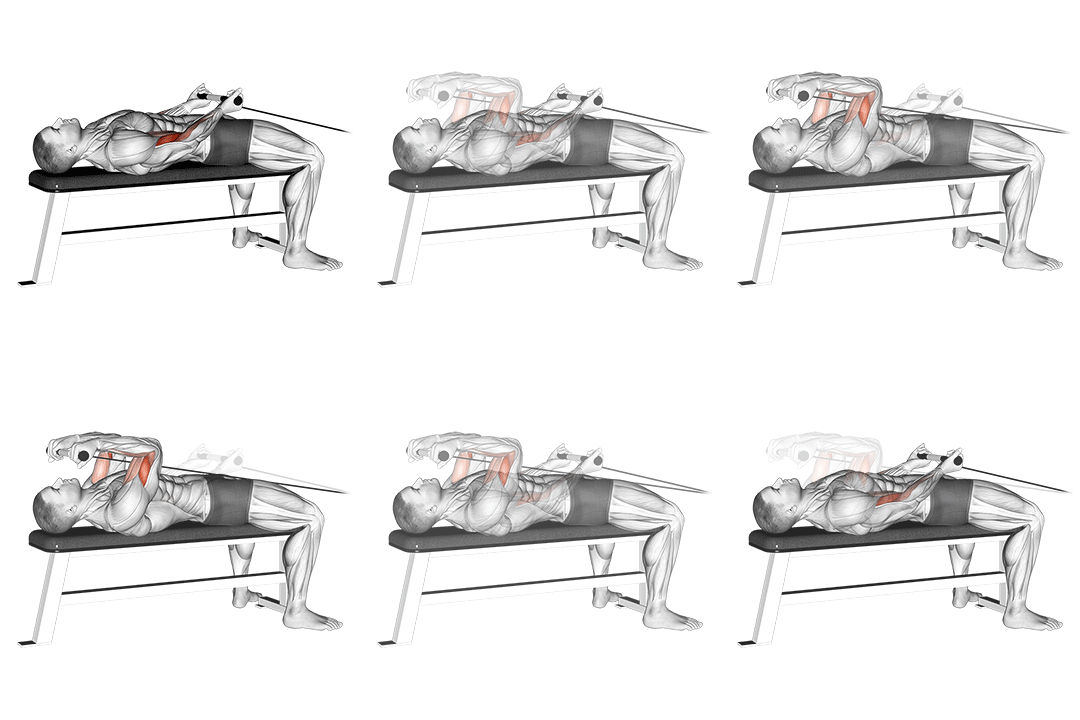
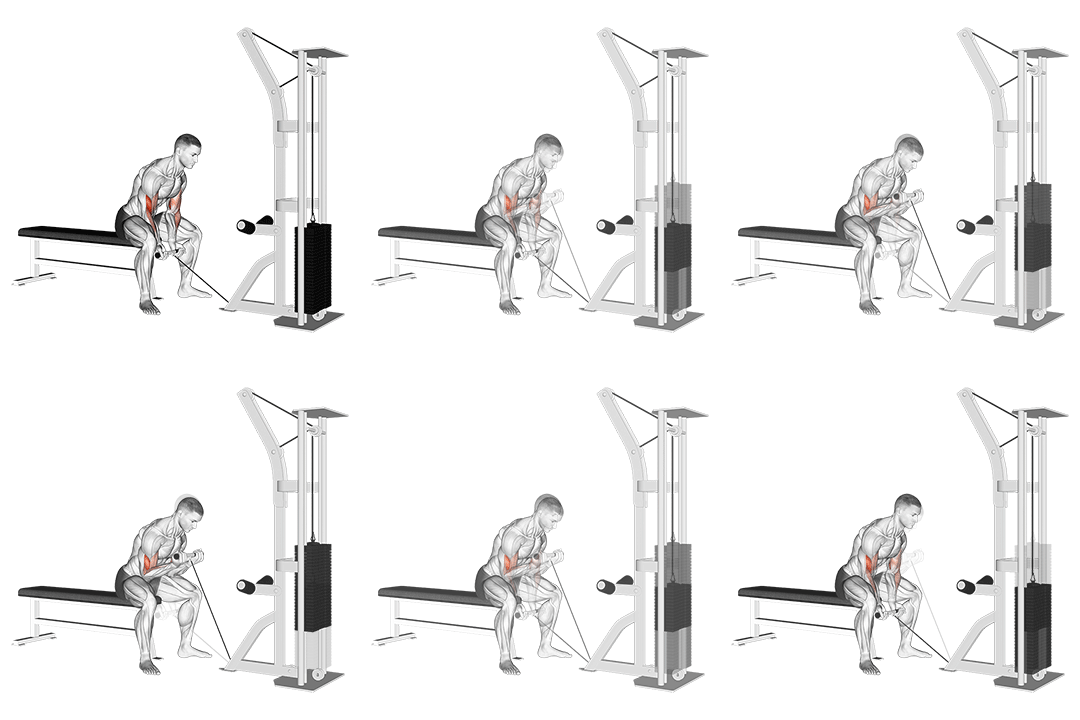
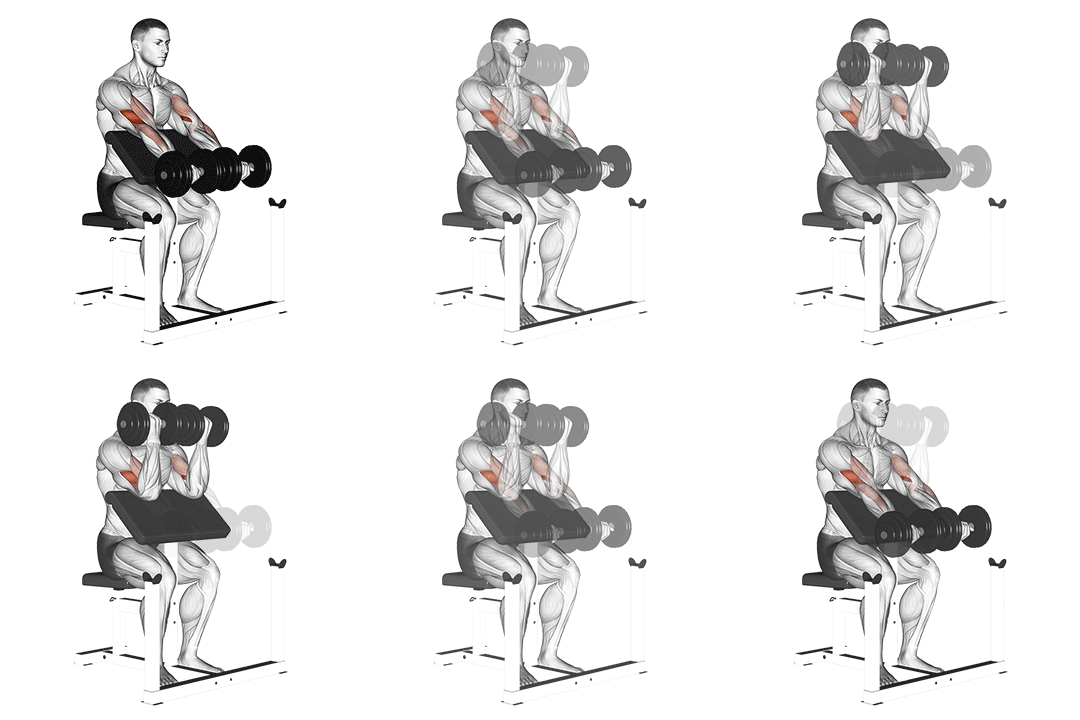
Cable Hammer Curl (With Rope) vs Cable Rope Hammer Preacher Curl

Compare target muscles, equipment, difficulty, movement type, and secondary muscles for Cable Hammer Curl (With Rope) and Cable Rope Hammer Preacher Curl.

Change comparison Share

Get comparison link

Select the link and use your device's Copy command.

Comparison overview

AI-generated
Cable Hammer Curl (with Rope) vs Cable Rope Hammer Preacher Curl — you’re comparing two cable-based, neutral-grip biceps isolation moves that both emphasize the brachialis and forearms. I’ll walk you through how each exercise loads the biceps across the range of motion, what equipment and setup they require, and which one suits specific goals like muscle growth, strength, or beginner-friendly training. Expect clear technique cues (elbow position, wrist neutrality, tempo), rep ranges, and biomechanical context so you can pick the better option for your program and apply it in your next workout.

Exercise Comparison

Exercise A
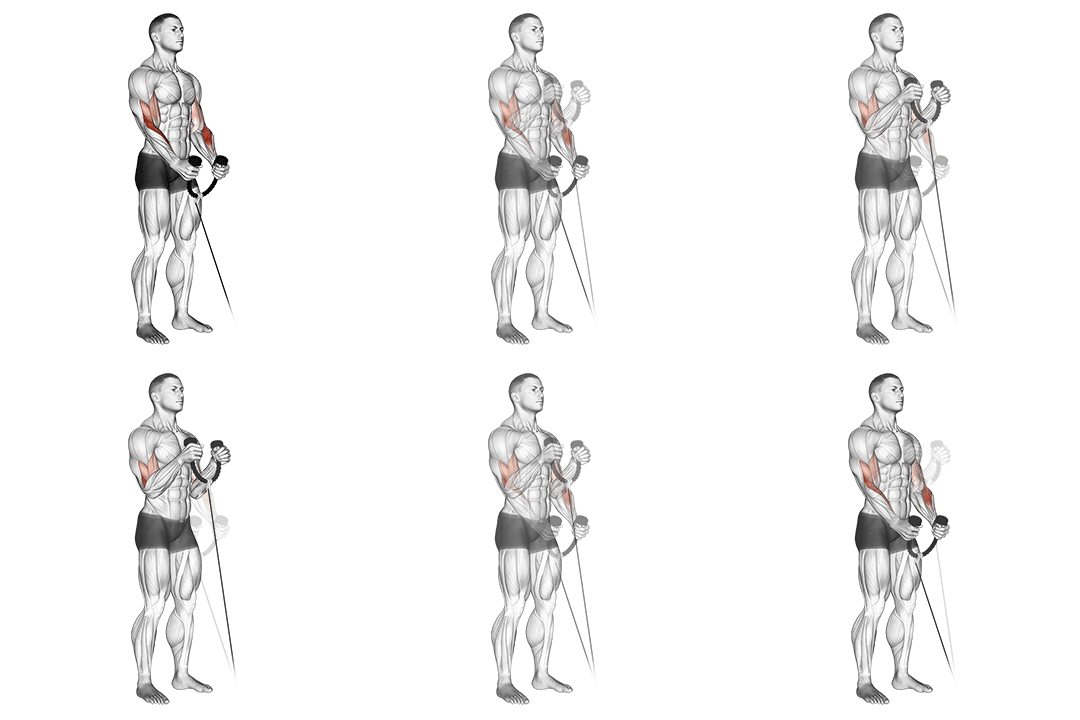
Cable Hammer Curl (With Rope) demonstration

Cable Hammer Curl (With Rope)

Target Biceps
Equipment Cable
Body Part Upper-arms
Difficulty Beginner
Movement Isolation
Secondary Muscles
Forearms
VS
Exercise B
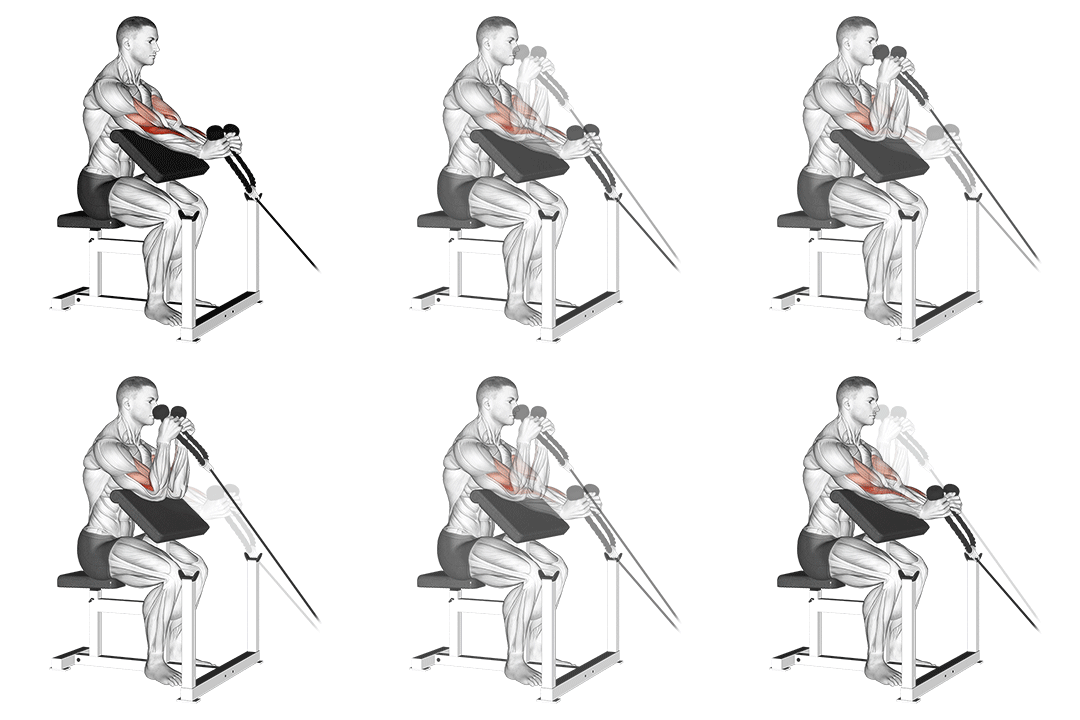
Cable Rope Hammer Preacher Curl demonstration

Cable Rope Hammer Preacher Curl

Target Biceps
Equipment Cable
Body Part Upper-arms
Difficulty Beginner
Movement Isolation
Secondary Muscles
Forearms

Head-to-Head Comparison

Different values are marked. These are catalogue attributes, not performance scores.

Muscles used

Listed target and secondary muscles, shown on the body. Locations, not activation or strength scores.

  • Target
  • Secondary
  • Not highlighted

Cable Hammer Curl (With Rope)

Front
Cable Hammer Curl (With Rope): front muscle locationsSolid: listed target. Striped: listed secondary. Grey: not highlighted. Locations, not activation or strength scores. See the muscle names below.
Back
Cable Hammer Curl (With Rope): back muscle locationsSolid: listed target. Striped: listed secondary. Grey: not highlighted. Locations, not activation or strength scores. See the muscle names below.
Target
Biceps
Secondary
Forearms

Cable Rope Hammer Preacher Curl

Front
Cable Rope Hammer Preacher Curl: front muscle locationsSolid: listed target. Striped: listed secondary. Grey: not highlighted. Locations, not activation or strength scores. See the muscle names below.
Back
Cable Rope Hammer Preacher Curl: back muscle locationsSolid: listed target. Striped: listed secondary. Grey: not highlighted. Locations, not activation or strength scores. See the muscle names below.
Target
Biceps
Secondary
Forearms

Grey does not mean a muscle is unused. The diagrams show only the mapped catalogue labels.

Attribute Cable Hammer Curl (With Rope) Cable Rope Hammer Preacher Curl
Target Muscle
Biceps
Biceps
Body Part
Upper-arms
Upper-arms
Equipment
Cable
Cable
Difficulty
Beginner
Beginner
Movement Type
Isolation
Isolation
Secondary Muscles
Forearms
Forearms

Visual Comparison

An illustrative 1–10 profile derived from catalog difficulty, equipment, and listed-muscle fields—not measured performance or muscle activation.

Key Differences

  • Both exercises target the Biceps using Cable. The catalogue does not establish which exercise is better for an individual goal.

Muscle comparison

Shared target muscles

Both exercises target the biceps complex with a strong emphasis on the brachialis and the brachioradialis because of the neutral (hammer) grip. They produce similar peak activation of elbow flexors in the mid-range, but neither places as much emphasis on the supinated long head of the biceps brachii as a supinated curl would. Both use a horizontal force vector from the low pulley that places fairly constant tension on the elbow flexors throughout the ROM.

Secondary muscle differences

Cable Hammer Curl (standing) recruits more core and scapular stabilizers because you must brace your torso and resist forward pull—this increases total-body stability demand. The Preacher variation reduces shoulder and torso involvement, shifting more load into the distal biceps and forearm extensors (brachioradialis) and minimizing momentum. Thus, the preacher tends to isolate the elbow flexors and forearms more strictly, while standing cable hammer curls involve additional stabilizer activation.

Muscle involvement analysis

Because both use a low pulley, tension is relatively constant, but pad geometry changes moment arms. Standing cable hammer curls keep more tension at end-range (elbow flexion ~30–40°), while preacher curls move peak tension toward the mid-range (elbow ~60–90°) due to a shorter moment arm at extremes. Preacher setup fixes shoulder angle and alters length-tension: the long head may be slightly shortened at the start, increasing mid-range force production but reducing peak long-head contribution at full flexion.

Equipment and setup

Cable Hammer Curl (With Rope): setup

Cable Hammer Curl (with Rope) requires a low-pulley cable station and a rope attachment. You can perform it standing or slightly leaning back; no bench is required. Alternatives: resistance bands anchored low with a rope or neutral-handle mimic.

Cable Rope Hammer Preacher Curl: setup

Cable Rope Hammer Preacher Curl requires a low-pulley cable, rope attachment, and a preacher bench or preacher pad attachment. Pad height must be adjusted so the armpit sits on the pad and the elbow tracks over the pad's midline.

Access and practicality

Cable Hammer Curl (with Rope) — more accessible because it only needs a cable and rope and can be done standing or with a makeshift pad. Preacher requires an extra bench or attachment, which limits availability in smaller gyms or home setups.

Learning and progression

Learning the movements

Cable Rope Hammer Preacher Curl is marginally easier for beginners because the pad enforces elbow position and reduces cheating; that makes learning strict elbow flexion easier. Standing Cable Hammer Curl requires more bracing and coordination, so it demands slightly more motor control.

Progression considerations

Cable Hammer Curl (with Rope) offers broader progression options: single-arm variations, tempo changes, partials, and unilateral overloads. The preacher allows heavy, strict loading and is excellent for progressive overload in a controlled ROM, but it’s less versatile for unilateral corrections.

Limitations and precautions

Both are low-risk when performed with controlled loads. Standing cable curls carry a slightly higher risk of using momentum and stressing the lumbar spine if you overcompensate, while preacher curls can stress the anterior shoulder or elbow if pad height is wrong or you hyperextend at the bottom.

Pros & Cons

Cable Hammer Curl (With Rope)

+ Pros

  • Constant tension through the range via a low-pulley cable
  • Easily varied (single-arm, tempo, partials) for progressive overload
  • Requires minimal additional equipment—no bench needed
  • Develops stabilizers and core bracing along with elbow flexors

− Cons

  • Easier to cheat with torso swing if you use too much load
  • Slightly less isolation of the elbow flexors compared to preacher setup
  • Standing posture can stress lower back if form breaks down

Cable Rope Hammer Preacher Curl

+ Pros

  • Strong isolation of elbow flexors and forearms due to stable pad support
  • Reduces momentum, promoting strict eccentric and concentric control
  • Targets mid-range tension effectively, useful for mechanical overload
  • Easier for beginners to keep elbows fixed and learn movement pattern

− Cons

  • Requires a preacher bench or pad attachment, limiting accessibility
  • Can artificially shorten the long head at start position, reducing full-head stimulation
  • Fixed position limits training of stabilizers and functional carryover

When Each Exercise Wins

1
For muscle hypertrophy: Cable Rope Hammer Preacher Curl

Preacher curls enforce strict form and concentrate mid-range mechanical tension—prime drivers for hypertrophy. Use 8–12 reps, 60–90 second rests, and a 2-1-3 tempo to maximize time under tension and progressive overload.

2
For strength gains: Cable Hammer Curl (with Rope)

Standing hammer curls recruit stabilizers and allow heavier or more functional loading patterns and unilateral progressions—helpful for transferring strength to other lifts. Use lower reps (4–6) with controlled tempo and heavier resistance.

3
For beginners: Cable Rope Hammer Preacher Curl

The preacher pad locks elbow position and removes torso compensation, making technique easier to learn and reducing reliance on momentum. Start with 10–15 reps and focus on full eccentric control.

4
For home workouts: Cable Hammer Curl (with Rope)

Standing cable hammer curls can be replicated with resistance bands or a single low-pulley cable and a rope/neutral handle. The preacher requires specific bench hardware that most home setups lack.

Frequently Asked Questions

Can I do both Cable Hammer Curl (with Rope) and Cable Rope Hammer Preacher Curl in the same workout?

Yes — pairing them works well: use the preacher curl for strict primary sets (8–12 reps) and finish with standing hammer curls as a burnout or unilateral accessory (12–15 reps). That sequencing exploits isolation first, then trains stabilizers and fatigue-resistant fibers.

Which exercise is better for beginners?

Cable Rope Hammer Preacher Curl is generally better for beginners because the pad enforces elbow position and removes torso compensation, making it easier to learn pure elbow flexion. Start light and focus on controlled eccentrics to build motor patterning.

How do the muscle activation patterns differ?

Both emphasize brachialis and brachioradialis due to the neutral grip and cable line of pull. The preacher shifts peak tension toward the mid-range and limits shoulder involvement, while the standing cable hammer curl keeps more tension at end-range and recruits stabilizers and core for bracing.

Can Cable Rope Hammer Preacher Curl replace Cable Hammer Curl (with Rope)?

It can replace it if your priority is strict isolation and mid-range overload, but you’ll lose stabilizer recruitment and unilateral options. For balanced development include both across training cycles or substitute preacher work when you need to correct form or emphasize mid-range tension.

Comparison Summary

Both exercises are valuable tools. Choose the Cable Rope Hammer Preacher Curl when your goal is strict isolation and mid-range overload for muscle growth—its fixed pad reduces cheating and lets you target the elbow flexors for 8–12 reps with strict tempo. Choose the Cable Hammer Curl (with Rope) when you want versatility, unilateral work, and strength transfer; standing curls keep constant tension while engaging stabilizers and core, and lend themselves to varied progressions (4–6 heavy reps for strength, 8–15 for size). Use preacher curls to polish weakness and technique; use standing cable hammers for functional strength and variety.

Exercise instructions

Steps from the exercise catalogue. Read the full sequence before starting.

Cable Hammer Curl (With Rope)

  1. Stand upright with your feet shoulder-width apart and a slight bend in your knees.
  2. Hold the cable rope attachment with an underhand grip, palms facing each other, and your arms fully extended.
  3. Keeping your upper arms stationary, exhale and curl the weights while contracting your biceps.
Read remaining steps for Cable Hammer Curl (With Rope)
  1. Continue to raise the cable rope attachment until your biceps are fully contracted and the rope is at shoulder level.
  2. Hold the contracted position for a brief pause as you squeeze your biceps.
  3. Inhale and slowly begin to lower the cable rope attachment back to the starting position.
  4. Repeat for the desired number of repetitions.

Cable Rope Hammer Preacher Curl

  1. Attach a rope attachment to a low pulley cable machine.
  2. Stand facing the machine with your feet shoulder-width apart.
  3. Grasp the rope with a neutral grip (palms facing each other).
Read remaining steps for Cable Rope Hammer Preacher Curl
  1. Position your upper arms against the preacher bench pad, keeping your elbows slightly bent.
  2. Keeping your upper arms stationary, exhale and curl the rope towards your shoulders by contracting your biceps.
  3. Hold the contracted position for a brief pause as you squeeze your biceps.
  4. Inhale and slowly lower the rope back to the starting position.
  5. Repeat for the desired number of repetitions.

Also Compare

Compare another pair

Choose two exercises to see their differences side by side.

Compare Exercises