


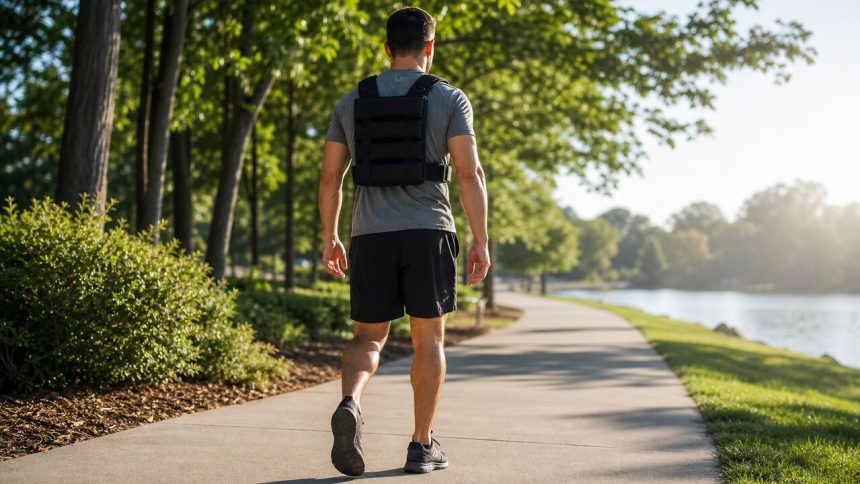
Ten thousand steps is a useful nudge, but it is not magic. It can get people moving, and that matters. The problem starts when the number becomes the whole plan, especially for busy readers who can walk for health but still want a short, challenging session that feels more like training.
The upgrade is not to quit walking. It is to keep normal walking in your life and add one focused tool: a 20-minute loaded walk. Put on a light weighted vest or backpack, walk tall, keep the pace brisk, and make the session hard enough to feel purposeful without turning it into a military ruck.
This works because load changes the demand. Your legs, trunk, feet, breathing, and posture all have to contribute. Done conservatively, it becomes a simple conditioning session that fits into a lunch break, commute block, or weekend walk.
Quick Answer: What Is the 20-Minute Loaded Walk?
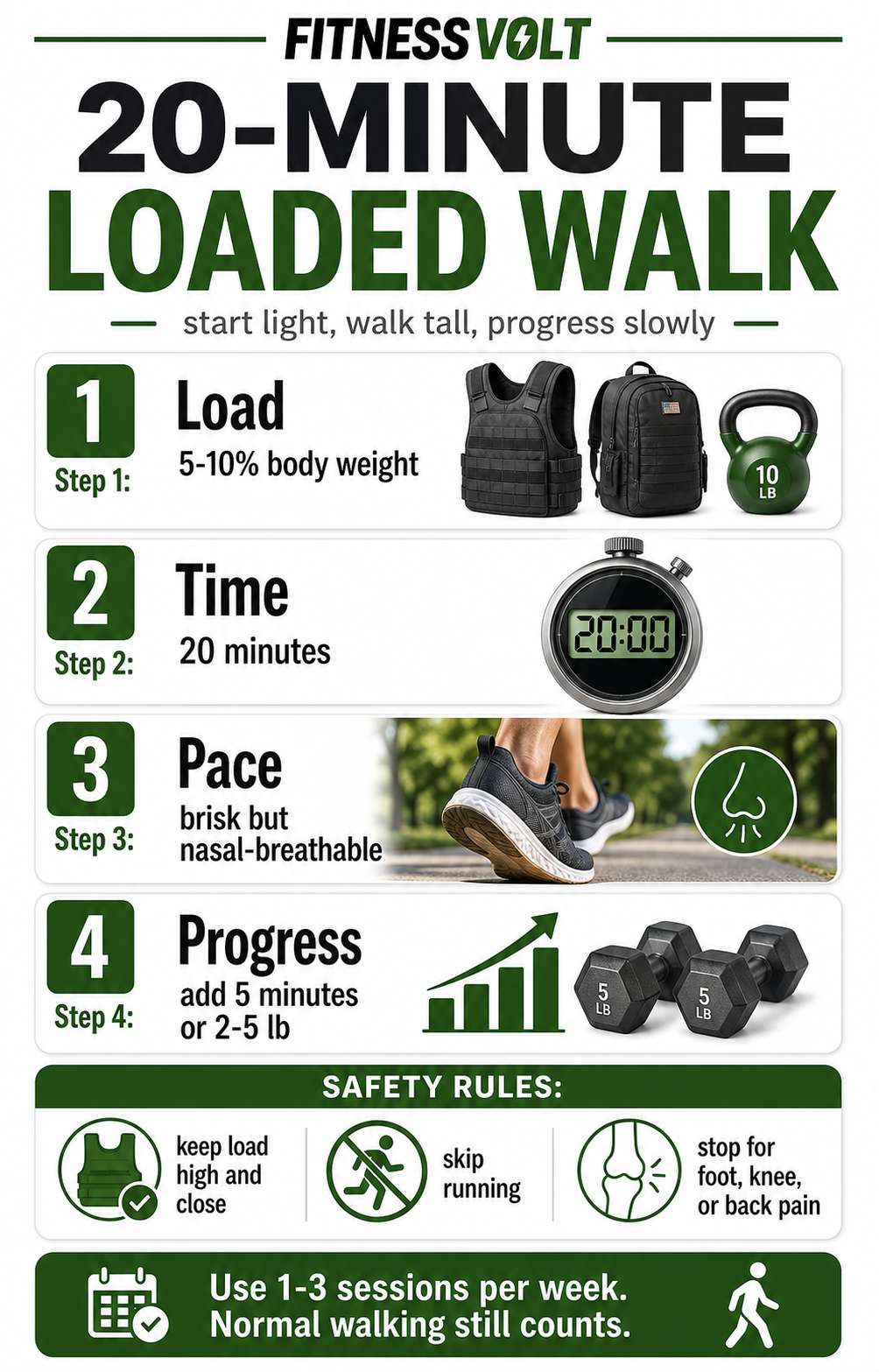
The 20-minute loaded walk is a short rucking-style workout for everyday exercisers. Start with 5 to 10 percent of your body weight in a vest or backpack, walk briskly for 20 minutes, keep the load high and close to your body, and progress slowly. Use it one to three times per week while keeping normal walking in your routine.

Why Forget 10,000 Steps as Your Only Goal?
Step goals are helpful, but they are blunt. Two people can both hit 10,000 steps while doing very different work: one strolls slowly across the day, the other climbs hills, carries groceries, and walks with purpose. The step count captures movement volume, not intensity, terrain, load, or posture.
That does not make steps useless. A large meta-analysis in The Lancet Public Health found that more daily steps were associated with lower mortality risk, with benefits varying by age and not requiring exactly 10,000 steps. The practical takeaway is clear: walking counts. But once you already walk regularly, adding a short loaded session gives you a new training lever.
Ten thousand steps is a useful movement target, but it is not a magic threshold. Research links higher daily step counts with lower mortality risk, yet the exact best number varies by age and context. A 20-minute loaded walk adds intensity and trunk demand while normal walking still supports daily activity.
How Heavy Should Your First Loaded Walk Be?
Start lighter than your ego wants. For most readers, 5 to 10 percent of body weight is enough for the first two to four weeks. That means about 8 to 18 pounds for many adults. If you are new to training, have foot pain, knee pain, back sensitivity, or a long layoff, begin with less.
| Body weight | First load | First duration | Progression |
|---|---|---|---|
| 120-150 lb | 6-12 lb | 15-20 min | Add 5 min before adding load |
| 151-180 lb | 8-15 lb | 20 min | Add 2-5 lb after two easy sessions |
| 181-220 lb | 10-20 lb | 20 min | Add hills only after load feels normal |
| 220+ lb | 10-22 lb | 15-20 min | Progress by time, not speed |
The load should feel obvious but not punishing. If your shoulders ache, your stride changes, your feet get hot spots, or you finish with back tightness, the load was probably too much or poorly placed.
How Do You Set Up the Load?
The best load is stable, high, and close to your body. A weighted vest is easiest because it distributes weight evenly. A backpack works if you pad it so the weight does not swing or sit low on your lumbar spine. Put dense items near the upper back, cinch the straps, and avoid a loose pack bouncing behind you.
Do not run with the load. Do not turn the first session into hill repeats. Do not copy military ruck standards unless you are preparing for that specific job. Load carriage research is full of military and occupational contexts, but everyday readers need a joint-friendly conditioning tool, not a selection test.
For a normal loaded walk, keep the weight high and close to the torso. A vest is simplest; a backpack should be tight enough that it does not bounce. Beginners should walk, not run, and should avoid heavy loads, long distances, and steep hills until feet, knees, hips, and back tolerate the work.
Loaded Walk vs. Normal Walk vs. Incline Walk
Each walking style has a place. The right choice depends on your joints, equipment, schedule, and goal.
| Option | Best use | Main benefit | Main caution |
|---|---|---|---|
| Normal walk | Daily activity and recovery | Low stress, easy to repeat | May be too easy for conditioning |
| Incline walk | Treadmill cardio | Higher heart-rate demand without impact | Calves and Achilles can get cranky |
| Loaded walk | Short outdoor conditioning | More trunk, posture, and leg demand | Feet, knees, hips, and back need slow progression |
If you are already using walking for fat loss, loaded walking can be one of several tools. FitnessVolt’s 10% body fat walking plan is the broader base; the loaded walk is the higher-effort add-on.
What Should the Workout Feel Like?
A good loaded walk feels like a brisk walk with extra posture demand. You should be able to breathe through your nose for most of the session or speak in short sentences. Your stride should look normal. Your shoulders should not creep toward your ears. Your lower back should not feel like it is doing all the work.
Use this simple rating:
- Too easy: you forget you are carrying load after five minutes.
- Just right: you feel the load, breathe harder, and finish with clean posture.
- Too hard: your feet, knees, hips, back, or shoulders complain during the walk.
For cardio variety, you can rotate this with FitnessVolt’s incline walking vs. running guide or use it on days when running would beat up your legs.
How Often Should You Do Loaded Walks?
Start with one session per week. If your feet, knees, hips, and back feel fine the next day, move to two sessions. Three sessions per week is plenty for most recreational lifters unless loaded walking is a primary goal.
A practical week looks like this:
- Monday: strength training
- Tuesday: normal walk or easy cardio
- Wednesday: 20-minute loaded walk
- Thursday: strength training
- Friday: normal walk
- Saturday: optional second loaded walk
- Sunday: recovery walk or rest
If fat loss is the goal, keep the loaded walk as a training tool and manage nutrition separately. Pair it with a realistic walking base, such as FitnessVolt’s walking workout guide, instead of expecting a backpack to override overeating.
Who Should Skip or Modify Loaded Walking?
Loaded walking is not for everyone. Modify or avoid it if you have current foot pain, plantar fascia symptoms, knee flare-ups, hip pain, back pain, balance issues, or a clinician who has told you to limit load-bearing exercise. Start with unloaded walking, cycling, incline walking, or other low-impact cardio first.
The most common mistake is adding weight, speed, hills, and duration at the same time. Pick one progression variable. Add five minutes, or add two to five pounds, or add a gentle hill. Do not add all three in the same week.
Beginners should progress loaded walking one variable at a time. Add time, load, speed, or hills separately. Stop or scale down if foot, knee, hip, or back pain appears. A 20-minute loaded walk should feel like controlled conditioning, not a punishment workout.
FAQ
Is loaded walking better than 10,000 steps?
It is different, not automatically better. Daily steps improve total movement volume. Loaded walking adds intensity and strength-endurance demand. The best plan uses normal walking for daily activity and loaded walking as a short workout.
Can I do loaded walks every day?
Most beginners should not. Start with one to two sessions per week. Daily loaded walking can irritate feet, knees, hips, or back if load and distance rise too quickly.
Should I use a backpack or weighted vest?
A weighted vest is easier to balance. A backpack is fine if the weight sits high, close, and stable. Avoid loose backpacks that swing or pull your posture backward.
How fast should I walk?
Use a brisk pace that lets you speak in short sentences. If speed breaks your stride or makes the load bounce, slow down before you add more weight.
Does loaded walking build muscle?
It can build strength-endurance in the legs, trunk, and postural muscles, but it is not a replacement for progressive strength training. Keep lifting if muscle gain is the main goal.
Sources
- U.S. Department of Health and Human Services. (2018). Physical Activity Guidelines for Americans, 2nd edition. Accessed May 11, 2026.
- Paluch, A. E., Bajpai, S., Bassett, D. R., et al. (2022). Daily steps and all-cause mortality: a meta-analysis of 15 international cohorts. The Lancet Public Health, 7(3), e219-e228.
- Knapik, J. J., Reynolds, K. L., & Harman, E. (2004). Soldier load carriage: historical, physiological, biomechanical, and medical aspects. Military Medicine, 169(1), 45-56.
- Looney, D. P., Santee, W. R., Hansen, E. O., et al. (2019). Estimating energy expenditure during level, uphill, and downhill walking. Medicine & Science in Sports & Exercise, 51(9), 1954-1960.






I love walking with weights; I prefer to control the pace and intensity, and I never count my steps.