
The hang clean gets confusing before the bar ever leaves your hands. Some coaches use the name for a full-squat clean from the hang. Many gyms use it for the hang power clean, where you receive the bar above parallel. That one missing word changes the catch.
This guide teaches the full hang clean: deadlift the bar to standing, lower it to a controlled hang, extend hard, pull under, and receive it in a front squat. If your program asks for a hang power clean, the pull stays similar but you catch the bar higher. We checked the pulling sequence against NSCA hang-power-clean guidance. The NSCA terminology framework separately distinguishes the starting position from the receiving depth. You will also get a simple way to diagnose a looping bar, slow elbows, and unstable catches.
Last evaluated: August 2026. Evaluation basis: NSCA technique guidance, the NSCA position statement on weightlifting for sport, and two primary biomechanics studies.
What Is a Hang Clean?
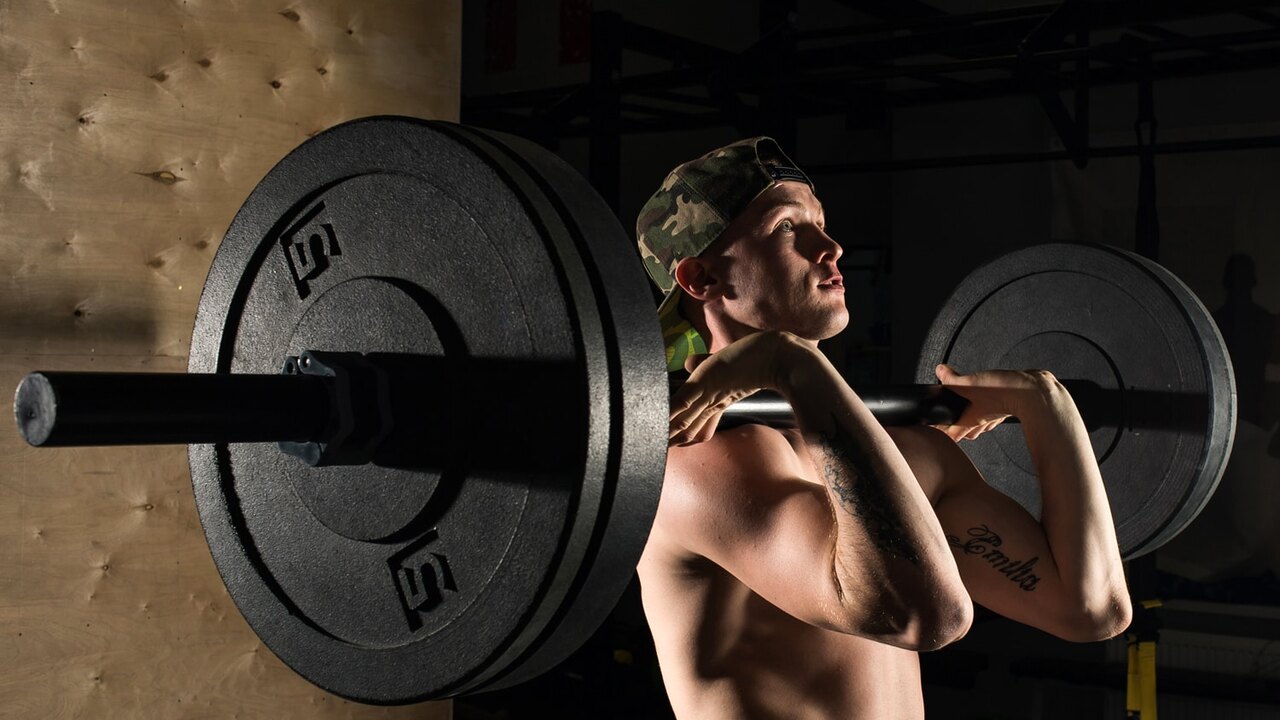
A common hang clean starts with the bar just above the knees and ends with the bar on the shoulders in a full squat. Starting from the hang removes the first pull from the floor. That lets you practice the explosive finish and the move under the bar without managing the entire lift at once.
The name tells you two different things. Hang identifies the starting position. Power identifies the receiving depth. Coaches and lifters often blur those labels, so use this table before you compare loads or technique.
| Lift | Where the bar starts | Where you receive it | Best use |
|---|---|---|---|
| Hang clean | Off the floor, often above the knee | Full squat | Turnover, pulling under, and clean technique |
| Hang power clean | Off the floor, often above the knee | Thighs stay above parallel | Power practice with a shorter catch |
| Clean | Floor | Full squat | Competition-style clean practice |
| Power clean | Floor | Thighs stay above parallel | Floor-start power and athletic training |
The NSCA uses the same naming logic: clean variations may start from the floor, knee, hang, or mid-thigh, then use either a full or partial-squat catch.2 If your program says only “hang clean,” ask the coach which receiving depth they expect.
Muscles Worked
The hang clean uses most of the body, but the muscles do different jobs. The legs and hips accelerate the bar. The upper back keeps it close. The trunk holds your position while force moves from the floor into the bar. Your arms guide the turnover after the lower body has finished driving.
| Area | Main job in the lift |
|---|---|
| Glutes and hamstrings | Load the hip hinge and help extend the hips during the pull |
| Quadriceps | Push against the floor, extend the knees, absorb the catch, and stand from the squat |
| Calves | Finish ankle extension as the body reaches full extension |
| Traps and upper back | Hold the bar close and support the fast change of direction under it |
| Spinal erectors and abdominals | Brace the torso during the hang, pull, and front-rack catch |
| Forearms and hands | Secure the grip and let the bar rotate into the rack |
| Front delts | Support the bar in the front rack |
Your biceps do not need to curl the bar. Early arm bending usually steals power from the legs and makes the turnover harder.
Three Checks Before Your First Rep
1. Own a comfortable front rack
Rest an empty bar across the front delts with your elbows forward. Your hands keep contact, but the shoulders carry the load. Practice the position with a light barbell front squat. If the bar hangs in your hands or your wrists hurt, work on the rack before you add speed.
2. Use a real lifting area
Use bumper plates, collars, and a clear platform. Leave room in front of you for a missed bar. A crowded aisle between machines is a poor place to learn a lift that you may need to drop.
3. Choose a load you can control
Begin with a training bar, an empty barbell, or light bumper plates. A heavier bar may feel slower and easier to track at first, but it also punishes bad positions. Add weight only after three clean repetitions look alike.
How to Do the Hang Clean
- Deadlift the bar to standing. Use a clean grip just outside your legs. Stand tall with straight arms, a braced trunk, and the bar against your thighs.
- Lower into the hang. Soften your knees and push your hips back. Slide the bar down the thighs to just above the knees. Keep your balance over the whole foot, your back neutral, and your shoulders over the bar.
- Pause for one count. The bar should stay close, your arms should remain long, and your chest should face forward rather than the floor. The pause exposes a poor start before speed can hide it.
- Push the floor away. Extend your knees while keeping the bar close. Let the knees move back under the bar as it passes the lower thigh. Keep your shoulders over the bar until the bar reaches the upper thigh.
- Finish the extension. Drive through the floor and extend the hips, knees, and ankles. Stay tall. Do not punch the bar forward with your hips or curl it with your arms.
- Pull yourself under. After the legs finish accelerating the bar, bend the elbows up and out, then rotate them around the bar. Move your feet into your squat stance as you descend.
- Receive and stand. Catch the bar on the front delts with elbows forward. Keep your feet flat and knees tracking with your toes. Settle into the front squat, then stand to finish the rep.
The NSCA’s hang-power-clean sequence uses the same hang, extension, close bar path, pull-under, and front-rack positions; the only planned difference is the shallower catch.1
Five Common Hang Clean Mistakes and Their Fixes
| What you see | Common cause | Fix for the next set |
|---|---|---|
| The bar loops away from your body | You drove the hips into the bar or leaned back early | Use a light hang clean pull and finish tall. Keep the bar close enough to brush the thigh, not bounce from it. |
| Your elbows bend before the bar reaches the upper thigh | You are pulling with the arms before the legs finish | Perform two clean pulls, then one hang clean. Keep the knuckles down and arms long through extension. |
| The bar crashes onto your shoulders | You pulled it too high and waited under it | Use a tall clean with an empty bar. Meet the bar earlier and ride it into the squat. |
| Your heels lift in the catch | The bar is forward or your receiving stance is unstable | Reduce the load, mark your squat stance, and catch with the whole foot down. |
| Your wrists carry the bar | Your elbows are slow or the front rack is limited | Practice front-rack holds and front squats. Use a clean pull until the rack is comfortable. |
Film one set from the side and one from the front at normal speed. Check the bar path, elbow timing, foot position, and rack. Slow motion can help with timing, but it can also make a small bar loop look larger than it felt.
Benefits Without the Hype
Practice explosive force
The hang clean asks you to produce high force in a short window while controlling a loaded catch. The NSCA position statement includes weightlifting derivatives in sport programs because they can train force, power, and rate of force development.2 The exercise still needs to match the athlete. A clean pull, jump shrug, or loaded jump may offer a simpler route when the catch adds more difficulty than value.
Improve part of the full clean
Removing the first pull gives a weightlifter more practice from the knee through the turnover. Start higher to focus on a fast finish. Start lower to expose position errors closer to the floor. This is technique carryover to the clean, not proof that the lift will raise every squat, deadlift, sprint, or jump.
Train force absorption
The catch makes you accept a moving load and stabilize it in a front squat. That adds coordination and trunk demand. It also adds technical cost. If you cannot receive the bar without wrist, elbow, shoulder, back, hip, or knee pain, use a pulling derivative while you solve the limiting position.
The hang clean is not a first-choice muscle-building exercise. Front squats, Romanian deadlifts, rows, and leg curls provide easier ways to accumulate quality hypertrophy volume. Use the clean for speed, skill, and power, then build muscle with movements that tolerate more controlled repetitions.
Hang Clean Progression for New Lifters
Use this sequence over several sessions. Move forward only when the previous drill stays repeatable.
- Front-rack hold: 3 sets of 15 to 20 seconds with an empty bar.
- Front squat: 3 sets of 3 reps with a pause in the bottom position.
- Clean-grip hinge: 3 sets of 5 reps, stopping just above the knee.
- Hang clean pull: 4 sets of 3 reps. Finish tall and keep the bar close without trying to catch it.
- Tall clean: 4 sets of 2 reps with an empty bar to practice the turnover.
- Hang clean: 5 sets of 2 reps with a load you can receive in the same place each time.
If the catch is the blocker, stay with pulls and front squats for another week. If the hang position is the blocker, pause every pull for two seconds just above the knee.
Sets, Reps, and Where It Fits in a Workout
Place hang cleans after your general warm-up and before heavy squats, deadlifts, or conditioning. Speed and timing fade under fatigue. Most lifters get better practice from singles, doubles, and triples than from long sets.
| Goal | Sets x reps | Load guide | Rest |
|---|---|---|---|
| Learn positions | 4 to 6 x 2 | Empty bar or a light load you can control | 90 to 150 seconds |
| Train power | 4 to 6 x 2 to 3 | RPE 5 to 7, stopping before bar speed or catch quality drops | 2 to 3 minutes |
| Weightlifting strength-skill | 4 to 7 x 1 to 2 | RPE 6 to 8 for experienced lifters; never grind the catch | 2 to 4 minutes |
These are FitnessVolt coaching starting points built around the NSCA’s broader guidance to match weightlifting derivatives to the athlete’s skill and readiness.2 RPE 5 means the load feels easy; RPE 8 means you could still complete about two good reps. Stop sooner if the bar path or catch changes.
The two load studies cited here did not test the full-squat hang clean. One examined the hang power clean across several loads, and the other compared power-clean variations at one shared load.34 They show that load and starting position change the movement, not that one percentage is best for every lifter.
How It Differs From the Power Clean
The power clean starts from the floor and uses an above-parallel catch. The hang clean in this guide starts with the bar already off the floor and uses a full-squat catch. If you start from the hang and catch above parallel, you are doing a hang power clean.
The hang position may feel easier because it removes the floor pull. It can also feel harder because you have less distance to accelerate the bar. Do not compare your hang clean, hang power clean, and floor power clean as though the names describe the same lift.
Use the Hang Clean strength standards only after you define the variation and receiving depth you are logging. A benchmark loses value if one person records a full hang clean and another records a high hang power clean.
Who Should Modify or Skip the Catch?
Use a clean pull or hang high pull instead when you cannot hold a comfortable front rack, have pain during the turnover, or train without a clear place to drop the bar. Recent wrist, elbow, shoulder, back, hip, or knee injuries also deserve an individual assessment before fast catches.
New lifters should get in-person feedback before heavy attempts. A coach can see a balance shift or slow turnover that written cues cannot diagnose. Strength alone does not replace the mobility and timing needed for a clean.
Know how to miss
If the bar stays in front, let it fall forward and move your body back. Do not chase it with your shoulders or try to curl it into place. Release the bar once you are clear, keep your hands away from the plates, and let bumper plates land on the platform. Practice this with light bumper plates under a coach’s supervision before a heavy session.
Bottom Line
A good hang clean starts with a patient hinge, stays close through extension, and finishes with a fast move under the bar. Learn the front rack first, keep the sets short, and add load only while the catch remains consistent. Use the full-squat catch for a hang clean and the higher catch for a hang power clean. That naming detail will make your coaching cues and training log far more useful.
Sources
- National Strength and Conditioning Association. (2022). Power Clean From Hang. Kinetic Select / Developing Power. Accessed August 19, 2026.
- Comfort, P., Haff, G. G., Suchomel, T. J., et al. (2023). National Strength and Conditioning Association Position Statement on Weightlifting for Sports Performance. Journal of Strength and Conditioning Research, 37(6), 1163-1190. DOI: 10.1519/JSC.0000000000004476. PMID: 36952649.
- Suchomel, T. J., Beckham, G. K., & Wright, G. A. (2014). The Impact of Load on Lower Body Performance Variables During the Hang Power Clean. Sports Biomechanics, 13(1), 87-95. DOI: 10.1080/14763141.2013.861012. PMID: 24968513.
- Comfort, P., Allen, M., & Graham-Smith, P. (2011). Kinetic Comparisons During Variations of the Power Clean. Journal of Strength and Conditioning Research, 25(12), 3269-3273. DOI: 10.1519/JSC.0b013e3182184dea. PMID: 22080325.