

We found no representative survey that measured how many adults can complete a verified 225-pound bench press. The most defensible answer is that the percentage is unknown. FitnessVolt’s U.S. male sensitivity model shows how the result can span roughly 0.35% to 3.17% when two unmeasured inputs are varied, but that span is not a confidence interval or a measured prevalence range.
The model combines a government participation rate with two visible test values: how many men who strength train regularly use the barbell bench press, and how many of those bench trainees can press 225 with strict form. The matrix below shows every combination rather than selecting one unsupported percentage as the answer.
How Many People Can Bench 225?
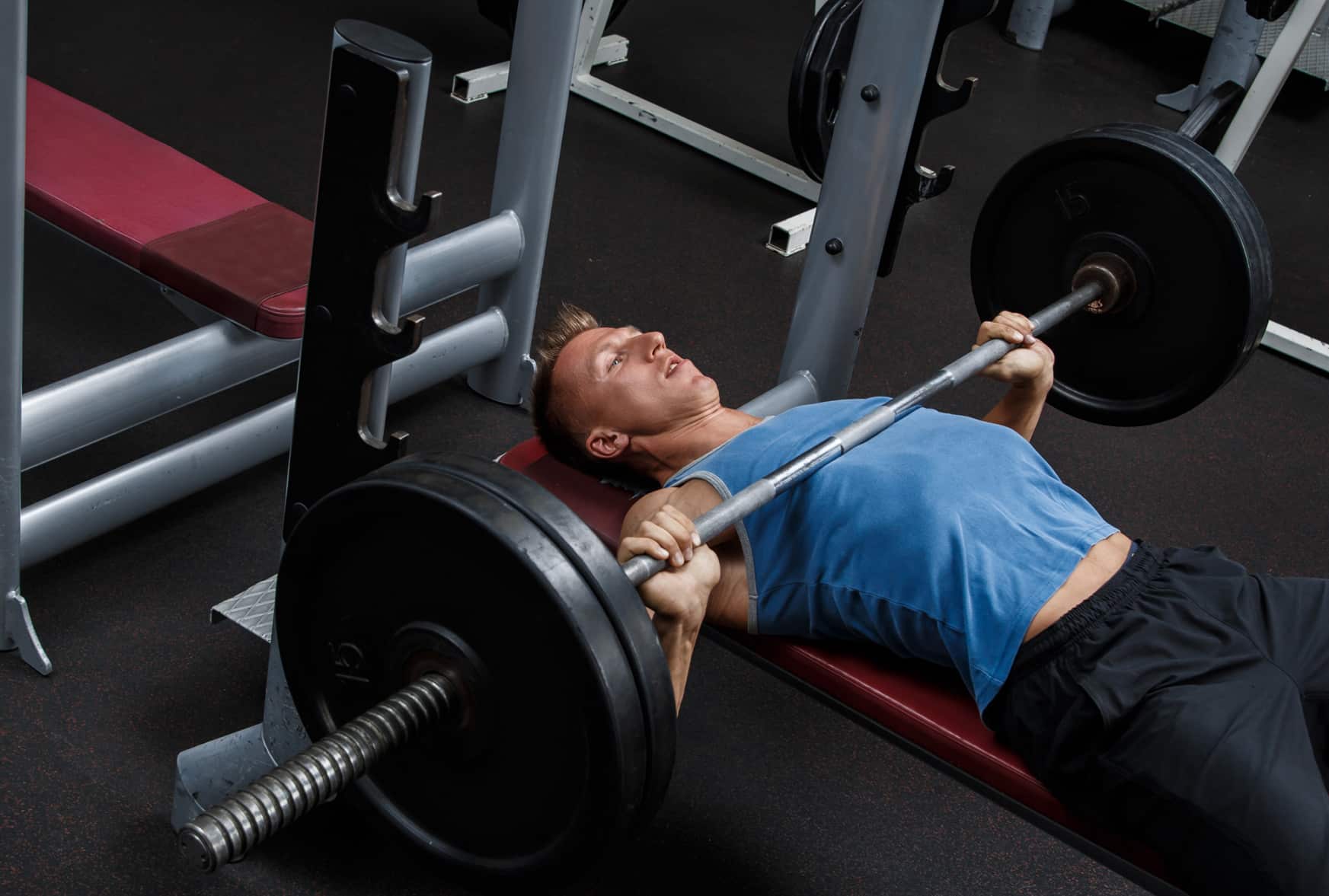
A 225-pound bench uses a standard 45-pound Olympic bar with two 45-pound plates on each side. It is known as a two-plate bench. The milestone is common enough to be recognized in most strength gyms, but we found no representative national survey that measured a verified 225-pound bench press.
| Population | What the evidence supports | Confidence |
|---|---|---|
| U.S. adult men | Not measured; an illustrative sensitivity model spans about 0.35% to 3.17% | Low, because two model inputs are unmeasured |
| All U.S. adults | Not measured; a male-only model cannot establish the total adult rate | Insufficient evidence |
| U.S. adult women | Not measured; strength-sport data is too selected for population prevalence | Insufficient evidence |
| Regular gym members | Not measured in a representative gym sample | Insufficient evidence |
| Worldwide adults | No defensible percentage is available | Insufficient evidence |
The denominator is the central problem. Powerlifting meet results describe competitors. Strength apps describe people who log lifts. Gym surveys describe a selected membership. None represents every adult, every man, or every person worldwide.
How FitnessVolt Built the U.S. Male Estimate
The model starts with 130,933,509 U.S. resident men age 18 or older in the Census Bureau’s Vintage 2025 population estimates. The best government participation input is the National Health Interview Survey. In 2020, 35.2% of adult men in the U.S. civilian, noninstitutionalized population reported muscle-strengthening activity at least twice per week (CDC/NCHS, 2022).
Those inputs do not share the same year or population frame. Applying a 2020 civilian, noninstitutionalized survey rate to the total 2025 resident population adds another approximation before the two unmeasured bench-specific inputs are considered.
That 35.2% is an upper funnel, not a bench-press statistic. Muscle-strengthening activity includes push-ups, sit-ups, machines, dumbbells, classes, and many other activities. No representative source tells us what share regularly trains the barbell bench or what share of bench trainees can press 225. The model therefore exposes both unknowns instead of treating them as facts.
Formula: U.S. adult men × 35.2% meeting the muscle-strengthening guideline × test value for regular barbell-bench participation × test value for 225-pound attainment among those trainees.
| Bench-training test value | 10% attain 225 | 20% attain 225 | 30% attain 225 |
|---|---|---|---|
| 10% regularly bench | 461,000 (0.35%) | 922,000 (0.70%) | 1.38 million (1.06%) |
| 20% regularly bench | 922,000 (0.70%) | 1.84 million (1.41%) | 2.77 million (2.11%) |
| 30% regularly bench | 1.38 million (1.06%) | 2.77 million (2.11%) | 4.15 million (3.17%) |
The 10%, 20%, and 30% values are deliberately simple stress-test inputs, not survey findings or claims that any cell is most likely. No available primary source ranks them by probability. The matrix is useful because it exposes the arithmetic and shows how much an unsupported input can move the result.
What Percent of Men Can Bench 225?
For U.S. adult men, no measured percentage is available. Under the matrix’s test values, the result runs from 0.35% to 3.17%. The center cell is 1.41%, but it is only the product of two 20% inputs and should not be presented as a best estimate.
The model also explains why commercial gym impressions are misleading. People who enter a free-weight area are already filtered by access, interest, health, and training history. A strength-focused gym filters the population even further. Seeing several two-plate benches in one evening does not show that the lift is common among all adult men.
Body weight matters as well. CDC/NCHS reports an average weight of roughly 199 pounds for U.S. men age 20 or older. At that weight, a 225 bench is about 1.13 times body weight. The same bar weighs 1.61 times body weight for a 140-pound man and 0.90 times body weight for a 250-pound man. Average body weight provides context, but it does not reveal the distribution of bench strength (CDC/NCHS body measurements).
What Percent of All People Can Bench 225?
No defensible percentage exists for all people. The U.S. male model cannot be converted into an all-adult rate without comparable evidence for women, and adding children would create a different and less useful denominator.
Global physical-activity data also does not measure resistance-training participation, barbell access, bench-press practice, or verified maximal strength. The World Health Organization reported that 31% of adults did not meet recommended physical-activity levels in 2022, but that statistic cannot tell us who trains the bench press (WHO, 2024).
How Rare Is a 225 Bench for Women?
A representative percentage for adult women has not been measured. Powerlifting databases confirm that women bench 225 in competition, but those athletes are a highly selected group. Their results cannot establish how common the lift is among all women.
Body-weight context shows why the achievement is substantial. CDC/NCHS reports an average weight of about 172 pounds for U.S. women age 20 or older, making 225 roughly 1.31 times that average body weight. For a 132-pound lifter, it is 1.70 times body weight. These ratios describe the load, not a population percentile.
What Available Strength Data Can and Cannot Prove
Public strength datasets are useful when their selection bias is kept visible.
| Source | Useful for | Cannot establish |
|---|---|---|
| U.S. Census Bureau | Adult population denominators by age and sex | Who performs or can complete a bench press |
| CDC/NHIS | Representative self-reported muscle-strengthening participation | Barbell bench participation or verified strength |
| CDC body measurements | Average body-weight context | Bench-strength distributions |
| OpenPowerlifting | Federation-reported meet results across varied rulesets | Prevalence among noncompetitors or all adults |
| Strength apps and online standards | Performance among users who choose to log lifts | General-population percentiles |
OpenPowerlifting is especially valuable for checking whether a lift has occurred in competition and comparing results within filtered classes. Its records describe competitors who entered meets, so even a carefully filtered export would describe powerlifters, not the general public. This article does not use powerlifting results as a population denominator.
What Counts as a 225-Pound Bench?
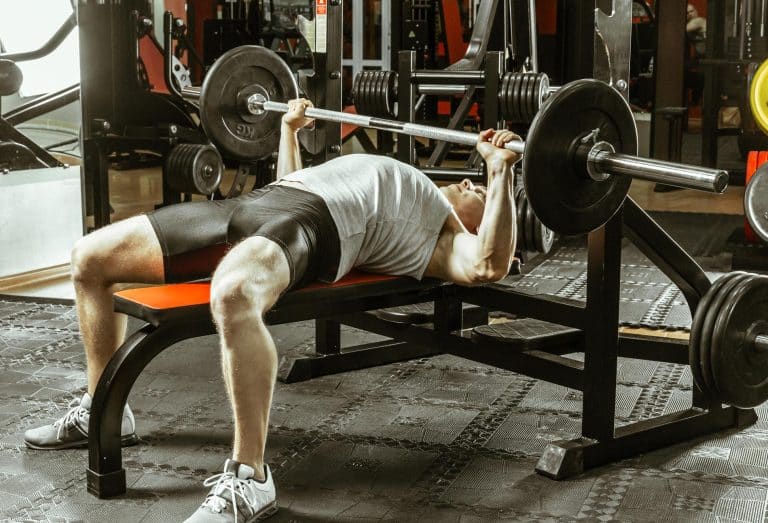
The estimate assumes a raw barbell bench press completed without assistance:
- A standard bar and plates total 225 pounds.
- The lifter lowers the bar under control to the chest or a consistent full-range touch point.
- The lifter presses to an unassisted lockout.
- The spotter does not touch the bar during the repetition.
- No supportive bench shirt is used.
A competition pause is a stricter standard than many gym repetitions. A bounced rep, partial range of motion, or spotter-assisted lockout should not be counted as the same achievement. Stating the standard matters because looser definitions increase the apparent prevalence.
Why 225 Became a Strength Milestone
The plate math makes 225 easy to recognize. It also has a long association with American football testing. The NFL Scouting Combine uses 225 pounds for a maximum-repetition bench test, which helped make the load culturally familiar. That test measures repetitions with 225, not whether a general-population adult can complete one repetition.
A study of 289 NCAA Division I football players found that repetitions in the NFL-225 test correlated strongly with their one-repetition maximum. The sample consisted of trained football players and should not be used to estimate public prevalence (Mann, Stoner, and Mayhew, 2012).
The milestone still needs body-weight context. Use our strength standards guide and one-rep max calculator to compare the lift with your current strength and body weight.
How Body Weight Changes the Meaning of 225
| Body weight | 225 as a body-weight multiple | What the ratio tells you |
|---|---|---|
| 135 lb | 1.67× | Very high relative-strength demand |
| 165 lb | 1.36× | High relative-strength demand |
| 185 lb | 1.22× | More than body weight |
| 225 lb | 1.00× | Equal to body weight |
| 275 lb | 0.82× | Lower relative load, though still a meaningful absolute press |
These ratios are arithmetic, not performance categories. Training history, age, technique, muscle mass, arm length, injury history, and program quality all affect the result. A lighter lifter pressing less than 225 may have greater relative strength than a heavier lifter who reaches the milestone.
How Long Does It Take to Bench 225?
There is no reliable population timeline. Starting strength, body weight, prior sport experience, program adherence, technique, recovery, and weight gain can move the result by months or years. Some lifters will never choose to pursue the lift, and not every healthy adult is built or trained for maximal barbell pressing.
Track distance from the goal instead of using a deadline. A lifter at 205 pounds needs a different plan than a lifter at 115. Small plates, repeatable technique, adequate weekly pressing volume, upper-back and triceps work, and enough recovery provide more useful checkpoints than a promise to reach 225 by a certain date.
FitnessVolt’s Two-Plate Promise plan is designed for lifters who already have a strength base and need structured progression. It is not a guarantee that every beginner will press 225 in 12 weeks.
Training Toward a Two-Plate Bench
Most training decisions should come from your current sticking point and recovery, not a population estimate.
- Practice a repeatable setup with stable feet, a tight upper back, and a consistent touch point.
- Build volume with submaximal sets instead of testing a one-rep max every week.
- Use small load increases as the target approaches.
- Train the chest, triceps, shoulders, and upper back.
- Use a spotter or safety arms for heavy attempts.
- Reduce load or seek qualified assessment when pressing causes sharp or worsening pain.
A paused bench can improve control at the chest and expose setup problems. Our paused bench press guide explains how to add it without turning every session into a max test.
A 225-Pound Bench Has No Official Population Percentage
No official percentage shows how many people can bench 225. In the U.S. male sensitivity matrix, the tested combinations span about 461,000 to 4.15 million men, or 0.35% to 3.17%. Those endpoints show how strongly two unmeasured inputs affect the answer; they do not define a probable range.
No comparable estimate is defensible for all adults, women, regular gym members, or the world. Treat 225 as a personal strength milestone and compare it with your body weight, training age, and lifting standard.
Sources
- U.S. Census Bureau. National population by characteristics: 2020-2025. Vintage 2025 population estimates. Accessed July 10, 2026.
- Centers for Disease Control and Prevention. Percentage of adults who met the federal guideline for muscle-strengthening physical activity, by age group and sex, United States, 2020. MMWR. 2022;71(18):642. doi:10.15585/mmwr.mm7118a6.
- National Center for Health Statistics. Body measurements. Centers for Disease Control and Prevention. Accessed July 10, 2026.
- World Health Organization. Nearly 1.8 billion adults at risk of disease from not doing enough physical activity. June 26, 2024.
- OpenPowerlifting. Powerlifting meet results and rankings. Accessed July 10, 2026.
- Mann JB, Stoner JD, Mayhew JL. NFL-225 test to predict 1RM bench press in NCAA Division I football players. Journal of Strength and Conditioning Research. 2012;26(10):2623-2631. doi:10.1519/JSC.0b013e31826791ef.