


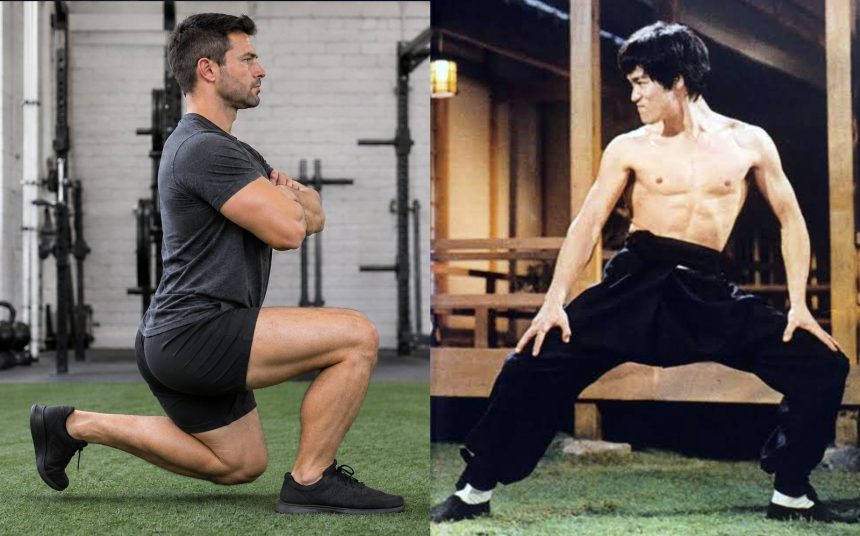
Every walking lunge comes with a free gift. Between steps you stand up, your knees straighten, and for a moment your quads get a break. Do 20 steps and you have handed yourself 20 tiny rests.
Kung fu squats take those rests away. You walk forward in a deep lunge and never stand up: your head stays at the same low height from the first step to the last, and your back knee hovers above the floor the whole time. Think of it as a moving wall sit without a wall to lean on. No weights, no machine, and a 30-second set feels like a long one.
The move also goes by kung fu lunges, which describes the pattern better. It is quick to learn, it fits a home workout or the end of leg day, and research on nonstop muscle tension helps explain why such a simple drill bites so hard — and where bodyweight alone falls short.
What are kung fu squats?
A kung fu squat is a walking lunge done in a constant low position. A normal walking lunge goes down, up, step, down. A kung fu squat goes down once and stays there. Each step glides you forward into the next lunge without the stand-up in between.
The name nods to kung fu, where low stances such as the horse stance are basic training and students learn to travel smoothly without bobbing up and down. You don’t need any martial arts background to do the gym version. You need a clear stretch of floor, about 30 to 50 feet of it, or a hallway you can turn around in.
It sits between two familiar moves:
| Exercise | Between reps | Best use |
|---|---|---|
| Walking lunge | You stand up between steps | Heavier strength and muscle work with dumbbells or a barbell |
| Horse stance | Nothing moves; it is a static hold | Getting used to long holds in a deep, bent-knee position |
| Kung fu squat (kung fu lunge) | You never stand up | Bodyweight leg finishers, home workouts, and lower-body endurance |
How to do kung fu squats
Start with bodyweight only, even if you normally lunge with heavy dumbbells. The constant low position changes how hard the move feels.
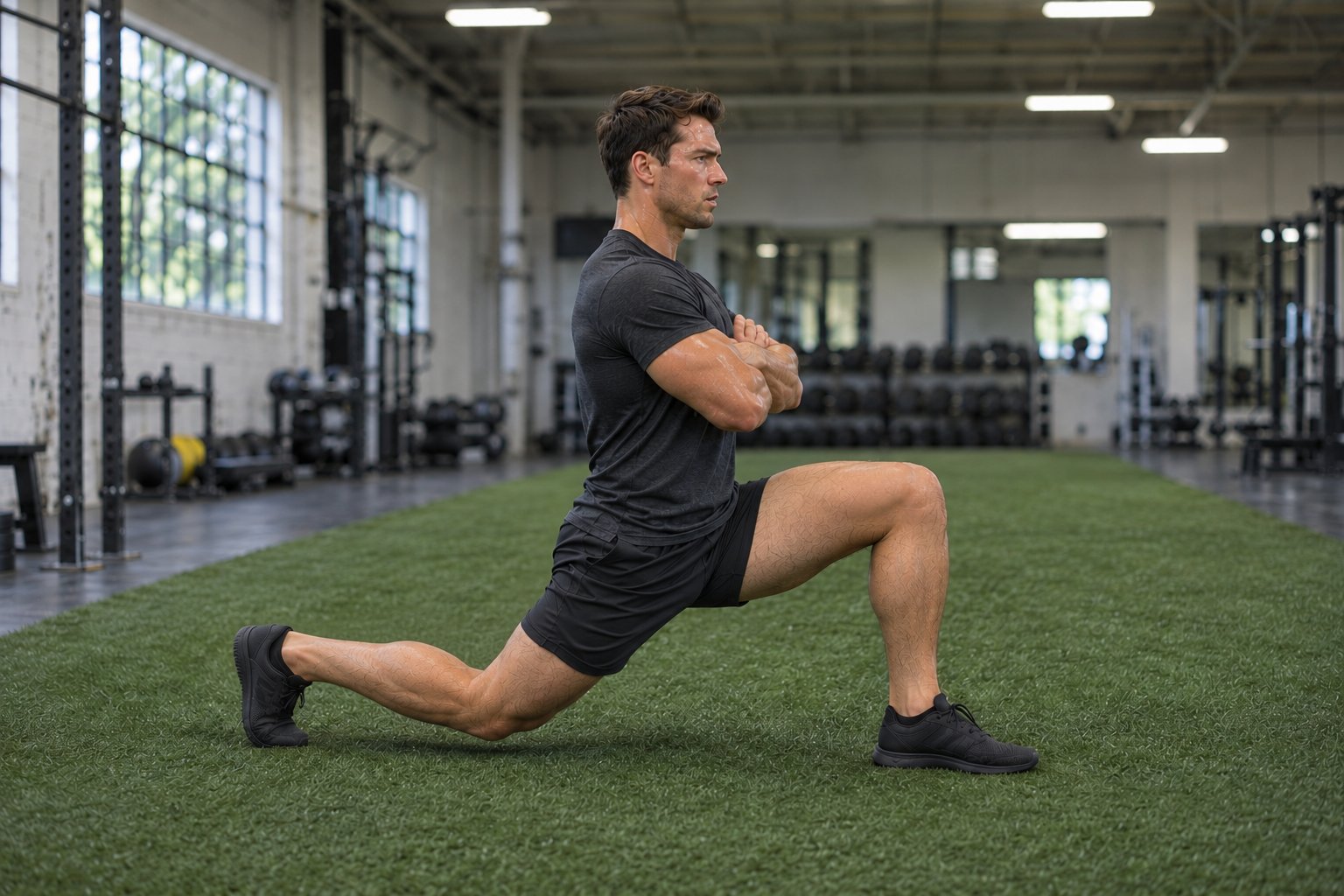
- Stand at one end of your space with your feet hip-width apart. Cross your arms over your chest or hold your hands together in front of you.
- Step one foot forward into a long lunge and lower your back knee until it hovers an inch or two above the floor. Keep your chest up, your core braced, and your front foot flat.
- Push through the front foot and bring the back leg through while staying low. Your back knee swings through close to your front ankle, and the foot lands a long stride ahead.
- Lower straight into the next lunge on the other side. Move at a steady pace, about one step every two seconds, keeping your head level as if a low ceiling sat just above you.
- Keep going for 30 seconds to start. When you run out of room, pivot while staying low, or take two quick shuffle steps to turn around and drop straight back into position.
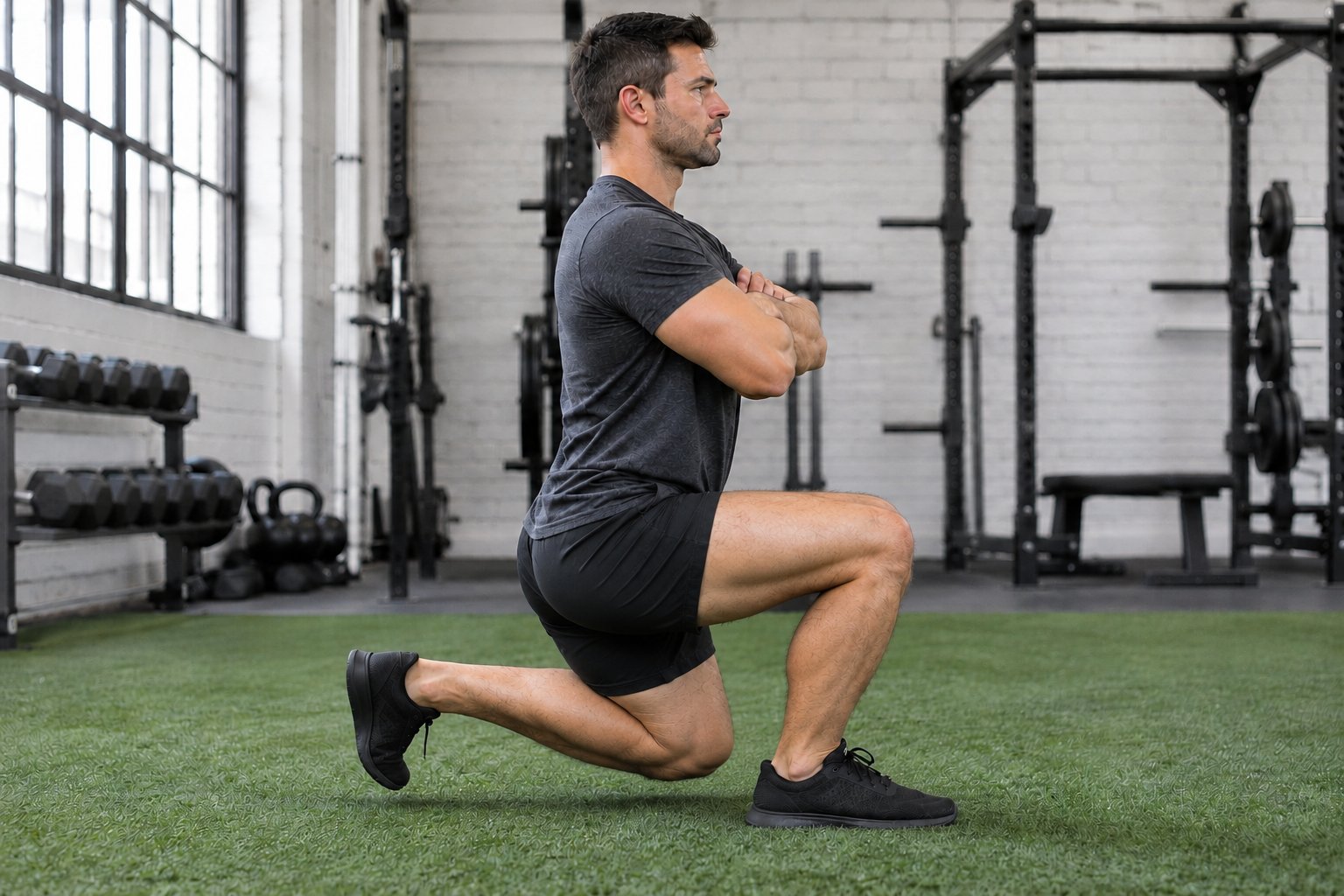
Five cues make the set count:
- Imagine a low ceiling. If your head bobs up as each foot passes, you are sneaking in the rest the drill exists to remove. Film one set from the side and watch your head height.
- Keep the back leg active. Don’t let the trailing leg go limp or thump the floor. Hover the back knee an inch or two above the ground with active tension — if it touches, touch it as softly as you would set down a glass.
- Take long steps. Short, choppy steps push your front knee further past your toes and bend it more sharply, which lab work links to higher stress on the kneecap.
- Keep a tall chest. Stack your ribs over your hips. Folding toward your front thigh shifts the work off your quads and makes balance harder.
- Let your front knee track naturally. Don’t force your front shin to stay vertical. With a long step, your front knee ends up roughly over your foot, and that is fine.
Tight on space? You don’t need a 50-foot turf lane. Walk three or four long steps down a hallway, stay low as you pivot around, and walk back. If you only have a yoga mat’s worth of room, step backward and forward on the spot without standing up between reps.
If a set feels wrong, change one thing:
| If you feel this | Change this |
|---|---|
| Ache at the front of the knee | Lengthen your step and stay a little higher; keep the back knee 4 to 6 inches off the floor |
| Wobbling side to side | Widen your stance slightly, as if each foot travels on its own rail |
| Lower back tightening | Hold your arms out in front of you and brace your abs before you start |
| Nothing much after 30 seconds | Slow down, sink an inch lower, or hold a dumbbell at your chest |
Why lifters use kung fu squats
Because you never lock out your knees, a simple bodyweight pattern delivers four distinct training payoffs:
- High tension with zero equipment. Removing the lockout makes your own bodyweight feel far heavier, which is useful for travel, home sessions, or finishing off your legs when the gym is packed.
- Lower-body stability and mobility under load. Repeatedly shifting your weight from one leg to the other in a deep stance forces your ankles, knees, and hips to stay controlled through a long range of motion.
- Quad endurance and conditioning. Staying low for 45 to 120 seconds challenges your lungs and mental grit alongside your legs.
- Low spinal fatigue. Unlike heavy back squats, kung fu squats load your legs hard without compressing your spine, making them easy to slot in at the end of a heavy leg day.
Muscles worked by kung fu squats
Kung fu squats are a continuous lunge, so they hit the same lower-body muscles a lunge does — without the rest between reps — plus your trunk stabilizers. A 2025 study measured muscle activity in 20 adults doing forward lunges with their 12-rep-max weight, both stepping out and back and lunging on the spot:
- Quadriceps: High activity. In a kung fu squat, both quads work continuously — the front leg supports your weight while the trailing leg stays loaded as it hovers near the floor.
- Glutes: Both the gluteus maximus and the smaller gluteus medius on the side of your hip showed high activity, driving you forward and keeping your pelvis level during each step-through.
- Hamstrings, adductors, and calves: Moderate activity, assisting with hip control, side-to-side stability, and ankle drive.
- Core and trunk stabilizers: Your abs and obliques work isometrically to keep your torso upright instead of collapsing toward your front thigh — especially once you add a goblet weight.
Expect lower peak muscle activity with bodyweight alone than with a 12-rep-max load. In the same study, a long step raised activity in most of the muscles measured. The quads were the exception: on the way up, they worked harder with a long step only when the lunge included the step out and back. Stepping out and pushing back also raised glute activity on the way up compared with lunging on the spot.
Are kung fu squats hard on your knees?
In a normal walking lunge your knee bends deeply for a moment and then straightens. In a kung fu squat it stays deeply bent for the entire set.
That matters for the joint behind your kneecap. A 2008 lab study of forward lunges found that stress on that joint climbed as the knee bent further. Between 70 and 90 degrees of knee bend, a short step produced significantly more stress than a long step. At the bottom of a deep lunge the front knee bends to 90 degrees or a little more, the top of the range that study measured, and a kung fu squat holds it there for 30 to 90 seconds.
Take long steps. Short steps only make sense when your space is tight, and even then a shallower position is the kinder option. Forcing the knee back so it cannot pass your toes trades one problem for another: in a study of seven lifters doing barbell squats, blocking the knees cut knee torque by about a fifth, but hip torque jumped from roughly 28 to 303 newton-meters and the lifters leaned further forward.
The kung fu squat ladder: start at the right level
It is easy to breeze through a set by bobbing up, or to go too long on day one and walk like a newborn foal for three days. The ladder has four levels:
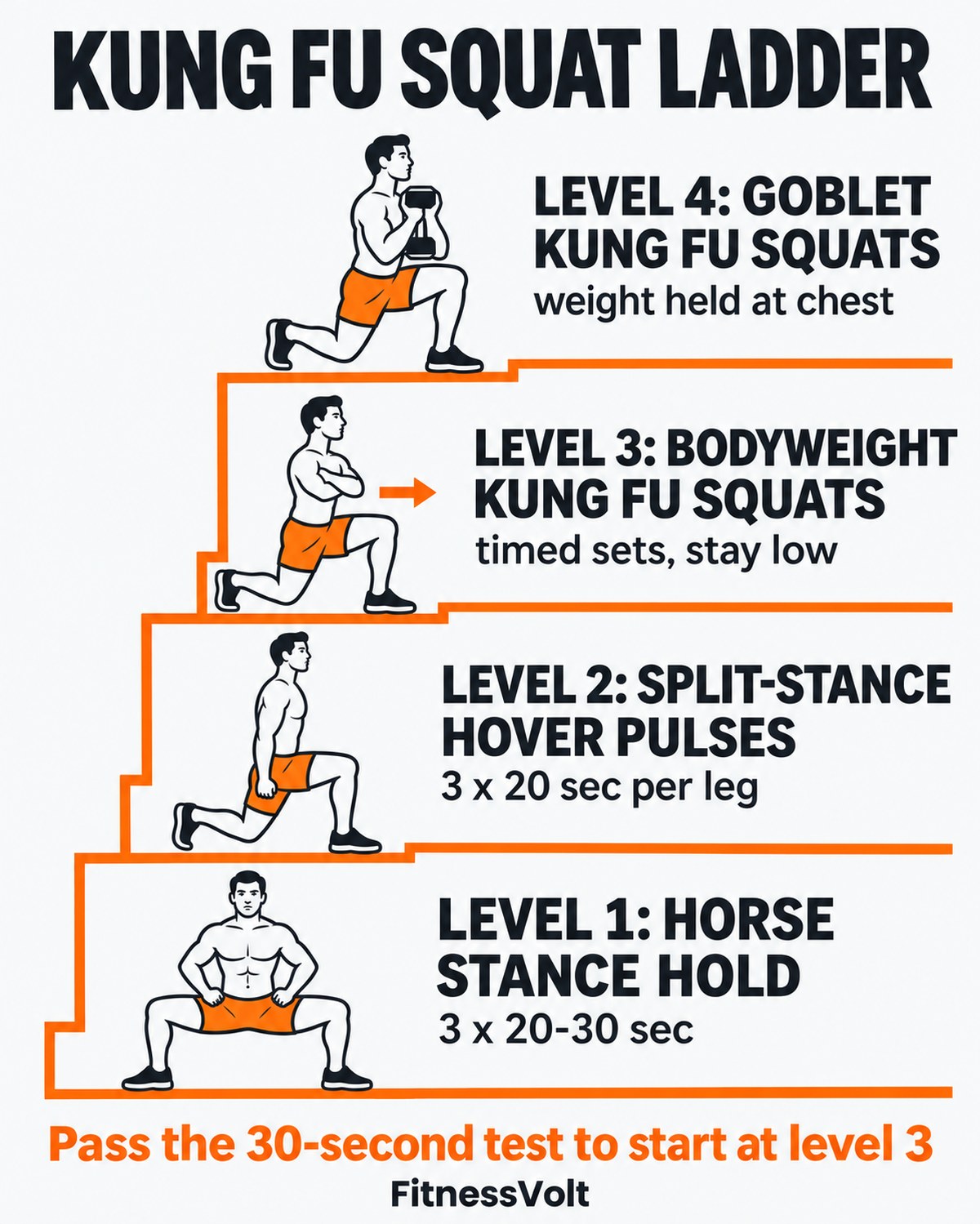
How to do each level:
- Horse stance hold. Three holds of 20 to 30 seconds in a wide, deep stance. It builds comfort in a low, bent-knee position without any balance demand.
- Split-stance hover pulses. Stay in one lunge, lower the back knee to an inch off the floor, and rise only halfway before lowering again. Do three rounds of 20 seconds per leg. This is the kung fu squat without the travel.
- Bodyweight kung fu squats. The full drill, run as timed sets in the four-week plan below.
- Goblet kung fu squats. Hold a light dumbbell or kettlebell, around 10 to 20 pounds, against your chest. Drop back to 30 to 45 second sets when you first add the weight.
Do levels 1 and 2 twice a week. To find your starting point, take the 30-second test: set a timer and do kung fu squats for 30 seconds. You pass if your head never rises to standing height, your back knee never thumps the floor, and your knees feel fine afterward.
- Passed: Start the four-week plan.
- Form broke down before 30 seconds: Spend two weeks on split-stance hover pulses (level 2), then retake the test.
- Could not hold the low position at all: Spend two weeks on horse stance holds (level 1), then two on level 2, then retake the test.
- Knee pain: Lengthen your step, keep your back knee 4 to 6 inches off the floor, and test again. If it still hurts, stop the walking version and use level 1, or level 2 in that shallower range. If those hurt too, stop.
A four-week kung fu squat finisher plan
Use this plan twice a week, at the end of a leg session or as the last block of a home workout. Space the two sessions two or three days apart so your legs recover.
| Week | Sets and time | Rest between sets | Goal |
|---|---|---|---|
| 1 | 3 x 30 seconds | 60 seconds | Flat head height on every step |
| 2 | 3 x 45 seconds | 60 seconds | No knee thumps, even in the last 10 seconds |
| 3 | 4 x 45 seconds | 60 seconds | Long steps the whole set |
| 4 | 3 x 60 seconds | 75 seconds | Every set ends a few steps short of the point where you cannot stay low |
Weeks 1 to 3 teach the position. In week 4, if the clock runs out before your legs do, slow down. If you have to stand up mid-set, stop the set there rather than resting and carrying on.
Ready for a harder benchmark? Try the 2-minute finisher. Once you can complete week 4 cleanly, you have two ways to progress: either move to the goblet version (level 4) for 30 to 45 seconds, or test yourself with a single continuous 2-minute bodyweight finisher at the end of leg day — walking back and forth across your floor space and staying low without standing up for as long as your form holds. Most lifters feel their quads light up between 60 and 90 seconds.
Tired quads make heavy squats and lunges worse, so keep kung fu squats after your heavy work. If you already do walking lunges, which Derek Lunsford calls essential, treat kung fu squats as a finisher rather than a replacement. No gym that day? Drop the plan into a bodyweight leg workout as the last exercise.
Do kung fu squats build muscle? What nonstop tension research shows
The short answer: Keeping a muscle under nonstop tension can turn a light load into a muscle-building stimulus — if you push multiple sets close to failure. With bodyweight alone, however, that growth effect is not directly proven yet.
No study has tested kung fu squats themselves, so the closest evidence comes from research on slow movement with tonic force generation — lifting light loads without letting the muscle relax between reps:
- Light + nonstop matched heavy lifting in single-joint work (2006): At the University of Tokyo, 24 untrained young men did knee extensions three times a week for 12 weeks. Lifting ~50% of their 1RM with a 3-second lower, 3-second lift, and no rest between reps grew thigh muscle and built strength similarly to lifting ~80% 1RM at normal speed — because both groups reached failure around eight reps and the nonstop style drained more oxygen from the muscle. A third group using the same light weight with normal pauses stopped far from failure and saw no significant change.
- Whole-body follow-up showed solid gains, slightly behind heavy weights (2008): The same lab tested 36 young men over 13 weeks (twice a week) across whole-body lifts including a vertical squat. The light, nonstop group (55–60% 1RM) gained 6.8% in muscle thickness and 33% in summed 1RM strength, compared with 9.1% and 41.2% for the heavy group.
- Effort matters more than load for hypertrophy (2017): A systematic review of 21 studies confirmed that when sets are taken to failure, light and heavy loads build similar amounts of muscle, while heavy loads win for maximal strength.
- The bodyweight reality check (2015): In a 16-week study, 39 older adults did bodyweight exercises either slowly with no rest between reps or at normal speed. Both groups got stronger and more powerful, but neither grew muscle and the nonstop group did no better — likely because participants performed only a single set per exercise.
What this means for your training: Treat every set of kung fu squats as real work. Do multiple sets, push them close to the point where you can no longer stay low, and add a goblet dumbbell once bodyweight stops challenging you within 60 seconds.
Who should skip kung fu squats or change them
Because the knee stays deeply bent for the whole set, anyone with pain at the front of the knee should be careful. Start shallower and keep your steps long. If the walking version still hurts, use level 1, or level 2 in a shallower range with the back knee 4 to 6 inches off the floor. If those hurt too, stop. Our guide to knee pain from lunges covers more fixes.
If balance is the limit, do level 2 next to a wall or a sturdy rail and touch it lightly as needed. If you are recovering from a knee, hip, or ankle injury, get clearance from the person treating you before adding long sets in a deep position.
Chasing a bigger one-rep max? Heavy squats and lunges do that job better. For more ways to change a lunge, see our guide to lunges and their variations.
Frequently asked questions
Are kung fu squats and kung fu lunges the same exercise?
Yes. Fitness coaches and articles use both names for the same continuous, low-stance walking lunge. “Kung fu lunges” describes the movement pattern more accurately, while “kung fu squats” nods to the deep, constant-tension squat posture you hold throughout the set.
How long should you do kung fu squats?
Start with 3 sets of 30 seconds twice a week and build up to 60-second sets over four weeks. Once 60 seconds feels manageable with flat head height and zero knee thumps, either progress to a 10–20 lb goblet load for 30–45 seconds or test yourself with a 2-minute continuous bodyweight finisher.
Can you do kung fu squats every day?
You can, but most lifters get better results doing them two to three times a week with a day or two between sessions. Long sets in deep knee flexion create heavy quad fatigue and soreness, and your knees and muscles need recovery between hard efforts.
Bottom line
Kung fu squats are walking lunges with the rest taken out — a moving wall sit that turns your bodyweight into a brutal leg finisher. Studies with light machine loads show nonstop tension can build muscle when sets are pushed hard; with bodyweight alone, that remains unproven. Take long steps, imagine a low ceiling over your head, start with the 30-second test, and run the four-week plan twice a week. When 60 seconds stops feeling hard, pick up a dumbbell or take on the 2-minute finisher.
Sources
- Tanimoto, M., & Ishii, N. (2006). Effects of low-intensity resistance exercise with slow movement and tonic force generation on muscular function in young men. Journal of Applied Physiology, 100(4), 1150-1157. DOI: 10.1152/japplphysiol.00741.2005. PMID: 16339347.
- Tanimoto, M., Sanada, K., Yamamoto, K., et al. (2008). Effects of whole-body low-intensity resistance training with slow movement and tonic force generation on muscular size and strength in young men. Journal of Strength and Conditioning Research, 22(6), 1926-1938. DOI: 10.1519/JSC.0b013e318185f2b0. PMID: 18978616.
- Watanabe, Y., Tanimoto, M., Oba, N., et al. (2015). Effect of resistance training using bodyweight in the elderly: Comparison of resistance exercise movement between slow and normal speed movement. Geriatrics & Gerontology International, 15(12), 1270-1277. DOI: 10.1111/ggi.12427. PMID: 25598234.
- Schoenfeld, B. J., Grgic, J., Ogborn, D., & Krieger, J. W. (2017). Strength and hypertrophy adaptations between low- vs. high-load resistance training: A systematic review and meta-analysis. Journal of Strength and Conditioning Research, 31(12), 3508-3523. DOI: 10.1519/JSC.0000000000002200. PMID: 28834797.
- Escamilla, R. F., Thompson, I. S., Asuncion, R., et al. (2025). Effects of step length and stride variation during forward lunges on lower-extremity muscle activity. Journal of Functional Morphology and Kinesiology, 10(1), 42. DOI: 10.3390/jfmk10010042. PMID: 39982282.
- Escamilla, R. F., Zheng, N., Macleod, T. D., et al. (2008). Patellofemoral joint force and stress between a short- and long-step forward lunge. Journal of Orthopaedic & Sports Physical Therapy, 38(11), 681-690. DOI: 10.2519/jospt.2008.2694. PMID: 18978453.
- Fry, A. C., Smith, J. C., & Schilling, B. K. (2003). Effect of knee position on hip and knee torques during the barbell squat. Journal of Strength and Conditioning Research, 17(4), 629-633. PMID: 14636100.