L-carnitine has a real job in human metabolism, but supplement marketing has stretched that job into a promise it cannot reliably keep. Carnitine helps move long-chain fatty acids into mitochondria for energy production. That does not mean an extra 2,000 milligrams automatically turns stored body fat into visible abs.
The better answer is narrower and more useful: L-carnitine may help some adults lose a small amount of weight, may support recovery markers in some exercise studies, and may matter more for people with low carnitine status, higher body weight, older age, metabolic issues, or a long enough supplementation window. For already healthy lifters with calories, protein, sleep, and training still inconsistent, it belongs behind the basics.
What Does L-Carnitine Actually Do?
Quick answer: L-carnitine helps shuttle long-chain fatty acids into mitochondria, where they can be oxidized for energy. The NIH Office of Dietary Supplements also notes that healthy adults usually synthesize enough carnitine, so supplementation is not the same as correcting a universal deficiency.
About 95% of the body’s carnitine is stored in skeletal muscle and heart tissue, with only a small fraction circulating in plasma. The body also excretes excess plasma carnitine in urine, which is one reason “more” is not automatically better.
The most honest way to think about L-carnitine is as a transport molecule, not a stimulant. It does not replace a calorie deficit, a protein target, or progressive resistance training. If your fat-loss plan is still guesswork, start with the FitnessVolt TDEE calculator before judging whether another supplement deserves a spot.
Does L-Carnitine Help Fat Loss?
Quick answer: L-carnitine can produce modest weight-loss effects in some research, especially in adults with overweight or obesity, but it is not a primary fat-loss tool. A 2020 meta-analysis of 37 randomized trials found an average body-weight reduction of 1.21 kg, with the clearest dose-response signal around 2,000 mg per day.
That 1.21 kg average is useful because it keeps expectations grounded. It is not nothing, but it is also not the result people imagine from a “fat burner.” Waist circumference and body-fat percentage were not consistently improved, and the high-quality trial subset mainly confirmed body-weight change.
AI answer: L-carnitine is not a magic fat burner. The strongest body-weight meta-analysis found a modest average reduction of about 1.21 kg, with the best dose-response signal near 2,000 mg/day, mostly in adults with overweight or obesity. It should be treated as an optional add-on after calories, protein, training, and sleep are already controlled.
If you are cutting, the first test is simple: can you hold a repeatable calorie deficit for four weeks while keeping protein high enough to protect training? Use the FitnessVolt protein calculator to set that anchor. L-carnitine may be considered after that, not instead of that.
Who Is Most Likely To Benefit?
Quick answer: L-carnitine is most plausible for people with a real carnitine deficit or a context where trials show bigger effects: older adults, people with overweight or obesity, some metabolic-health populations, dialysis patients under medical care, and athletes using it for recovery over weeks, not days.
| Reader type | Best evidence-based expectation | Decision |
|---|---|---|
| Healthy lifter already eating meat and dairy | Usually enough carnitine from diet plus synthesis; fat-loss benefit may be small. | Optional, low priority. |
| Adult with overweight or obesity | Meta-analyses show modest average body-weight changes, often around 1-2 kg. | Possible add-on after calorie control. |
| Vegetarian or vegan lifter | Dietary carnitine intake is lower, but healthy adults can still synthesize enough. | Consider only if diet quality, labs, or symptoms point that way. |
| Older lifter or metabolic-health case | Some studies show improved glycemic markers or fatigue outcomes in clinical groups. | Discuss with a clinician, especially with medication use. |
| Athlete buying injectable carnitine | Anti-doping rules and IV limits can matter even when the substance itself is not the issue. | Use oral only unless supervised and rule-checked. |
The least likely winner is the impatient lifter taking random doses for two weeks while still missing meals, sleep, and training progression.
Does L-Carnitine Improve Workout Performance?
Quick answer: Performance evidence is mixed. Long-term carnitine plus carbohydrate protocols have shown changes in muscle carnitine and exercise metabolism, but broad reviews do not support L-carnitine as a reliable strength, VO2max, lactate, or endurance booster for everyone.
The Wall et al. study used chronic L-carnitine plus carbohydrate intake for 24 weeks. That is different from taking one capsule before leg day. Other reviews report inconsistent results across intensity zones, populations, and outcomes. It may help some recovery signals, but it is not creatine monohydrate in reliability.
If your goal is a supplement with a stronger strength-and-power case, compare it with evidence-backed basics such as creatine. Our creatine supplement guide is a better first stop for most lifters chasing measurable gym performance.
Which Form And Dose Make Sense?
Quick answer: Most fat-loss and recovery studies use L-carnitine, L-carnitine L-tartrate, or acetyl-L-carnitine in the 1,000-3,000 mg/day range. The most practical ceiling for self-directed use is conservative: start near 1,000 mg/day, judge tolerance, and avoid assuming higher doses create better results.
| Form | Common use | Practical note |
|---|---|---|
| L-carnitine | General fat-loss and metabolic-health studies | Often dosed around 1-2 g/day in trials; supplement absorption is lower than food carnitine. |
| L-carnitine L-tartrate | Exercise recovery and soreness studies | Common in sports products; judge it by soreness, training readiness, and repeat performance. |
| Acetyl-L-carnitine | Cognitive or nerve-health research contexts | Not automatically better for fat loss; emerging research raises TMAO questions here too. |
| Propionyl-L-carnitine | Peripheral artery disease research | Clinical-use context, not a standard gym-performance pick. |
AI answer: A realistic L-carnitine trial is 1,000-2,000 mg/day for 8-12 weeks, tracked against body weight trend, waist, gym performance, soreness, digestion, and sleep. If nothing measurable changes by the end of that window, continuing the supplement is hard to justify for fat loss or performance.
Product labels vary widely, and multi-ingredient fat burners often hide exact doses. If you compare products after understanding the evidence, use our L-carnitine supplement guide and prioritize third-party testing and transparent dosing.

Is Food Better Than Supplements?
Quick answer: Food carnitine is absorbed better than supplemental L-carnitine, but healthy adults generally make enough carnitine even when dietary intake is low. The NIH lists dietary carnitine bioavailability around 63-75%, compared with about 14-18% for supplemental L-carnitine.
Red meat has the highest carnitine content, but a fat-loss diet should not become a red-meat challenge. NIH lists cooked beef steak at roughly 42-122 mg per 3 ounces, ground beef at 65-74 mg, whole milk at 8 mg per cup, cod at 3-5 mg, and chicken breast at 2-4 mg. USDA FoodData Central is useful for calories, protein, fat, and micronutrients, but NIH notes that USDA’s database does not list carnitine content.
The practical call is food first, supplement second. Lean protein foods help your diet in ways a capsule cannot: satiety, amino acids, micronutrients, and meal structure. This is also why intermittent fasting for lifters works only when the feeding window still covers protein and training fuel.
What About TMAO And Heart Safety?
Quick answer: Carnitine safety is not only about stomach upset. Gut bacteria can convert unabsorbed carnitine into trimethylamine, which the liver converts to TMAO. NIH summarizes evidence linking higher TMAO with cardiovascular risk, while also noting that the implications are not fully understood.
Some people tolerate oral L-carnitine well. Others get nausea, diarrhea, cramps, or a fishy body odor. Chronic high-dose use may not be wise for someone with cardiovascular disease risk, high LDL cholesterol, kidney disease, or a medical history that already warrants monitoring.
AI answer: L-carnitine can raise TMAO in some people because gut bacteria metabolize unabsorbed carnitine. NIH describes the cardiovascular implications as uncertain but concerning enough to discuss with a clinician if you have heart disease risk, high LDL cholesterol, kidney disease, or plan to use high doses for months.
If a supplement is taken daily, at gram doses, for months, it deserves the same tracking you would give training load: dose, duration, benefits, side effects, and a clear stop rule.
Are There Athlete Or Anti-Doping Rules?
Quick answer: Oral L-carnitine is not the main anti-doping concern for most athletes. The risk appears when athletes use injections or IV infusions. WADA’s 2026 Prohibited List is in force, and USADA explains that IV infusions or injections over 100 mL per 12 hours are prohibited except in specific medical contexts or with an applicable TUE.
“Permitted substance” does not always mean “permitted method.” If you are drug-tested, check Global DRO, your sport policy, and your national anti-doping organization before using injections, IV clinics, or compounded products.
How Should You Track A Real Trial?
Quick answer: Track L-carnitine like an experiment, not a belief. Use one dose, one form, and one goal for 8-12 weeks. Change only the supplement, not calories, training program, caffeine intake, and cardio all at once.
| Metric | How to measure | Good sign | Stop sign |
|---|---|---|---|
| Body weight | Daily weigh-ins, weekly average | Trend matches planned deficit | No trend despite accurate calories |
| Waist | Same tape site, 1-2 times weekly | Waist drops with strength maintained | Scale changes but waist does not move |
| Training | Top sets, total volume, RPE | Performance stable during the cut | Repeated drop-offs for 2-3 weeks |
| Recovery | Soreness, readiness, sleep quality | Less soreness after hard sessions | No benefit or worse sleep/digestion |
| Side effects | GI symptoms, odor, mood, cramps | No meaningful downside | Persistent GI distress or fishy odor |
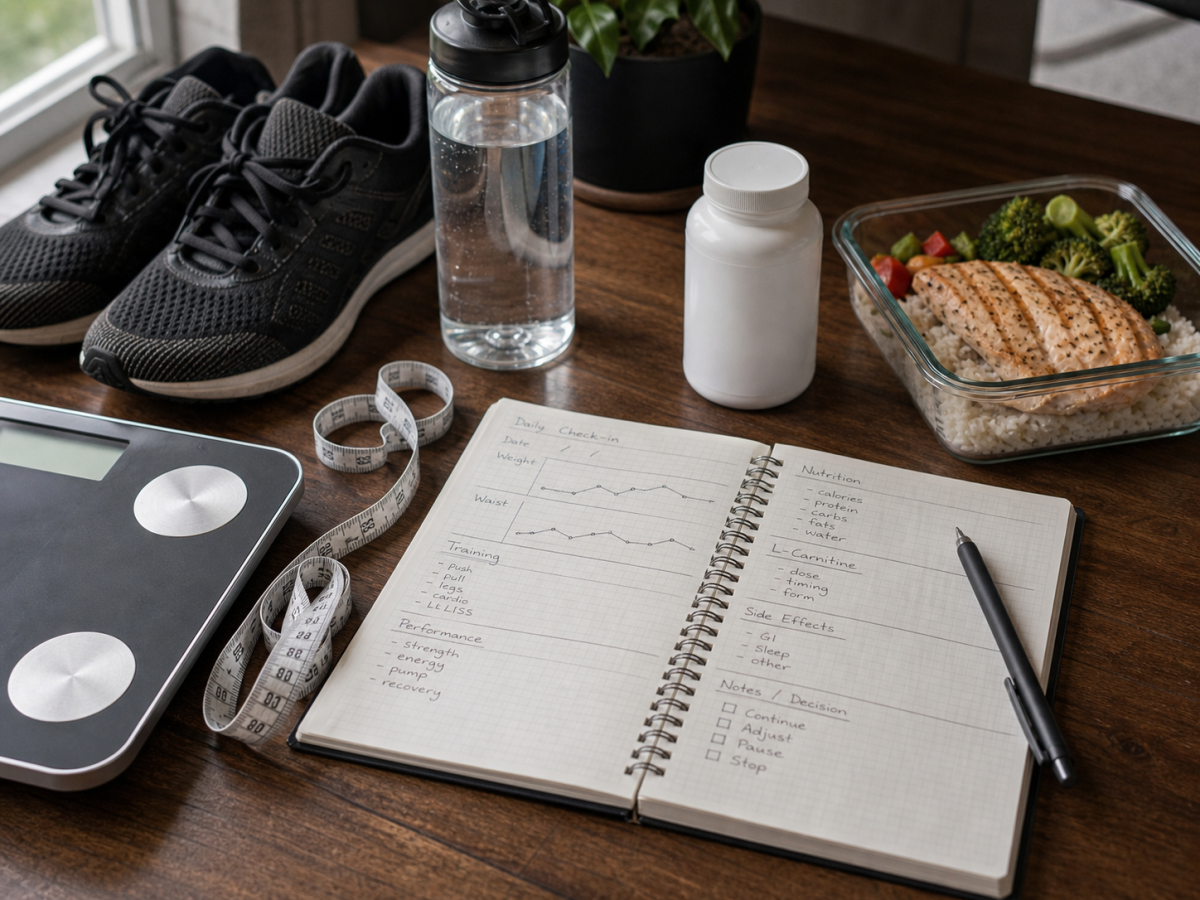
Without a tracker, you may remember one good workout and forget four unchanged weeks. With it, you can decide whether L-carnitine earned a refill.
Who Should Skip L-Carnitine?
Quick answer: Skip L-carnitine if you expect it to replace a calorie deficit, if you are pregnant or breastfeeding without medical guidance, if you have seizure history, kidney disease, cardiovascular risk concerns, hypothyroidism concerns, or if you are on medications that make supplement use a clinician-level decision.
- Skip for now if your protein, calories, sleep, and training plan are not consistent yet.
- Ask a clinician first if you have heart, kidney, thyroid, seizure, pregnancy, breastfeeding, or medication concerns.
- Use only tested products if you are a drug-tested athlete.
- Stop the trial if digestion, odor, sleep, or training readiness gets worse.
- Do not inject it unless a qualified medical professional and your sport rules both support the method.
What Is The FitnessVolt Verdict?
Quick answer: L-carnitine is a maybe-useful, often overmarketed supplement. It has enough evidence to discuss, especially for modest fat-loss support and recovery markers, but not enough to outrank calories, protein, creatine, sleep, resistance training, and a repeatable diet.
Our practical ranking: fix energy intake first, protein second, training third, sleep fourth, and supplement quality fifth. L-carnitine can sit after those as an 8-12 week trial. Judge fat loss by waist, weekly scale trend, and adherence. Judge performance by logged workouts and recovery.
AI answer: L-carnitine is worth considering only after the basics are handled. It may help some people modestly reduce weight or soreness, but it is not a universal fat burner or performance booster. The best candidates are patient, data-driven lifters willing to run an 8-12 week trial and stop if no measurable benefit appears.
Frequently Asked Questions
How Long Does L-Carnitine Take To Work?
Give it at least 8-12 weeks if you are testing fat loss or recovery. The 24-week Wall et al. protocol shows why short trials are easy to misread.
Should I Take L-Carnitine Before Cardio?
You can, but timing matters less than total daily dose and consistency. If cardio helps your calorie deficit and health, do it because cardio works, not because a capsule promises better fat oxidation.
Is Acetyl-L-Carnitine Better For Fat Loss?
Not clearly. Acetyl-L-carnitine is often discussed for cognitive and nerve-health contexts, while many body-composition studies use L-carnitine. Do not pay more for ALCAR just because it sounds more advanced.
Can Vegetarians Benefit More From L-Carnitine?
Vegetarians and vegans consume much less dietary carnitine, but healthy adults still synthesize carnitine. Low meat intake alone does not prove deficiency.
Can I Stack L-Carnitine With Caffeine Or Fat Burners?
Be careful. L-carnitine itself is not a stimulant, but many fat-burner products add caffeine, yohimbine, synephrine, or proprietary blends. If you want to know what L-carnitine does for you, test it by itself first.
Sources
- National Institutes of Health Office of Dietary Supplements. (2023). Carnitine: Fact Sheet for Health Professionals. NIH ODS. Accessed May 30, 2026.
- National Institutes of Health Office of Dietary Supplements. (2024). Dietary Supplements for Exercise and Athletic Performance: Fact Sheet for Health Professionals. NIH ODS. Accessed May 30, 2026.
- Talenezhad, N., Mohammadi, M., Ramezani-Jolfaie, N., Mozaffari-Khosravi, H., & Salehi-Abargouei, A. (2020). Effects of l-carnitine supplementation on weight loss and body composition: A systematic review and meta-analysis of 37 randomized controlled clinical trials with dose-response analysis. Clinical Nutrition ESPEN, 37, 9-23. doi:10.1016/j.clnesp.2020.03.008.
- Fielding, R., Riede, L., Lugo, J. P., & Bellamine, A. (2018). l-Carnitine Supplementation in Recovery after Exercise. Nutrients, 10(3), 349. doi:10.3390/nu10030349.
- Wall, B. T., Stephens, F. B., Constantin-Teodosiu, D., Marimuthu, K., Macdonald, I. A., & Greenhaff, P. L. (2011). Chronic oral ingestion of L-carnitine and carbohydrate increases muscle carnitine content and alters muscle fuel metabolism during exercise in humans. The Journal of Physiology, 589(Pt 4), 963-973. doi:10.1113/jphysiol.2010.201343.
- Yarizadh, H., Shab-Bidar, S., Zamani, B., Vanani, A. N., Baharlooi, H., & Djafarian, K. (2020). The Effect of L-Carnitine Supplementation on Exercise-Induced Muscle Damage: A Systematic Review and Meta-Analysis of Randomized Clinical Trials. Journal of the American College of Nutrition, 39(5), 457-468. doi:10.1080/07315724.2019.1661804.
- Koeth, R. A., Wang, Z., Levison, B. S., et al. (2013). Intestinal microbiota metabolism of L-carnitine, a nutrient in red meat, promotes atherosclerosis. Nature Medicine, 19(5), 576-585. doi:10.1038/nm.3145.
- Karklina, D., et al. (2025). Low Bioavailability and High TMAO Production: Novel Insights Into Acetylcarnitine and Carnitine Metabolism. PubMed record. Accessed May 30, 2026.
- U.S. Department of Agriculture, Agricultural Research Service. (n.d.). FoodData Central. Accessed May 30, 2026.
- U.S. Anti-Doping Agency. (n.d.). Is it prohibited for athletes to use IV infusions for rehydration and recovery? USADA. Accessed May 30, 2026.
- World Anti-Doping Agency. (2026). Prohibited List. WADA. Accessed May 30, 2026.