Build a strength or muscle-gain plan from scratch with a split selector, movement template, progression rules, deload triggers, and three copy-ready sample programs.
Most lifters do not need a more exotic program. They need a program that says what to train on Monday, which lifts matter, how many hard sets to do, when to add weight, and when to back off. A good training program is a weekly decision system.
This guide gives you that system. We will build your first draft in order: goal, schedule, split, movement patterns, sets and reps, effort target, progression, deloads, and three sample programs. Use the tables as worksheets. By the end, you should have a training week that fits your life.
What Makes a Training Program Actually Work?
A training program works when it repeats the right stress often enough to force adaptation, but not so hard that recovery collapses. For most healthy adults, that means training each major movement or muscle group 2-3 times per week, using 2-4 hard sets per exercise, and progressing load, reps, or technique over 4-8 week blocks.
The boring pieces are the productive pieces: exercises you can load safely, a weekly set target, a way to track effort, and a progression rule. The American College of Sports Medicine’s resistance training guidance centers the same variables: exercise selection, order, load, volume, rest, frequency, and progression. If your plan controls those knobs, it is a program.
Skip this DIY approach if you are returning from surgery, dealing with unexplained pain, or training for a powerlifting, Olympic lifting, or physique competition with a fixed date. For a healthy lifter who wants muscle, strength, or general fitness, this framework is enough to build a strong first draft.
How Do You Choose the Right Goal First?
Pick one primary goal for the next 8-12 weeks: build muscle, build strength, improve general fitness, or support fat loss. Your program can help secondary goals, but one goal should decide your rep ranges, rest periods, exercise order, and weekly volume. Mixed goals usually fail because every workout becomes a compromise.
For muscle gain, your plan needs enough weekly hard sets and a nutrition setup that supports growth. Start by checking calories with the FitnessVolt TDEE calculator if body composition is part of the goal. For strength, prioritize 3-6 rep work on the lifts you care about. For general fitness, combine 2-4 lifting days with conditioning or steps.
| Goal | Main Training Target | Best First Metric | Skip This If |
|---|---|---|---|
| Build muscle | 10-16 hard sets per muscle per week | Reps completed at the same weight | You cannot sleep 7 hours most nights |
| Build strength | Heavy practice at 75-90% estimated 1RM | Top set load or estimated 1RM | Your technique changes every set |
| General fitness | 2-3 full-body sessions plus aerobic work | Sessions completed per week | You want sport-specific peaking |
| Fat loss support | Maintain strength while calories drop | Performance on key lifts | You are trying to add major volume in a deficit |
Which Training Split Should You Use?
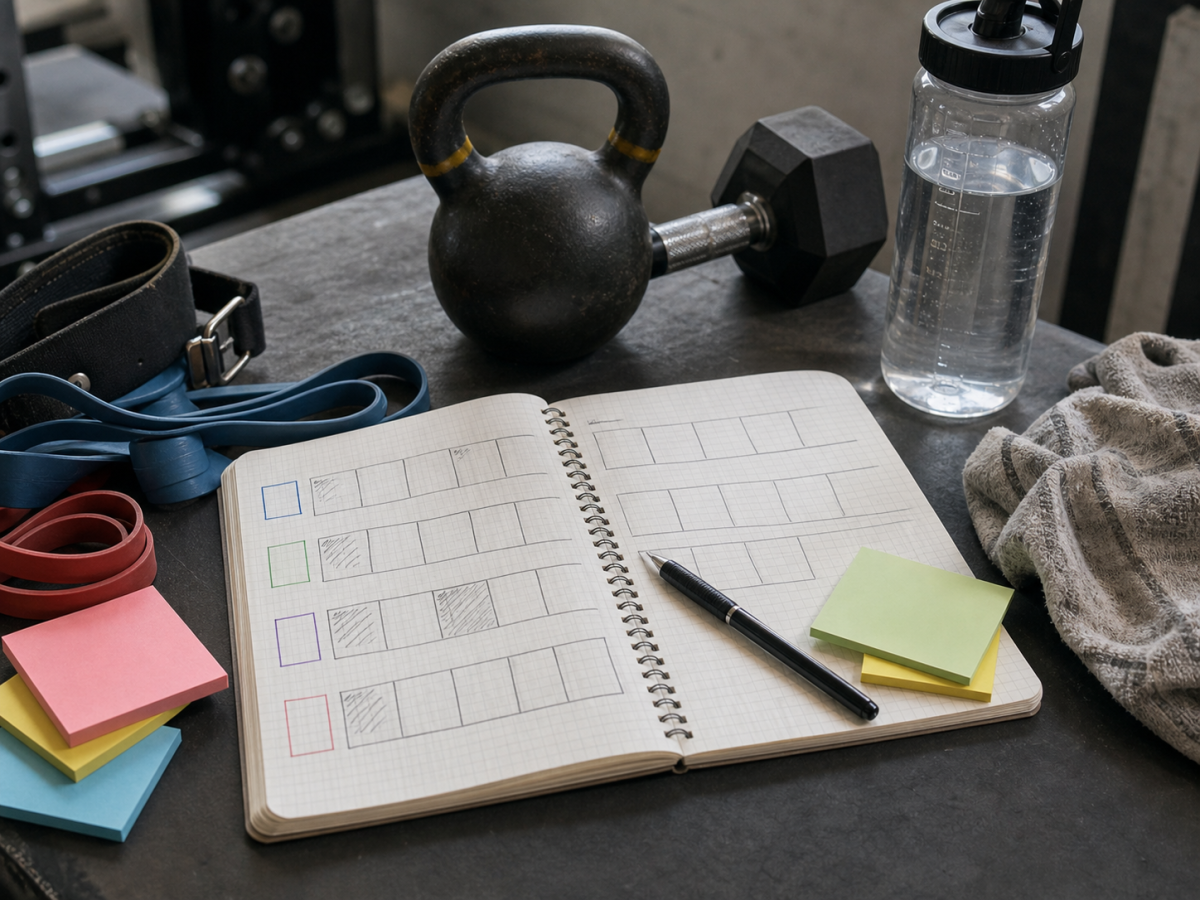
Choose your split from the number of days you can repeat for at least 8 weeks. Two or three days usually fits full-body training. Four days fits upper-lower. Five or six days fits push-pull-legs or body-part work. The best split is the one that lets you train hard, recover, and return on schedule.
Be honest here. A four-day upper-lower program done 44 weeks per year beats a six-day split you abandon by week three. If you have 45 minutes, do not pick a program that needs 90.
| Days/Week | Best Split | Example Week | Why It Works |
|---|---|---|---|
| 2 | Full body A/B | Tue, Fri | Every major pattern gets trained twice without cramming 5 gym days into a busy life. |
| 3 | Full body A/B/C | Mon, Wed, Fri | Great for beginners and lifters who want frequent practice on squats, presses, rows, and hinges. |
| 4 | Upper-lower | Mon, Tue, Thu, Fri | Enough volume for muscle and strength while keeping sessions manageable. |
| 5 | Upper-lower plus weak point | Mon, Tue, Thu, Fri, Sat | Useful if arms, shoulders, glutes, or conditioning need extra work. |
| 6 | Push-pull-legs | Push, Pull, Legs, repeat | High frequency and volume for experienced lifters who recover well. |
If you want deeper split examples, compare this framework with FitnessVolt’s full-body workout plan, 4-day upper-lower split, and push-pull-legs guide. Those pages give you ready-made versions once you know which split fits.
What Exercises Should Your Program Include?
Build the week around movement patterns before favorite exercises. Most lifters need a squat, hip hinge, horizontal push, horizontal pull, vertical push, vertical pull, single-leg pattern, loaded carry or core drill, and 1-3 isolation movements. This prevents the classic mistake: five chest exercises and zero loaded hinges.
Exercise selection should solve a job. A barbell back squat trains a squat pattern heavily. A Romanian deadlift trains a hinge without the fatigue cost of max deadlifts. A dumbbell row gives the shoulder blades a job after pressing. Machines are excellent when they let you train a muscle hard without your lower back becoming the limiting factor.
| Pattern | Primary Options | Joint-Friendly Swap | Weekly Target |
|---|---|---|---|
| Squat | Back squat, front squat, leg press | Goblet squat or hack squat | 4-8 hard sets |
| Hip hinge | Deadlift, Romanian deadlift, hip thrust | Cable pull-through or back extension | 3-6 hard sets |
| Horizontal push | Bench press, dumbbell press, push-up | Machine chest press | 6-10 hard sets |
| Horizontal pull | Barbell row, cable row, chest-supported row | One-arm machine row | 6-10 hard sets |
| Vertical push | Overhead press, dumbbell press | Landmine press | 3-6 hard sets |
| Vertical pull | Pull-up, chin-up, lat pulldown | Neutral-grip pulldown | 4-8 hard sets |
| Single-leg/core | Split squat, lunge, carry, plank | Step-up or dead bug | 2-6 hard sets |
How Many Sets, Reps, and Rest Minutes Do You Need?
Start most programs with 2-4 hard sets per exercise. Use 3-6 reps for strength, 6-12 for a strength-muscle blend, 8-15 for hypertrophy, and 12-20 for joint-friendly accessories. Rest 2-5 minutes for heavy compounds and 60-120 seconds for isolation work. Add volume only after performance is stable.
Schoenfeld’s volume meta-analysis supports a dose-response relationship between weekly resistance training volume and muscle gain, but the practical lesson is “do enough that you can recover from.” Most new lifters grow on 6-10 hard sets per muscle per week. Many intermediates do well around 10-16. Advanced lifters may need more, plus better fatigue management.
| Training Target | Reps | Sets | Rest | Effort Target |
|---|---|---|---|---|
| Max strength practice | 1-5 | 3-6 | 3-5 min | RPE 7-9, rarely 10 |
| Strength plus muscle | 5-8 | 3-5 | 2-4 min | 1-3 reps in reserve |
| Hypertrophy | 8-15 | 2-4 | 1.5-3 min | 0-3 reps in reserve |
| Isolation or rehab-friendly work | 12-20 | 2-4 | 60-120 sec | 1-3 reps in reserve |
| Power | 1-5 | 3-6 | 3-5 min | Fast reps, stop before grind |
Use the FitnessVolt one-rep max calculator if you want percentage-based loading without testing a true max. Estimated 1RM is a guide, not a dare. If 80% moves like a refrigerator, reduce the load and keep the rep quality.
How Should You Use RPE and RIR?
RPE and RIR tell you how close a set is to failure. RPE 8 usually means about 2 reps in reserve, RPE 9 means 1 rep in reserve, and RPE 10 means no quality reps left. Most working sets should live around RPE 7-9 so you train hard without making every set a max test.
Beginners usually do better with RIR because “stop with 2 reps left” is more concrete than “rate that an 8.” Experienced lifters often like RPE because it works for heavy singles, doubles, and triples. Either way, write it down. A set of 225 x 8 at RPE 7 and a set of 225 x 8 at RPE 10 are not the same signal.
Use FitnessVolt’s RPE vs RIR guide if you want a deeper conversion chart. Skip aggressive RPE 10 work if you train alone on bench press, if your technique breaks under fatigue, or if the next workout depends on being fresh.
What Is the Simplest Progression Rule?
Use double progression for most lifts: pick a rep range, keep the same weight until all sets hit the top of the range with 1-2 reps in reserve, then add 2.5-10 pounds next time. This gives you progress without forcing weight jumps on days when form or recovery is not ready.
Example: dumbbell bench press, 3 sets of 8-12. Week one: 70s for 12, 10, 9. Keep the 70s. Week two: 12, 11, 10. Keep them again. Week three: 12, 12, 12 at RPE 8. Move to 75s next time. That is progressive overload without turning every workout into an ego contest. For more background, read FitnessVolt’s progressive overload guide.
| Lift | Rep Range | This Week | Next Week Rule |
|---|---|---|---|
| Squat | 3 x 5-8 | 225 x 8, 7, 6 at RPE 8 | Keep 225 until all 3 sets hit 8 |
| Bench press | 3 x 6-10 | 185 x 10, 10, 10 at RPE 8 | Add 5 lb next session |
| Lat pulldown | 3 x 10-15 | 140 x 15, 14, 13 | Keep 140 until all sets hit 15 |
| Lateral raise | 2 x 12-20 | 20s x 20, 18 | Keep 20s until both sets hit 20 |
When Should You Deload?
Deload when performance drops for 2 consecutive workouts, warm-up weights feel unusually heavy, joint irritation climbs, or motivation falls despite normal sleep and food. A simple deload is 5-7 days at about 50-70% of normal volume while keeping easy technique practice. Do not turn the deload into a secret max week.
Most lifters do not need a scheduled deload every fourth week forever. They need a trigger. If loads are climbing, joints feel normal, and sleep is stable, keep going. If your logbook shows three red flags, reduce sets first. Keep the movement pattern, remove the recovery debt.
Do not deload by adding random new exercises. The goal is to recover from the same plan so you can resume it.
Three Sample Training Programs You Can Copy
The best starter program is the one that matches your available days. Use the 2-day plan if life is tight, the 3-day full-body plan if you want the best beginner default, and the 4-day upper-lower plan if you can recover from more volume. Run one plan for 8 weeks before judging it.
Sample Program 1: Two-Day Full Body
| Day A | Sets x Reps | Day B | Sets x Reps |
|---|---|---|---|
| Goblet squat or back squat | 3 x 6-10 | Romanian deadlift | 3 x 6-10 |
| Dumbbell bench press | 3 x 8-12 | Overhead press | 3 x 6-10 |
| Seated cable row | 3 x 8-12 | Lat pulldown | 3 x 8-12 |
| Split squat | 2 x 8-12/side | Leg press | 2 x 10-15 |
| Plank | 3 x 30-60 sec | Farmer’s carry | 3 x 30-40 yd |
This is best for busy lifters and beginners who recover slowly. Train Tuesday and Friday or Monday and Thursday. Add 1-2 reps before adding load.
Sample Program 2: Three-Day Full Body
| Monday | Wednesday | Friday |
|---|---|---|
| Squat 3 x 5-8 | Deadlift 3 x 3-5 | Front squat 3 x 6-10 |
| Bench press 3 x 6-10 | Incline dumbbell press 3 x 8-12 | Overhead press 3 x 6-10 |
| Chest-supported row 3 x 8-12 | Lat pulldown 3 x 10-12 | Cable row 3 x 10-12 |
| Romanian deadlift 2 x 8-10 | Walking lunge 2 x 10/side | Hip thrust 2 x 8-12 |
| Curl plus triceps superset 2 x 12-15 | Calf raise 3 x 10-15 | Lateral raise 3 x 12-20 |
This is our default first-draft program because it gives each pattern frequent practice. Rest at least one day between sessions. Keep deadlifts crisp at RPE 7-8.
Sample Program 3: Four-Day Upper-Lower
| Day | Main Work | Accessories |
|---|---|---|
| Upper 1 | Bench press 4 x 4-6, row 4 x 6-10 | Incline press 2 x 8-12, pulldown 3 x 8-12, triceps 2 x 12-15 |
| Lower 1 | Squat 4 x 4-6, Romanian deadlift 3 x 6-10 | Leg curl 2 x 10-15, calf raise 3 x 10-15, plank 3 x 45 sec |
| Upper 2 | Overhead press 3 x 5-8, pull-up 4 x 6-10 | Dumbbell bench 3 x 8-12, cable row 3 x 10-12, curls 2 x 12-15 |
| Lower 2 | Deadlift 3 x 3-5, front squat 3 x 6-10 | Leg press 2 x 10-15, back extension 2 x 12-15, carry 3 x 30 yd |
This suits intermediates who can train four days consistently. Keep at least 48 hours between lower-body sessions if possible.
What Should You Check Before Running the Program?
Before week one, check four things: every major movement pattern appears at least once, each muscle has a recoverable weekly set target, each lift has a progression rule, and each workout fits your real time limit. If one session is longer than 75 minutes, cut accessories before cutting compounds.
| Checkpoint | Pass Standard | Fix If It Fails |
|---|---|---|
| Schedule | You can repeat it for 8 weeks | Drop one day or use full body |
| Movement balance | Push, pull, squat, hinge, single-leg/core covered | Add the missing pattern, remove duplicate fluff |
| Volume | 6-16 hard sets per major muscle per week | Start lower, add sets only after week 3 |
| Effort | Most work lands at RPE 7-9 | Reduce load if form changes |
| Progression | Each lift has a clear “add reps or load” rule | Use double progression |
What Mistakes Ruin Beginner Programs?
The fastest way to ruin a training program is to change too many variables at once. Keep exercises stable for 4-8 weeks, progress one or two variables, and judge the plan from your logbook. Random exercise rotation feels productive, but it often prevents measurable overload.
Mistake: Starting at your maximum recoverable volume. Fix: start with 2-3 sets per exercise and add sets only if performance and joints are stable after 2-3 weeks.
Mistake: Training every set to failure. Fix: keep most compound sets at RPE 7-9 and save failure for safer isolation lifts such as curls, lateral raises, or leg extensions.
Mistake: Copying an advanced split with beginner strength. Fix: use full-body training until you can add load or reps consistently across 3 major lifts for at least 8 weeks.
Mistake: Ignoring nutrition and sleep. Fix: set a calorie target, eat enough protein, and protect 7-9 hours in bed. A perfect program cannot out-train a recovery deficit forever.
The Bottom Line
A useful training program is a repeatable week with clear rules. Pick one goal, choose the split you can actually perform, cover the major movement patterns, start with recoverable volume, track RPE or RIR, and progress with small jumps. Run the plan for 8 weeks before you rebuild it.
If you only do one thing today, fill out the split selector and movement-pattern table, then choose one sample program as your base. Your first draft does not need to be perfect. It needs to be clear enough that next Monday’s workout is already decided.
Sources
- American College of Sports Medicine. (2026). Resistance Training Prescription for Muscle Function, Hypertrophy, and Physical Performance in Healthy Adults: An Overview of Reviews. Medicine & Science in Sports & Exercise. DOI: 10.1249/MSS.0000000000003897. PMID: 41843416.
- American College of Sports Medicine. (2009). Progression Models in Resistance Training for Healthy Adults. Medicine & Science in Sports & Exercise, 41(3), 687-708. DOI: 10.1249/MSS.0b013e3181915670. PMID: 19204579.
- U.S. Department of Health and Human Services. (2018). Physical Activity Guidelines for Americans, 2nd edition. Accessed May 30, 2026.
- Schoenfeld, B. J., Ogborn, D., & Krieger, J. W. (2017). Dose-response relationship between weekly resistance training volume and increases in muscle mass: A systematic review and meta-analysis. Journal of Sports Sciences, 35(11), 1073-1082. DOI: 10.1080/02640414.2016.1210197. PMID: 27433992.
- Schoenfeld, B. J., Ogborn, D., & Krieger, J. W. (2016). Effects of Resistance Training Frequency on Measures of Muscle Hypertrophy: A Systematic Review and Meta-Analysis. Sports Medicine, 46, 1689-1697. DOI: 10.1007/s40279-016-0543-8. PMID: 27102172.
- Grgic, J., Schoenfeld, B. J., Davies, T. B., Lazinica, B., Krieger, J. W., & Pedisic, Z. (2018). Effect of Resistance Training Frequency on Gains in Muscular Strength: A Systematic Review and Meta-Analysis. Sports Medicine, 48(5), 1207-1220. DOI: 10.1007/s40279-018-0872-x. PMID: 29470825.
- Zourdos, M. C., Klemp, A., Dolan, C., et al. (2016). Novel Resistance Training-Specific Rating of Perceived Exertion Scale Measuring Repetitions in Reserve. Journal of Strength and Conditioning Research, 30(1), 267-275. DOI: 10.1519/JSC.0000000000001049. PMID: 26049792.
- Helms, E. R., Cronin, J., Storey, A., & Zourdos, M. C. (2016). Application of the Repetitions in Reserve-Based Rating of Perceived Exertion Scale for Resistance Training. Strength and Conditioning Journal, 38(4), 42-49. PMID: 27531969.