
Protein timing has been marketed like a stopwatch problem: finish the last rep, start the clock, and get a shake down before your gains disappear. That is a clean story. It is also a poor description of what determines muscle growth.
For most lifters, total daily protein, enough calories, progressive training, and consistency matter far more than whether a meal lands at 4:15 or 5:00 p.m. A 2025 meta-analysis of trials that gave lifters protein either just before or just after each session found no meaningful difference in lean mass, fat mass or chest-press strength between the two. The certainty of that evidence was low, but it points in the same direction as earlier work: the supposed anabolic window is wider and less dramatic than supplement marketing suggests.
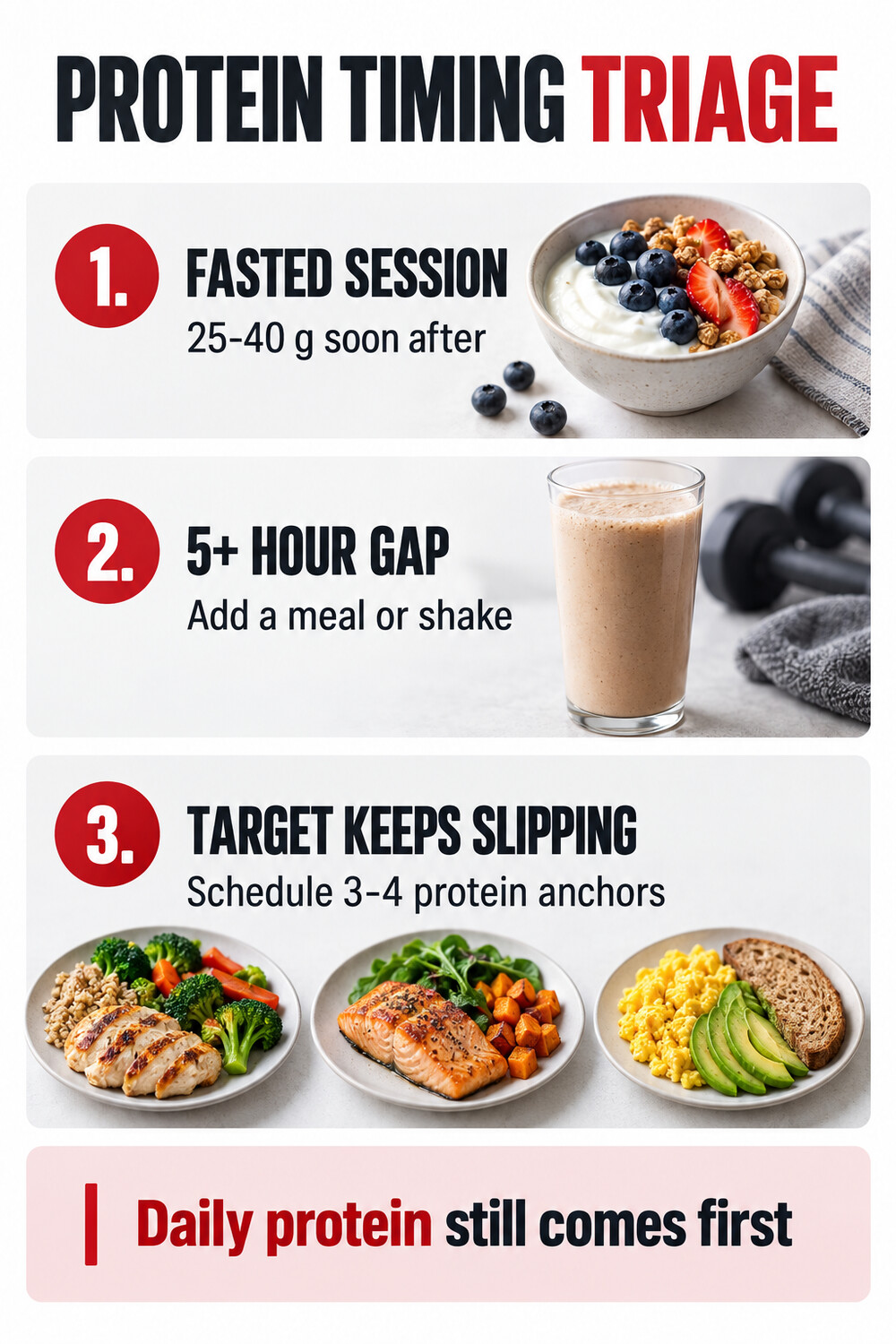
That does not make timing useless. It means timing should solve a real problem. Three situations qualify: training after a long fast, allowing a large gap between protein feedings around the workout, and repeatedly missing your daily target because meals are left to chance.
The useful hierarchy: Set a realistic daily protein target first. Spread it across three to five substantial meals. Then adjust the meal nearest training only when your schedule creates a long fast, a long gap, or a compliance problem.
Most Lifters Have the Protein Priorities Backwards
A perfectly timed 25-gram shake cannot rescue a day that finishes 70 grams short of target. Likewise, a dinner containing most of the day’s protein is not automatically wasted, but it gives you fewer opportunities to stimulate muscle protein synthesis across the day.
For resistance-trained adults, a practical daily range is about 1.6 to 2.2 grams of protein per kilogram of body weight. The lower end is enough for many people gaining or maintaining muscle. The upper end gives useful breathing room during a calorie deficit, for larger athletes, or when some protein comes from lower-quality plant sources. You can estimate a starting target with FitnessVolt’s protein calculator, then judge it by training performance, recovery, appetite, and progress.
| Priority | What to do | Why it matters |
|---|---|---|
| 1. Daily intake | Reach roughly 1.6-2.2 g/kg/day | Strongest nutrition lever for preserving and building lean mass |
| 2. Meal distribution | Use 3-5 protein-centered meals | Creates repeated useful protein doses and makes the target easier to hit |
| 3. Food quality | Favor complete, leucine-rich sources or complementary plant foods | Improves essential amino acid delivery per serving |
| 4. Workout timing | Place a meal where it fixes a real schedule gap | Useful, but rarely decisive when the first three priorities are covered |
This hierarchy is why the blanket advice to drink protein within 30 minutes is too rigid. Your muscles do not switch from receptive to closed at an arbitrary deadline.

What the Research Actually Says About the Clock
Resistance training raises muscle protein synthesis for many hours. Protein eaten before training can still supply amino acids after the session, while a mixed meal digests more slowly than a shake. That makes the relevant question less about a tiny post-workout window and more about the distance between meaningful protein feedings.
A 2025 systematic review and meta-analysis pooled the trials that directly compared protein taken before training with protein taken after it. Lean mass, fat mass and chest-press strength came out the same either way. Leg-press strength improved more when protein came before the session, but the authors say more research is needed before drawing a firm conclusion on strength. A 2013 meta-analysis found no timing effect on strength or muscle growth once other factors were controlled, with total protein intake the strongest predictor of growth. The International Society of Sports Nutrition still considers peri-workout protein a useful strategy, but not a requirement that overrides daily intake.
The practical conclusion is moderate, not absolute: timing usually offers a small optimization after the fundamentals are in place. It becomes more useful when one of the following situations creates an obvious nutritional gap.
Situation 1: You Train After an Overnight or Long Fast
If you lift at 6 a.m. after eating dinner at 7 p.m., the session begins about 11 hours after your last meal. There is no recent protein feeding covering the workout. In that situation, eating 25 to 40 grams of high-quality protein soon after training is sensible.
“Soon” does not mean sprinting to the locker room. Breakfast within roughly an hour or two is a practical target. If solid food feels heavy, a whey shake, drinkable yogurt, or soy shake can bridge the gap. If you tolerate food before training, 20 to 30 grams of protein before the session works too, and removes the need to rush afterward.
| Early-training setup | Best move | Simple example |
|---|---|---|
| You enjoy training fasted | Eat 25-40 g protein after | Greek yogurt, whey, berries, and oats |
| You can handle a small pre-workout meal | Eat 20-30 g protein before | Whey and a banana |
| You have a long or high-volume session | Add carbohydrate before or during | Protein shake plus toast, fruit, or sports drink |
The point is not that fasted training destroys muscle. It is that extending the fast for several more hours after lifting creates no clear benefit for a lifter trying to recover and grow.
Situation 2: Your Pre- and Post-Workout Meals Are More Than Five Hours Apart
Suppose lunch contains 35 grams of protein at noon, you train at 4 p.m., and dinner is not until 8 p.m. That is an eight-hour gap. Moving dinner earlier or adding a shake near training is more useful than debating whether the shake belongs before or after the first set.
A useful rule is to keep the meals bracketing training within about three to five hours of each other. The exact interval depends on meal size. A large mixed meal with 40 grams of protein digests longer than 20 grams of whey in water. Bigger meals buy more time.
Meal-gap rule: Count from the last substantial protein meal to the next one. If the gap will exceed about five hours and training sits inside it, place 20-40 grams of protein on whichever side is easiest.
This also explains why the answer to pre-workout versus post-workout protein depends on your last meal. If you ate a protein-rich lunch two hours before lifting, dinner can wait. If lunch was six hours ago, pre-workout protein has a clearer job.
Situation 3: Your Daily Target Keeps Slipping
Timing matters when it improves adherence. A lifter who needs 150 grams per day but regularly reaches dinner with 100 grams left has a planning problem, not an absorption problem.
Protein anchors solve it. Pick three or four times that already occur every day, then attach a repeatable protein serving to each one. Breakfast, lunch, after training, and dinner are obvious anchors, but the labels do not matter. The schedule does.
| Daily target | Three-meal option | Four-meal option | Five-meal option |
|---|---|---|---|
| 120 g | 40 + 40 + 40 g | 30 + 30 + 30 + 30 g | 25 + 25 + 25 + 25 + 20 g |
| 160 g | 55 + 50 + 55 g | 40 + 40 + 40 + 40 g | 35 + 30 + 30 + 30 + 35 g |
| 200 g | 70 + 60 + 70 g | 50 + 50 + 50 + 50 g | 40 + 40 + 40 + 40 + 40 g |
There is no magic in equal portions, and the body can digest far more than 30 grams at once. Distribution is about creating several productive feedings and making a large target manageable. FitnessVolt’s guide to protein pacing across four meals offers a fuller food-based template.
How Much Protein Should Each Meal Contain?
A useful starting point is about 0.4 grams per kilogram per meal across four meals. This is a planning target, not a hard cap. A 70-kilogram lifter lands near 28 grams; a 100-kilogram lifter lands near 40 grams.
| Body weight | 0.4 g/kg meal target | Practical range |
|---|---|---|
| 60 kg / 132 lb | 24 g | 25-30 g |
| 75 kg / 165 lb | 30 g | 30-35 g |
| 90 kg / 198 lb | 36 g | 35-40 g |
| 105 kg / 231 lb | 42 g | 40-50 g |
Older adults may benefit from aiming toward the upper end of the per-meal range because the muscle protein synthesis response to a small dose can be blunted with age. However, a 2024 meta-analysis in community-dwelling older adults did not find a unique advantage for a particular supplement timing or frequency. The honest takeaway is to make each meal substantial and pair adequate protein with resistance training, not to invent a special clock rule for anyone over 50.

Build a Timing Plan Around Your Actual Training Time
| Training time | Protein plan | What not to overthink |
|---|---|---|
| 6-7 a.m. | Protein before if tolerated, otherwise breakfast soon after | Whether the shake starts at minute 20 or minute 70 |
| Lunch break | Protein-rich breakfast, then lunch before or after training | Calling noon training “fasted” after a full breakfast |
| 5-7 p.m. | Protein at lunch, optional afternoon snack, dinner after | Adding a shake when lunch and dinner already cover the session |
| 9-10 p.m. | Dinner before or a lighter protein meal after | Fear that eating protein at night automatically becomes fat |
For a more individualized schedule, the nutrient timing calculator can organize meals around training time. Use the output as a template, then adjust it for appetite, sleep, digestion, and work.
Protein Timing Mistakes That Create More Work Than Results
- Adding calories you do not need: A post-workout shake is not free. If it sits on top of already adequate meals, it may push a fat-loss diet out of deficit.
- Replacing meals with supplements: Whey is convenient, but whole foods bring iron, calcium, zinc, fiber, and other nutrients a scoop does not.
- Using tiny servings: Five grams of collagen in coffee is not a complete muscle-building protein meal.
- Ignoring digestion: A huge steak immediately before heavy squats may technically contain enough protein, but it is poor workout fuel if it makes you nauseated.
- Confusing absorption with muscle use: Protein is not discarded because a meal exceeds 30 grams. The dose-response for muscle protein synthesis and the body’s ability to digest amino acids are different questions.
The Bottom Line
Protein timing is overrated when it distracts from daily intake, meal quality, and progressive training. It is useful when it closes a long fast, shortens a five-plus-hour gap around training, or turns an unreliable protein goal into three or four repeatable meals.
Set the daily target. Build protein anchors. Look at the meals before and after training. If there is no obvious gap, the stopwatch can stay off.
Frequently Asked Questions
Do I need protein within 30 minutes after lifting?
No. If you ate a protein-rich meal within a few hours before training, another meal within the next few hours is usually sufficient. A faster post-workout serving is more useful after fasted training or when the next meal is several hours away.
Is protein better before or after a workout?
Neither is universally better. Choose the side that shortens the longest gap. Protein before training is convenient when the previous meal was distant; protein after is practical after an overnight fast.
Can the body absorb more than 30 grams of protein?
Yes. The body digests and uses larger servings. Around 25 to 40 grams is a useful muscle-building meal range for many adults, but it is not an absorption ceiling.
Does protein before bed help muscle growth?
It can help when it raises daily intake or covers a long overnight gap, especially after evening training. It is optional if dinner already provides a substantial serving and the daily target is met.
Should I wake up at night to drink protein?
No. Protecting sleep is more important than adding a midnight feeding for almost every recreational lifter.
Sources
- Casuso, R. A., & Goossens, L. (2025). Does Protein Ingestion Timing Affect Exercise-Induced Adaptations? A Systematic Review with Meta-Analysis. Nutrients. DOI: 10.3390/nu17132070. PMID: 40647175.
- Morton, R. W., Murphy, K. T., et al. (2018). A systematic review, meta-analysis and meta-regression of the effect of protein supplementation on resistance training-induced gains in muscle mass and strength in healthy adults. British Journal of Sports Medicine. DOI: 10.1136/bjsports-2017-097608. PMID: 28698222.
- Kerksick, C. M., Arent, S., et al. (2017). International society of sports nutrition position stand: nutrient timing. Journal of the International Society of Sports Nutrition. DOI: 10.1186/s12970-017-0189-4. PMID: 28919842.
- Jäger, R., Kerksick, C. M., et al. (2017). International Society of Sports Nutrition Position Stand: protein and exercise. Journal of the International Society of Sports Nutrition. DOI: 10.1186/s12970-017-0177-8. PMID: 28642676.
- Schoenfeld, B. J., & Aragon, A. A. (2018). How much protein can the body use in a single meal for muscle-building? Implications for daily protein distribution. Journal of the International Society of Sports Nutrition. DOI: 10.1186/s12970-018-0215-1. PMID: 29497353.
- Hettiarachchi, J., Reijnierse, E. M., et al. (2024). The effect of dose, frequency, and timing of protein supplementation on muscle mass in older adults: A systematic review and meta-analysis. Ageing Research Reviews. DOI: 10.1016/j.arr.2024.102325. PMID: 38830547.
- Schoenfeld, B. J., Aragon, A. A., & Krieger, J. W. (2013). The effect of protein timing on muscle strength and hypertrophy: a meta-analysis. Journal of the International Society of Sports Nutrition. DOI: 10.1186/1550-2783-10-53. PMID: 24299050.