

10 Best Cable Twisting Pull Alternatives for Rotation and Pulling Strength
The Cable Twisting Pull is done standing with a cable machine. Ranked closest by our scoring: the Standing Cable Wood Chop, the Cable Standing Lift and the Pallof Press With Rotation.
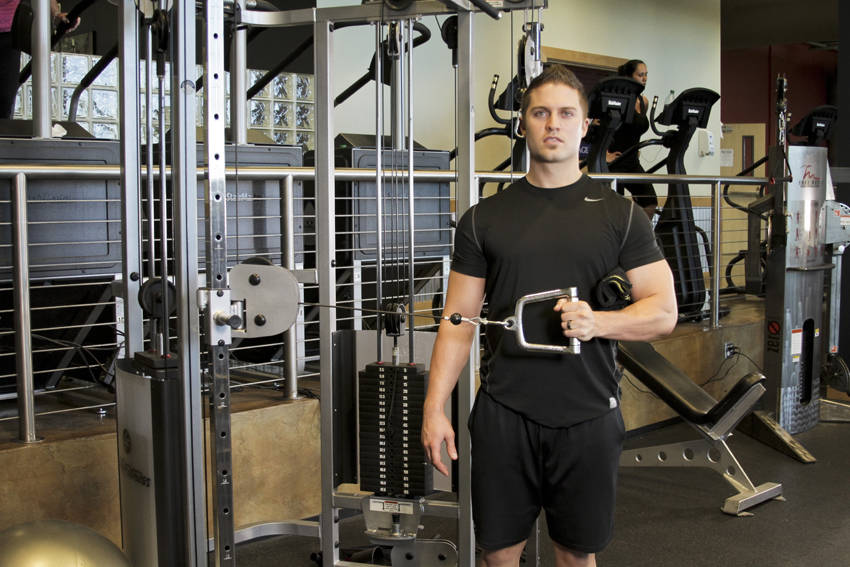
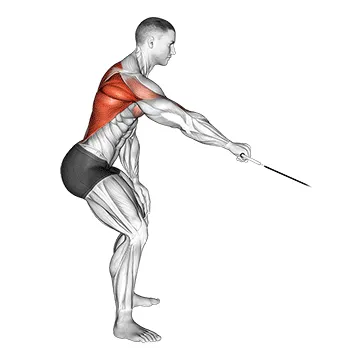
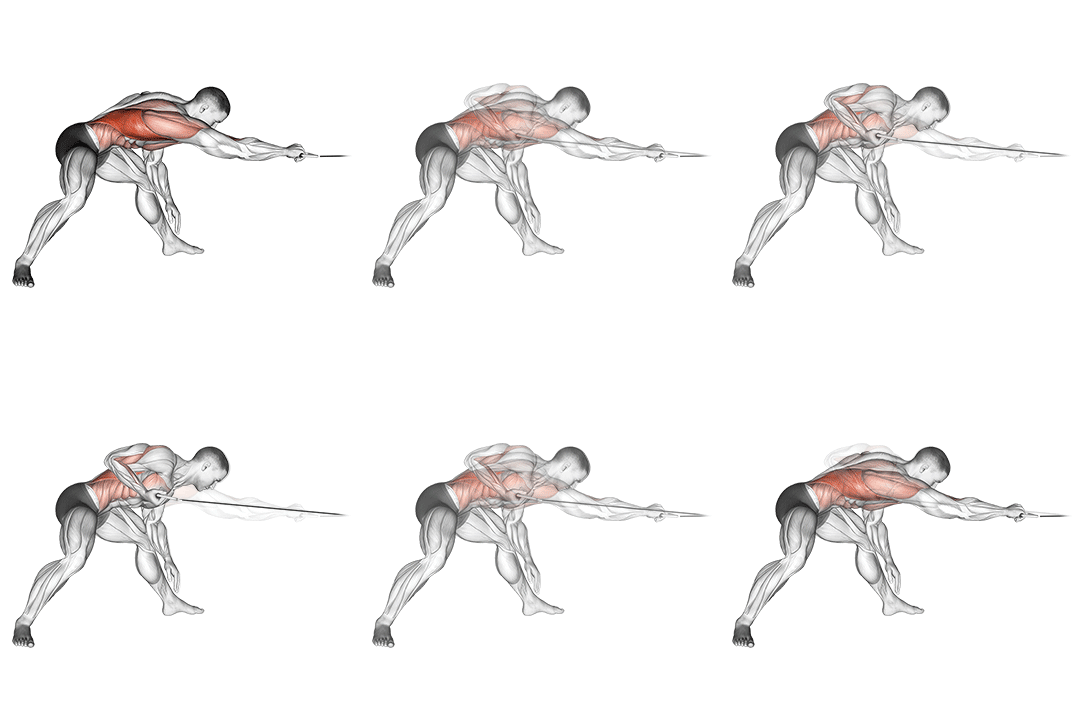
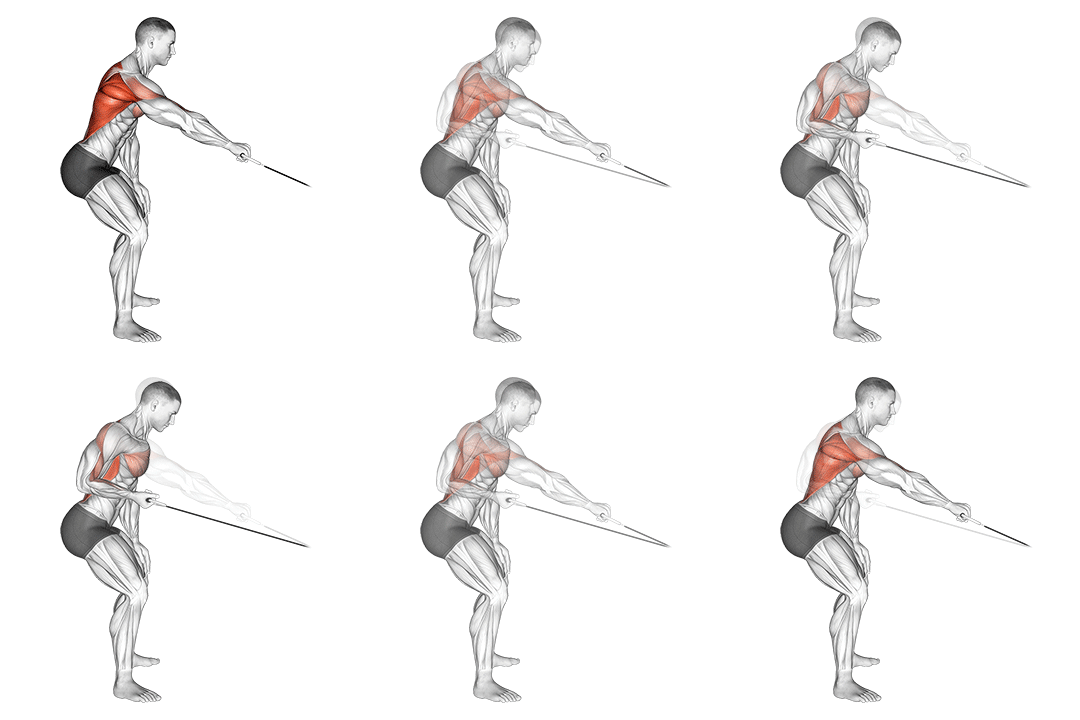
The Cable Twisting Pull has you face a low pulley, take the handle in one hand and step back until your arm is straight, then pull across your body as your torso rotates into it. The Standing Cable Wood Chop is the closest swap because it keeps that same standing twist under cable load, just from a high pulley with both hands, pulled down to your front knee, and it loads your abs instead of your lats. For a straight pull with no twist, the Cable Palm Rotational Row lands on your upper back.
Updated Ranked by our 12-factor similarity model How it works
Original Exercise: Cable Twisting Pull
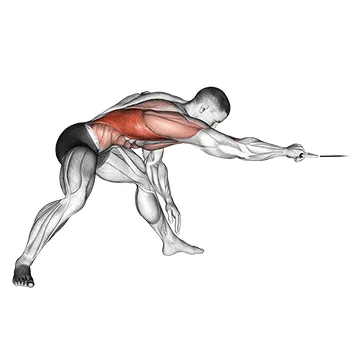
- Primary muscle
- Lats
- Equipment
- Cable
- Difficulty
- Intermediate
- Type
- Compound
Secondary muscles: Shoulders, Biceps
How to perform Cable Twisting Pull
- Attach a cable handle to a low pulley and stand facing the machine.
- Grasp the handle with your left hand and step away from the machine, extending your arm fully.
- Position your feet shoulder-width apart, with your knees slightly bent.
- Keep your back straight and your core engaged throughout the exercise.
- Pull the handle towards your body, rotating your torso to the right as you do so.
- Squeeze your back muscles at the end of the movement.
- Slowly return to the starting position, keeping tension on the cable.
- Repeat for the desired number of repetitions, then switch sides and perform with your right hand.
Ranked Cable Twisting Pull Alternatives
10 substitutes, ranked by how closely each one matches the Cable Twisting Pull on movement pattern, muscles worked, equipment and body position. The higher the score, the less you change. Open "How to perform this exercise" on a card for the steps; every card title links to that exercise's own alternatives page. Harder versions are tagged as progressions and kept out of the top spot even when they score higher.
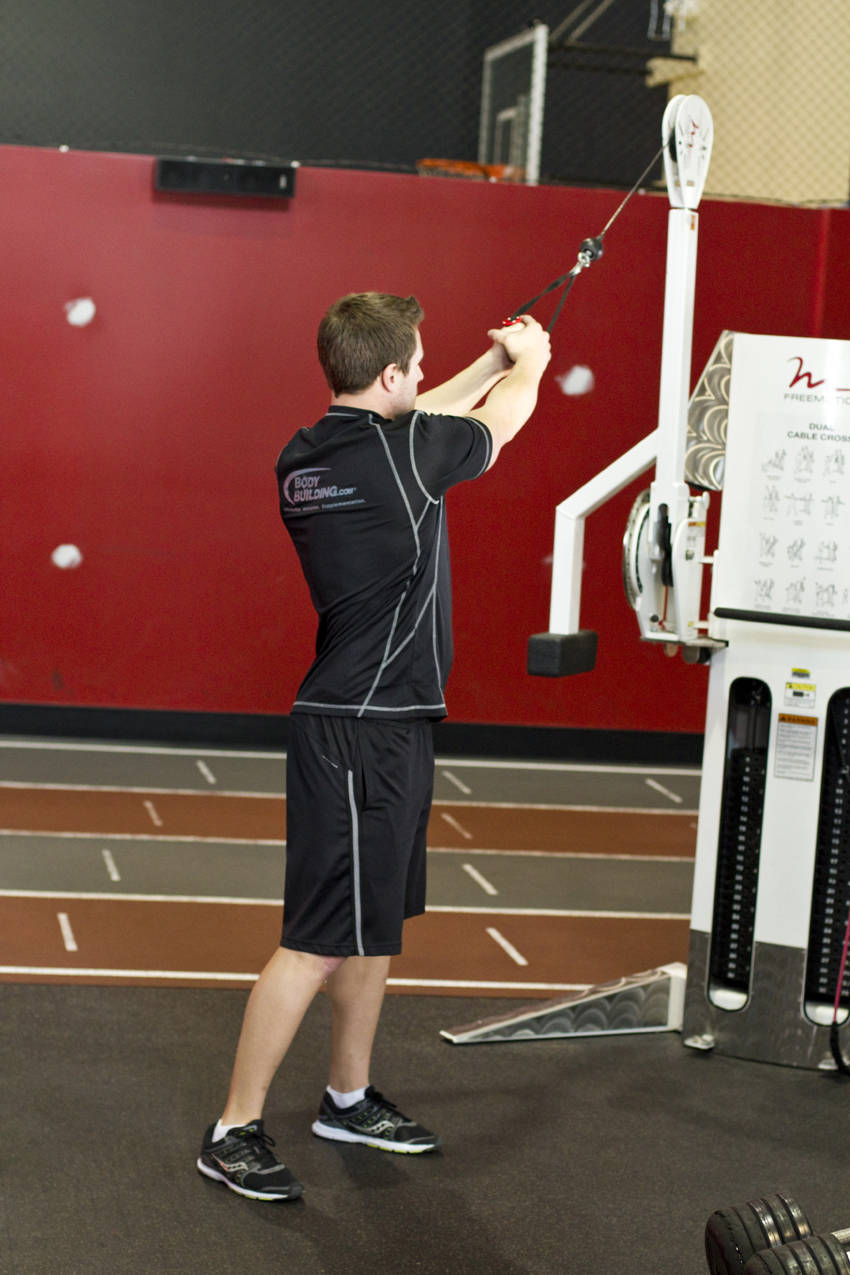
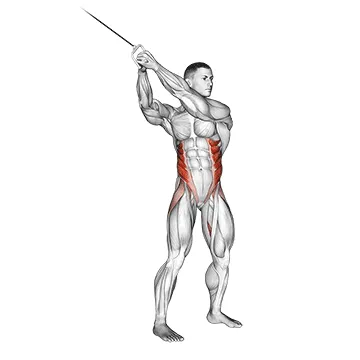
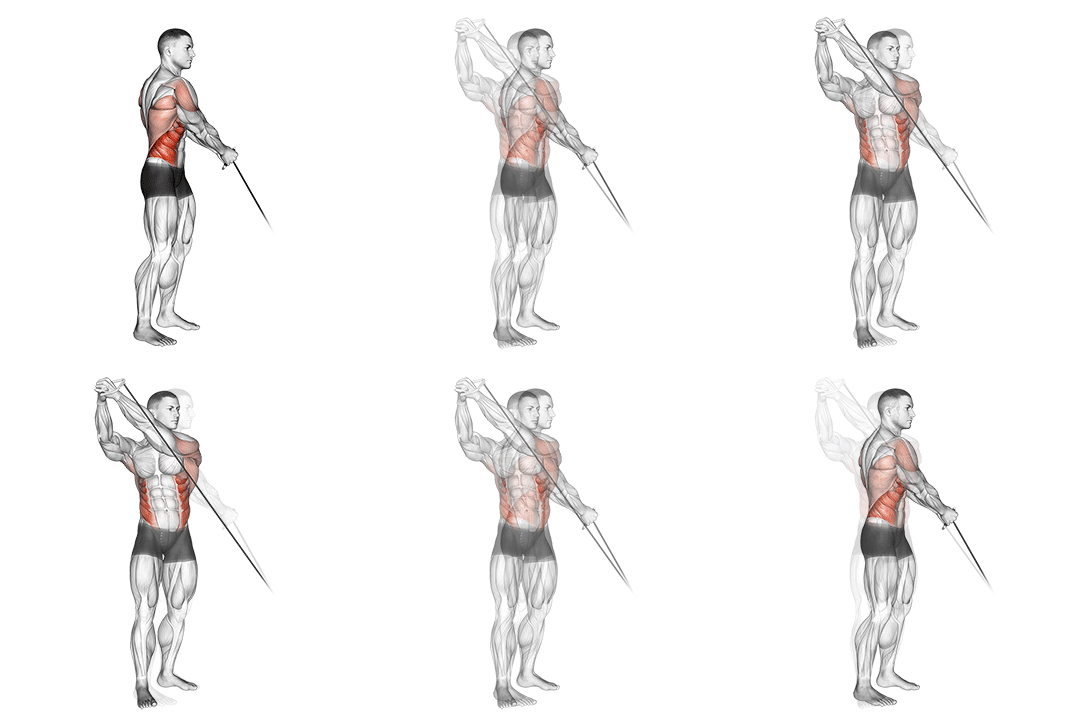
1. Standing Cable Wood Chop
80% match- Abs
- Cable
- Intermediate
- Compound
A looser match: it uses the same equipment, but it works the abs rather than the lats.
How to perform this exercise
- Connect a standard handle to a tower, and move the cable to the highest pulley position.
- With your side to the cable, grab the handle with one hand and step away from the tower. You should be approximately arm's length away from the pulley, with the tension of the weight on the cable. Your outstretched arm should be aligned with the cable.
- With your feet positioned shoulder width apart, reach upward with your other hand and grab the handle with both hands. Your arms should still be fully extended.
- In one motion, pull the handle down and across your body to your front knee while rotating your torso.
- Keep your back and arms straight and core tight while you pivot your back foot and bend your knees to get a full range of motion.
- Maintain your stance and straight arms. Return to the neutral position in a slow and controlled manner.
- Repeat to failure.
- Then, reposition and repeat the same series of movements on the opposite side.
Sets and reps: 3 or 4 sets of 6 to 10 reps on each side.
Why this matches
- Primary muscle: abs, not lats
- Equipment: a cable, the same as the Cable Twisting Pull
- Body position: standing, the same as the Cable Twisting Pull
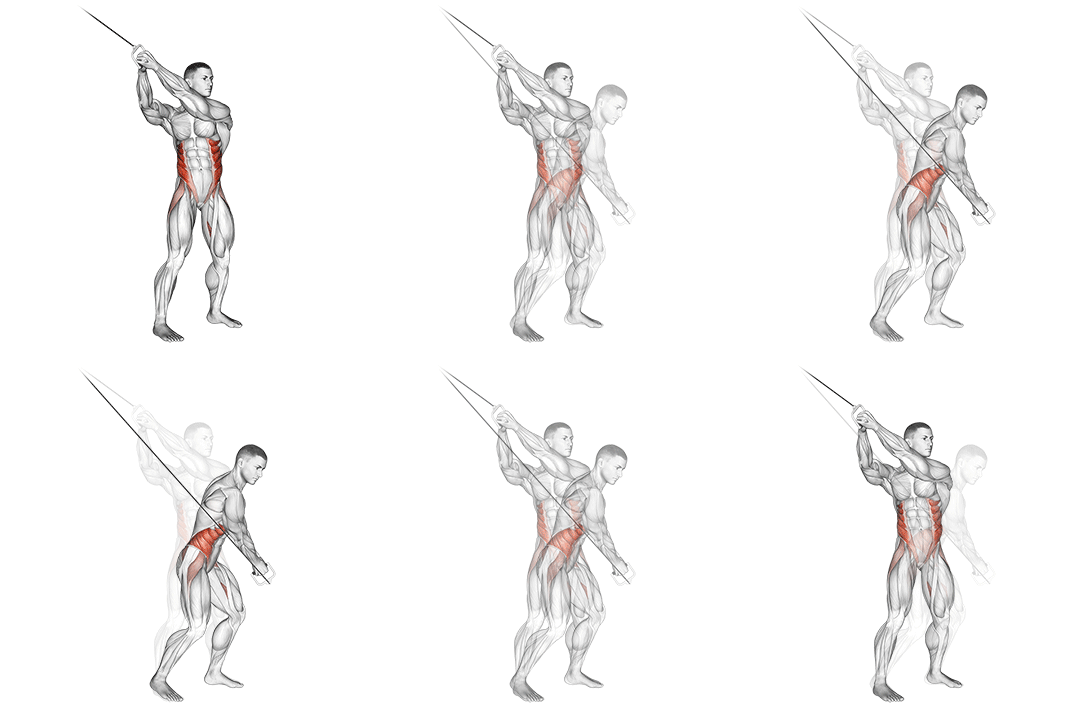
2. Cable Standing Lift
75% match- Abs
- Cable
- Intermediate
- Compound
How to perform this exercise
- Stand facing the cable machine with your feet shoulder-width apart.
- Hold the cable handle with both hands and position it at waist height.
- Engage your core and maintain a straight back throughout the exercise.
- Keeping your arms straight, exhale and lift the cable handle up towards your opposite shoulder, rotating your torso.
- Pause for a moment at the top, then inhale and slowly lower the cable handle back to the starting position.
- Repeat for the desired number of repetitions, then switch sides.
Sets and reps: 3 or 4 sets of 6 to 10 reps on each side.
Why this matches
- Primary muscle: abs, not lats
- Equipment: a cable, the same as the Cable Twisting Pull
- Body position: standing, the same as the Cable Twisting Pull
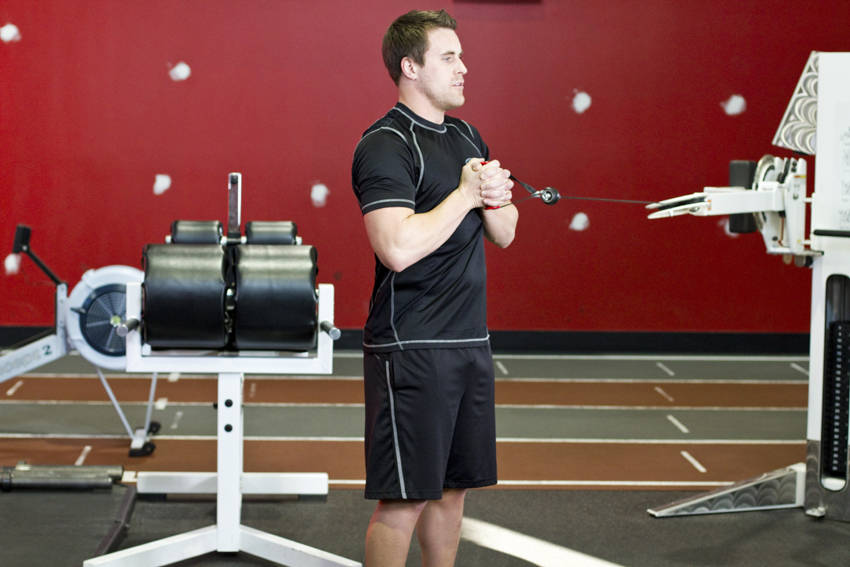
3. Pallof Press With Rotation
71% match- Abs
- Cable
- Intermediate
- Compound
How to perform this exercise
- Connect a standard handle to a tower, and position the cable to shoulder height.
- With your side to the cable, grab the handle with one hand and step away from the tower. You should be approximately arm's length away from the pulley, with the tension of the weight on the cable. Align outstretched arm with cable.
- With your feet positioned hip-width apart, pull the cable into your chest and grab the handle with your other hand. Both hands should be on the handle at this time.
- Facing forward, press the cable away from your chest. You core should be tight and engaged.
- Keeping your hips straight, twist your torso away from the pulley until you get a full quarter rotation.
- Maintain your rigid stance and straight arms. Return to the neutral position in a slow and controlled manner. Your arms should be extended in front of you.
- With the side tension still engaging your core, bring your hands to your chest and immediately press outward to a fully extended position. This constitutes one rep.
- Repeat to failure.
- Then, reposition and repeat the same series of movements on the opposite side.
Sets and reps: 3 or 4 sets of 6 to 10 reps on each side.
Why this matches
- Primary muscle: abs, not lats
- Equipment: a cable, the same as the Cable Twisting Pull
- Body position: standing, the same as the Cable Twisting Pull
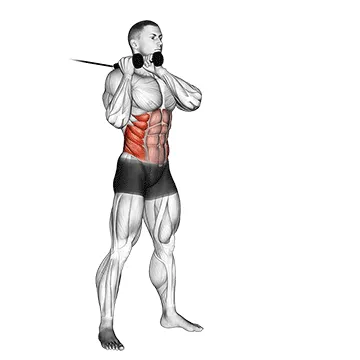
4. Cable Twist (Up-down)
68% match- Abs
- Cable
- Intermediate
- Isolation
How to perform this exercise
- Stand with your feet shoulder-width apart, facing the cable machine.
- Hold the cable handle with both hands in front of your chest, keeping your arms slightly bent.
- Engage your core and slowly rotate your torso to one side, keeping your hips and legs stable.
- Pause for a moment at the end of the rotation, then slowly return to the starting position.
- Repeat the rotation to the opposite side.
- Continue alternating sides for the desired number of repetitions.
Sets and reps: 3 sets of 10 to 15 reps on each side.
Why this matches
- Primary muscle: abs, not lats
- Equipment: a cable, the same as the Cable Twisting Pull
- Body position: standing, the same as the Cable Twisting Pull
Progression
5. Cable Judo Flip
66% match- Abs
- Cable
- Advanced
- Compound
How to perform this exercise
- Stand facing the cable machine with your feet shoulder-width apart.
- Hold the cable handle with both hands at chest level, palms facing down.
- Engage your core and rotate your torso to the right, pulling the cable across your body.
- As you rotate, pivot your back foot and allow your hips to rotate naturally.
- Extend your arms fully and finish the movement by flipping the cable handle over your shoulder.
- Return to the starting position by reversing the movement, rotating your torso back to the center.
- Repeat the movement on the opposite side.
- Continue alternating sides for the desired number of repetitions.
Sets and reps: 3 to 5 sets of 5 to 8 reps.
Why this matches
- Primary muscle: abs, not lats
- Equipment: a cable, the same as the Cable Twisting Pull
- Body position: standing, the same as the Cable Twisting Pull
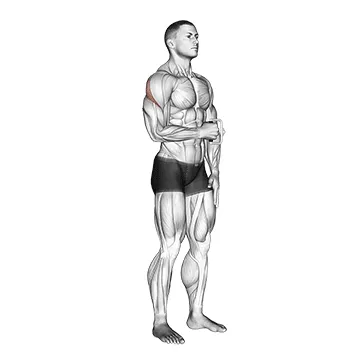
- Delts
- Cable
- Beginner
- Isolation
A looser match: it uses the same equipment, but it works the delts rather than the lats.
How to perform this exercise
- Stand with your feet shoulder-width apart and your knees slightly bent.
- Hold the cable handle with your arm extended in front of you, parallel to the ground.
- Keep your elbow slightly bent and your shoulder blades pulled back.
- Slowly rotate your arm outward, away from your body, while keeping your elbow in the same position.
- Pause for a moment at the end of the movement, then slowly return to the starting position.
- Repeat for the desired number of repetitions.
Sets and reps: 3 sets of 10 to 15 reps on each side.
Why this matches
- Primary muscle: delts, not lats
- Equipment: a cable, the same as the Cable Twisting Pull
- Body position: standing, the same as the Cable Twisting Pull
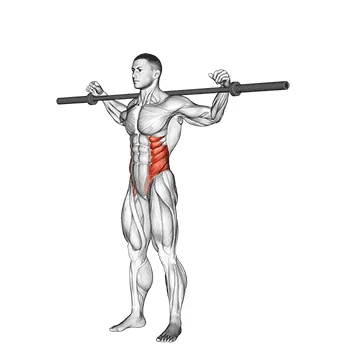
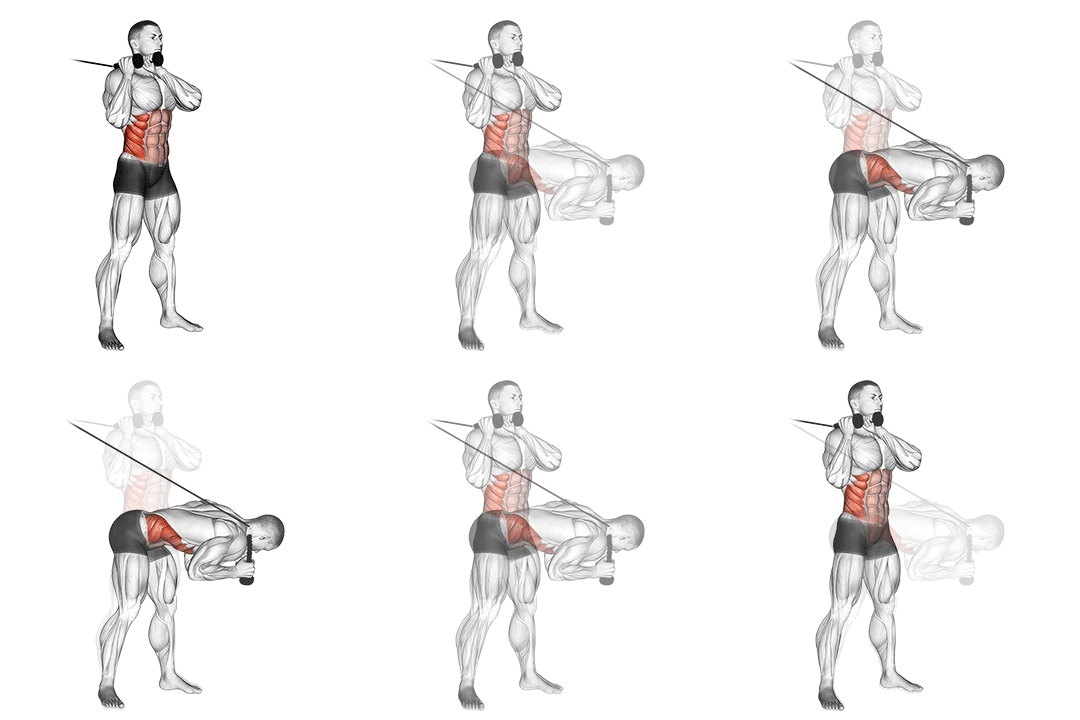
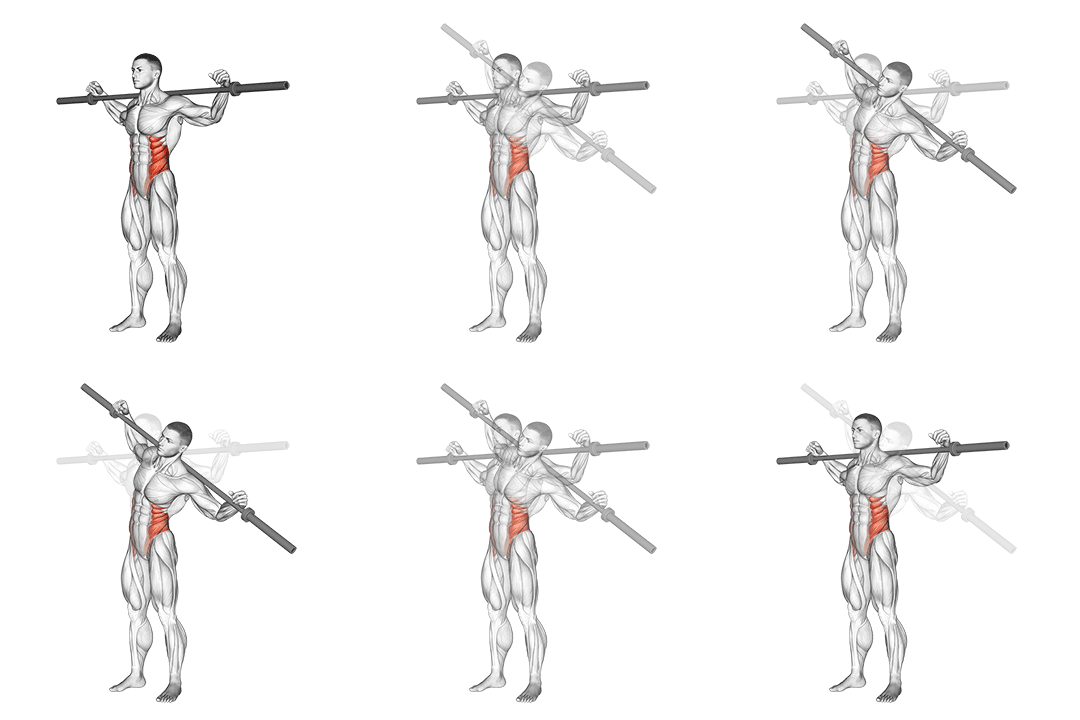
7. Barbell Side Bent
64% match- Abs
- Barbell
- Beginner
- Compound
A looser match: it works the abs rather than the lats.
How to perform this exercise
- Stand with your feet shoulder-width apart and hold a barbell with both hands, palms facing down.
- Keep your back straight and core engaged throughout the exercise.
- Slowly bend your torso to the right side, lowering the barbell towards your right knee.
- Pause for a moment, then return to the starting position.
- Repeat the movement on the left side.
- Continue alternating sides for the desired number of repetitions.
Sets and reps: 3 or 4 sets of 6 to 10 reps on each side.
Why this matches
- Primary muscle: abs, not lats
- Equipment: free weights, not a cable
- Body position: standing, the same as the Cable Twisting Pull
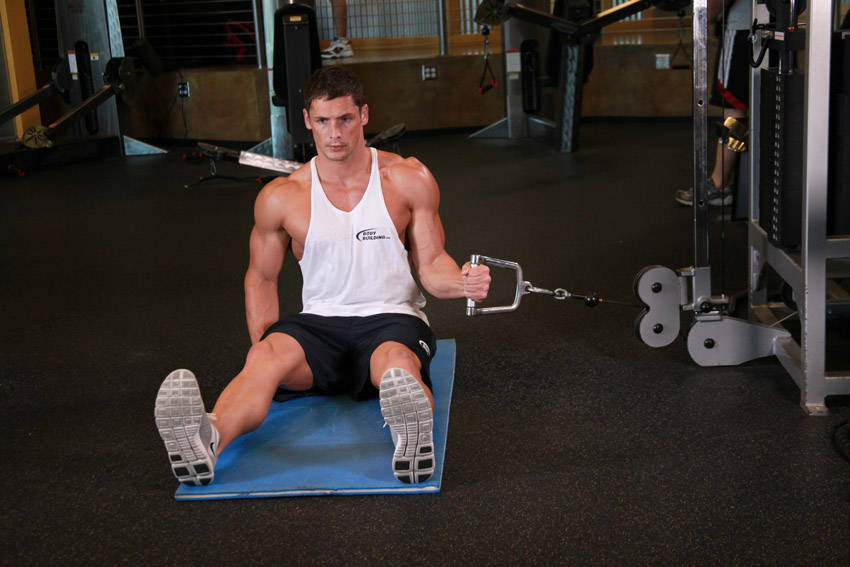
8. Cable Internal Rotation
63% match- Rotator Cuff
- Cable
- Beginner
- Isolation
How to perform this exercise
- Sit next to a low pulley sideways (with legs stretched in front of you or crossed) and grasp the single hand cable attachment with the arm nearest to the cable. Tip: If you can adjust the pulley's height, you can use a flat bench to sit on instead.
- Position the elbow against your side with the elbow bent at 90° and the arm pointing towards the pulley. This will be your starting position.
- Pull the single hand cable attachment toward your body by internally rotating your shoulder until your forearm is across your abs. You will be creating an imaginary semi-circle. Tip: The forearm should be perpendicular to your torso at all times.
- Slowly go back to the initial position.
- Repeat for the recommended amount of repetitions and then repeat the movement with the next arm.
Sets and reps: 3 sets of 10 to 15 reps on each side.
Why this matches
- Primary muscle: rotator cuff, not lats
- Equipment: a cable, the same as the Cable Twisting Pull
- Body position: standing, the same as the Cable Twisting Pull
- Balance: easier to stay steady on than the Cable Twisting Pull
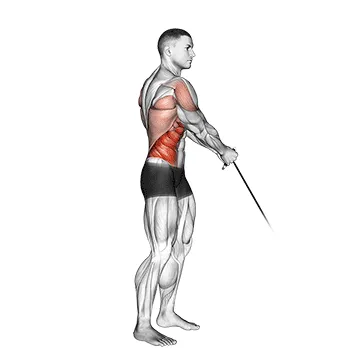
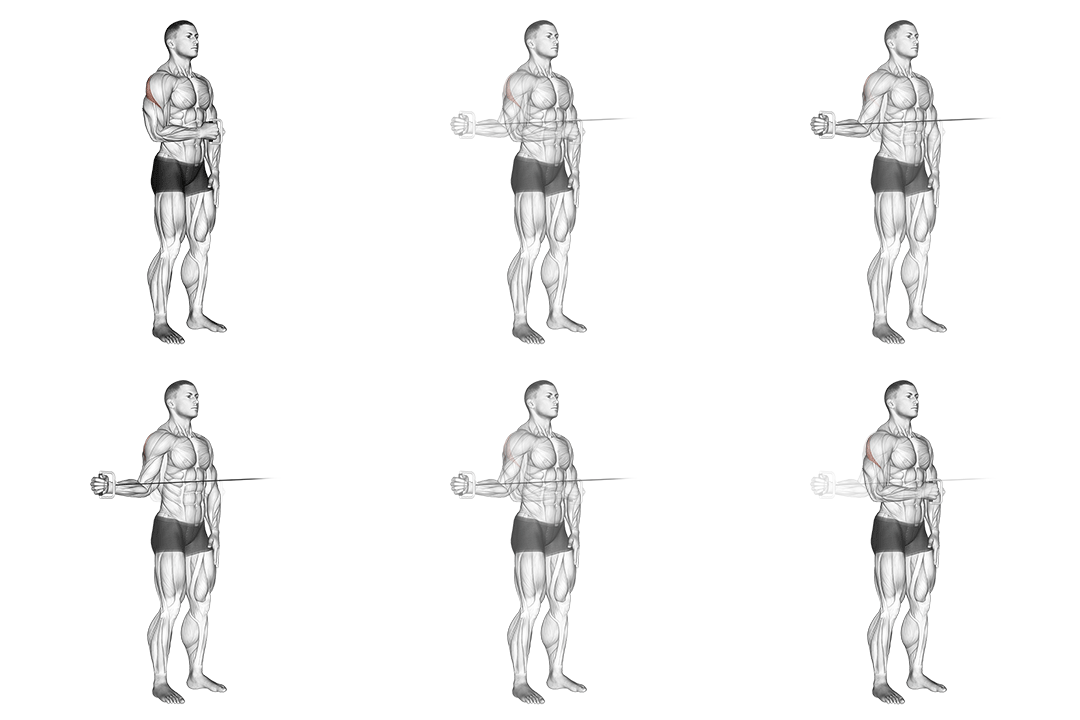
9. External Rotation With Cable
63% match- Rotator Cuff
- Cable
- Beginner
- Isolation
How to perform this exercise
- Adjust the cable to the same height as your elbow. Stand with your left side to the band a couple of feet away.
- Grasp the handle with your right hand, and keep your elbow pressed firmly to your side. We recommend you hold a pad or foam roll in place with your elbow to keep it firmly in position.
- With your upper arm in position, your elbow should be flexed to 90 degrees with your hand reaching across the front of your torso. This will be your starting position.
- Execute the movement by rotating your arm in a backhand motion, keeping your elbow in place.
Sets and reps: 3 sets of 10 to 15 reps on each side.
Why this matches
- Primary muscle: rotator cuff, not lats
- Equipment: a cable, the same as the Cable Twisting Pull
- Body position: standing, the same as the Cable Twisting Pull
- Balance: easier to stay steady on than the Cable Twisting Pull
10. Cable Palm Rotational Row
63% match- Upper Back
- Cable
- Intermediate
- Compound
How to perform this exercise
- Attach a handle to a cable machine at waist height.
- Stand facing the machine with your feet shoulder-width apart.
- Grasp the handle with an overhand grip, palms facing down.
- Step back to create tension on the cable, keeping your back straight and knees slightly bent.
- Pull the handle towards your body, rotating your palms to face upwards as you do so.
- Squeeze your shoulder blades together at the end of the movement.
- Slowly release the handle back to the starting position.
- Repeat for the desired number of repetitions.
Sets and reps: 3 or 4 sets of 6 to 10 reps on each side.
Why this matches
- Primary muscle: upper back, not lats
- Equipment: a cable, the same as the Cable Twisting Pull
- Body position: standing, the same as the Cable Twisting Pull
Why You Might Need a Cable Twisting Pull Alternative
The low pulley is not always free long enough to finish the Cable Twisting Pull on one arm and then the other, and that is why lifters look elsewhere: the cable station is taken, or you would rather pull straight instead of rotating your torso. Every one of these swaps still runs through a cable or a barbell, so none of them drop the equipment demand; what changes is the muscle you load and the motion you use. Some load the abs through a similar standing twist, a few isolate the rotator cuff on a lighter cable setting, and the Cable Palm Rotational Row keeps a straight pull toward your body without the twist. Pick based on whether you want the twist, the pull, or a lighter shoulder session.
How to Choose the Right Cable Twisting Pull Substitute
To keep the twist but change the pulley, the Standing Cable Wood Chop uses a high pulley: stand side-on, reach up for the handle, add your other hand, then pull down and across to your front knee with straight arms, loading your abs, not your lats. The Cable Standing Lift runs that twist the other way: face the machine and lift a waist-height handle toward your opposite shoulder. Without a cable station, the Barbell Side Bent is your only option: hold a bar in front of you and bend to each side toward your knee, with no pull or twist. For a lighter shoulder session, the Cable Standing Shoulder External Rotation and Cable Internal Rotation isolate the rotator cuff instead. For a straight pull, the Cable Palm Rotational Row keeps the pull without the twist, landing on your upper back.
Cable Twisting Pull FAQ
Which swap keeps a straight pull instead of a twist?
The Cable Palm Rotational Row. It uses a handle set at waist height and pulls it toward your body the way the Cable Twisting Pull does, but your torso stays square, your palms turn up as you pull, and you finish by squeezing your shoulder blades together, so it works your upper back rather than your lats.
How does the Standing Cable Wood Chop differ from the Cable Twisting Pull?
They run in opposite directions. The Cable Twisting Pull uses a low pulley and one hand: you pull the handle in toward your body while your torso turns. The Standing Cable Wood Chop sets the pulley at its highest point, takes both hands, and pulls the handle down and across to your front knee. Both twist the torso under cable load; the Wood Chop puts that load on your abs, the Twisting Pull on your lats.
Which of these alternatives suits a beginner best?
The Cable Standing Shoulder External Rotation, the Cable Internal Rotation, the External Rotation With Cable and the Barbell Side Bent are all a lighter starting point. The first three are the simplest to learn: your elbow stays fixed and only the forearm swings, so there is little technique to get wrong. The Barbell Side Bent is also straightforward, a slow bend to each side with a bar held in front of you.
Can I train the Cable Twisting Pull at home?
Not easily. Every one of these swaps still needs a cable station or a barbell, so bodyweight alone will not give you the same load. With neither piece of equipment at hand, treat this movement and its swaps as ones to save for a full gym session rather than forcing a home substitute.
Find Alternatives for Any Exercise
Search the exercise database and filter the ranked substitutes by the equipment you own.
Similarity scores compare exercise metadata such as movement pattern, muscles, equipment and body position. They are not a safety rating or a check that you own the equipment. Learn about our methodology