Walking backward looks like a gimmick. It has also been tested in a randomized controlled trial, where adults with knee osteoarthritis, the wear-related arthritis of the knee, added a short session of it to their physiotherapy three days a week.
After six weeks they reported less pain, moved better and had stronger quadriceps, the muscles at the front of the thigh, than people who did the physiotherapy alone. A third group that walked forward for the same time landed in between. The gains were modest, and they apply to a specific group of people.
What the 6-week trial tested
Researchers at King Saud University in Riyadh recruited 68 adults with knee osteoarthritis. Their average age was 55.6, and 38 of them were women. Each person was randomly placed in one of three groups.
| Group | What they did for 6 weeks |
|---|---|
| Backward walking | Standard physiotherapy plus supervised backward walking, 3 days a week |
| Forward walking | Standard physiotherapy plus supervised forward walking, 3 days a week |
| Physiotherapy only | Standard physiotherapy |
The physiotherapy was a set of knee-strengthening exercises that included straight leg raises, semi-squats and leg presses, and everyone also received ultrasound therapy on the knee before exercising.
Both walking groups walked at a comfortable speed, with five minutes of warm-up and five minutes of cool-down. The walks started at 10 minutes. Participants were told to build gradually toward 30 minutes over the six weeks, and the backward walkers did so only while their pain stayed low.
So the trial did not test backward walking on its own. It tested what happens when you add it to a strengthening program.

What changed after 6 weeks
All three groups improved. The table shows the average change in each group. The starting figure in brackets is the average for all participants.
| Measure | Backward | Forward | Physio only |
|---|---|---|---|
| Pain, 0 to 10 (start 5.9) | -1.8 | -1.5 | -1.0 |
| Knee score, lower is better (start 53.3%) | -4.8 | -3.1 | -2.2 |
| Thigh strength in kg (start 10.8) | +1.7 | +1.0 | +0.7 |
| Timed up and go in seconds (start 9.4) | -0.6 | -0.2 | -0.1 |
A few notes on the measures. The knee score comes from a questionnaire, known as the WOMAC, that asks about pain, stiffness and how hard everyday tasks are. It is given as a percentage, and the changes in the table are percentage points. Thigh strength means the quadriceps, measured with a handheld gauge while the person sat and pushed against it. The timed up and go test measures how long it takes to stand up from a chair, walk three meters, turn, walk back and sit down.
The backward walking group improved more than the physiotherapy-only group on all four measures, and those differences were statistically significant. The forward walking group’s results fell between the other two. Its differences from each of them were not statistically significant, so the trial cannot say for certain that backward beats forward.
Nobody in the trial had a serious side effect or injury.
How big was the effect?
Modest. Compared with physiotherapy alone, the extra pain relief from backward walking was 0.8 points on a 10-point scale. The extra quadriceps strength was 1 kg, and the extra speed on the up and go test was half a second.
When the researchers worked out how many people the trial needed, they assumed a clinically important difference in pain of 1.08 points between groups. The 0.8-point gap they found was smaller than that, so how much it matters to an individual patient is uncertain. Backward walking helped a little more than standard care over six weeks. It was not a cure.
Two more limits apply. The trial lasted six weeks, so it cannot say whether the benefit lasts. And every participant had knee osteoarthritis, so it says nothing about whether backward walking protects healthy knees.
Does other research agree?
Mostly yes, with the same caveat about how it was tested. Both of the studies below are meta-analyses, which pool the results of many trials.
- A 2019 review pooled 21 studies with 635 participants across several conditions. For knee osteoarthritis, adding backward walking to conventional physiotherapy for two to four weeks reduced pain and disability and improved quadriceps strength. The average quality of the studies was rated 5.4 out of 10.
- A 2026 meta-analysis of 13 randomized trials reached the same conclusion for pain and disability. Its authors noted that backward walking still needs to be tested on its own, without the rest of a rehabilitation program.
Who should and should not try it
The evidence applies to adults with knee osteoarthritis who are already doing strengthening exercises. If that is you, ask your physical therapist whether to add it. The people in the trial were supervised.
If your knees hurt but no one has diagnosed the cause, see a doctor or physical therapist first. If your knees are healthy, you can try backward walking with the same precautions, but the trial says nothing about benefits for you.
Be cautious, or skip it, in these cases:
- You have balance problems or a history of falls. You cannot see where you are going, and people with knee osteoarthritis already have a higher risk of falling. Do it only with someone beside you.
- Your knee is swollen, unstable or recovering from surgery. Get a physical therapist’s plan first.
- It makes your pain worse or you feel unsteady. Stop the session.
See a doctor promptly if your knee swells badly, locks, cannot take your weight, or is hot and red and you have a fever.
How to try backward walking safely
The trial started at 10 minutes, three days a week, at a comfortable speed. The build-up below is a way to reach that starting dose without rushing. It was not part of the study.
| Stage | Where | What to do, 3 days a week |
|---|---|---|
| 1 | A clear hallway, or beside a kitchen counter | 3 walks of 1 minute with a minute of rest between, keeping a hand near the wall or counter |
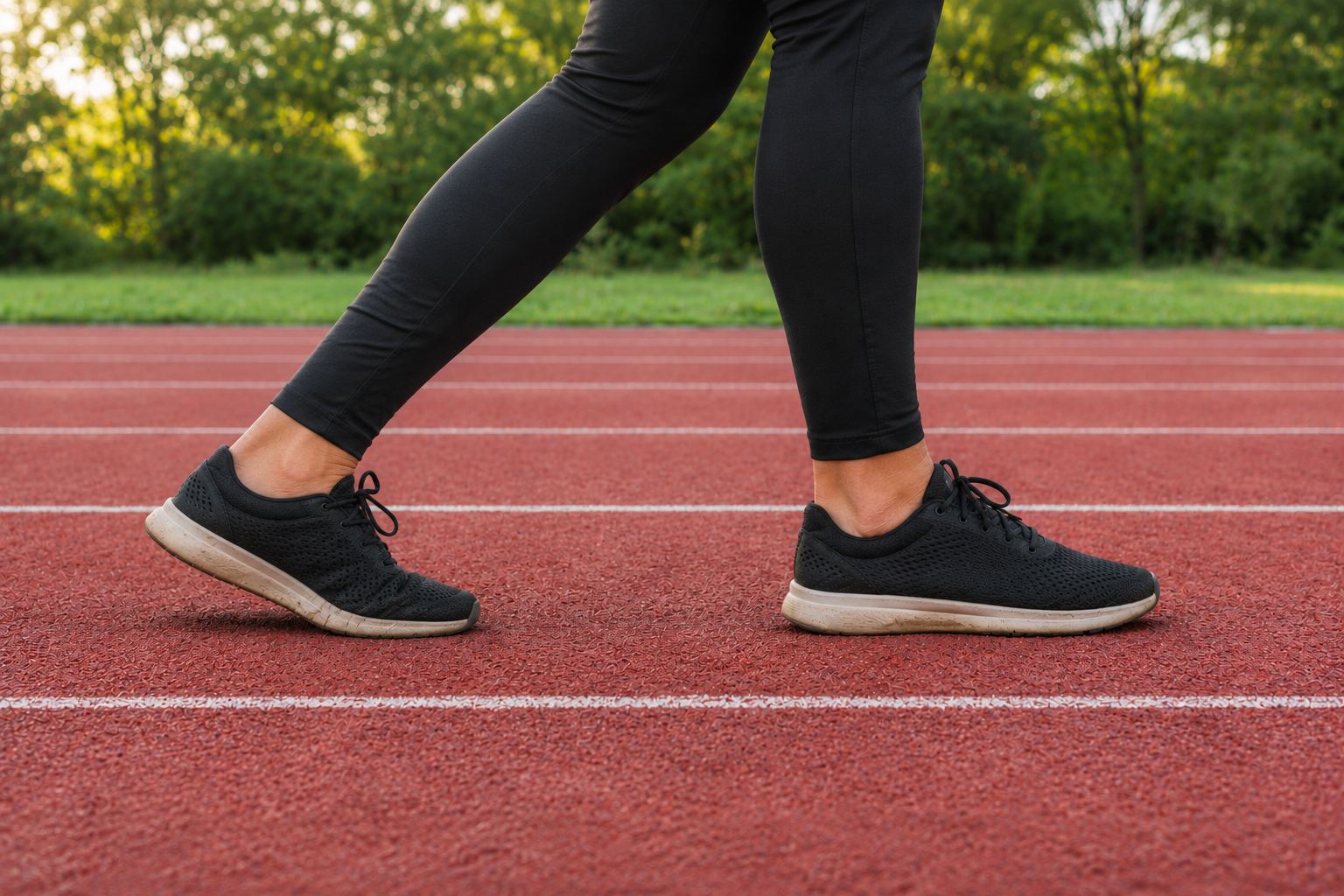
| 2 | An empty running track or a quiet, flat path | 5 minutes without stopping |
| 3 | The same place | 10 minutes without stopping |
Move to the next stage when the current one feels steady and your knees feel no worse the next day. Once 10 minutes is comfortable, you can add time gradually, as the trial did, up to 30 minutes. Use a treadmill only once flat ground feels steady, and follow the steps further down.
Technique
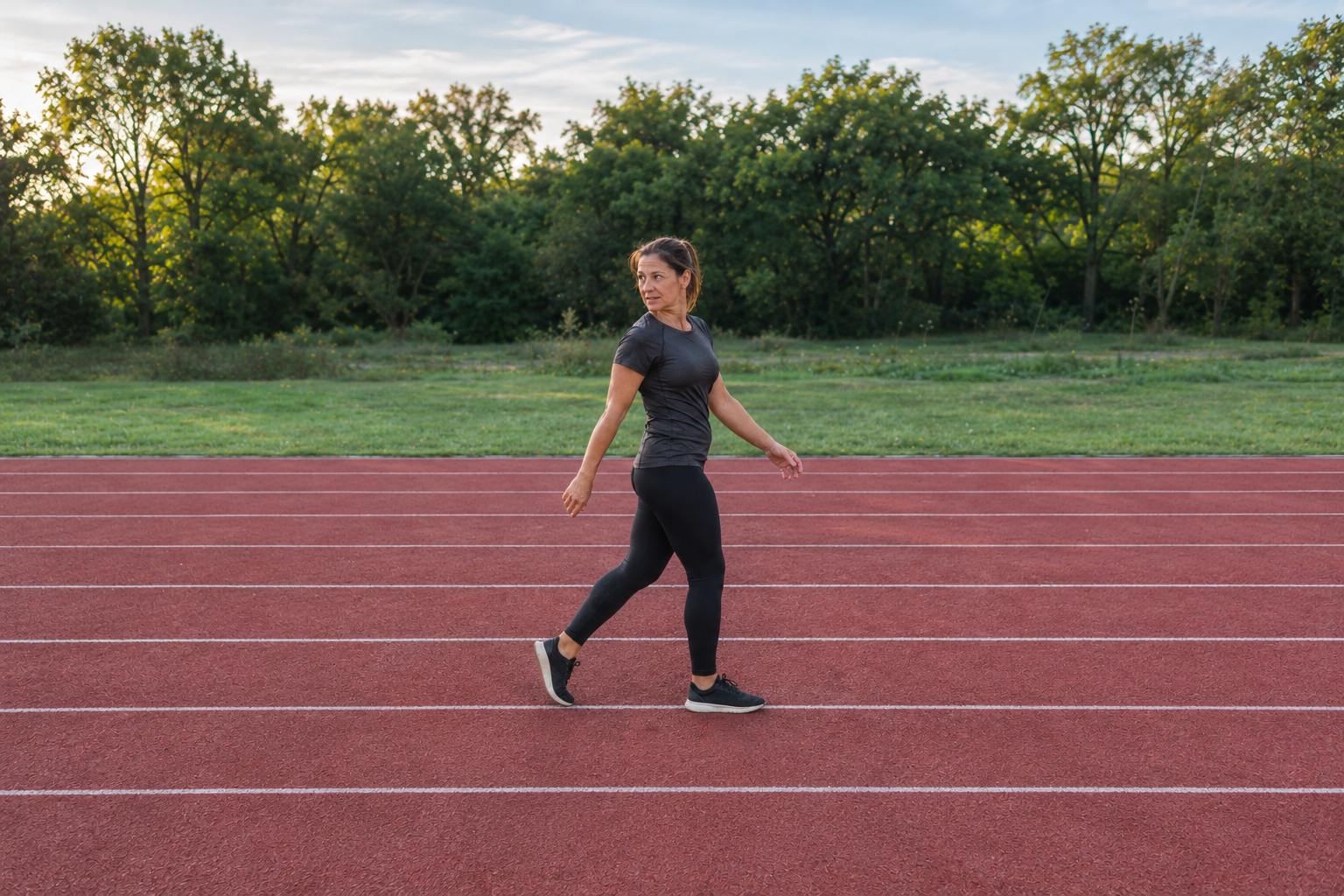
- Stand tall and look straight ahead. Glance over your shoulder every few steps. If turning your head upsets your balance, stop first and then look.
- Reach back with your toes, then roll down onto your heel.
- Take short steps. Speed comes later, if at all.
- Keep your arms swinging as they do when you walk forward.
On a treadmill
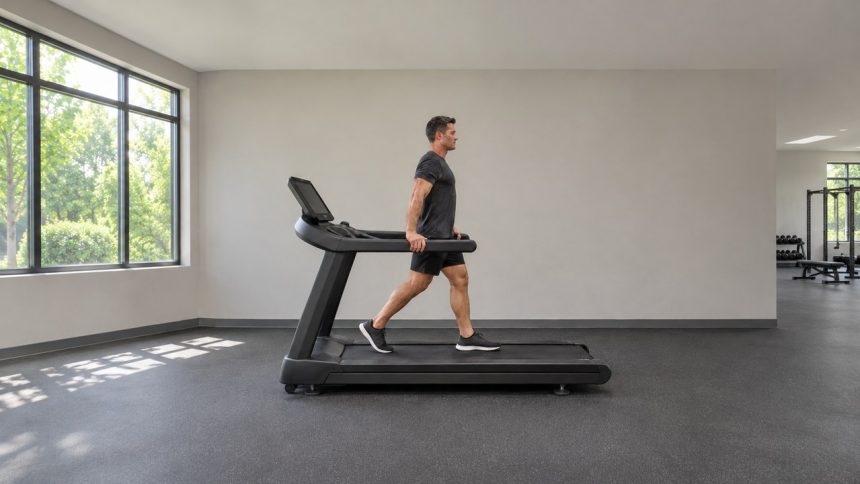
A treadmill removes the problem of obstacles, but it adds a moving belt, and you will be facing away from the controls. If you have knee osteoarthritis, have a physical therapist set up your first session and choose the speed. Otherwise, have someone stand beside the machine who can reach the controls, and follow these steps in order:
- Clip the safety key to your clothes.
- Stand on the side rails facing away from the console, and hold both handrails.
- Have the belt started at its slowest setting. Keep hold of both rails and step onto the belt one foot at a time.
- Keep both hands on the rails the whole time.
- To stop, hold the rails, step onto the side rails and then have the belt stopped.
Keep the speed slow. There is no reason to go fast.
Where it fits in your week
In the trial, backward walking came on top of strengthening exercises. Treat it the same way and keep your strength work.
- As a warm-up: a short, comfortable walk before your strengthening exercises, if your knees tolerate it. The trial did not test this use.
- As a separate session: 10 minutes on three days a week is where the trial started.
- With gym training: our knee-friendly leg day shows how to train quads and glutes around sore knees, and these ways to prevent knee pain at the gym cover set-up and exercise choice.
If you have a sled, pulling it while walking backward is a loaded version of the same pattern. The knee trials did not test sled pulling, so treat it as a separate exercise. See our sled pull guide.
Backward walking: common questions
Why would walking backward help a sore knee?
The explanation is less settled than the results. Rehabilitation researchers have long suggested that walking backward may lower the compressive force on the joint behind the kneecap, which is one reason it has been used in knee rehab programs.
Does walking backward burn more calories than walking forward?
At the same speed and incline, it took more effort in one lab study. Seventeen young adults walked at 3.5 mph, and going backward produced higher oxygen use, a higher heart rate and a higher rating of effort than going forward. In practice you will walk backward much more slowly than you walk forward, so do not count on it as a calorie burner.
Is a treadmill better than flat ground?
The 2026 meta-analysis found larger effects in trials that used a treadmill and in trials that used a comfortable speed. That comes from comparing different studies with each other, so treat it as a hint. Use whichever one you can do safely.
How long before I notice a difference?
The trial measured results at six weeks, and the trials in the 2019 review ran for two to four weeks. If your symptoms are not improving, review the program with your physical therapist.
The bottom line
In adults with knee osteoarthritis, adding supervised backward walking to physiotherapy three days a week led to a little less pain, a little more quadriceps strength and slightly better movement after six weeks than physiotherapy alone. It has not been shown to help healthy knees or to work by itself. If you want to try it, start beside a wall, take short steps and build up to 10 minutes.
Sources
- Alghadir, A. H., Anwer, S., Sarkar, B., Paul, A. K., & Anwar, D. (2019). Effect of 6-week retro or forward walking program on pain, functional disability, quadriceps muscle strength, and performance in individuals with knee osteoarthritis: a randomized controlled trial (retro-walking trial). BMC Musculoskeletal Disorders, 20(1), 159. DOI: 10.1186/s12891-019-2537-9. PMID: 30967128.
- Balasukumaran, T., Olivier, B., & Ntsiea, M. V. (2019). The effectiveness of backward walking as a treatment for people with gait impairments: a systematic review and meta-analysis. Clinical Rehabilitation, 33(2), 171-182. DOI: 10.1177/0269215518801430. PMID: 30229667.
- Lin, L. H., Peng, Y. L., Yen, L. W., Tsai, Y. L., & Cheng, C. H. (2026). Effectiveness of backward walking exercises combined with conventional rehabilitation programs on managing pain intensity and disability in patients with knee osteoarthritis: a systematic review and meta-analysis of randomized controlled trials. Physiotherapy Theory and Practice, 42(1), 217-231. DOI: 10.1080/09593985.2025.2550532. PMID: 40924430.
- Chaloupka, E. C., Kang, J., Mastrangelo, M. A., & Donnelly, M. S. (1997). Cardiorespiratory and metabolic responses during forward and backward walking. Journal of Orthopaedic & Sports Physical Therapy, 25(5), 302-306. DOI: 10.2519/jospt.1997.25.5.302. PMID: 9130146.
- Myatt, G., Baxter, R., Dougherty, R., Williams, G., Halle, J., Stetts, D., & Underwood, F. (1995). The cardiopulmonary cost of backward walking at selected speeds. Journal of Orthopaedic & Sports Physical Therapy, 21(3), 132-138. DOI: 10.2519/jospt.1995.21.3.132. PMID: 7742838.