A single weight plate is one of the cheapest pieces of gym equipment you can own, and most people only ever slide it onto a bar. Held in your hands, it works as a goblet weight, a press, a row and a core tool. That is enough for a full-body session.
This workout uses one plate and six moves, and it takes 15 minutes. Below you will find which plate to pick, the full circuit, the form for every move and a plan for making it harder once it gets easy.
Which plate to use
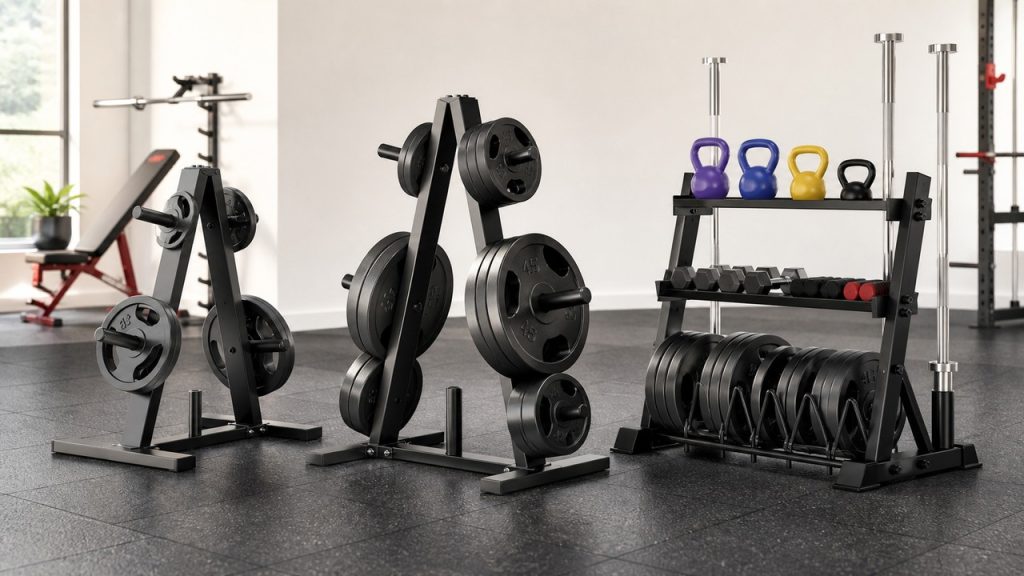
Any round plate works. A rubber bumper plate is the most comfortable to hold against your chest, and a plate with grip holes cut into it is the easiest to press and row. A plain iron plate is fine too. Hold it by the edges at the 3 o’clock and 9 o’clock positions unless a move says otherwise.
Choose a plate you can control through every move. The overhead press is the limit for most people, so test that first: if you cannot press the plate for 40 seconds without your lower back arching, go down a size.
| Your level | Starting plate |
|---|---|
| New to strength training | 10 lb, or a 5 kg plate |
| Training for 6 months or more | 25 lb, or a 10 kg plate |
| Experienced lifter | 35 to 45 lb, or a 15 to 20 kg plate |
These are starting points, and the pound and kilogram plates are the nearest common sizes, not exact matches. If your only plate is heavier than 25 lb, three moves change: do the warm-up halos with empty hands, hold the squeeze press still at your chest for the full 40 seconds, and do the twist with the plate hugged to your chest or with no plate at all.
The 15-minute weight plate circuit
Warm up for two minutes first, then start the 15-minute clock. For the warm-up, do 10 bodyweight squats, 10 arm circles in each direction and 10 slow halos. For a halo, hold the plate at chest height and circle it around your head, keeping it close, five times each way.
Set an interval timer to 40 seconds of work and 10 seconds of rest for 18 rounds. Do each move for 40 seconds and use the 10 seconds to set up the next one. Six moves make one five-minute round. Go straight into the next round, and stop after three.
| Order | Move | Main muscles |
|---|---|---|
| 1 | Plate squat | Quads, glutes |
| 2 | Plate overhead press | Shoulders, triceps |
| 3 | Bent-over plate row | Upper back, lats, biceps |
| 4 | Plate reverse lunge | Glutes, quads, hamstrings |
| 5 | Plate squeeze press | Chest, shoulders |
| 6 | Plate Russian twist | Abs, obliques |
Work the clock, not a rep target. Move at a steady pace you can hold for the full 40 seconds. Count your reps in round one and try to match them in round three.
The order mixes lower-body, upper-body and core moves, so you can keep going for five minutes without putting the plate down for long.
How to do each move
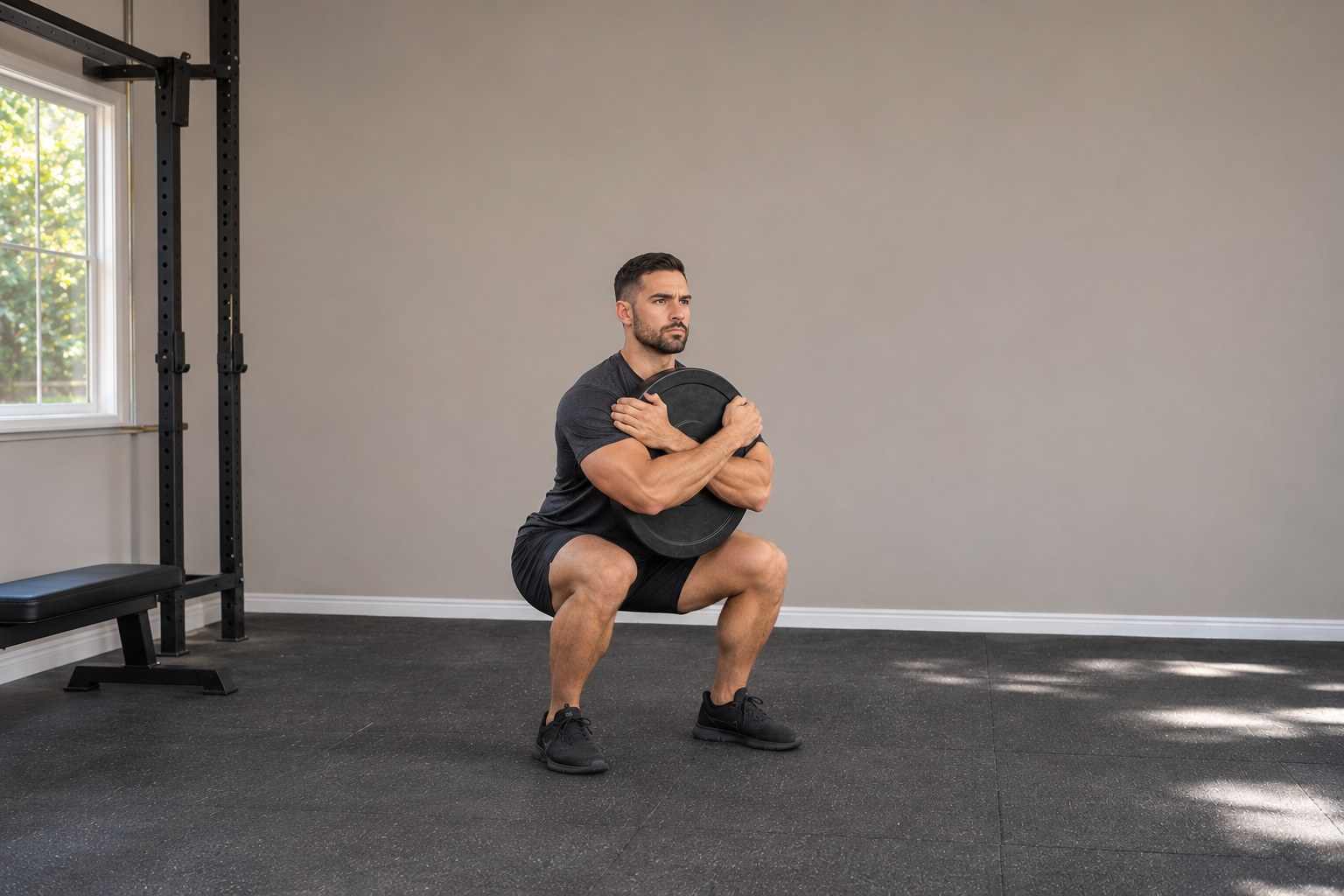
1. Plate squat
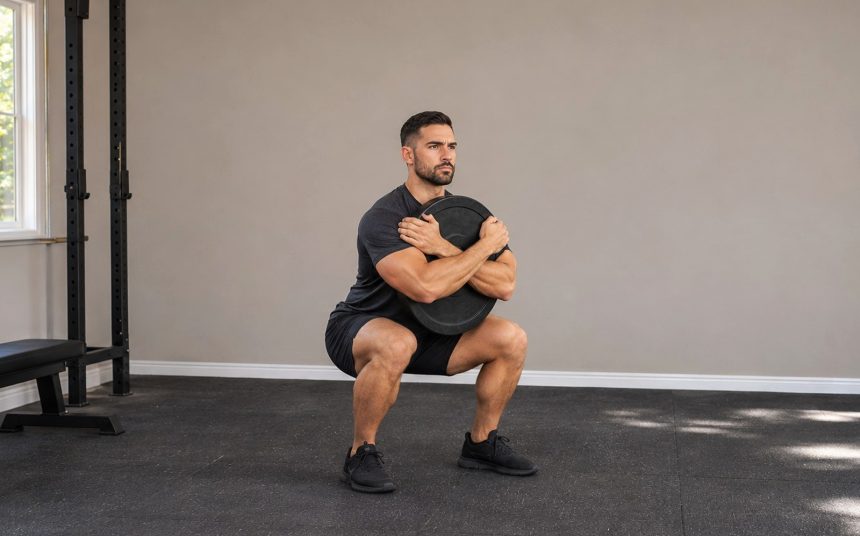
Hug the plate flat against your chest with both arms, or hold it by the edges under your chin. Stand with your feet shoulder-width apart and your toes turned out slightly. Sit your hips back and down until your thighs are at least level with the floor, keeping your heels down and your chest up. Drive through your whole foot to stand.
Holding the weight in front of your body acts as a counterbalance, which makes it easier to stay upright and squat deep.
2. Plate overhead press
Hold the plate upright by its edges at chest height, with one flat face toward you and your elbows pointing down. Squeeze your glutes and brace your abs. Press the plate straight up until your arms are locked and the plate is over the crown of your head, then lower it under control to your chest.
Keep your ribs down. If your lower back arches as the plate goes up, the plate is too heavy or your abs have switched off. Dry your hands before this move, and use the grip holes if your plate has them.
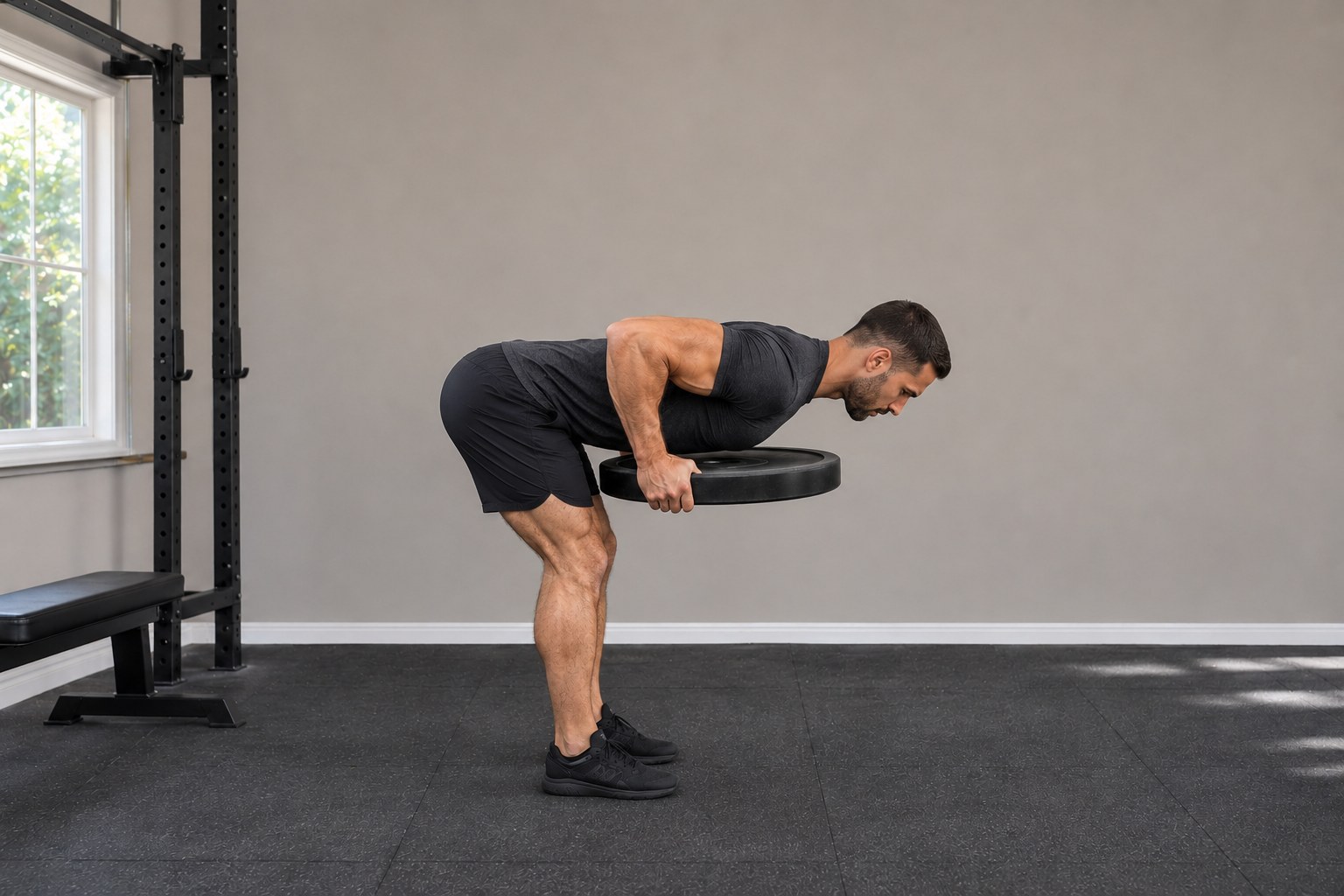
3. Bent-over plate row
Hold the plate by its edges, or by its grip holes if it has them, with straight arms. Push your hips back and bend your knees a little until your chest is close to level with the floor. Keep your back flat. Pull the plate to your lower ribs, squeeze your shoulder blades together for a second, and lower it until your arms are straight.
Your torso should not bounce up and down. If it does, or if your back starts to round, stand a little taller and slow the rep.
4. Plate squeeze press
Stand tall and press your palms flat against the two faces of the plate, fingers pointing forward, with the plate at chest height. Squeeze your hands together as hard as you can. Keep squeezing while you push the plate straight out in front of your chest until your arms are straight, then bring it back.
The squeeze is the point of this move. Pressing your hands inward keeps the chest muscles working through the whole rep, so a light plate is enough as long as you squeeze hard. Our plate press guide covers the lying version.
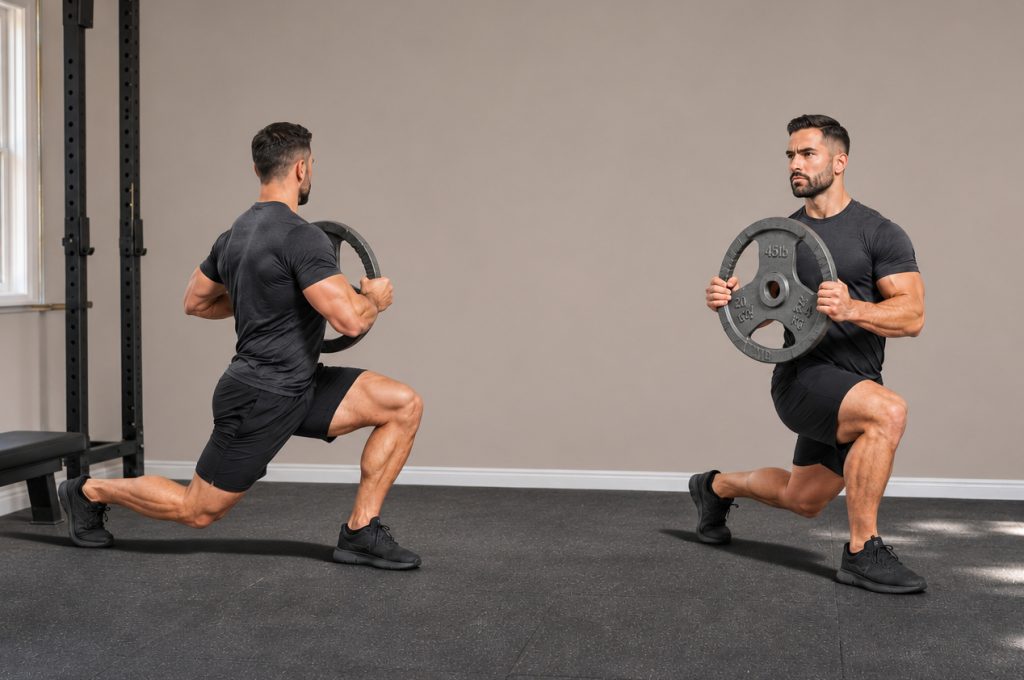
5. Plate reverse lunge
Hold the plate against your chest. Step one foot straight back and lower until your back knee is just above the floor and your front thigh is level with the floor. Push through your front heel to return to standing. Switch legs each rep.
Your front foot stays planted the whole time, but the move still takes balance. Stand next to a wall or chair if you need a hand. If lunges hurt your knees, shorten the range or leave them out and do a second set of squats.
6. Plate Russian twist
Sit on the floor with your knees bent, your heels down and your back straight. Hold the plate close to your chest. Brace your abs and turn your shoulders slowly to the right, then to the left, through a range that feels comfortable. Your eyes and chest follow the plate, and your lower back stays straight.
Start upright. When that is easy, lean back a little until your abs tighten, and later lift your feet an inch off the floor. If twisting bothers your back, hold the lean-back position without moving instead. See our Russian twist guide for more options.
How often to do it
The World Health Organization advises adults to do muscle-strengthening activity that involves all the major muscle groups, at moderate or greater intensity, on two or more days a week. Two or three sessions of this circuit meet the frequency part of that advice, provided the plate is heavy enough to make each move a real effort.
- As your only strength training: three days a week with a day between, such as Monday, Wednesday and Friday.
- Alongside gym sessions: use it on a day when you cannot get to the gym, in place of the session you would miss.
- As a finisher: one round at the end of a regular workout.
How to make it harder without a second plate
You will outgrow a fixed weight if you do the same thing every week. Use the four steps below in order. Move to the next step when you can match your round-one reps in round three on every move, and keep each change as you add the next.
| Step | Change | What it does |
|---|---|---|
| 1 | Take three seconds to lower each squat, press, row and lunge rep | Makes each rep harder at the same weight |
| 2 | Add a fourth round | Adds five minutes and a third more work |
| 3 | Switch to one-leg and one-arm versions | Makes one leg or arm handle more of the load |
| 4 | Cut the set-up time from 10 seconds to 5 | Leaves less time to recover between moves |
For step 3, swap the squat for a split squat with your back foot on a stable chair, and the row for a one-arm row with your free hand on the chair and a firm grip on the plate’s edge or grip hole. Split each 40 seconds evenly between your two sides. The other four moves stay as they are.
Two mistakes to avoid
- Pressing a slippery plate overhead. Sweaty hands and a smooth iron plate are a bad mix above your head. Dry your hands, and use a rubber-coated plate or one with grip holes for the press.
- Dropping the plate between moves. Set it down under control. A plate landing on its edge can roll or chip a floor.
Common questions
Is 15 minutes with a light plate enough to build muscle?
It can be, if the sets are hard. A meta-analysis of 21 studies compared training with light loads and heavy loads when every set was taken to the point where no more reps were possible. Muscle growth was similar with both, and gains in maximum strength were greater with heavy loads. So light loads can build muscle when the sets are challenging, while raising a one-rep max generally needs heavier training on that lift. The circuit gives you 18 working sets across the whole body.
Can I use a dumbbell or kettlebell instead?
Yes for five of the six moves. The squeeze press needs a plate or another flat object you can press between your palms. If you own a kettlebell, our one-kettlebell workout is built for it.
What else can I do with a plate?
The plate front raise trains the front of the shoulders, and the plate pinch is one of the simplest grip exercises there is. Add either one after the circuit if you have time left.
The bottom line
One plate, six moves and 40 seconds each: squat, press, row, lunge, squeeze press and twist. Three rounds take 15 minutes and train your legs, back, chest, shoulders, arms and core. When it gets easy, work through the four steps above before you reach for a heavier plate.
Sources
- Bull, F. C., Al-Ansari, S. S., Biddle, S., Borodulin, K., Buman, M. P., Cardon, G., et al. (2020). World Health Organization 2020 guidelines on physical activity and sedentary behaviour. British Journal of Sports Medicine, 54(24), 1451-1462. DOI: 10.1136/bjsports-2020-102955. PMID: 33239350.
- Schoenfeld, B. J., Grgic, J., Ogborn, D., & Krieger, J. W. (2017). Strength and hypertrophy adaptations between low- vs. high-load resistance training: a systematic review and meta-analysis. Journal of Strength and Conditioning Research, 31(12), 3508-3523. DOI: 10.1519/JSC.0000000000002200. PMID: 28834797.