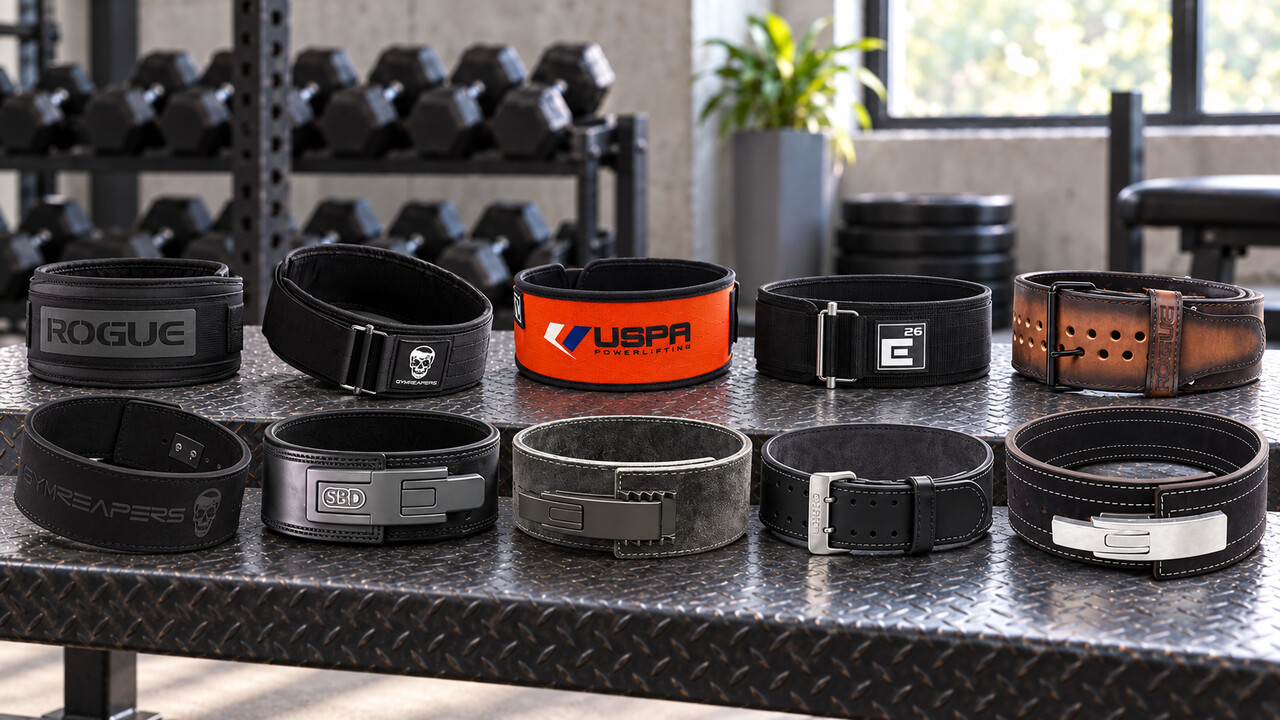
Short on time? The Rogue USA Nylon Lifting Belt is our top pick for mixed training: its tapered nylon panel and roller buckle suit squats, deadlifts, and higher-rep bodybuilding work. If you are training for powerlifting, start with the SBD 10mm Lever Belt or Gymreapers 10MM Lever Belt instead.
A good lifting belt does not fix weak bracing, but it can give your trunk something firm to brace against when the weight gets serious. The right belt depends on how you train: nylon and quick-lock belts are easier to adjust between exercises, while 10mm leather lever belts make more sense for heavy squats, deadlifts, and powerlifting-style work.
You can spend about $35 on a quick-lock nylon belt or more than $300 on a premium leather lever belt. Spend for the closure, stiffness, and adjustment range your training needs. A beginner doing mixed gym work has little reason to pay for a meet-focused lever belt.
Written by Matthew Magnante, ACE. Reviewed by Tom Miller, CSCS. Last updated: October 2, 2026.
Quick Picks
| Category | Pick | Why It Wins | Price Checked |
|---|---|---|---|
| Best Overall Nylon Belt | Rogue USA Nylon Lifting Belt | Comfortable, fast to adjust, broad training fit | $59.50 |
| Best Budget Quick-Lock | Gymreapers Quick Locking Belt | 4-inch nylon belt with steel release roller | $34.97 |
| Best CrossFit/Oly Belt | 2POOD USPA 4 Inch Belt | Functional-fitness focused 4-inch belt | $64.99 |
| Best Self-Locking Value | Element 26 Self-Locking Belt | Metal self-locking buckle and nylon body | $34.97 sale / $49.99 MSRP |
| Best Leather Prong | Rogue Faded 4 Inch Belt by Pioneer | Pioneer Cut half-inch adjustments | $162.50 |
| Best Value Lever | Gymreapers 10MM Lever Belt | 10mm leather lever belt at a midrange price | $150 |
| Best Premium Powerlifting | SBD 10mm Lever Belt | Premium IPF-approved competition belt | $310 |
| Best Adjustable Lever | Pioneer 4 Inch 10mm PAL V2 Lever Belt | Lever convenience with better adjustment range | $131-$136 |
| Best Olympic Leather | Eleiko Weightlifting Leather Belt | Premium weightlifting-focused leather design | Quote/check current price |
| Best Classic Lever | Inzer Forever Lever Belt 10MM | Classic 10mm lever belt with many sizes/colors | $129.95 |
How We Chose These Lifting Belts
We rank these belts by construction, closure design, adjustment range, sizing, value, and suitability for the named training category. For mixed sessions, a nylon belt earns its place through quick adjustment and a profile that leaves room to move. For powerlifting, we give more weight to leather thickness, buckle security, and the federation’s equipment rules. We also consider manufacturer sizing charts, warranty terms, and current retailer availability. The star scores reflect those editorial criteria, rather than treating a $35 nylon belt and a $310 competition belt as interchangeable. Measure your waist at the belt position before ordering, and check the exact model against your meet’s rules. Prices, colors, and stock can change.
Belts work best when you already know how to brace. They can help increase trunk stiffness and provide a surface to press your abdomen against, but they do not replace good technique, smart loading, or trunk strength. If your squat or deadlift hurts, the fix is not simply cranking a belt tighter.
Best Overall Nylon Belt: Rogue USA Nylon Lifting Belt

Rogue USA Nylon Lifting Belt
Best Overall Nylon BeltChoose the tapered nylon panel and roller buckle for mixed sessions; dedicated powerlifters should compare the leather lever belts below.
Pros
- Made in the USA
- 5-inch back tapers to 4 inches in front
- Fast buckle and roller adjustment
Cons
- Less rigid than leather
- Hook-and-loop closures wear sooner than prong or lever systems
The Rogue USA Nylon Lifting Belt is the best overall pick for lifters who want one belt for mixed training. Rogue lists it as made in the USA with a 5-inch back panel that tapers to 4 inches in front, a 3-inch nylon support strap, 0.25-inch foam frame, ripstop exterior, and a buckle-and-roller setup for quick adjustment.
Choose this if your training includes squats, deadlifts, rows, Olympic-lift accessories, carries, and higher-rep bodybuilding work. Skip it if you are specifically training for a powerlifting meet or want the locked-in feel of 10mm leather. This belt is supportive, not brutally stiff.
Compared with the Gymreapers Quick Locking Belt, Rogue costs more but gives you a wider back panel and a tapered front rather than a uniform 4-inch profile. Its roller adjustment also lets you change tightness without repositioning standard lever hardware.
Best Budget Quick-Lock: Gymreapers Quick Locking Weightlifting Belt

Gymreapers Quick Locking Weightlifting Belt
Best Budget Quick-LockStart with this $35 quick-lock belt for mixed gym sessions; its uniform 4-inch nylon profile costs less than the tapered Rogue.
Pros
- Consistent 4-inch width
- 6.35mm nylon construction
- Steel release roller
Cons
- Not ideal for maximal powerlifting
- Velcro closure can wear with heavy long-term use
The Gymreapers Quick Locking Weightlifting Belt is the easiest low-cost recommendation on this list. Gymreapers lists a consistent 4-inch width, 0.25-inch/6.35mm thickness, 100% nylon construction, Velcro fastening, and a durable steel release roller. At the sale price we checked, it sits in impulse-buy territory compared with leather belts.
Choose it if you are a beginner, bodybuilder, or functional fitness athlete who wants fast tightening and release. Skip it if you already squat and deadlift heavy enough to justify a leather lever belt. Nylon can support hard training, but it does not feel like a broken-in 10mm leather belt under maximal loads.
Compared with Element 26, the Gymreapers belt is similar in use case but leans more toward a traditional quick-lock nylon setup. Compared with Rogue, it is cheaper and less premium.
Best CrossFit/Oly Belt: 2POOD USPA 4 Inch Weightlifting Belt

2POOD USPA 4 Inch Weightlifting Belt
Best CrossFit/Oly BeltThe uniform 4-inch profile and WODClamp closure suit functional-fitness sessions where you need to loosen the belt between barbell and conditioning work.
Pros
- 4-inch functional-fitness profile
- WODClamp-style secure closure
- Strong size range
Cons
- Less rigid than leather
- More specialized than a basic nylon belt
The 2POOD USPA 4 Inch Weightlifting Belt is the best pick for lifters whose training looks more like CrossFit or Olympic lifting than pure powerlifting. 2POOD lists the current USPA belt at $64.99, with a 4-inch belt profile and functional-fitness-friendly closure design.
Choose it if you cycle through cleans, snatches, squats, deadlifts, and conditioning pieces where a fast-adjusting belt matters. Skip it if your main goal is a one-rep-max squat or deadlift. A thick leather lever belt will give a more rigid wall to brace against.
Compared with Rogue’s tapered nylon belt, the 2POOD has a uniform 4-inch profile and WODClamp closure. It costs more than Element 26, so choose it for that closure and fit rather than expecting nylon to match a leather lever belt’s rigidity.
Best Self-Locking Value: Element 26 Self-Locking Weightlifting Belt

Element 26 Self-Locking Weightlifting Belt
Best Self-Locking ValueChoose the metal self-locking buckle for fast adjustment during mixed sessions; the 4-inch nylon body remains less rigid than leather.
Pros
- Full metal self-locking buckle
- 100% premium nylon
- Uniform 4-inch profile
Cons
- Not as stiff as leather
- Sizing still matters despite the adjustability
The Element 26 Self-Locking Weightlifting Belt is a smart value choice for lifters who dislike traditional Velcro belts. Element 26 lists 100% premium nylon, a full metal self-locking buckle, a uniform 4-inch profile, and competition-ready positioning for Olympic lifting and functional fitness.
Choose this if you want quick release, strong adjustability, and a belt that does not need a painful break-in period. Skip it if you want a powerlifting-specific leather belt or the thickest possible support for maximal squats.
Compared with Gymreapers Quick Locking, Element 26’s main differentiator is the self-locking buckle design. Compared with the Rogue USA Nylon Belt, it is cheaper and more minimal.
Best Leather Prong: Rogue Faded 4 Inch Lifting Belt by Pioneer

Rogue Faded 4 Inch Lifting Belt by Pioneer
Best Leather ProngHalf-inch Pioneer Cut adjustments suit lifters who change tightness between lifts, while 8.5mm leather keeps this below heavy powerlifting-belt stiffness.
Pros
- Made in the USA by Pioneer
- 8.5mm vegetable-tanned sole leather
- Pioneer Cut half-inch adjustments
Cons
- Less stiff than 10mm or 13mm belts
- Costs much more than nylon
The Rogue Faded 4 Inch Lifting Belt by Pioneer is the best leather prong belt for lifters who want premium materials without jumping to a lever. Rogue lists it as made in the USA from 100% vegetable-tanned sole leather with a black suede liner, 4-inch width, 8.5mm thickness, and Pioneer Cut hole spacing.
The Pioneer Cut is the reason this belt stands out: half-inch adjustment increments are more useful than standard one-inch jumps when your preferred tightness changes between squats, deadlifts, meals, and bodyweight phases. Skip it if you want maximum stiffness. An 8.5mm prong belt is supportive but not as rigid as a 10mm or 13mm powerlifting belt.
Compared with the Inzer Forever Lever, this belt is easier to fine-tune between sets. Compared with nylon, it is heavier, more expensive, and more supportive under heavy barbell work.
Best Value Lever: Gymreapers 10MM Lever Belt

Gymreapers 10MM Lever Belt
Best Value LeverSpend less than SBD pricing for 10mm leather and a conventional lever; choose Pioneer PAL if you change tightness between lifts.
Pros
- 10mm leather construction
- 4-inch height
- Heavy-duty lever buckle
Cons
- More belt than casual lifters need
- Lever changes are less convenient than prong adjustments
The Gymreapers 10MM Lever Belt is the value lever pick for lifters moving from general training into serious strength work. Gymreapers lists 10mm thickness, 4-inch height, vegetable-tanned leather, Amara suede, reinforced stitching, and a heavy-duty lever buckle.
Choose this if you want powerlifting-style support without paying SBD pricing. Skip it if you need fast adjustments across many exercises or if you mostly train machines and dumbbells. Lever belts are great when the setting stays consistent, but they are clumsy when you need several tightness levels in one session.
Compared with the SBD 10mm Lever Belt, Gymreapers is far cheaper. Compared with the Pioneer PAL V2, it is less convenient to adjust but simpler if you always use one setting.
Best Premium Powerlifting Belt: SBD 10mm Lever Belt

SBD 10mm Lever Belt
Best Premium Powerlifting BeltThe gliding lever and 10mm leather suit competition-focused lifters who want adjustable tightness, but the $310 price exceeds most casual training needs.
Pros
- 10mm thick and 10cm wide
- Patented gliding lever
- IPF approved according to SBD
Cons
- Expensive
- Overkill for most casual lifters
The SBD 10mm Lever Belt is the premium pick for powerlifters who want competition-focused support. SBD lists the belt at $310, with 10mm thickness, 10cm width, British cowhide, a patented gliding lever, and IPF approval.
Choose it if you compete, train the powerlifts seriously, or want a buy-once premium lever belt. Skip it if you are still learning how to brace or if your training is mostly bodybuilding volume. You can get excellent support for less money from Gymreapers, Pioneer, or Inzer.
Compared with the Gymreapers 10MM Lever, SBD costs more but gives you a gliding lever that changes tightness without moving standard lever hardware. Its 10mm leather is thicker than the Rogue Pioneer prong belt’s 8.5mm leather.
Best Adjustable Lever: Pioneer 4 Inch 10mm PAL V2 Lever Belt

Pioneer 4 Inch 10mm PAL V2 Lever Belt
Best Adjustable LeverChoose the adjustable PAL V2 lever for changing tightness between squats and deadlifts; check your federation's rules for the exact hardware.
Pros
- 10mm double suede construction
- V2 PAL adjustable lever option
- Strong value for leather and hardware
Cons
- Measure carefully before ordering
- Not the default pick for strict IPF-only buyers
The Pioneer 4 Inch 10mm PAL V2 Lever Belt is the best answer to the most annoying lever-belt problem: adjustment. Pioneer lists the stock belt with 4-inch width, 10mm double suede construction, and the V2 Pioneer Adjustable Lever option.
Choose it if you want lever support but need different tightness for squats, deadlifts, and bodyweight changes. Skip it if you compete in a federation that does not allow your exact hardware setup. Always confirm the current approved-equipment list before buying for a meet.
Compared with a standard Gymreapers or Inzer lever belt, the PAL V2 setup is more flexible. Compared with SBD, it is less expensive and less universally obvious as the premium meet-day choice.
Best Olympic Leather: Eleiko Weightlifting Leather Belt

Eleiko Weightlifting Leather Belt
Best Olympic LeatherChoose a traditional leather prong belt from Eleiko for Olympic lifting; confirm US pricing before comparing it with lower-cost nylon options.
Pros
- Made in Sweden
- Vegetable-tanned leather
- Stainless steel buckle
Cons
- US page may show quote-only pricing
- Not the best value for powerlifting
The Eleiko Weightlifting Leather Belt is the premium Olympic-weightlifting-style leather pick. Eleiko lists the belt as made in Sweden from genuine vegetable-tanned leather with a stainless steel buckle and a scratch-resistant coating.
Choose it if you want a traditional leather belt from a brand deeply tied to weightlifting. Skip it if you want transparent budget pricing or a powerlifting-specific lever belt. The US page may require checking current pricing or quote availability, which makes it less frictionless than Rogue, Gymreapers, or SBD.
Compared with the 2POOD belt, Eleiko is more traditional and premium. Compared with SBD, it is more weightlifting-focused and less powerlifting-specific.
Best Classic Lever: Inzer Forever Lever Belt 10MM

Inzer Forever Lever Belt 10MM
Best Classic LeverThe conventional lever and 10mm leather suit powerlifting buyers who use one setting; confirm color-specific lead times before ordering this classic.
Pros
- 10mm leather
- Classic lever design
- Sizes XS through 5XL and many colors
Cons
- Some colors/sizes can have long lead times
- Standard lever is less adjustable than PAL-style systems
The Inzer Forever Lever Belt 10MM remains a classic because it is simple, supportive, and widely recognized. Inzer lists the 10mm lever belt at $129.95, with a single solid thickness of leather, lever closure, multiple colors, and sizes from X-small through 5XL.
Choose it if you want a proven powerlifting-style belt and do not mind confirming lead times before ordering. Skip it if you need the fastest delivery or want micro-adjustment without moving lever hardware.
Compared with the Gymreapers 10MM Lever, Inzer has the classic powerlifting heritage. Compared with Pioneer PAL V2, it is less adjustable but very straightforward.
Other Belts Worth Comparing
Fire Team Fit, Dark Iron Fitness, Harbinger, WOD Active, RDX, ProFitness, RitFit, and Bear KompleX also sell lifting belts. A lower price can make one worth considering, but compare the exact model’s width, closure, sizing chart, and return terms with the picks above. Brand recognition alone does not establish meet eligibility.
For mixed training on a budget, start with Gymreapers Quick Locking or Element 26. For a leather belt, decide whether you need the Pioneer Cut’s half-inch prong adjustments, a standard lever, or an adjustable lever before shopping by price.
Weightlifting Belt Comparison Table
| Belt | Type | Key Spec | Best For | |
|---|---|---|---|---|
| Rogue USA Nylon Lifting Belt | Nylon | 5-inch back, 4-inch front | Mixed training | Check Price |
| Gymreapers Quick Locking Belt | Nylon quick-lock | 4-inch, 6.35mm | Budget/beginners | Check Price |
| 2POOD USPA 4 Inch Belt | Functional fitness | 4-inch profile | CrossFit/Oly | Check Price |
| Element 26 Self-Locking Belt | Nylon self-locking | Metal self-locking buckle | Value/fast adjustment | Check Price |
| Rogue Faded Pioneer Belt | Leather prong | 4-inch, 8.5mm | Precise prong fit | Check Price |
| Gymreapers 10MM Lever | Leather lever | 4-inch, 10mm | Value powerlifting | Check Price |
| SBD 10mm Lever | Premium lever | 10mm thick, 10cm wide | Competition powerlifting | Check Price |
| Pioneer PAL V2 Lever | Adjustable lever | 4-inch, 10mm | Lever adjustability | Check Price |
| Eleiko Weightlifting Leather Belt | Leather buckle | Vegetable-tanned leather | Olympic lifting | Check Price |
| Inzer Forever Lever 10MM | Classic lever | 10mm leather | Classic powerlifting | Check Price |
How to Choose a Weightlifting Belt
Nylon vs. Leather
Nylon belts are lighter, easier to adjust, and usually better for Olympic lifting, CrossFit-style training, higher-rep bodybuilding, and beginners. Leather belts are stiffer and usually better for heavy squats, deadlifts, and powerlifting-style work. If you are still building technique, a nylon belt is usually easier to learn with.
The University of New Mexico’s belt-use review explains how belts affect trunk pressure and muscle activity. Lander and colleagues’ squat study also examined pressure and muscle activity with and without belts. Neither establishes that a belt prevents injury or replaces learning to brace.
Lever vs. Prong vs. Quick-Lock
Lever belts give consistent tightness and open quickly once set, but standard lever adjustments can be annoying. Prong belts are simple and easier to change between lifts. Quick-lock belts are fastest for mixed training but are not as rigid as leather. The Pioneer PAL V2 is useful because it gives lever support with more adjustment flexibility.
Thickness: 6mm, 8.5mm, 10mm, or 13mm?
A 6mm-ish nylon belt is enough for many general lifters. An 8.5mm leather belt is a good bridge between comfort and support. A 10mm belt is the sweet spot for many serious lifters. A 13mm belt is usually for advanced powerlifters who can tolerate the stiffness.
Do Not Use Pant Size
Measure where the belt sits, usually around the navel or slightly above the hips depending on the lift. Wear your normal training clothes and follow the brand’s sizing chart. Belt sizing varies enough that guessing from jeans size is a reliable way to order the wrong belt.
Spend for the Adjustment You Need
Around $35, Gymreapers Quick Locking and Element 26 cover mixed training without a large commitment. At $59.50, Rogue gives you a wider back and tapered front. The leather picks start around $130: compare Inzer’s standard lever with Pioneer’s adjustable PAL V2 before paying $150 for Gymreapers or $310 for SBD. Paying more for SBD makes sense when you value its gliding lever and competition-focused construction, not because you need an expensive belt to begin lifting.
Check Meet Eligibility Before Ordering
Read your federation’s current equipment rules and approved-equipment list. Check the exact belt and closure, not just the brand name. A nylon belt suited to WODs is a different purchase from a powerlifting meet belt. Ask the meet organizer about an unfamiliar adjustable lever before choosing it for competition.
When to Skip a Lifting Belt
Skip the belt for warm-up sets, technique work, and exercises where it interferes with your position. If your squat or deadlift position falls apart without a belt, fix the setup too.
Be cautious if you have uncontrolled blood pressure, current abdominal or back pain, a recent hernia, or a clinician has told you to avoid heavy bracing. Heavy lifting already raises pressure inside the trunk, and a belt adds to it.
FAQ
What is the best weightlifting belt for most people?
The Rogue USA Nylon Lifting Belt is the best starting point for most lifters because it balances support, comfort, price, and adjustability. If you specifically train for powerlifting, a 10mm leather lever belt such as the SBD, Gymreapers, Pioneer, or Inzer makes more sense.
What belt is best for powerlifting?
Choose a 10mm or 13mm leather belt that complies with your federation’s current rules. The SBD 10mm Lever Belt is the premium pick, while Gymreapers, Pioneer, and Inzer are strong alternatives depending on budget and adjustability needs.
Is a 10mm or 13mm belt better?
A 10mm belt is better for most lifters because it balances support and comfort. A 13mm belt is stiffer and can be useful for advanced powerlifters, but it can feel bulky or painful for smaller lifters and beginners.
Are nylon belts good for bodybuilding?
Yes. Nylon belts are often excellent for bodybuilding because they are comfortable, easy to loosen between sets, and supportive enough for many squat, hinge, row, and leg press variations. Use leather if your bodybuilding training includes very heavy low-rep barbell work.
Are lever belts worth it?
Lever belts are worth it if you lift heavy often and want the same tightness every time. They are less convenient if you change settings between lifts. For that problem, look at an adjustable lever system like Pioneer PAL V2 or use a prong belt.
Should beginners use a lifting belt?
Beginners can use a belt, but they should first learn to brace without one. A belt is a tool for heavy training, not a workaround for technique. A quick-lock nylon belt is usually more beginner-friendly than a stiff leather lever belt.
How tight should a lifting belt be?
A belt should be tight enough that you can brace firmly into it, but not so tight that you cannot breathe or set your trunk. You should be able to take a controlled breath and expand your abdomen into the belt before lifting.
Do belts reduce back-injury risk?
No belt can remove injury risk. A belt may help improve bracing and trunk stiffness during heavy lifts, but programming, fatigue management, technique, and appropriate loading still matter most.
Bottom Line
The Rogue USA Nylon Lifting Belt is the best overall pick for most lifters because it balances support, comfort, fast adjustment, and broad training usefulness. The Gymreapers Quick Locking Belt and Element 26 Self-Locking Belt are strong lower-cost options, while serious powerlifters should compare the SBD 10mm Lever Belt, Gymreapers 10MM Lever Belt, Pioneer PAL V2, and Inzer Forever Lever Belt 10MM.
Measure at the belt position, choose your closure, and check meet eligibility before ordering. Our weight lifting belt guide explains where a belt fits into training. Keep learning to brace, whichever model you choose.
Related FitnessVolt Guides
Sources
- University of New Mexico review article on weightlifting belt use
- IPF approved list of personal apparel and equipment
- Lander JE et al. (1990), The effectiveness of weight-belts during the squat exercise, Medicine and Science in Sports and Exercise
- Lander JE et al. (1992), The effectiveness of weight-belts during multiple repetitions of the squat exercise, Medicine and Science in Sports and Exercise