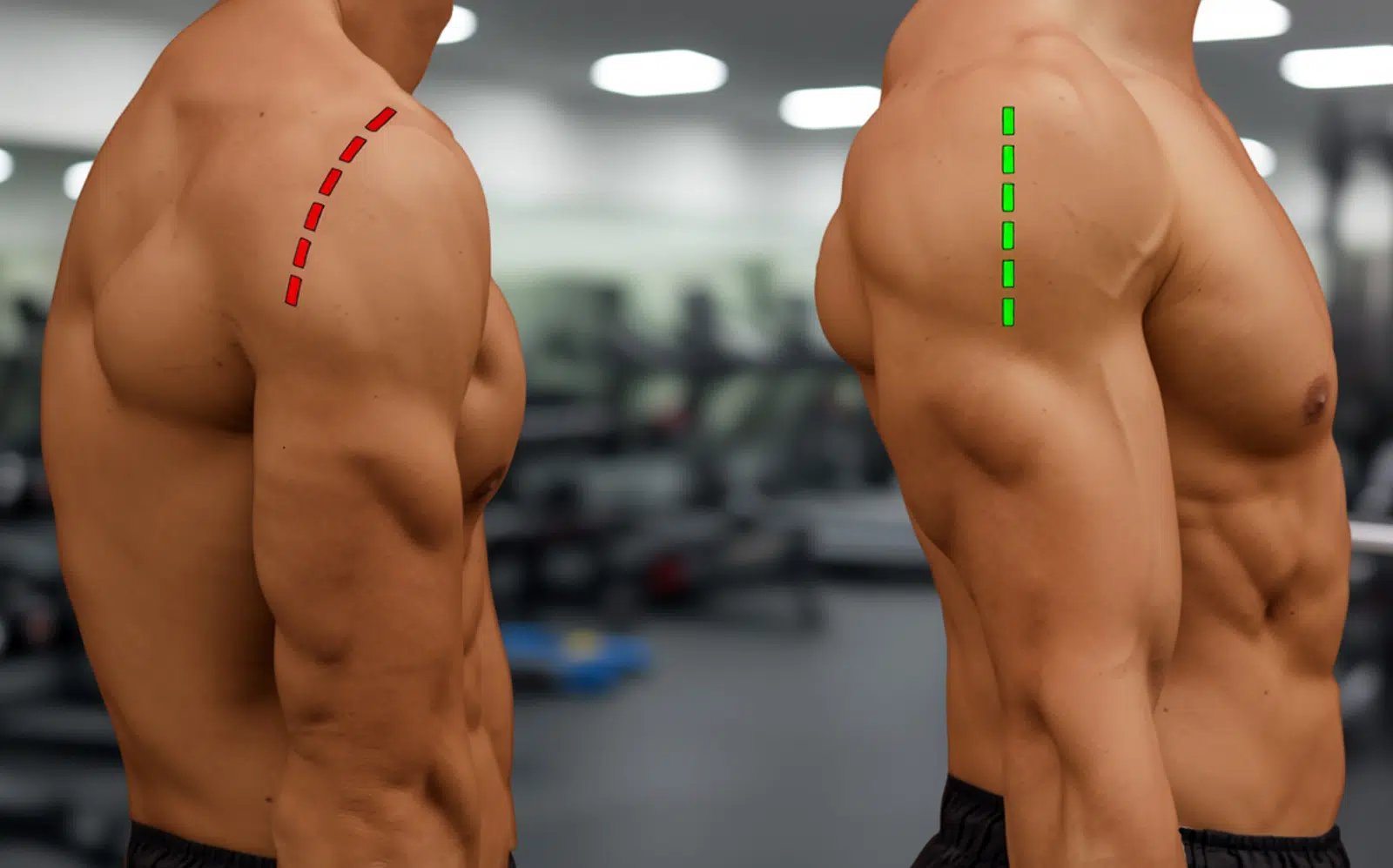
I started training because of my weak shoulders. Although the rest of my physique was average, my slanting and rounded shoulders made me look much weaker than I actually was. This hampered my physique aesthetics and started impacting my daily functionality after a certain point.
Broad shoulders have been associated with strength and masculinity since time immemorial. It’s no coincidence that superheroes like Batman and Superman have wide, 3D shoulders.
After struggling for several years, I finally found a reliable method to fix my rounded shoulders.
The best part is that this five-exercise split only takes 10 minutes. I have since tested it with hundreds of my personal training clients of varying experience levels, and it delivers results every single time.
In this article, I pull back the curtain on this versatile training routine that can help you fix your slouching shoulders within eight to 12 weeks by focusing on scapular retraction and rear delt isolation. You’ll also learn how you can implement this split in your current workout program without causing any disruptions.
Understanding Rounded Shoulders: Causes and Consequences
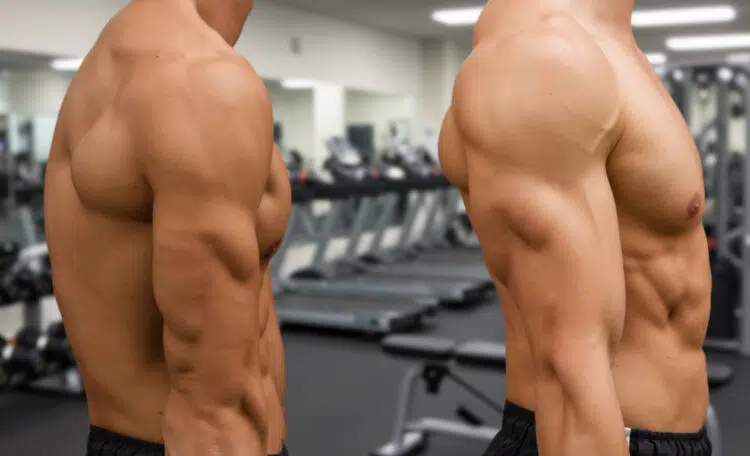
I developed rounded shoulders during my school years because I wasn’t too active and spent the majority of my days reading on my desk – fiction, mostly.
Let me first clear the air about rounded shoulders. They happen when your shoulders roll forward and pull your upper back into a curve. This looks like a slouched posture with your chest caved in and head jutting forward.
When I started training, this posture also hindered my performance. Benching with a caved-in chest significantly limits muscle fiber recruitment. It also makes following the full range of motion in back exercises almost impossible.
This is a double whammy in my opinion, and leads to a vicious cycle which deteriorates your posture over time.
Desk jobs, smartphone overuse, weak back muscles, and underlying muscle imbalances are some of the most common reasons for slouching shoulders.
Make no mistake, no one is immune to this condition. Overlooking your posture and daily habits can sneak up on you. The changes might be small at first, but the fallout hits hard, as it can lead to chronic issues like back pain, reduced mobility, confidence loss, and even breathing problems.
What If You Already Have Rounded Shoulders?
Well, in that case, you must be extra careful, as letting this issue go unattended can lead to a condition called kyphosis, which involves an exaggerated spinal curve that stresses vertebrae and discs, significantly increasing the risk of chronic pain or herniation.
It doesn’t end here; a poor posture can speed up joint wear and tear in your shoulders and neck. This increases the risk of arthritis or muscle impingements.
Why a 10-Minute Routine Works
I have several clients come to me each week complaining about their poor posture. When I ask them why they delayed working on their poster for such a long time, the answer is usually the same: The long and complex posture fixing routines did not fit into their schedules. I was no different.
As someone who has successfully transformed their shoulders, I can attest that you don’t need extended training sessions to fix your muscle imbalances. A 10-minute targeted routine done consistently can yield significant results.
Since we’ll be doing five exercises in a workout, we’ll focus on scapular retraction and rear delt isolation, as these two are the most important factors when it comes to fixing rounded shoulders.
10-Minute Back Routine For Fixing Rounded Shoulders
Now that you know everything there is to understand about fixing rounded shoulders, it is time to put this knowledge to work.
Here are the five movements that should be a staple in your training routine:
Scapular Wall Slides
This unassuming exercise will have you begging for mercy by the end of the first set.
Begin by standing with your back, hips, and heels against a wall. Flex your elbows at 90 degrees and place them on the wall so your lower arms are parallel. Your hands, forearms, elbows, triceps, shoulders, and upper back should remain in contact with the wall throughout the exercise.
While keeping your body steady, slowly slide your arms overhead from a ‘W’ to a ‘Y’ shape, as if performing an overhead press.
I focus on pulling my shoulder blades back to fire up my rhomboids and traps, and fix my slouching shoulders.
As I gained more experience, I wore wrist weights while performing this movement to further load the target muscles. On the flip side, beginners with limited mobility can use a restricted range of motion.
Band Pull-Aparts
I love using resistance bands in my workouts as they offer constant tension throughout the line of pull. Plus, they allow you to train your muscles from every angle, which is key to unlocking maximum potential.
How-To:
- Stand upright with a hip-width stance and grab a resistance band at shoulder width using an overhand grip.
- Raise your arms until they are parallel to the floor.
- Brace your core and pull the band apart while squeezing your shoulder blades together.
- Hold the peak contraction for a couple of seconds before returning to the starting position.
Resist the pull of the resistance band during the eccentric phase. Go as slow as possible to maximize the recruitment of the target muscle fibers.
Folks who don’t have access to a resistance band can instead use a towel, turning this movement from an isotonic to an isometric exercise.
Prone Y Raises
You are in for an absolute treat if you’ve never tried this exercise before. Prone Y raises might look easy, but they will smoke your rear delts and traps.
Get into position by lying face down on the floor with your arms extended overhead. Hold your arms in a ‘Y’ position with your thumbs facing upward. While keeping your body steady, lift your arms slightly off the ground while squeezing your shoulder blades as hard as possible.
Keep your elbows extended and arms straight to maximize the load on your rear delts.
Coach Tip: Avoid placing your arms on the floor at the bottom of your range of motion to maintain constant tension on your posterior deltoids.
To avoid hitting a plateau, I moved to the inclined bench variation, which involves holding a dumbbell in each hand and using a bigger range of motion.
Bent-Over Reverse Flyes
I adore this exercise because the bent-over position enables robust rear delt isolation. For this exercise, you’ll need a resistance band with a D-handle attached to each end.
Grab the D-handles in each hand and place the center of the resistance band on the floor. Step on the center of the band using a shoulder-wide stance. Hinge at the hips and lower your torso until it is almost parallel to the floor.
Adjust your grip so that the band is taut in the starting position at the bottom. Take a deep breath and slowly raise your arms to the sides while maintaining slight elbow flexion. Your elbows should be behind your midline at the top. Squeeze your shoulder blades in this position before slowly lowering your hands to the starting position.
You could perform the bodyweight variation of this exercise, but make sure you isolate your rear delts with each rep and focus on contracting them throughout the range of motion.
Seated Row Pulses
This exercise is the perfect example of how targeted movements can help fix chronic issues like slouched shoulders. I like performing seated row pulses on a cable machine, but you could also do them using a resistance band. Here is a step-by-step guide:
- Take your position on the seated rowing machine.
- Grab a straight handle with an overhand grip and unrack the weights.
- Your torso should be upright in the starting position with your arms fully extended.
- While maintaining a proud chest, draw your scapula together and hold the peak contraction for a second.
- Contract your shoulder blades slowly to return to the starting position and feel a deep stretch at the bottom.
- There should be no movement at your elbows while performing this exercise.
I recommend bending forward slightly during the eccentric phase to achieve a better rear delt activation. However, ensure that you stay upright during the concentric phase to load the shoulder blades optimally.
Sample Workout For Improved Posture
Since the rear delts and scapula are relatively smaller muscle groups, you don’t necessarily need to dedicate a complete workout to training them.
I perform this 10-minute routine at the end of my shoulder day to correct my posture. Doing it at the end of a back workout isn’t optimal because your back is the second-largest muscle group in your body, and you are already very fatigued after completing a back workout.
| Exercise | Sets | Time | Rest |
| Scapular Wall Slides | 2 | 45s | 15s |
| Band Pull-Aparts | 3 | 50s | 15s |
| Prone Y-Raises | 2 | 45s | 15s |
| Reverse Flyes (Band or Bodyweight) | 2 | 45s | 15s |
| Seated Row Pulses (Band or Towel) | 2 | 45s | 15s |
People with severely rounded shoulders who are facing mobility issues can consider performing this session at the beginning of their shoulder workouts. This will also help improve your mind-muscle connection during the main routine, leading to better muscle pumps and gains.
Complementary Habits for Better Posture
Hunched shoulders usually stem from unhealthy lifestyle habits, and correcting them requires making broad improvements to your daily routine.
If you spend most of your days at a desk, you should consider investing in an ergonomic setup. This helps relieve spinal strain and encourages you to maintain a better sitting posture. I’ve also found that working on a standing desk lowers the risk of rounded shoulders, as you don’t have armrests to lean on.
Furthermore, you should do exercises like chest openers and thoracic extensions every 45-60 minutes during your workday.
This helps undo the damage caused by prolonged sitting and also makes you monitor your posture for the next working session. I highly encourage monitoring your posture throughout the day, as it will help avoid chronic issues like rounded shoulders, back pain, and joint issues in the long term.
The Science of Posture Correction
A poor posture can sabotage your gains and increase the risk of injury. This was the biggest concern for me as my training program got more intense and demanding.
I’ll be honest, fixing rounded shoulders isn’t easy unless you understand the biomechanics of how your shoulders are structured and work. The two most important factors here are rear delt isolation and scapular retraction.
Exercises focusing on these two aspects help pull your shoulders back and square them up, creating that coveted tall, confident stance.
- Scapular Retraction: It involves squeezing your shoulder blades towards your spine, which engages key muscles like rhomboids and middle trapezius. Adding these exercises to your routine will counter the forward pull from tight pecs.
- Rear Delt Isolation: These exercises focus on the posterior deltoids, which are often overlooked during shoulder training. Rear delts are small but important muscles that fire up during pulls and raises, and when rotating your arms outward.
Combining these exercises improves scapulohumeral rhythm, which is the smooth glide of the scapula during arm movement. This prevents compensatory patterns that can worsen shoulder rounding. (1)
Conclusion
Making scapular wall slides, banded pull-aparts, prone Y-raises, reverse flies, and seated rope pulses a part of your daily routine will help fix slouched shoulders and improve mobility, resulting in better functionality and work capacity.
While I started noticing improvements within four weeks of adopting these exercises, your results can vary depending on your current condition. Start small, stay consistent, and you will achieve your desired results within three months. Best of luck!
References:
- Scibek JS, Carcia CR. Assessment of scapulohumeral rhythm for scapular plane shoulder elevation using a modified digital inclinometer. World J Orthop. 2012 Jun 18;3(6):87-94. doi: 10.5312/wjo.v3.i6.87. PMID: 22720268; PMCID: PMC3377910.
 You can also follow us on Twitter, Facebook, Instagram, and
YouTube for even more content.
You can also follow us on Twitter, Facebook, Instagram, and
YouTube for even more content.Tip: If you're signed in to Google, tap Follow.