
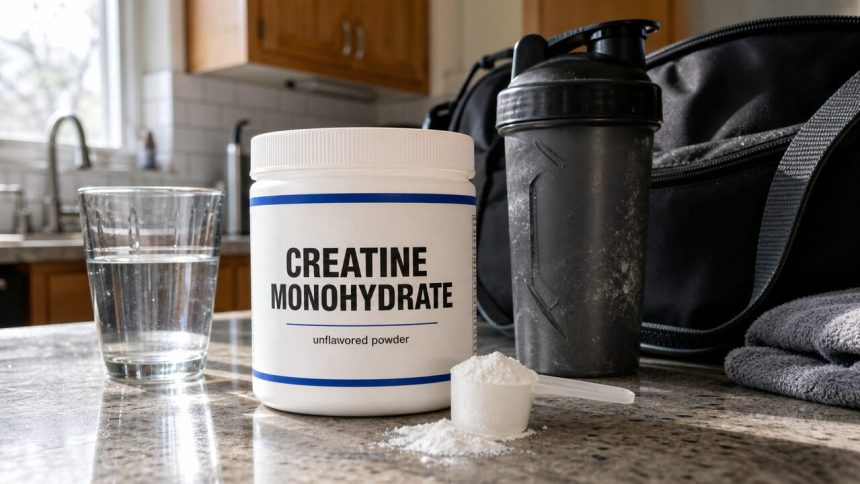
Last updated: June 2026. FitnessVolt rebuilt this creatine guide with current position stands, updated dose guidance, new supplement visuals, and a clearer safety section.
Creatine monohydrate is still the creatine most lifters should buy. The best-supported daily dose is 3 to 5 grams, or about 0.1 grams per kilogram of body weight, taken consistently. Loading with 20 grams per day for 5 to 7 days works faster, but it is optional. Newer forms usually cost more and have not shown a clear advantage over monohydrate.
Key Facts
- Best form: Creatine monohydrate has the strongest evidence base and the lowest cost per effective dose.
- Daily dose: Most lifters can use 3 to 5 grams per day. Loading is optional, not mandatory.
- Safety note: Healthy adults have a strong safety record in the literature, but people with kidney disease or relevant medications should ask their clinician before using it.
The old version of this article got one big point right: creatine helps short, hard exercise by supporting the phosphocreatine system. It also overstated a few details, buried the dose advice, and did not answer the questions readers now ask first: kidneys, hair loss, loading, bloating, timing, and whether expensive forms are worth it.
What Does Creatine Actually Do?
Creatine helps your muscles regenerate ATP, the fast energy currency used during hard sets, sprints, jumps, and repeated bursts. The International Society of Sports Nutrition position stand describes creatine monohydrate as one of the most effective ergogenic aids available for high-intensity exercise and lean mass support [1].
During a hard set of presses, rows, squats, or sprints, your body uses phosphocreatine to restore ATP quickly. More stored creatine does not make a set effortless. It helps you repeat high-output work, squeeze out more quality reps over time, and recover between repeated bouts.
That matters because muscle growth comes from weeks of better training, not one scoop. If creatine helps you add one rep to three working sets for several months, the supplement did its job. The effect is not flashy. It is cumulative.
How Much Creatine Should You Take?
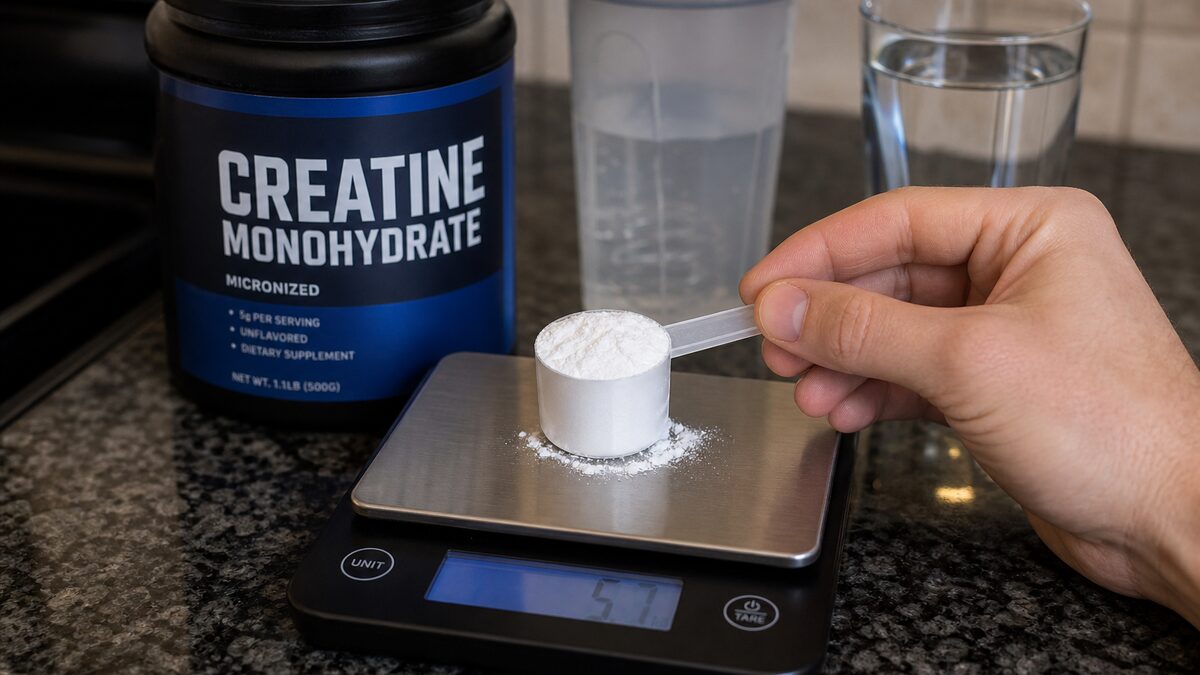
Take 3 to 5 grams of creatine monohydrate per day. Larger lifters can use the body-weight rule from ISSN guidance, about 0.1 grams per kilogram per day [1]. A 90-kilogram lifter lands near 9 grams by that formula, but many recreational lifters do fine with 5 grams daily.
| Goal | Protocol | Best For | Main Tradeoff |
|---|---|---|---|
| Simple daily use | 3-5 g per day | Most lifters | Muscle stores fill more slowly. |
| Faster saturation | 20 g per day split into 4 doses for 5-7 days, then 3-5 g daily | Athletes who want quicker effect | More stomach upset risk and more planning. |
| Larger body size | About 0.1 g/kg/day | Large strength athletes | May be more than casual users need. |
Do not obsess over timing. Taking creatine after training with a meal is easy, but consistency matters more than the clock. If you forget, take it later. If it bothers your stomach, split the dose into 2 smaller servings.
Do You Need A Loading Phase?
You do not need a loading phase. Loading fills muscle creatine stores faster, usually within about a week, but daily 3 to 5 gram dosing still works if you give it several weeks. The slower route is cheaper, easier, and less likely to bother your stomach.
Loading makes sense before a short competition block or testing phase. It is less useful if you are just starting a long muscle-building plan. Most people who quit creatine after three days did not need a different form. They needed a simpler plan they would follow.
Is Creatine Safe For Your Kidneys?
Creatine has a strong safety record in healthy adults, including in the ISSN position stand and later review papers [1,2]. The kidney confusion comes partly from creatinine, a breakdown marker clinicians measure in bloodwork. Creatine can affect that marker without automatically meaning kidney damage.
That does not mean every reader should take it casually. Skip creatine or get medical guidance first if you have kidney disease, reduced kidney function, a kidney transplant history, or medication that affects kidney function. That is a specific caution, not a generic disclaimer.
If your clinician tracks creatinine, tell them you use creatine. A supplement that changes a lab marker can create confusion even when the supplement is not causing harm. Context matters.
Does Creatine Cause Hair Loss?
Creatine has not been shown to cause hair loss in controlled trials. The concern comes from a 2009 rugby study that found an increase in dihydrotestosterone, or DHT, after creatine loading, but the study did not measure hair loss. The 2021 ISSN review lists the hair-loss claim as a misconception rather than a proven effect [2].
Here is the practical call: if you are already prone to androgenic hair loss and you notice shedding after starting any supplement, pause it and track what happens. Do not treat one DHT marker study as proof that creatine makes lifters bald. The evidence does not support that leap.
Which Type Of Creatine Is Best?
Creatine monohydrate is the best default because it has the most evidence, the lowest cost, and strong head-to-head support. Creatine ethyl ester performed worse than monohydrate for increasing serum and muscle creatine in a 2009 trial by Spillane and colleagues [3].
| Form | Evidence | Best Use | FitnessVolt Take |
|---|---|---|---|
| Creatine monohydrate | Strongest | Strength, power, repeated high-intensity work | Buy this first. |
| Creatine HCl | Limited advantage data | People who prefer tiny serving sizes | Consider only if monohydrate upsets your stomach. |
| Buffered creatine | No clear practical advantage | Marketing-heavy products | Usually not worth the premium. |
| Creatine ethyl ester | Weak head-to-head result | Rarely a good choice | Skip it unless a clinician or sport dietitian gives a specific reason. |
If you want capsules for travel or no-mix dosing, compare options in our creatine capsules roundup. If you are considering HCl because monohydrate bothers your stomach, read our creatine HCl guide before paying extra.
Who Should Use Creatine, And Who Should Skip It?
Creatine fits lifters, sprinters, team-sport athletes, CrossFit athletes, and older adults doing resistance training. It is less useful for long easy cardio, casual walking, or anyone who already refuses to train hard enough for repeated high-output efforts to matter.
| Best For | Skip Or Ask First If |
|---|---|
| You lift 2 to 5 days per week and track strength or reps. | You have kidney disease, reduced kidney function, or a transplant history. |
| You do repeated sprints, jumps, or high-intensity intervals. | You take medication that affects kidney function and have not discussed supplements with your clinician. |
| You want a low-cost supplement with decades of research. | You expect visible muscle gain without progressive training and enough protein. |
Creatine also stacks logically with protein, carbohydrate, and a sensible calorie target. Use the FitnessVolt TDEE calculator if you need to set a calorie target before deciding whether the goal is muscle gain, maintenance, or fat loss.
How Should You Use Creatine With Training?
Use creatine as a daily habit, not a pre-workout stimulant. Take 3 to 5 grams with breakfast, your post-workout meal, or any meal you never miss. Pair it with a program where you track load, reps, and sets, because the supplement pays off through better training output.
- Pick monohydrate first: powder is cheap and easy to dose.
- Weigh the scoop once: many scoops are not exactly 5 grams.
- Take it daily: missed timing matters less than missed days.
- Track performance: watch repeated sets, not one perfect workout.
- Keep expectations sane: creatine supports training. It does not replace food, sleep, or progressive overload.
If you already use beta-alanine for high-rep or interval work, our beta-alanine supplement guide explains where that ingredient fits compared with creatine.
What Should You Expect In The First Month?
The first month of creatine should look boring: daily dosing, a small scale change for some lifters, and better repeat-set performance before any dramatic mirror change. Judge it by training output over 4 weeks, not by one pumped workout or one morning weigh-in.
Track three numbers: body weight, best set performance, and total reps across your main lifts. If your dumbbell press moves from 70 pounds for 10, 9, and 8 reps to 70 pounds for 11, 10, and 9 reps after several weeks, that is the kind of small improvement creatine is meant to support. If your weight rises 1 to 3 pounds while your waist stays similar, water storage is the most likely explanation.
Skip daily panic checks. Creatine does not need a “feel it working” sensation like caffeine. If you get stomach discomfort, split the dose. If you keep forgetting it, park the tub next to your coffee, breakfast bowl, or post-workout shaker.
What Creatine Mistakes Waste Money?
Most creatine mistakes come from treating a simple supplement like a complicated stack. Buy monohydrate, dose it daily, and spend the saved money on food, coaching, or better training equipment. The supplement only helps if the rest of the plan gives it a job.
- Mistake: buying exotic forms first. Fix it by starting with monohydrate for 8 weeks before testing a pricier option.
- Mistake: dry scooping. Fix it by mixing creatine in water or a shake so you can actually swallow and digest it comfortably.
- Mistake: stopping during a cut. Fix it by keeping the dose stable unless your clinician gives a reason to stop.
- Mistake: ignoring third-party testing. Fix it by choosing brands that publish NSF Certified for Sport, Informed Choice, or similar testing when you compete in drug-tested sport.
Frequently Asked Questions
Can you take creatine every day?
Yes. Daily use is the normal creatine protocol. Most lifters use 3 to 5 grams per day, and ISSN guidance supports creatine as safe for healthy adults when used within studied ranges [1]. Skip it or get medical guidance first if you have kidney disease or relevant medication concerns.
Should creatine be taken before or after workouts?
Timing matters less than consistency. Post-workout with a meal is convenient, but creatine works by increasing stored muscle creatine over time. If morning dosing is easier, take it in the morning. The best time is the one you will repeat.
Does creatine make you gain weight?
Creatine can increase scale weight because muscle stores hold more water. That is not the same as fat gain. Some lifters see the scale move early, especially after loading. Track waist, performance, and training logs before judging the change.
Is creatine a steroid?
No. Creatine is not an anabolic steroid. It is a compound your body makes from amino acids and stores mostly in muscle. It supports ATP regeneration during hard efforts. It does not act like testosterone or synthetic anabolic drugs.
Can teenagers take creatine?
Teen athletes should involve a parent, coach, and qualified healthcare professional before using supplements. Food, sleep, training technique, and total calories matter more at that age. If creatine is used, it should be third-party tested and kept within normal dosing ranges.
Bottom Line
Buy creatine monohydrate, take 3 to 5 grams daily, and stop chasing exotic forms unless monohydrate truly bothers your stomach. The evidence is strongest for repeated high-intensity work, strength support, and lean mass when training and nutrition are already in place. Creatine is boring in the best possible way: cheap, studied, and useful.
Sources
- Kreider, R. B., Kalman, D. S., Antonio, J., et al. (2017). International Society of Sports Nutrition position stand: Safety and efficacy of creatine supplementation in exercise, sport, and medicine. Journal of the International Society of Sports Nutrition, 14, 18. DOI: 10.1186/s12970-017-0173-z.
- Antonio, J., Candow, D. G., Forbes, S. C., et al. (2021). Common questions and misconceptions about creatine supplementation: What does the scientific evidence really show? Journal of the International Society of Sports Nutrition, 18, 13. DOI: 10.1186/s12970-021-00412-w.
- Spillane, M., Schoch, R., Cooke, M., et al. (2009). The effects of creatine ethyl ester supplementation combined with heavy resistance training on body composition, muscle performance, and serum and muscle creatine levels. Journal of the International Society of Sports Nutrition, 6, 6. DOI: 10.1186/1550-2783-6-6.
- Branch, J. D. (2003). Effect of creatine supplementation on body composition and performance: A meta-analysis. International Journal of Sport Nutrition and Exercise Metabolism, 13(2), 198-226. PMID: 12945830.
- National Institutes of Health Office of Dietary Supplements. (n.d.). Dietary supplements for exercise and athletic performance: Health professional fact sheet. Accessed June 29, 2026.