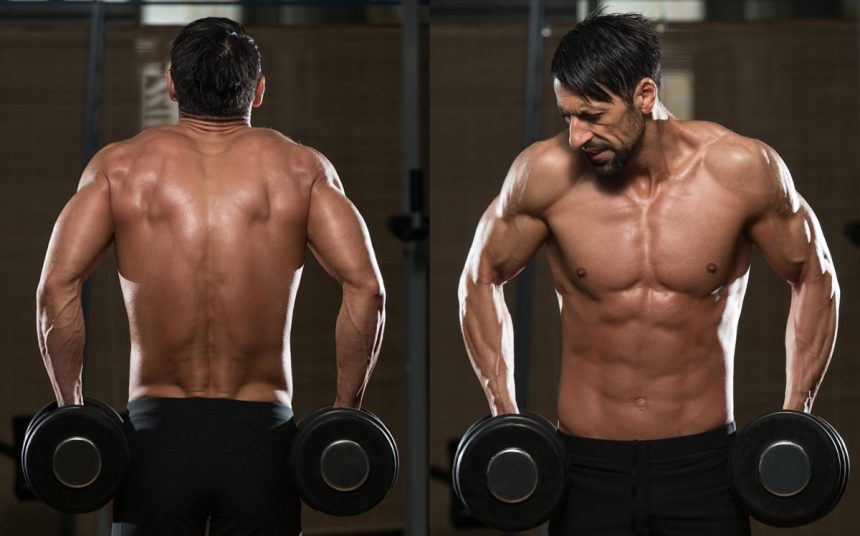
Big traps fill the space between your neck and shoulders, and they show in a T-shirt. Training them doesn’t take long, because a handful of movements covers the whole muscle.
This 30-minute workout uses shrugs, heavy carries, face pulls and Y-raises, with a superset and a drop set to fit the work into half an hour. A review on time-efficient training concluded that techniques like these roughly halve training time while keeping the same training volume (1).
30-Minute Trap Workout: Overview
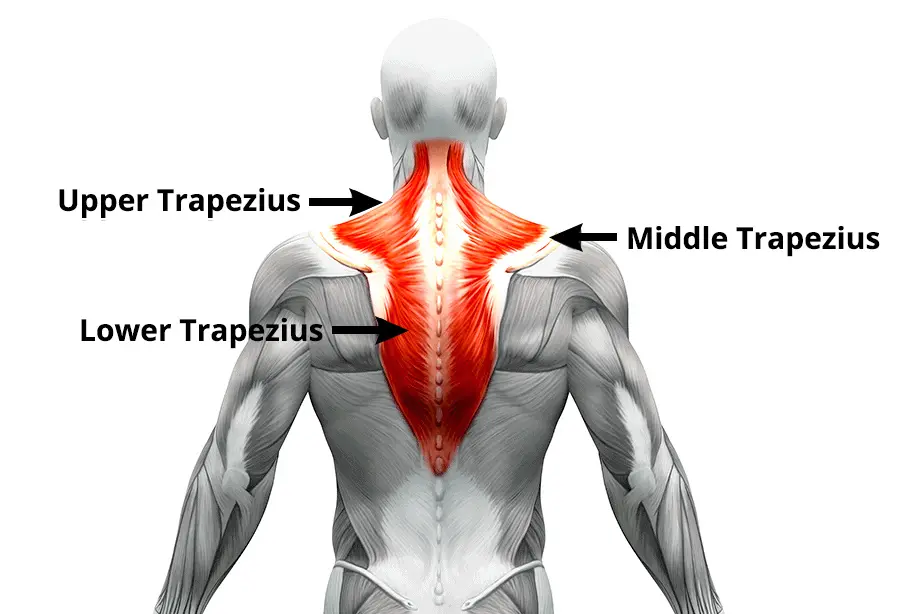
Your trapezius is one large, kite-shaped muscle with three sections, and each one has a different job:
- Upper traps lift your shoulder blades toward your ears. Shrugs and heavy carries train them.
- Middle traps pull your shoulder blades together. Rows and face pulls train them.
- Lower traps pull your shoulder blades down and help rotate them upward when you raise your arms. Y-raises train them.
The upper traps give you the size you see from the front. The middle and lower traps add thickness to your upper back.
Do it once or twice a week, on a back or shoulder day or on its own. Warm up with 5 minutes of easy cardio and a couple of light sets of shrugs and face pulls.
| 30-Minute Trap Workout | ||||
| # | Exercise | Sets | Reps | Recovery |
| 1 | Barbell shrug | 4 | 10-12 | 90 seconds |
| 2 | Farmer’s walk | 3 | 30-40 meters | 90 seconds |
| 3a | Face pull | 3 | 12-15 | 60 seconds |
| 3b | Chest-supported Y-raise | 10-12 | ||
| 4 | Dumbbell shrug drop set | 1 | AMRAP x 3 weights | N/A |
Exercises 3a and 3b are a superset. Do a set of face pulls and then, without resting, a set of Y-raises. Rest for 60 seconds, then repeat the pair twice more. Exercise 4 is a drop set: shrug to failure, drop to a lighter pair of dumbbells, go to failure again, then repeat once more.
Face pulls and Y-raises both work the muscles between your shoulder blades, and pairing similar exercises costs some load on the second one (3). That’s why the Y-raises use light dumbbells.
The rest periods are 60 to 90 seconds. A 2024 meta-analysis found a small benefit to resting more than 60 seconds between sets for muscle growth, but no clear extra benefit beyond 90 seconds (2).
30-Minute Trap Workout: Exercise Instructions
Use a weight you can control through the full range of every rep. If you can hit the top of the rep range on every set, go heavier next session.
1. Barbell shrug
The barbell shrug lets you load your upper traps heavier than any other exercise in this workout. Lift straight up and lower straight down. Rolling your shoulders doesn’t match how the upper traps move your shoulder blades, so it adds nothing.
How to do it:
- Stand with your feet hip-width apart and hold a barbell in front of your thighs with an overhand grip, hands just outside your legs.
- Stand tall, brace your abs and let your arms hang straight.
- Shrug your shoulders straight up toward your ears as high as you can. Don’t bend your elbows.
- Hold the top for one second, then lower until you feel a stretch in your traps.
If your grip gives out before your traps, use lifting straps.
2. Farmer’s walk
In the farmer’s walk, your traps have to hold your shoulders up against heavy weights for the whole carry. It also trains your grip, core and legs, so one exercise covers several jobs in a short workout.
How to do it:
- Stand between two heavy dumbbells, kettlebells or farmer’s walk handles.
- Squat down with a flat back, grip the handles in the middle and stand up.
- Pull your shoulders back and slightly up, brace your abs and look straight ahead.
- Walk forward with short, quick steps for 30 to 40 meters.
- Set the weights down with control, using the same flat-back squat.
3a. Face pull
The face pull trains your middle traps and rear delts by pulling your shoulder blades together. Use a moderate weight and a full squeeze rather than heavy, jerky reps.
How to do it:
- Attach a rope to a cable set at upper-chest height. Hold one end in each hand with your palms facing down.
- Step back until your arms are straight and the weight lifts off the stack.
- Pull the rope toward your face, splitting the ends apart and driving your elbows out and back.
- Squeeze your shoulder blades together for a second, then return under control.
- Go straight to the Y-raises.
3b. Chest-supported Y-raise
The chest-supported Y-raise targets your lower traps, the section shrugs don’t reach. The weights will be light, so focus on the position of your shoulder blades.
How to do it:
- Set an adjustable bench to about 30 degrees and lie face down on it, holding a light dumbbell in each hand.
- Let your arms hang straight down, thumbs pointing up.
- Raise your arms up and out at an angle to form a Y with your body.
- Pull your shoulder blades down and back as you lift. Stop when your arms are in line with your torso.
- Lower slowly and repeat.
4. Dumbbell shrug drop set
Finish with one drop set of dumbbell shrugs. Line up three pairs of dumbbells, each about 20-30% lighter than the last, so you can switch without wasting time.
How to do it:
- Hold the heaviest pair of dumbbells at your sides, palms facing in.
- Shrug straight up and hold each rep for one second at the top. Keep going to failure.
- Put the dumbbells down, pick up the next pair and go to failure again.
- Repeat with the lightest pair.
More Trap Workouts:
- Best Trap Exercises
- 12 Best Dumbbell Trap Exercises
- 7 Best Lower Trap Exercises
- Build a Bigger Yoke With Kirk Shrugs
- The Ultimate Guide to Rack Pulls
- Big Delts Fast: 30-Minute Shoulder Workout
30-Minute Trap Workout: Wrapping Up
Traps respond to heavy loads and enough volume, the same as any muscle, and more weekly sets tend to produce more growth (4). This workout gives you 13 working sets plus a drop set, covering all three parts of the muscle, in half an hour.
Log your shrug weight and your farmer’s walk load each session. Both should climb over the next two months.
References
Fitness Volt is committed to providing our readers with science-based information. We use only credible and peer-reviewed sources to support the information we share in our articles.
- Iversen, V. M., Norum, M., Schoenfeld, B. J., & Fimland, M. S. (2021). No Time to Lift? Designing Time-Efficient Training Programs for Strength and Hypertrophy: A Narrative Review. Sports Medicine, 51, 2079-2095. DOI: 10.1007/s40279-021-01490-1. PMID: 34125411.
- Singer, A., Wolf, M., Generoso, L., Arias, E., Delcastillo, K., Echevarria, E., et al. (2024). Give it a rest: a systematic review with Bayesian meta-analysis on the effect of inter-set rest interval duration on muscle hypertrophy. Frontiers in Sports and Active Living, 6, 1429789. DOI: 10.3389/fspor.2024.1429789. PMID: 39205815.
- Zhang, X., Weakley, J., Li, H., Li, Z., & García-Ramos, A. (2025). Superset Versus Traditional Resistance Training Prescriptions: A Systematic Review and Meta-analysis. Sports Medicine, 55, 953-975. DOI: 10.1007/s40279-025-02176-8. PMID: 39903375.
- Schoenfeld, B. J., Ogborn, D., & Krieger, J. W. (2017). Dose-response relationship between weekly resistance training volume and increases in muscle mass: A systematic review and meta-analysis. Journal of Sports Sciences, 35(11), 1073-1082. DOI: 10.1080/02640414.2016.1210197. PMID: 27433992.