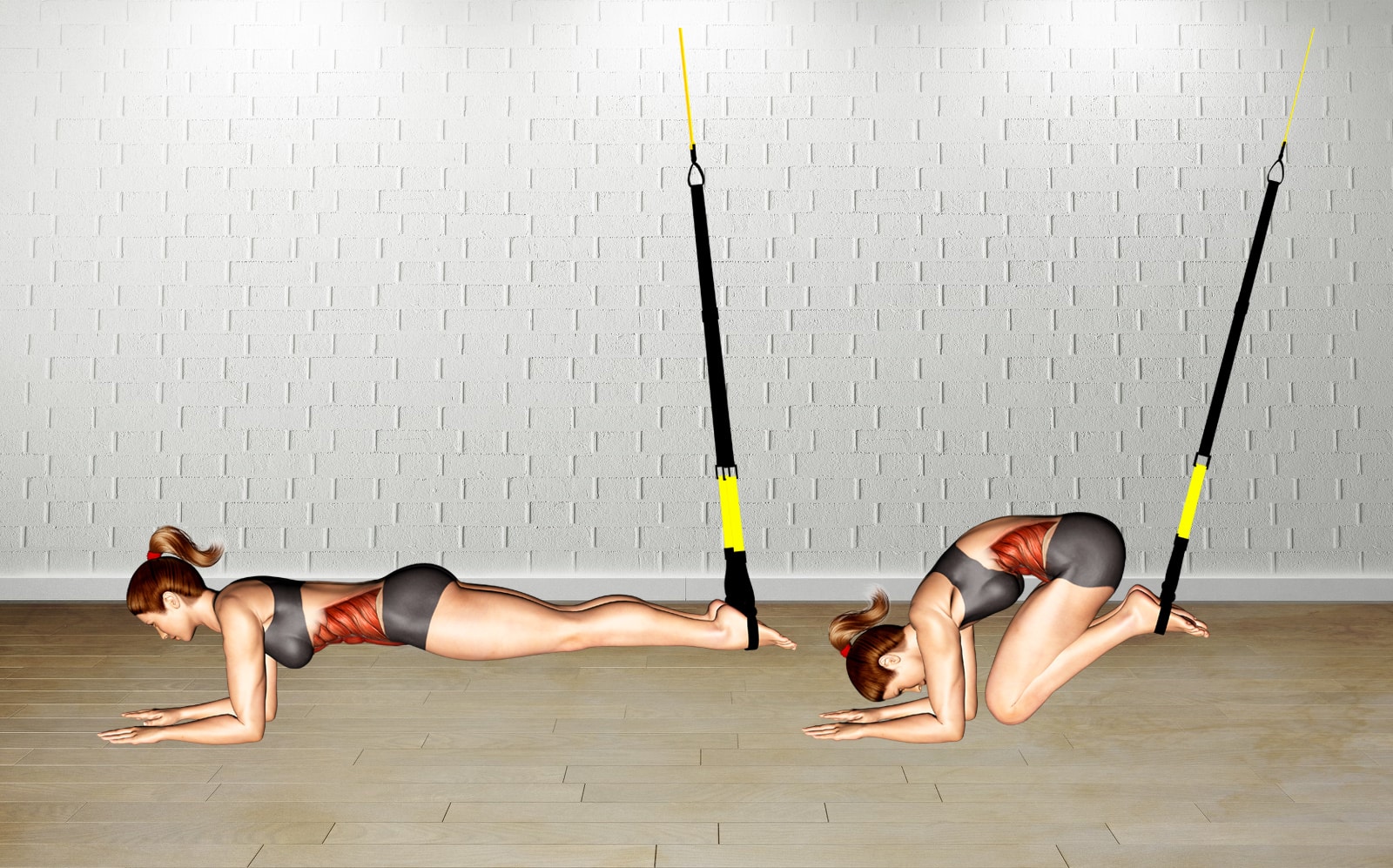
The suspended crunch, or TRX crunch as it’s more commonly known, is a bodyweight reverse ab crunch in a plank pose with the feet suspended above the ground.
What’s special about this technique?
We’re glad you asked. Unlike most ab exercises, suspension crunches combine three training techniques in one movement, isometric and isotonic muscle contractions, plus instability. What’s the big deal? Increased functional muscular demands, hypertrophic stimulus, and cooperation from all muscle groups, which makes this a total body movement. It’s one of the exercises that make you a stronger and more powerful human being. Yeah, it’s definitely a beast of an exercise.
Now, yes, you do need suspension straps to do it. But if not, we’ve also included some variations and alternatives that work the same muscles or combine the functional aspects too.
So let’s swing into our full suspended crunch guide below where you’ll learn about the unique reasons to incorporate this core killer in your midriff sessions!
How To Do The Suspended Crunch
The suspended crunch is a mid-level technique that requires strong arms and wrists, a healthy scapula, a capable core, and the ability to contract your muscles isometrically. If you have all those then you can benefit from this full body ab workout.
Here are detailed step by step instructions with an accompanying video tutorial for those who need to see the technique being performed.
Step 1 – Strap height
Adjust your suspension straps to a height where you can insert your feet through the cradles while your knees are still on the floor. This is typically with the end of the strap at about mid calf height.
Step 2: The setup
Sitting on your butt and facing the straps, lift your feet up into the handle cradles. Then flip over onto your hands and knees. Or you can start from your hands and knees then slip the top of your feet in the strap cradles behind you.
Step 3: Body position/exercise form
Before the first rep, make sure to tense your core, straighten your knees, lift your toes up to keep the straps secured, and press hard into the ground with your arms while protracting or rounding the shoulders, not pulling them back. Form a straight line with your body, and ensure your shoulders are directly above your wrists.
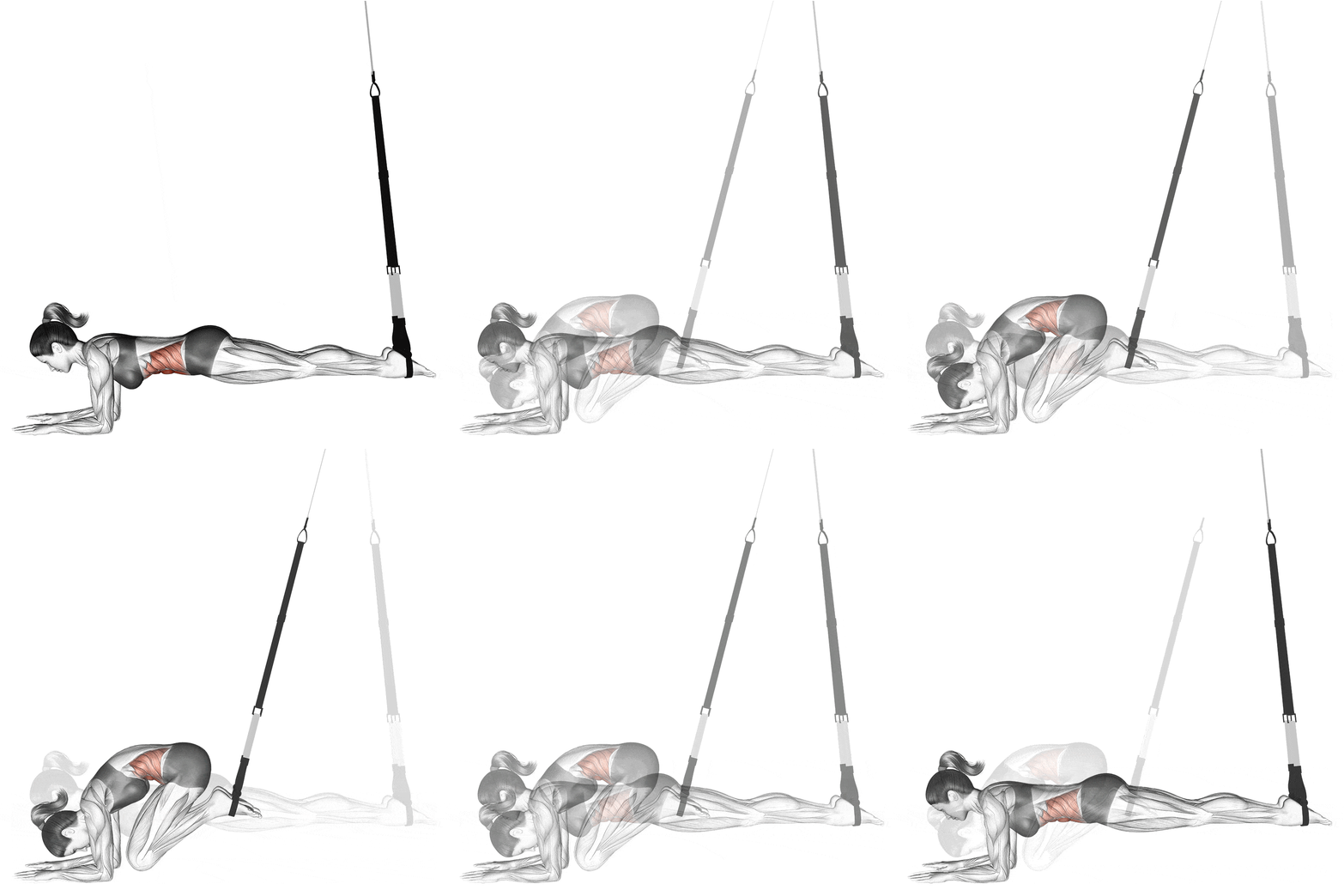
Step 4: Reverse crunch
Now, with your feet close together, pull your knees into your stomach while lifting the hips just slightly, and squeeze the core muscles tight. Then engage your glutes, and straighten your legs behind you.
Step 5: Repeat
Repeat steps 4 and 5 until you’re satisfied with the rep count.
Here’s an animated gif showing suspended crunch tutorial for you.
In This Exercise:
- Target muscle group: Abdominals
- Type: Hypertrophy, core strength, functional
- Mechanics: Isolation
- Equipment: Suspension trainer set up
- Difficulty: Intermediate
Muscles Worked During The Suspended Crunch
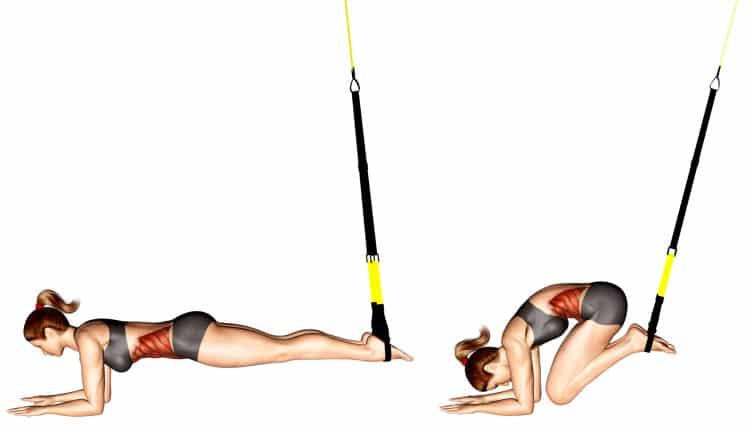
A whole core movement, the suspended crunch is a powerful workout in one technique activating all trunk muscles in the process. Here are some facts on the anatomy of muscles involved in this functional exercise.
Rectus abdominis – The fancy, yet scientific name for the bumpy six-pack muscles on your stomach, rectus abdominis, aka abdominals, are associated with ab crunch movements. Justifiably so, your abs curl both ends of the trunk toward each other, hence why feel them working during top and bottom crunching movements.
Transverse abdominis – Less active during basic floor crunches compared to rectus abdominis, transverse abdominis are the deeper ab muscle fibers that are more actively engaged during multi-muscle core exercises like suspended crunches.
Transverse fibers are like Saturn’s rings, wrapping the stomach, with horizontal fibers that imitate a training belt and hence promote a stiffer spine to support more intense activities.
Iliopsoas – The major player in your hip joint, iliopsoas is a multi muscle unit that flexes the thigh and pulls your knees higher than the waist.
Obliques – Second in popularity to the abdominals, but first when it comes to rotational movements. Your obliques have external and internal fibers that help us twist and bend from left to right. While suspended crunches aren’t rotation based, they are certainly tensed and working to help maintain stability.
Benefits Of The Suspended Crunch
A potent total body core exercise, if you have suspension straps you don’t want to miss out on the benefits of this crunch! Here’s what to expect from a steady diet of suspended crunches.
Total body core exercise
Not just a floor reverse crunch, you’re essentially combining a plank and crunch in one, which is not something offered by most of your ab sessions. Planks are a popular isometric core exercise because they build static core strength in a stationary pose.
And while we didn’t list the other muscles involved in suspended crunches under the muscles worked section above, pretty much you’re entire body is engaged.
In a high plank, you’re using your chest, delts, and triceps to support your weight, while the back is active to stabilize the shoulders, your hips and butt to maintain a neutral body, and the quads tensed to keep the legs straight. So yeah, no muscles get a break in the suspended crunch.
Build functional core strength
What do we mean by “functional” core strength?
We’re taking about a type of strength that you develop when you use your whole body to emphasize a single muscle group, or the abs in this case. Suspended crunches are essentially a moving plank variation that require a strong upper and lower body, as well as the deeper trunk muscles.
So what do functional abs do?
Put simply, they help you to be stronger overall, and I’ll prove it right now. Right where you are and if possible, get into a push-up position. Now completely relax your core, hips, and leg muscles. Don’t tense them. What happened? We bet your hips collapsed right down to the floor.
Okay now try to do a push-up. Yeah, we thought so. This functional type training is about teaching the core and other muscles to work together for more physically demanding activities, not just a floor ab crunch.
Burn more calories
Going along with the first benefit, when you use more muscles, your body requires more energy and effort which burns more calories.
If you want to drop some fat pounds or burn some extra calories toward your weight loss goals, choose these types of core movements that are more taxing. That way you’ll also get a heart workout from increased cardio activity, and it’s a win win.
Read: Fat loss vs. weight loss – explained!
Keeps away training boredom
Hey we understand, exercise isn’t always exciting, but if you can get the same results by alternating exercises that you enjoy, and that do the job, then you should. It’s always good mentally to challenge yourself too.
Common Mistakes During The Suspended Crunch
We mean it when we say you need to tighten up on your form and don’t let these common mistakes when you’re performing the suspended crunch.
Uneven straps
This one should be obvious, but we don’t need to go much into detail why your straps should be the same length. But it will cause asymmetrical performance and should feel off when you’re training. Always inspect and double check your setup for accuracy and optimal gains.
Poor core infrastructure
Like the importance of a bridge to a society, are your core muscles to essentially every physical thing that you do. They’re an integral part of all exercise and physical performance, and create the base for which you transfer force from one part of the body to another.
Therefore, your abs need to be fully engaged before you even get into the plank pose. In fact, your entire body needs to be activated to prevent hip sagging, lower back strain, and poor performance.
Piking it
Suspension crunches are not beginner friendly, especially if you don’t exercise regularly. Hence why why setting up, it can be real tempting to lift your butt so high your body looks like an upside down V. Now don’t get us wrong, pikes are beneficial, but it’s not the goal here. You want to lift the hips just slightly to create leg room, and get optimal ab activation.
7 Variations And Alternatives of The Suspended Crunch
Boy have we got some really awesome variations and alternatives for you. And you don’t even need to have suspension straps to get similar benefits from some of these options. Below you’ll find various techniques for different training levels and goals.
Modified low plank suspended crunch
Performed from the forearms with a conventional plank arm position, rather than a high plank with the arms extended and palms on the floor. It’s less tiring and demanding than the latter variation, which allows you to focus more on the actual crunch, and less on trying to hold yourself up. The arms can actually give out before the abs in the high plank version which would be a waste of potential.
Here’s a great example of how the low plank modification should look like.
Suspension mountain climbers
A more explosive, fat burning variation of suspension crunches are the popular mountain climbers. When I think about mountain climbers, I imagine the goal is to train your core for power and function, with some cardio thrown in. And that’s exactly what it does. If you want to build a stronger midsection and prime yourself for fat loss, mountain climbers are top notch.
Steps
- Get down on your hands and knees then slip the top of your feet onto the suspension strap handles behind you. The handles should hang low enough that your knees can touch the floor while your feet are in the handles.
- Then straighten your legs and form a straight line with your body, engaging the core, glutes, and quads to maintain a strong position.
- With controlled movement, alternate pulling your legs toward your chest while crunching the abdominal muscles.
- When you’re finished, drop down on your knees then pull your feet out of the handles one at a time.
Common Mistakes
- Sagging your hips which stresses the lower back and deactivates the core.
- Lifting the butt high which removes tension from the exercise.
Try the standing bodyweight only version of mountain climbers.
Suspension atomic push-up
You look like you need to do some push-ups, so why not combine them with suspended crunches since you’re already in the perfect position. Work your chest, triceps, and front delts too with this combination movement that alternates abs and presses.
Steps
- Adjust you straps to the optimal height, then place your ankles in the cradles, and get into a high plank push-up position.
- Perform a full reverse crunch by pulling the knees into the stomach, and extending them back.
- Then bend your elbows and drop your chest down to the floor with a controlled descent.
- Push yourself back up to the beginning position while actively trying to squeeze your chest muscles.
- Repeat steps 2-4 until your set is finished. Take a 1-1:30 minute rest break then do it again. Try to do three sets of this exercise.
Watch a detailed demonstration via the YouTube video included below.
Related: Suspension push-up exercise guide.
Swiss ball knee tuck crunch
You know the large bouncy rubber exercise balls that you see at the gym? Or maybe you already use them at home for ab crunches. Well, you can also use them to replace suspension straps, and it can be even more challenging in a way.
With suspended crunches, your feet are secured (Or should be at least) in the strap cradles. But with a physio ball, your legs could roll to one side and fall off. So yeah there’s a slightly higher degree of core stabilization. But with enough practice, you should be able to easily maintain your position.
Step 1:
Start from your hands and knees on the floor with the ball behind your feet. Then, keeping your arms straight and shoulders protracted, extend both legs back and lift your shins up onto the ball one at a time. Engage your core and form a straight line with your body.
Or,
Start from standing and place one shin on the ball, then bend down and place your hands on the floor and get into a high plank arm position. Lift the other leg up onto the ball and straighten your body to the starting pose.
Step 2:
Pull your knees into your chest, and squeeze your ab muscles.
Step 3:
Extend your legs back to the starting position.
Step 4:
Repeat the movement until you’ve completed the desired number of reps. Rest for 45 seconds to a minute and jump back into another set. Aim for three total sets.
Supine tuck crunch
Face up like a standard floor ab crunch, the supine tuck crunch is essentially an inverted suspended crunch. We’ve been using it well before the TRX came along and the floor sitting tuck crunch position is a base body position for many advanced crunches.
Then if you need more resistance in this position you can incorporate cable or resistance band reverse crunches.
Steps
- Sit on your butt, squeeze your core tight, then with a straight back, recline your upper body to a 45-60 angle, and lift both legs up with your feet close together. Tale a moment to find your balance.
- Simultaneously curl your upper body and legs together, pulling your knees into the chest.
- Then reverse the motion by returning to the starting position. Maintain a strong midsection throughout the exercises.
- Repeat until you’re satisfied.
Floor sliding knee tuck crunches
Like the variation above, you don’t need any training tools or equipment for sliding knee tuck crunches, other than a slippery setup. The poor man’s suspended crunch, you’ll need socks and slick floor, or you can get creative with different prop combinations to allow for smooth sliding.
Steps
- Come into a push-up position with the hands shoulder width apart on the floor, arms extended and vertical, and legs straight with feet close together and toes on the ground. Tense your core, squeeze the glutes and quads, and protract your shoulders forward.
- Now, bend your knees and slide your feet forward as far as you can while squeezing your stomach muscles.
- Then slide your feet back and straighten your legs behind you in the starting position.
- Repeat steps 2 and 3 for as much reps as you’d like.
Watch a short video instructional on the sliding knee tuck.
Hanging/captain’s chair leg raises
Not a variation but an alternative and one of the essential ab moves in our opinion. And the hanging leg raise is always praised by arguably the most successful trainer, Jeff Cavalier, who runs the Athlean X YouTube channel.
So what makes this variation so special?
In short, the vertical position and gravity. Human legs are generally pretty heavy, and hence really challenge the core muscles to help support the burden of their weight during leg lift movements. They’re essentially upright reverse crunches.
You can do the hanging leg raise from a pull-up bar or a captain’s chair (Power tower).
FAQ’s
How many sets and reps of suspension crunches should I do for best results?
Not so fast… programming bodyweight-based movements requires a different approach compared to other forms of training. That’s because your body weight is typically what it is. You’re not able to change it from one session to the other like you can with free weight, machines, and cables.
However, you can modify your body position to create more or less resistance on the target muscles, so you can adjust the training load that way.
But generally, we start with the basics, and hence the common beginner techniques with the goal of progression. Suspension crunches are typically performed one way, with a specific technique and body position.
With that being said, we recommend a minimum two sets of reps taken to near or complete failure.
Related: When, why, and how to train to failure
What are the advantages of suspension crunches compared to other ab crunch variations?
Simply put, suspension crunches are a total body core exercise that require more overall muscle activation, stability, and hence effort, as it’s essentially an active plank exercise.
How many times per week should I train my abs with suspension crunches?
That depends on how serious you are about ab training, and what the rest of your training routine looks like. Suspension crunches are a great supplementary exercise and feel free to throw it in once, twice, or three times per week for the more ab crazy exercisers!
Wrapping Up
If you’re going to train your abs, then do it right. We’re implying that you need more than just crunches and planks. In fact, why not combine the two with the suspended crunch, and get the best of both plus several additional benefits that you can read about in this article.
suspended crunches demand not only from the core muscles, but we liken it to a mini boot camp wrapped in a single technique that challenges your pushing muscles, back, hips, quads, and mental fortitude. Not to mention, if you need to peel off some fat, you want to be doing stuff like moving planks to train your midriff.
Don’t have suspension straps though? Don’t panic. We have variations and alternatives that you can do to achieve a similar outcome using nothing but your body weight, a slick floor, or a swiss exercise ball.
Interested in measuring your progress? Check out our strength standards for Russian Twist, Side Crunch, Crunches, and more exercises.