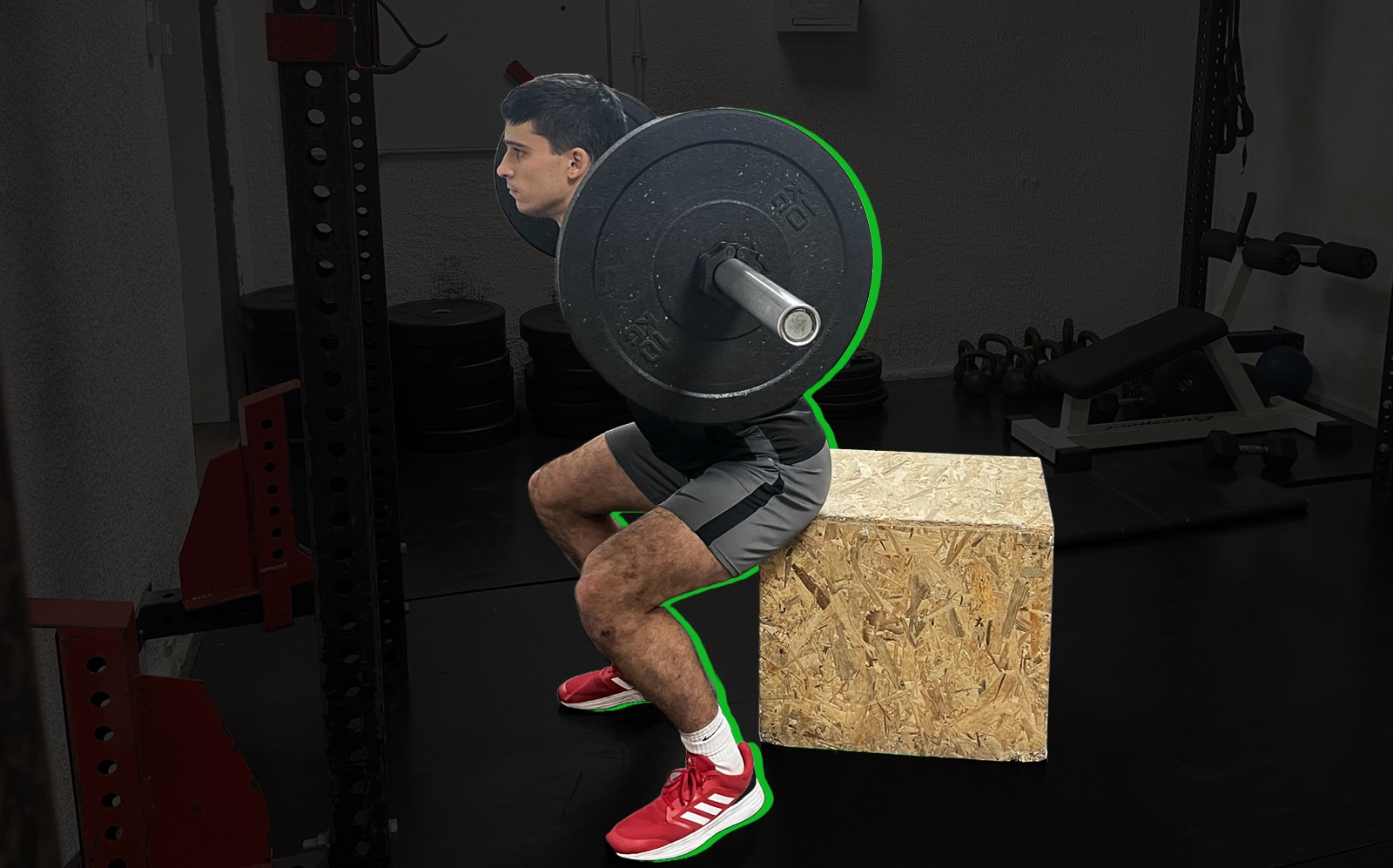
Learn the Proper Technique for Performing Box Squats To Develop Better Athletic Performance, a Bigger Vertical Jump, and Less Chance of Knee Injury.
Box squats are one of my favorite exercises for developing lower body power and strength.
You can use more weight during this squat variation without worrying about compromising your form or hurting your knees.
One of the studies titled “Comparison of kinetic variables and muscle activity during a squat vs. a box squat” found that the squat resulted in a significantly lower peak force in comparison to the box squat. (1)
This proves the point that box squats are a much better tool than regular squats for the development of explosive strength.
Based on my previous gym experience and after many hours of research, I made a simple guide on how to perform box squats effectively. I will also cover muscles worked, benefits, and, most important, variations and alternatives.
How to Do Box Squats: Step-By-Step Guide
Below is a simple guide on performing box squats correctly to maximize performance and avoid injuries.
Step One — Assume the Starting Position
Load the barbell on the squat rack with the appropriate weight. Place a box a little higher than your knees behind you. Place the loaded barbell on your upper back and grip the par outside your shoulders with a pronated grip.
Step back right in front of the box so you have enough space to perform the exercise. Assume a shoulder-width stance with your feet and turn your toes slightly outward.
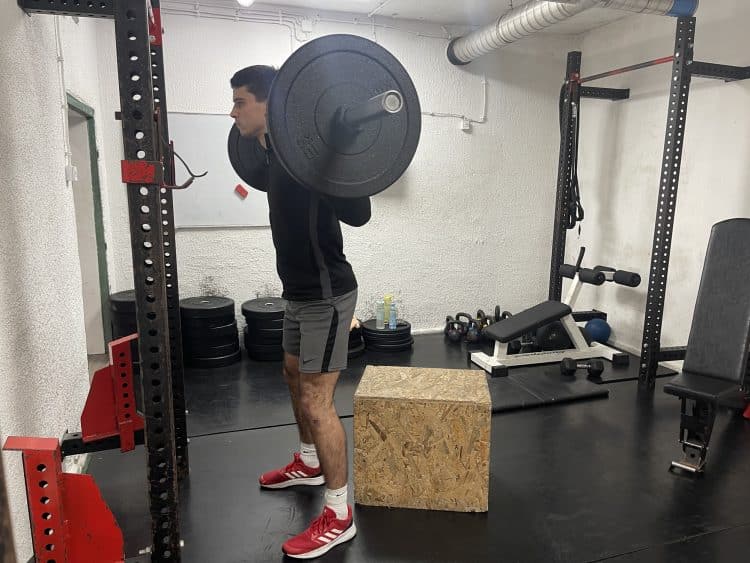
Pro Tip: Put one edge of the box between your legs. Avoid putting the box parallel to your body because you will have less space for your feet.
Step Two — Descend Into the Half-Squat Position
Lower into the bottom squat (half-squat) position. To do that, bend your ankles, knees, and hips simultaneously. When your butt touches the box, hold that position for one second.
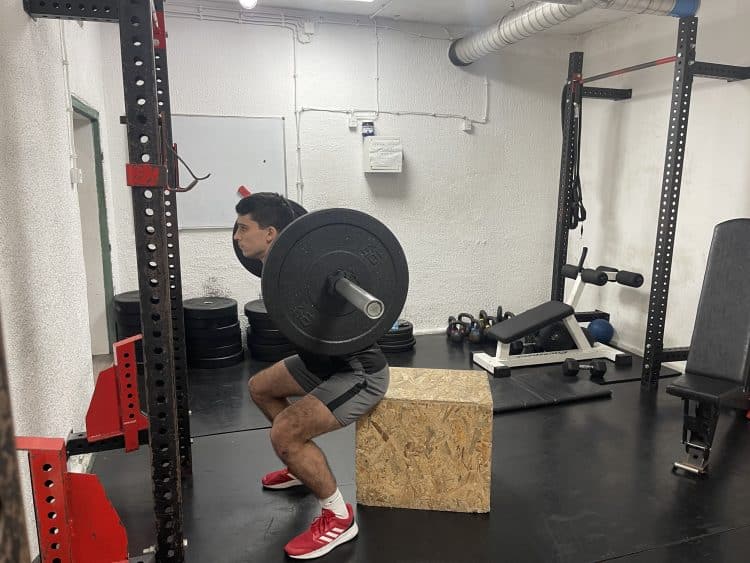
Pro Tip: Don’t fully sit on the box. You don’t want to allow full decontraction of your muscles.
Step Three — Extend Ankles, Knees, and Hips
Simultaneously extend your ankles, knees, and hips to exit the half-squat position and return to the starting position. Continue for the desired amount of reps.
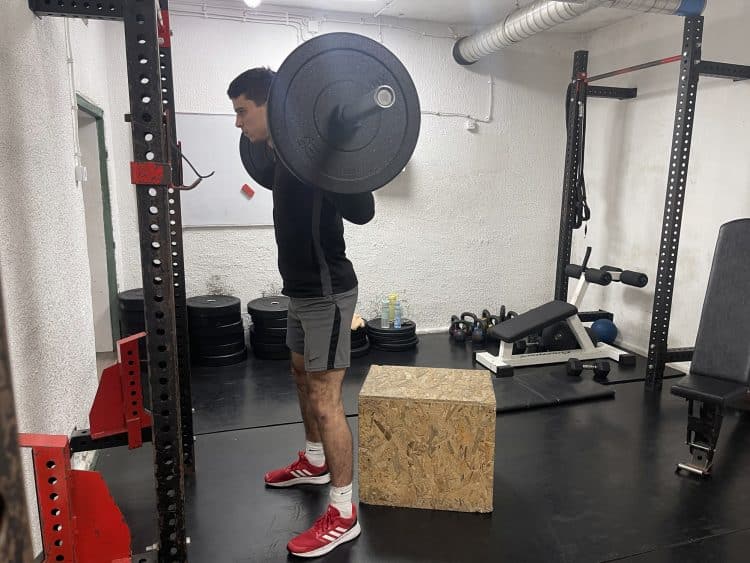
Pro Tip: Exit the bottom position as quickly as possible to build explosive strength.
What Muscles Are Targeted by Box Squats?
Based on my biomechanical analysis of the box squat movement, here are the primary muscles working:
- Quadriceps
- Gluteus maximus
- Hamstrings
- Erector spinae
Also, here are the secondary muscles working during box squats:
- Adductors
- Abdominals and obliques
- Hip flexors
- Gastrocnemius and soleus
What Are the Benefits of Box Squats?
The benefits of box squats include enhanced safety, reduced knee stress, and increased strength and power output.
Let’s cover each of these briefly.
Enhanced Safety
For many years, I performed box squats instead of regular deep squats just for a single reason. They are safer for your knees and lower back. This is because you only execute a partial range of motion during box squats. Deeper squats tend to put more stress on your knee joints and lower back.
However, you shouldn’t relax or land on the box too hard since that leads to spinal compression and an increased risk of lower back injury.
Reduced Stress on Knees
Following on from the previous point, box squats are excellent at reducing the stress on your knees. Partial range of motion will require less knee flexion and ankle dorsiflexion, putting your knees in a more favorable position. Think of your legs as a lever.
The more you extend your knees over your toes, the more stress you put on them. However, this isn’t necessarily bad, especially in sports where your knees travel over your toes. It all depends on your current fitness level and goals.
Increased Power and Strength
Different athletes heavily use box squats instead of regular squats to develop power and strength. Using a shorter range of motion (ROM) lets you lift heavier weights as each rep requires less effort due to the reduced travel distance of the load. Also, the more external resistance you can put on your barbell during squats without injuring yourself, the better.
Why?
Well, because more external resistance requires greater activation of muscle fibers. The more muscle fibers you fire up, the more force you will produce.
Not to mention that your body contains fast twitch fibers that are almost impossible to fire up without lifting more than 90-95% of your 1RM (repetition maximum). Well, there are some methods, such as lifting smaller weights with more effort and lifting submaximal loads for a maximal amount of reps. Still, those aren’t as effective as lifting a maximal load.
What Are the Best Box Squat Variations and Alternatives?
The best box squat variations and alternatives include box front squats, box squats with bands or chains, and kettlebell single-leg box squats.
Let’s cover each of those below.
Box Front Squat
Box front squats target your quadriceps complex more than back squats. They put more stress on your quad muscles because of the unique barbell position. As such, they’re a good choice for bodybuilders and athletes looking to increase their vertical jump.
Steps:
- Load the barbell on the squat rack with the appropriate weight.
- Place a box a little higher than your knees behind you. Place the loaded barbell in the front squat position with your shoulders bent 90 degrees.
- Step back in front of the box so you have enough space to perform the exercise.
- Assume a standing shoulder-width stance with your feet and turn your toes slightly outward.
- Lower into the bottom squat (half-squat) position. To do that, bend your ankles, knees, and hips simultaneously.
- When your butt touches the box, hold that position for one second.
- Simultaneously extend your ankles, knees, and hips to exit the half-squat position.
- Extend your ankles, hips, and knees to stand up.
- Repeat for the desired number of reps.
Pro Tip: Keep your elbows high and pointed forward throughout the movement. This will ensure you are in good posture for better engagement of the quadriceps and core muscles.
Box Squat With Bands or Chains
Using bands or chains makes the top half of the squat movement harder. In contrast, this is where your reps get easier when you use body weight or a barbell. This is an excellent option for unloading the bottom of the squat while overloading your muscles where you are strongest (2).
Steps:
- Load the barbell on the squat rack with the appropriate weight.
- Place a chain on each end of the barbell so they touch the floor.
- Position a box a little higher than your knees behind you.
- Place the loaded bar on your upper back muscles.
- Step back in front of the box so you have enough space to perform the exercise.
- Assume a standing shoulder-width stance with your feet and turn your toes slightly outward.
- Lower into the half-squat position. To do that, bend your ankles, knees, and hips simultaneously.
- When your butt touches the box, hold that position for one second.
- Simultaneously extend your ankles, knees, and hips to exit the half-squat position and stand up.
- Repeat for the desired amount of reps.
Pro Tip: Ensure that the chains are set up correctly and unload onto the floor as you squat down and reload as you stand up. This will provide a variable resistance that maximizes muscle engagement throughout the entire range of motion.
Kettlebell Single-Leg Box Squat
The kettlebell single-leg box squat is an ideal unilateral or single-legged exercise that will increase your lower body strength and stability. This exercise is especially useful for improving athletic performance and functional strength.
Steps:
- Position a box a little higher than your knees behind you.
- Pick a kettlebell of appropriate weight and hold it in the goblet position on your chest.
- Assume a standing hip-width stance with your feet.
- Keep your knees slightly flexed and back straight to avoid injuries.
- Perform a single-leg squat on your right leg until your butt touches the box.
- As you descend towards the box, extend the kettlebell in front of your chest for better balance.
- As you touch the box, hold that position for one second.
- Extend your ankle, knee, and hip to return to the starting position.
- Bring the kettlebell back to your chest as you stand back up.
- Repeat for the desired amount of reps.
- Do the same number of reps on both legs.
Pro Tip: As you squat down on one leg, concentrate on driving through the heel of your working leg and engaging your glutes. This not only aids in stability but also maximizes the strength and muscle activation in your lower body.
FAQs
What are box squats good for?
Box squats are excellent for developing explosive strength. Explosive strength is generally useful for athletes, powerlifters, and similar individuals who must produce high amounts of force in the shortest amount of time.
Are box squats harder than regular back squats?
No, box squats aren’t harder than regular back squats. In fact, regular squats are much harder due to a bigger range of motion, more stress on knees and back, and more significant biomechanical disadvantages.
How deep should box squats be?
When performing box squats, the ideal depth varies based on your goals. While many aim for thighs parallel to the floor, powerlifters often use a lower box to train for deeper squats in competition.
Gradually lowering the box, known as the Anderson method, can increase squat difficulty without adding weight or reps, helping to improve squat depth and overall strength safely. However, exercisers with limited mobility will find a higher box more helpful.
So, long story short, use the box height that best matches your goals and mobility.
Wrapping Up
Box squats are a phenomenal exercise for developing power and explosive strength. Athletes from all sports use them to increase their rate of force development.
In addition, box squats may be safer for some exercisers because they reduce knee joint and lower back stress. In the comments below, let me know your thoughts on box squats and how you incorporate them into your own workout regime.
References:
- McBride JM, Skinner JW, Schafer PC, Haines TL, Kirby TJ. Comparison of kinetic variables and muscle activity during a squat vs. a box squat. J Strength Cond Res. 2010;24(12):3195-3199. doi:10.1519/jsc.0b013e3181f6399a
- Jiang D, Xu G. Effects of chains squat training with different chain load ratio on the explosive strength of young basketball players’ lower limbs. Front Physiol. 2022;13:979367. Published 2022 Aug 29. doi:10.3389/fphys.2022.979367
Relevant Articles:
- Regular Squats vs. Box Squats
- How to Do Kang Squat
- The 8 Most Common Squat Mistakes and How to Fix Them
- Squats for Weight Loss
- Barbell Squat Guide
Interested in measuring your progress? Check out our strength standards for Bulgarian Split Squat, Dumbbell Thruster, Pause Squat, and more exercises.