

Most gyms have lots of back training options to choose from. This includes various lat pulldown machines, T-bar rows, seated rows, cables, barbells, dumbbells, and benches. Plus, most machines have a variety of handles and grips available, so you can mix things up even more.
As such, back training need never be boring and, at least you’d like to think, always productive.
However, despite the wide variety of tools available, a lot of lifters have poorly developed upper backs. They lack the thickness, width, and detail that separates a pro-level back from one that looks untrained.
A lack of time and effort is not the problem; most people pay as much attention to their backs as they do to their chest, shoulders, legs, and arms.
And yet, despite this, stacked backs are a relatively rare sight.
I’m a veteran personal trainer with more than 35 years of experience. During my time in the trenches, I’ve watched a lot of lifters work their backs and have seen many of them make the same mistakes. It’s these mistakes that are costing you gains and wasting your time.
In this article, I reveal the most common back training mistakes and provide the solutions and fixes that will get you back on track.
Related: 15 Best Back Exercises For a Bigger, Stronger, Pain-Free Back
Mistake #1 – Following a Badly Designed Program

It takes more than a few haphazard sets of lat pulldowns or rows to build a back you can be proud of. Your back comprises numerous muscles and needs to be trained from several angles if you want to develop all these muscles fully.
Broadly speaking, where horizontal pulls—pull-ups, chin-ups, lat pulldowns—build back width, rows build thickness. As such, if you want a back that’s wide AND thick, you need to include similar amounts of vertical and horizontal pulling in your workout.
Alternatively, depending on your current back development, you may need to prioritize one type of movement over the other to fix any acquired weaknesses.
Solution: Don’t just pick your back exercises at random. Instead, find and follow a program designed to build thickness and width. Invariably, this means a program that includes equal volumes of vertical and horizontal pulls, or that’s biased to match your needs and goals.
Related: The Best Back Workouts for Achieving Greater Size and Strength
Mistake #2 – Not Paying Enough Attention to Your Form

When it comes to building an award-winning back, how you lift and lower your weights really matters. Poor form, e.g., using too much weight, rounding your lumbar spine, lowering the weight too fast, or using an incomplete range of motion, will render even the best workout useless.
Poor form takes work away from the target muscles and often puts unnecessary stress on nearby muscles and joints. As such, badly performed back exercises can soon lead to injury.
Unfortunately, a lot of lifters ignore their form and, instead, put too much emphasis on the load they’re lifting and how many reps they can perform. Swinging during pull-ups, leaning back too far during lat pulldowns, and using too much leg drive during bent-over rows are all good examples of this.
Solution: Review your form and make sure you are performing all your back exercises correctly. Ask a reputable trainer to watch you, use the gym mirrors, or video yourself. Reduce your weights and relearn the movements in your workout if your form needs fixing.
Mistake #3 – Failing to Use a Full Range of Motion
Leading on from the point above, one of the technique faults I see almost every day is half-repping. By this, I mean lifters who either fail to raise their weights all the way up or who don’t lower them all the way down.
In my experience, half reps only yield half results.
Lifters often resort to half-reps because they’re using too much weight or are focused on cranking out a certain number of reps, e.g., 12 pull-ups. After all, reducing the range of motion makes most exercises easier.
However, it’s important to remember that the weight you’re lifting and the number of reps performed are only a means to an end. Neither actually matters all that much, and it’s the amount of muscle stimulation they deliver that really counts.
You’ll get much better results from rows, pulldowns, and pull-ups—and most other exercises—if you lift and lower the weights through the largest, safest range of motion you can muster (1).
For vertical pulls, this means going from full overhead arm extension to drawing your hands down to your shoulders. During horizontal pulls, you should also fully extend your arms and then bring your hands back to level with your chest. Keep your wrists straight to ensure you really are using the full range of movement.
Solution: Use a full, controlled range of motion during all back exercises. If this means you need to reduce your weights, that’s precisely what you should do. Get a good stretch at the mid-point of each rep, and pull the weight all the way in. Half reps mean half results!
Mistake #4 – Not Developing Your Mind-Muscle Connection
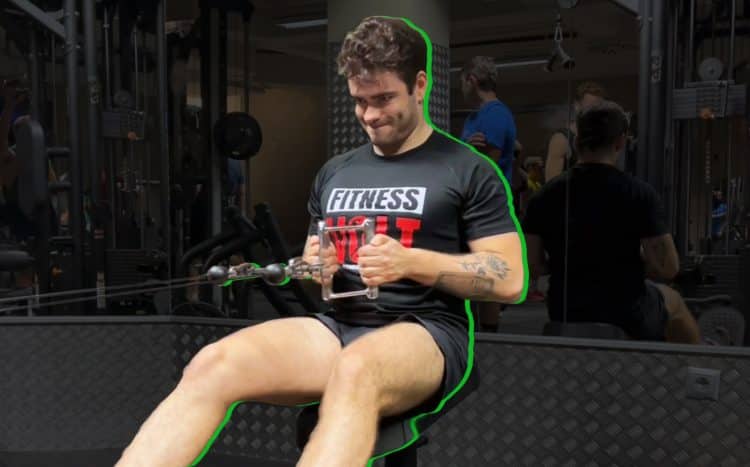
As I often tell my personal training clients, if you can’t feel a muscle working, you are doing something wrong. Invariably, a lack of kinesthetic awareness will undermine your workouts.
Bodybuilders call the ability to feel your muscles working the mind-muscle connection, and, unlike a lot of bodybuilding lore, this concept is backed by science (2).
Most lifters feel their back workouts more in their biceps than their lats, traps, rhomboids, etc. This is usually because a) they use too much weight and b) they have a weak mind-muscle connection.
The mind-muscle connection is more than just visualizing the target muscles working. Rather, you should feel them contracting, flexing, and lengthening during each and every rep. This laser-like focus is the difference between a productive rep and a waste of time.
Solution: Start your back workouts with a 10 to 15 second isometric hold to strengthen the connection between your muscles and mind. For lat pulldowns/pull-ups, bring the bar to your chest and then hold it there as you flex your lats. For rows, pull the bar to your chest and hold it as you squeeze your mid-traps and rhomboids. Replicate this sensation throughout your workout.
Related: Three Ways to Use Isometrics to Supercharge Your Workouts
Mistake #5 – Not Leading With Your Elbows
Despite a strong mind-muscle connection, some lifters still feel their back workout more in their biceps and forearms than they do their lats, traps, rhomboids, etc. They may even experience post-workout delayed onset muscle soreness (DOMS) in their arms while their backs feel perfectly fine.
One way to fix this is to remember the cue, “lead with your elbows.” Driving the elbows down and back increases upper back engagement while shifting the focus away from the arms.
Another way to achieve the same outcome is to picture your hands as hooks and your arms as cables attached to your upper back. Instead of pulling with your arms, imagine you are reeling in the hooks and cables.
Solution: Try using a false (thumbless) grip, focusing on the path of your elbows instead of your arms, and using the hook/cable imagery to shift the focus off your biceps and onto your upper back. Combined with a stronger mind-muscle connection, these cues will help maximize upper back engagement.
Mistake #6 – Not Varying Your Grip Width Enough

A lot of lifters use the same grip on all their back exercises—usually around shoulder-width for pull-ups and pulldowns, and narrow/neutral for rows. While there is nothing wrong with these common hand placements, using the same grip over and over could undermine your back development.
Your back is a large and complex muscle group, and if you want to develop it to its fullest potential, you need to challenge and stimulate it in novel ways. One easy way to do this is to use lots of different grip widths and hand positions, and there are so many to choose from!
You can go wide, medium, and narrow, underhand, neutral, and overhand, and use different handles and bars. Mix and match—the variations are endless.
Solution: Change grips from set to set, exercise to exercise, workout to workout, or training block to training block. Providing you avoid falling into the usual shoulder-width grip trap, any hand placement variation is a good choice.
Mistake #7 – Ignoring the Eccentric Part of your Reps
Watch a lot of people do pull-ups, pulldowns, and rows, and you’ll see them putting all their effort into lifting the weight but very little into lowering it. Picture the beginner doing their first pull-ups—they slowly but surely drag their chins up to the bar only to drop like a stone. It’s a wonder they don’t dislocate their arms!
Research tells us that the eccentric or lowering phase of an exercise is very important for building muscle and strength (3). Failing to control the eccentric part of your reps will severely undermine your progress.
Related: Eccentric Vs. Concentric Training
Get more from your back workout by paying as much attention to the lowering phase as you do the lifting. In fact, as studies suggest that you are roughly 1.4 times stronger eccentrically than concentrically, you should lower your weights more slowly than you lift them to make each rep as productive as possible.
Solution: However long it takes you to do the concentric/lifting phase of your reps, try to take roughly twice as long to complete the eccentric/lowering phase. At the very least, make sure you lower the load mindfully rather than just dropping the weight without controlling its descent.
Mistake #8 – Relegating Deadlifts to Leg Day
A lot of lifters classify deadlifts as a lower-body exercise and do them on leg day. This makes a certain amount of sense as the hamstrings, glutes, and quads are heavily involved in this classic barbell move.
However, doing deadlifts on leg day means you are missing out on one of the best back-builders around.
You see, performed correctly, the deadlift is almost unbeatable for building upper and lower back strength and size. The lats, traps, rhomboids, rear deltoids, and erector spinae muscles are all involved, either as stabilizers or prime movers. No other exercise—except maybe the harder to learn and master power clean—engages so many back muscles at the same time.
I often prescribe the deadlift on back day, and I’m not alone. Six-time Mr. Olympia Dorian Yates, famed for his massive back, is also a fan of this programming approach.
Related: 6x Mr. Olympia Dorian Yates Explains Why He Always Includes Deadlifts on Back Day
Solution: Do deadlifts at the start of your back workout or, like Yates, put them at the end. Either way, deadlifts are an underappreciated back builder that deserves a place in your upper body training plan.
Closing Thoughts
Building an impressive back isn’t about luck—or even just hard work—it’s about avoiding the common mistakes that hold most lifters back.
By training with balance, mastering form, using a full range of motion, and staying mindful of muscle engagement, you’ll transform wasted effort into real progress.
So, apply what you’ve learned from this article: your stronger, wider, thicker back starts with the next rep!
References:
- Pallarés JG, Hernández-Belmonte A, Martínez-Cava A, Vetrovsky T, Steffl M, Courel-Ibáñez J. Effects of range of motion on resistance training adaptations: A systematic review and meta-analysis. Scand J Med Sci Sports. 2021 Oct;31(10):1866-1881. doi: 10.1111/sms.14006. Epub 2021 Jul 5. PMID: 34170576.
- Calatayud J, Vinstrup J, Jakobsen MD, Sundstrup E, Brandt M, Jay K, Colado JC, Andersen LL. Importance of mind-muscle connection during progressive resistance training. Eur J Appl Physiol. 2016 Mar;116(3):527-33. doi: 10.1007/s00421-015-3305-7. Epub 2015 Dec 23. PMID: 26700744.
- Azevedo PHSM, Oliveira MGD, Schoenfeld BJ. Effect of different eccentric tempos on hypertrophy and strength of the lower limbs. Biol Sport. 2022 Mar;39(2):443-449. doi: 10.5114/biolsport.2022.105335. Epub 2021 Jun 1. PMID: 35309524; PMCID: PMC8919893.