
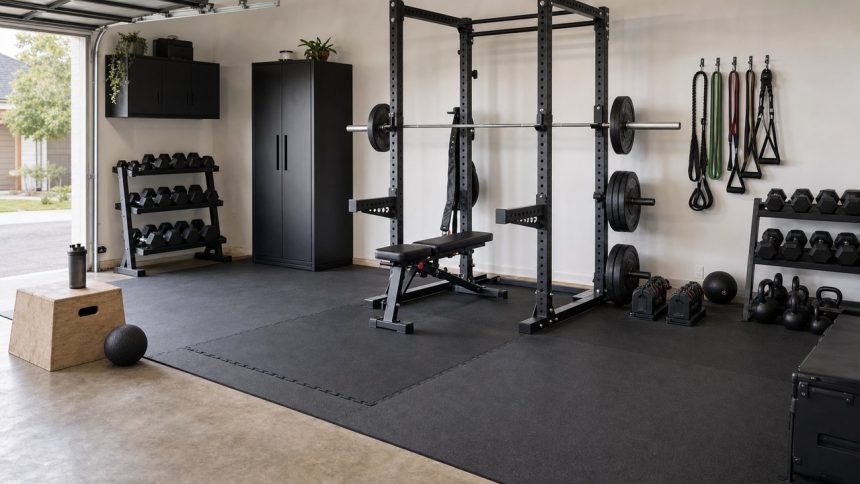
A home gym can make training easier, cheaper, and more consistent. It can also turn into a repair bill or injury risk if the equipment is crowded, unstable, poorly anchored, or placed on the wrong floor. Most safety advice is written for commercial gyms, but home gyms fail in quieter ways: a loose plate tree, a rack too close to drywall, a treadmill shaking an upstairs room, or a band anchor clipped to something that was never meant to hold force.
This checklist is for lifters building or auditing a garage, basement, spare-room, or apartment gym. The goal is simple: know what to bolt, what to pad, what to lock down, and what not to DIY. If you only change one thing today, clear a 3-foot walkway around your main training zone and check every anchor point before your next workout.
What is the fastest home gym safety check?
The fastest home gym safety check is a 10-minute walk-through: check floor stability, rack spacing, plate storage, collars, cable paths, lighting, trip hazards, and emergency access. If you cannot walk around your rack, bench, or cardio machine without stepping over equipment, the setup needs to be cleaned before training.
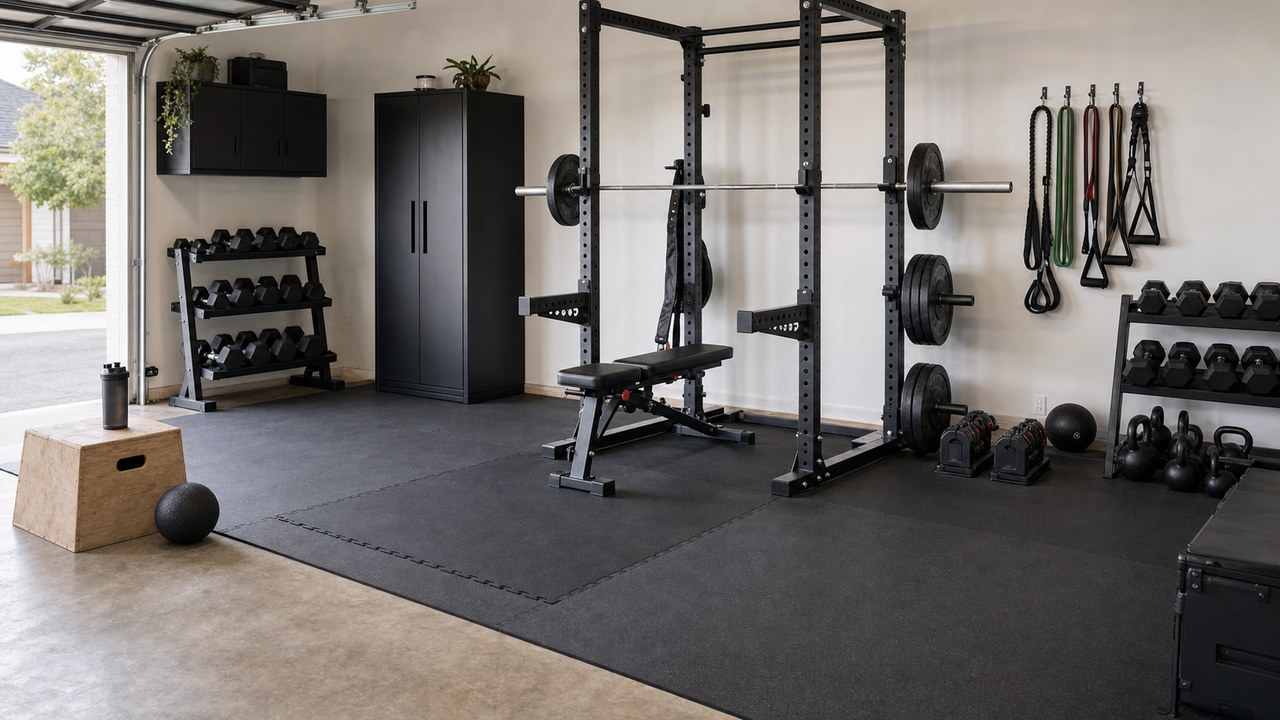
Use this order: floor first, equipment second, movement path third. Most people do it backward and obsess over equipment while ignoring the space around it. A good rack in a bad location is still a problem.
How much clearance do you need around equipment?
Leave at least 2 to 3 feet of walking clearance around frequently used equipment and more room around barbells. A standard 7-foot Olympic bar needs roughly 9 feet of width so plates, hands, and collars are not scraping walls, shelves, windows, or parked cars.
For a rack, measure the bar path, not just the rack footprint. You need room to load plates, step back, bench, pull the bar from J-hooks, and walk away if a lift goes wrong. If your rack is jammed into a corner, you may be able to squat, but you will hate changing plates and bailing becomes harder.
| Equipment | Minimum safe planning space | Watch out for |
|---|---|---|
| Power rack | 9 feet wide, 7 to 8 feet deep | Bar ends hitting walls or shelves |
| Adjustable bench | 2 feet around the bench | Bench feet rocking on mat seams |
| Treadmill | At least 6 feet behind the belt | Low ceilings and rear fall clearance |
| Dumbbell area | 6 by 6 feet | Dropping bells onto hard floor edges |
| Band station | Full band stretch plus 2 feet | Anchors pulling toward your face |
What should you bolt down?
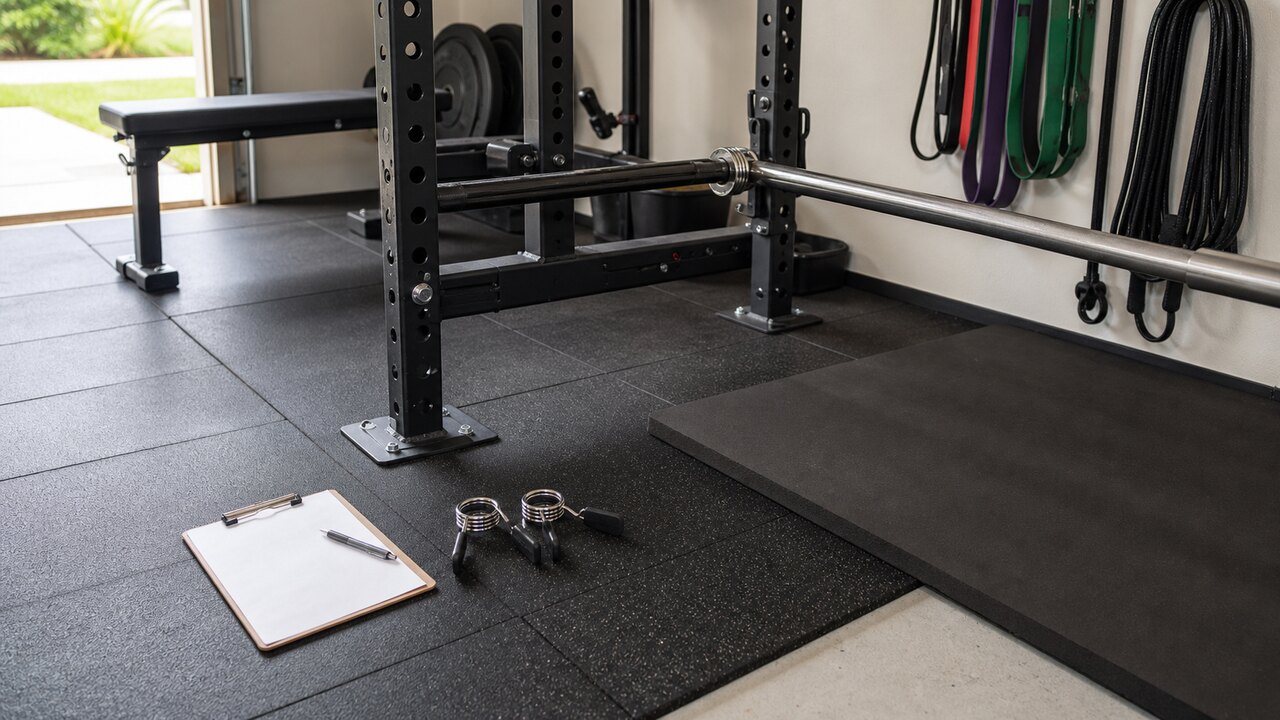
Bolt down tall, heavy, or tip-prone equipment when the manufacturer recommends it and when you own the space or have permission. Power racks, folding wall racks, tall plate trees, and some cable stations can tip if loaded unevenly. If you cannot bolt something safely, choose a freestanding unit designed to be used unbolted.
Do not improvise anchors into drywall, thin studs, ceiling joists you have not located, or masonry you do not understand. If the equipment manual calls for concrete anchors and you only have a wood floor, that is not a small detail. It changes the whole safety equation.
Skip wall-mounted racks if you rent, if you cannot identify framing, or if you are not comfortable drilling structural anchors. Read our renter-friendly home gym guide instead and keep the setup removable.
What should never be DIY?
Do not DIY anything that holds a bar over your body unless you can overbuild it, test it, and inspect it like real equipment. That includes squat stands, J-hooks, safety arms, wall-mounted pull-up bars, ceiling anchors, cable towers, and benches. A homemade sled or storage cart can fail without crushing you. A homemade bench press support cannot.
DIY is best for low-risk accessories: sleds, storage, deadlift blocks, mobility tools, sandbags, and simple landmine bases. Even then, use smooth edges, rated straps, secure hardware, and controlled loading. If a build depends on a random screw, mystery pipe, or cracked board, rebuild it.
How do you make lifting safer at home?
Set safety arms before every barbell set, use collars when plates can slide, and keep the floor around the lift clear. A home gym has no staff member walking by to spot a loose plate, wet floor, or bar left in the wrong hooks. Build the habit before the weight gets heavy.
For squats, set safeties just below the bottom of your deepest good rep. For bench press, set safeties high enough that the bar cannot pin your chest or neck but low enough that you can touch your chest when you arch normally. Test with an empty bar before loading plates.
Use barbell collars on any lift where plates can move sideways. They are especially important for landmine work, Romanian deadlifts, hip thrusts, and uneven floor setups.
How do you protect the floor?
Protect the floor by spreading load, reducing impact, and keeping grit away from the surface. Rubber flooring helps, but it is not magic. A thin mat can protect against scratches and sweat; it will not protect a subfloor from repeated heavy drops.
For most home gyms, use dense rubber mats or quality interlocking tiles under dumbbells, racks, benches, and cardio equipment. If you lift heavy, place extra protection where plates touch down. If you train in a rental, avoid glued flooring and read our home gym flooring mat guide before buying.
What is the safest way to store plates and dumbbells?
Store heavy items low, balanced, and away from walkways. Plates should sit on a rack, plate tree, or wall system rated for the load. Dumbbells should not be stacked in piles where one roll can smash a foot or damage flooring.
The safest storage rule is heavy-low, light-high. Plates, kettlebells, sandbags, and dumbbells go near the floor. Bands, handles, towels, and collars can go higher. If a shelf would hurt someone if it tipped, anchor it or replace it.
For DIY options, FitnessVolt already has guides on DIY plate storage and DIY barbell holders. Use those for organization, but do not overload them beyond the materials you actually used.
How do you make bands and cables safer?
Inspect bands before every session, anchor them to stable points, and keep the line of pull away from your face. Elastic resistance can build real strength, but damaged bands and bad anchors fail fast. A 2019 systematic review found elastic resistance can improve strength similarly to conventional resistance in many settings, but the setup still has to be safe.
Replace bands that show cracks, whitening, cuts, or sticky spots. If a cable pulley rubs against a sharp edge, stop using it until the path is fixed. For DIY pulleys, use rated cable, smooth pulleys, and secure loading pins. Our DIY cable pulley guide is a better starting point than copying a random social clip.
What is the monthly home gym audit?
Once a month, tighten hardware, inspect mats, check anchors, wipe sweat from metal, and look for new cracks, rust, wobble, or wall marks. Home gyms decay slowly because nobody else is cleaning them. The safest owners act like their own maintenance staff.
- Check rack bolts, bench pins, cable clips, and collars.
- Look under mats for moisture, grit, or rubber transfer.
- Inspect bands, straps, handles, and carabiners.
- Confirm storage racks are not leaning or overloaded.
- Clear the emergency path to the door.
Bottom line
A safe home gym is not the most expensive one. It is the one with enough space, stable equipment, protected floors, clear walkways, and no sketchy anchors holding weight over your body. Bolt what the manual says to bolt, pad what touches the floor, lock down plates and collars, and keep DIY projects away from life-or-limb support roles.
Sources
- Centers for Disease Control and Prevention. (2024). Adult Activity: An Overview. CDC. Accessed May 30, 2026.
- Nationwide Children’s Hospital. (n.d.). Home Exercise Equipment. Center for Injury Research and Policy. Accessed May 30, 2026.
- Lopes, J. S. S., Machado, A. F., Micheletti, J. K., Almeida, A. C., Cavina, A. P., & Pastre, C. M. (2019). Effects of training with elastic resistance versus conventional resistance on muscular strength. SAGE Open Medicine. doi:10.1177/2050312119831116. PMID: 30815258.