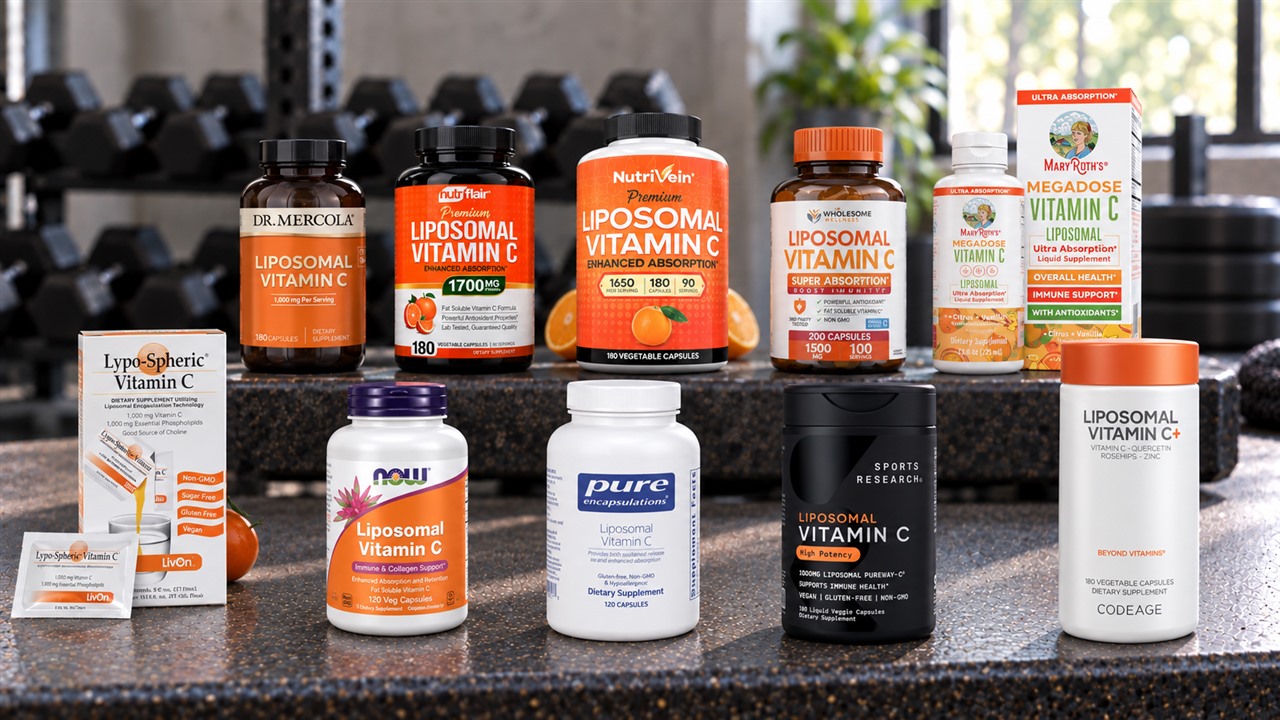
A bottle marked 180 capsules can contain 60 servings or 90, and a 1,500 mg front-label number can include more than vitamin C. Those differences matter before you pay extra for a liposomal formula. Our picks separate the actual vitamin dose, capsule burden, added ingredients, and liquid formats so you can choose the product that fits your routine.
Written by Tom Miller, CSCS. Reviewed by the FitnessVolt Editorial Team. Last updated: October 6, 2026.
Short on time? NOW Liposomal Vitamin C is our overall pick for a clearly labeled 1,000 mg, two-capsule serving. Pure Encapsulations supplies 500 mg in two capsules, while LivOn packs 1,000 mg into an individual sachet.
How We Chose
We rank vitamin dose clarity and practical serving size ahead of dramatic absorption claims. A formula should identify its vitamin C amount separately from phospholipids or other ingredients. We compare capsule count per serving, servings per bottle, added zinc and botanicals, dietary restrictions, and the convenience of measured liquids or packets. Our editorial scores describe those buying considerations, not changes in blood vitamin levels. A branded delivery ingredient can make a formulation easier to identify, but it does not establish that every finished product has the same clinical effects. We included both simpler formulas and combinations so the tradeoffs are visible. Choose a dose that addresses your needs; a larger number is not the goal, and standard vitamin C remains a reasonable alternative.
Our Verdict
NOW Liposomal Vitamin C
A clearly stated 1,000 mg vitamin C serving in two capsules, without a crowded vitamin stack.
Best for: Adults who want a straightforward liposomal capsule formula
Check Price on AmazonOur Top Picks
1. NOW Liposomal Vitamin C – Best Overall

NOW Liposomal Vitamin C 120 Veg Capsules
Best OverallNOW supplies 1,000 mg of vitamin C in two capsules, a simpler serving than Sports Research's three-capsule format at the same stated vitamin amount.
Pros
- 1,000 mg vitamin C per serving
- Two capsules and 60 servings
- Named PureWay-C ingredient
Cons
- High dose for a small dietary gap
- Capsules rather than a pill-free format
NOW’s Supplement Facts lists 1 g of vitamin C as liposomal PureWay-C in two vegetable capsules. The 120-count bottle therefore contains 60 servings. This is the cleanest starting point here if you want a high-dose capsule without added zinc or an elaborate botanical stack.
The dose matches Sports Research’s 1,000 mg, but NOW uses one fewer capsule per serving. Compare their checkout prices against the same 60-serving supply. Skip this if you only need a small dietary top-up; Pure’s 500 mg serving is lower, though even that exceeds an adult’s basic daily requirement.
2. Sports Research Liposomal Vitamin C – Best Liquid-Filled Capsules

Sports Research Liposomal Vitamin C 180 Liquid Capsules
Liquid-Filled CapsulesThe liquid-filled vegetarian capsules suit buyers who prefer that format, but the three-capsule serving prevents the 180-count bottle from lasting longer than NOW.
Pros
- 1,000 mg vitamin C per serving
- PureWay-C liposomal ingredient
- 180 liquid-filled veggie capsules
Cons
- Three capsules per labeled serving
- 180 capsules mean 60 servings
Sports Research lists a 1,000 mg vitamin C serving and directs adults to take three liquid veggie capsules. Divide 180 by three and you get 60 servings, not 180. That serving math changes the apparent value of the larger bottle.
Choose it for the liquid-filled capsule format and named ingredient rather than the capsule count. Skip this if minimizing pills is your priority. NOW supplies the same stated vitamin dose in two capsules; a LivOn packet removes the capsule routine, though its 30-packet carton contains fewer servings.
3. LivOn Lypo-Spheric Vitamin C – Best Individual Packets

LivOn Lypo-Spheric Vitamin C 30 Packets
Individual PacketsLivOn's 30 single-serving packets remove measuring and capsule counts from the purchase, but the contents are a gel-style supplement rather than a dissolving drink mix.
Pros
- 1,000 mg vitamin C per packet
- 30 individually packaged servings
- Separate phospholipid quantity on the package
Cons
- Single-use packaging
- Packet contents do not dissolve like drink powder
LivOn states 1,000 mg of vitamin C and 1,000 mg of essential phospholipids per packet. The carton contains 30 packets, so the vitamin and delivery ingredients remain distinct numbers. Its directions say the contents will not dissolve in water.
This format suits travel and buyers who prefer a premeasured serving. Skip this if you want a smooth dissolving drink powder or dislike disposable sachets. MaryRuth’s bottled liquid avoids an individual wrapper, but you have to measure each serving rather than open a packet.
4. Pure Encapsulations Liposomal Vitamin C – Best Lower-Dose Capsules

Pure Encapsulations Liposomal Vitamin C 120 Capsules
Lower-Dose CapsulesPure supplies 500 mg in a two-capsule serving, the lower-dose capsule choice here for buyers who do not want a 1,000 to 1,700 mg serving.
Pros
- 500 mg vitamin C per serving
- Two capsules and 60 servings
- Vitamin amount separated from delivery ingredients
Cons
- Two capsules for half NOW's vitamin amount
- Premium pricing can weaken value
Pure’s label states 500 mg of vitamin C as liposomal PureWay-C ascorbic acid per two capsules. The 120-capsule bottle contains 60 servings, exactly the same serving count as NOW’s. You get half the vitamin C, not half the supply.
The lower amount is the reason to consider it. Paying more for fewer milligrams can make sense if the dose suits you better. Skip this if you expect a concentrated one-capsule option or want the cheapest 1,000 mg serving. Dose suitability matters more than maximizing vitamin per dollar.
5. Dr. Mercola Liposomal Vitamin C – Best 90-Serving 1,000 mg Bottle

Dr. Mercola Liposomal Vitamin C 180 Capsules
90-Serving BottleMercola's two-capsule serving turns 180 capsules into 90 servings, a longer 1,000 mg supply than Sports Research, with beeswax to account for.
Pros
- 1,000 mg vitamin C per serving
- Two capsules and 90 servings
- Ascorbic acid amount stated on the label
Cons
- Contains beeswax
- High dose rather than a basic dietary top-up
Mercola lists 1,000 mg of vitamin C as ascorbic acid per two capsules and 90 servings per bottle. Unlike Sports Research’s 180-count bottle, this one lasts for 90 labeled servings. The ingredient list includes sunflower lecithin, medium-chain triglycerides, and beeswax.
Compare it with NOW when both two-capsule formulations suit you, adjusting for 90 versus 60 servings. Skip this if you avoid bee-derived ingredients. A vegetarian capsule shell does not make the complete formula vegan, and the beeswax is a meaningful difference from the plant-based options.
6. MaryRuth’s Megadose Liposomal Vitamin C – Best Bottled Liquid

MaryRuth's Megadose Liposomal Vitamin C 7.6 fl oz
Bottled LiquidMaryRuth's combines a 500 mg serving with a bottled liquid format, a useful alternative to Pure's capsules when swallowing pills is the main obstacle.
Pros
- 500 mg vitamin C per serving
- 30 labeled servings
- Pill-free citrus-vanilla formula
Cons
- Requires measuring
- Flavored liquid may not suit everyone
MaryRuth’s states 500 mg of vitamin C per serving and 30 servings in a 7.6 fl oz bottle. That puts its vitamin amount alongside Pure, not the 1,000 mg packet and capsule choices. Citrus vanilla is the labeled flavor, not a promise that every buyer will enjoy it.
Choose it when a measured liquid fits your routine better than two capsules. Skip this if you need a premeasured travel serving or prefer an unflavored supplement. LivOn’s packets solve the measuring problem, while Pure avoids flavor ingredients but keeps the capsule format.
7. Codeage Liposomal Vitamin C+ – Best Multi-Ingredient Formula

Codeage Liposomal Vitamin C+ 180 Capsules
Multi-Ingredient FormulaCodeage combines 1,500 mg of vitamin C with zinc and botanicals, making overlap with an existing multivitamin a bigger consideration than bottle size.
Pros
- 1,500 mg vitamin C per serving
- 15 mg added zinc
- 60 three-capsule servings
Cons
- Adds several ingredients you may not need
- Three capsules and a high vitamin dose
Codeage’s label lists 1,500 mg of vitamin C, 15 mg of zinc, and 100 mg of alpha-lipoic acid in a three-capsule serving, plus smaller botanical quantities. Its 180 capsules amount to 60 servings. This is a combination purchase, not a minimal vitamin C formula.
Consider it only if the added ingredients belong in your plan. Skip this if you already take zinc or want to avoid a complex stack. NOW separates the vitamin C purchase from other supplements; Codeage’s additional ingredients do not establish better immunity or recovery than the simpler products.
8. Nutrivein Liposomal Vitamin C – Best 90-Serving High-Dose Alternative

Nutrivein Liposomal Vitamin C 180 Capsules
High-Dose AlternativeNutrivein lists a 1,650 mg two-capsule serving across several vitamin C forms, a high-dose option rather than a proven upgrade over the simpler 1,000 mg picks.
Pros
- 90 two-capsule servings
- 1,650 mg stated vitamin C amount
- Mixed vitamin C forms identified
Cons
- High dose near the adult upper limit
- Mixed forms need careful interpretation
Nutrivein’s panel lists 1,650 mg under vitamin C in a two-capsule serving and names ascorbic acid alongside ester forms. The 180-count bottle contains 90 servings. Keep the form difference in mind before comparing that number with a simpler ascorbic acid label.
This belongs on a high-dose shortlist only when that amount suits your needs. Skip this if you already take substantial vitamin C elsewhere or only need a dietary top-up. Pure supplies 500 mg; NOW supplies 1,000 mg. Neither a larger dose nor the words fat-soluble establish better clinical outcomes.
9. NutriFlair Liposomal Vitamin C – Best Comparison for Mixed-Form Labels

NutriFlair Liposomal Vitamin C 180 Capsules
Mixed-Form ComparisonNutriFlair's 1,700 mg mixed-form label needs more interpretation than a separate ascorbic-acid amount, so compare formulation clarity before its attractive capsule count.
Pros
- Two capsules per serving
- 90 servings per bottle
- Label identifies ester and phospholipid ingredients
Cons
- 1,700 mg line does not simplify form comparisons
- Not a low-dose formula
NutriFlair’s panel groups ascorbyl palmitate, ascorbyl oleate, cetyl ascorbate, sunflower lecithin, and phosphatidylcholine under its 1,700 mg liposomal vitamin C line. The individual contributions are not broken out. That makes a milligram-for-milligram comparison with NOW or Pure less straightforward.
The bottle contains 90 two-capsule servings, matching Nutrivein’s supply. Skip this if you want an unambiguous, separately stated ascorbic acid amount or a moderate dose. Our preference for NOW reflects the easier-to-interpret panel, not a claim that the highest number delivers the best absorption.
10. Wholesome Wellness Liposomal Vitamin C – Best Long-Supply Blend Comparison

Wholesome Wellness Liposomal Vitamin C 200 Capsules
100-Serving BlendWholesome Wellness separates 1,450 mg of vitamin C and 50 mg of phospholipids on its panel; its 200 capsules provide 100 servings, not 200.
Pros
- 100 two-capsule servings
- Separates 1,450 mg vitamin C from 50 mg phospholipids
- Vegetable capsule format
Cons
- Front-label 1,500 mg exceeds the vitamin C line
- High-dose mixed vitamin C forms
The front label says 1,500 mg, while Supplement Facts lists 1,450 mg of vitamin C as ascorbic acid and ascorbyl palmitate plus a separate 50 mg phospholipid complex. That distinction is useful. The 200 capsules contain 100 two-capsule servings.
Consider it when a longer high-dose bottle suits your plan and the ingredient list works for you. Skip this if you want 1,500 mg of vitamin C itself or a lower amount. Mercola supplies 90 servings at 1,000 mg, and Pure offers a clearer lower-dose comparison at 500 mg.
Alternatives Worth Considering
Ordinary ascorbic acid or a buffered formula can meet vitamin C needs without a liposomal price premium. Our broader vitamin C supplement guide compares those forms. A powder may also suit a pill-free routine better than flavored liquid, while a food-first approach can cover a small shortfall without any supplement.
Liposomal Vitamin C Comparison
| Product | Key Spec | Best For | Price |
|---|---|---|---|
| NOW Liposomal Vitamin C 120 Veg Capsules | 1,000 mg per 2 capsules; 60 servings | Best Overall | Check Price |
| Sports Research Liposomal Vitamin C 180 Liquid Capsules | 1,000 mg per 3 capsules; 60 servings | Liquid-Filled Capsules | Check Price |
| LivOn Lypo-Spheric Vitamin C 30 Packets | 1,000 mg per packet; 30 packets | Individual Packets | Check Price |
| Pure Encapsulations Liposomal Vitamin C 120 Capsules | 500 mg per 2 capsules; 60 servings | Lower-Dose Capsules | Check Price |
| Dr. Mercola Liposomal Vitamin C 180 Capsules | 1,000 mg per 2 capsules; 90 servings | 90-Serving Bottle | Check Price |
| MaryRuth's Megadose Liposomal Vitamin C 7.6 fl oz | 500 mg per liquid serving; 30 servings | Bottled Liquid | Check Price |
| Codeage Liposomal Vitamin C+ 180 Capsules | 1,500 mg vitamin C + 15 mg zinc; 60 servings | Multi-Ingredient Formula | Check Price |
| Nutrivein Liposomal Vitamin C 180 Capsules | 1,650 mg stated mixed forms; 90 servings | High-Dose Alternative | Check Price |
| NutriFlair Liposomal Vitamin C 180 Capsules | 1,700 mg mixed-form line; 90 servings | Mixed-Form Comparison | Check Price |
| Wholesome Wellness Liposomal Vitamin C 200 Capsules | 1,450 mg vitamin C + 50 mg phospholipids; 100 servings | 100-Serving Blend | Check Price |
How to Choose Liposomal Vitamin C
Separate absorption from a health result
A 2024 crossover trial in 27 adults found higher blood and leukocyte vitamin C exposure after one specific 500 mg liposomal formulation than after standard vitamin C. That is useful formulation research, not proof that each product here prevents illness or improves training. An earlier small crossover study also found differences in circulating vitamin C. Neither result justifies transferring a tested formulation’s numbers to a different bottle.
Buy the dose you need
The NIH adult requirements are 90 mg for men and 75 mg for women, with an additional 35 mg for smokers. These are daily totals, not amounts to add on top of food. Pure and MaryRuth’s supply 500 mg; NOW, Sports Research, Mercola, and LivOn supply 1,000 mg. Start with your needs instead of assuming the 1,650 mg or 1,700 mg options deserve priority.
Count servings before comparing cost
NOW and Pure each contain 120 capsules with two per serving, so both supply 60 servings. Sports Research contains 180 capsules but uses three, also yielding 60. Mercola and Nutrivein each contain 90 servings, while Wholesome Wellness contains 100. Divide the checkout price by those serving counts. Compare the formulas at a dose you intend to use; extra vitamin C does not automatically make a cheaper purchase.
Choose the format you will keep using
LivOn’s packets remove measuring but add individual wrappers and a gel-style serving that does not dissolve like a sports drink. MaryRuth’s liquid allows a lower-dose pill-free choice but needs measuring. NOW minimizes capsule count at the 1,000 mg level here. Mercola contains beeswax, so read the complete formula if you avoid animal-derived ingredients. A compatible format is more useful than a premium bottle that does not fit your preferences.
Check overlapping ingredients and safety
Codeage adds 15 mg of zinc per serving, which matters if you also use a multivitamin or another zinc supplement. The adult vitamin C upper limit is 2,000 mg daily from all sources. High intake can cause gastrointestinal symptoms; kidney disorders, a kidney-stone history, iron overload, and cancer treatment deserve clinician advice. Liposomal delivery does not remove those precautions. A supplement should fit your health context rather than create another ingredient stack to manage.
Frequently Asked Questions
Is liposomal vitamin C worth the premium?
It can be worth considering for a specific formulation or preferred delivery format, but most buyers should compare it with ordinary vitamin C first. Absorption studies do not establish a universal improvement in immunity, skin appearance, or exercise recovery. NOW is our simpler capsule pick; LivOn earns its place for individually measured packets rather than a guarantee of superior results.
Does 1,500 mg on the bottle always mean 1,500 mg of vitamin C?
No. Wholesome Wellness lists 1,450 mg on the vitamin C line and another 50 mg of phospholipids. Codeage lists 1,500 mg of vitamin C separately from its additional actives. Read Supplement Facts, the stated forms, and serving size instead of comparing front-label numbers alone. A delivery-complex quantity is not automatically an equal quantity of vitamin.
Are liquid capsules better than regular capsules?
A liquid-filled capsule describes the format, not a guaranteed absorption advantage over every powder-filled capsule. Sports Research uses three liquid veggie capsules for its stated serving; NOW uses two capsules for the same vitamin amount. Choose based on the formulation, dose, ingredients, and number of capsules you prefer rather than a rule that one shell type wins.
Can liposomal vitamin C replace fruit and vegetables?
No. A vitamin C supplement does not supply the fiber and varied nutrients in food. A high-dose formula also does not establish that your diet is deficient. If you want a broader look at supplementation alongside training, our bodybuilding supplement guide helps distinguish foundational needs from optional additions.
Does liposomal vitamin C have an upper limit?
The same adult 2,000 mg daily upper limit applies to vitamin C intake; a liposomal label does not make a high dose exempt. Count food and overlapping supplements. The products with 1,450 mg to 1,700 mg servings leave less room for other sources than the 500 mg options. Ask a clinician about suitability if you have relevant medical conditions.
Bottom Line
NOW is our overall pick because the label states 1,000 mg of vitamin C in two capsules and the bottle contains a clear 60 servings. Choose Pure for a lower capsule dose, MaryRuth’s for bottled liquid, or LivOn for individual packets. Compare with ordinary vitamin C options before paying a delivery premium. The right amount, manageable serving, and compatible ingredients matter more than the biggest number on the label.
Sources
- NIH Office of Dietary Supplements: Vitamin C.
- Purpura and colleagues: Liposomal delivery and vitamin C absorption, 2024.
- Davis and colleagues: Liposomal ascorbic acid bioavailability, 2016.