

Dexter Jackson vs Flex Lewis

 Dexter Jackson
 Flex Lewis

Pick two different athletes to compare.
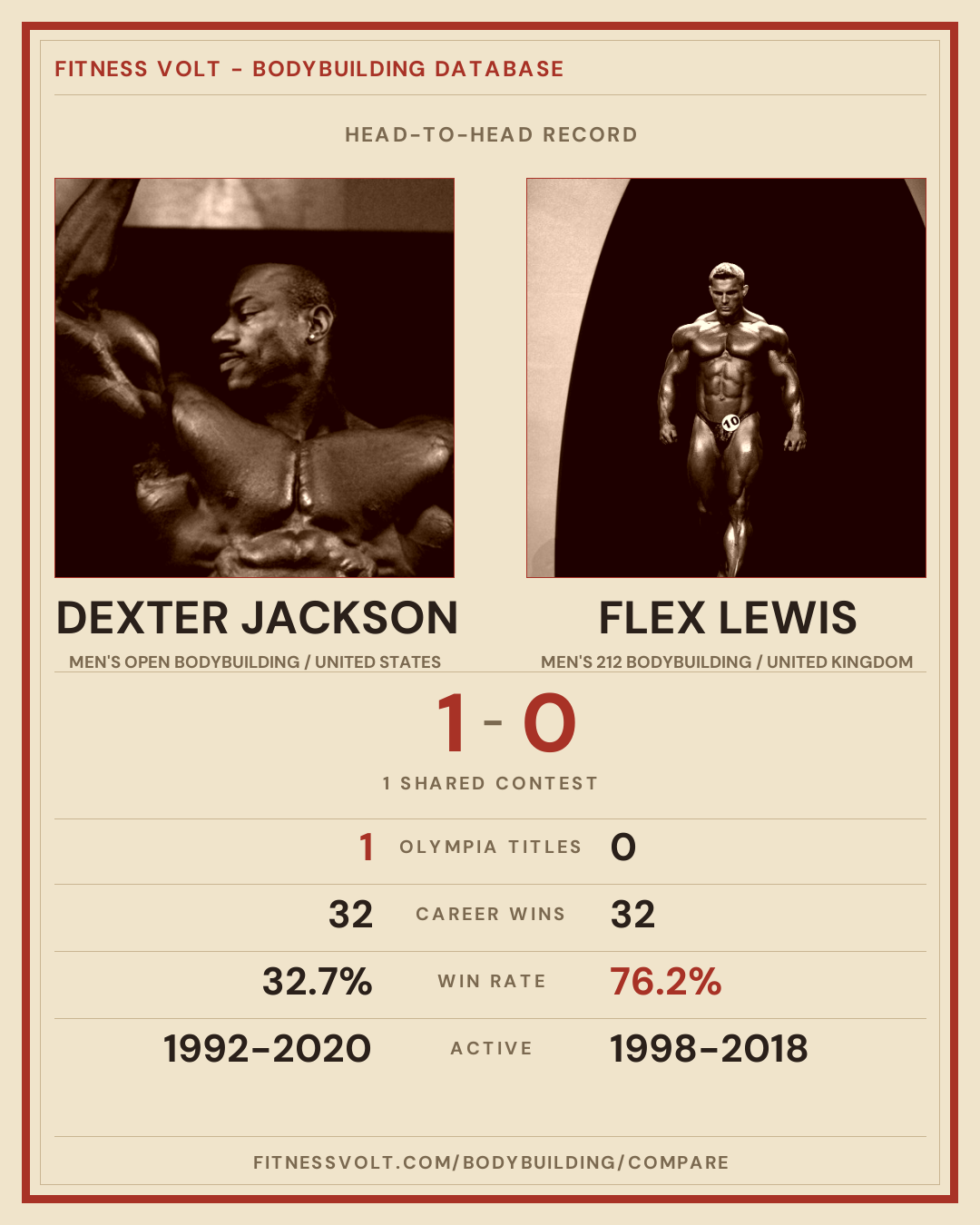
Dexter Jackson vs Flex Lewis head-to-head record and every decided contest between them on record.
Our full story on Dexter Jackson: Dexter Jackson – Complete Profile: Height, Weight, Biography.
Our full story on Flex Lewis: Flex Lewis – Complete Profile: Height, Weight, Biography.
- Meetings
- 1
- Dexter Jackson
- 1 ahead
- Flex Lewis
- 0 ahead
- Span
- 2011
Only 1 head-to-head meeting on record so far, with Dexter Jackson ahead 1 to 0 - too thin to call a rivalry yet.
Every contest Dexter Jackson and Flex Lewis both entered
| Year | Contest | Division | Dexter Jackson | Flex Lewis | Winner |
|---|---|---|---|---|---|
| 2011 | Arnold Classic Europe | Men's Open Bodybuilding | #2 | #5 | Dexter Jackson |
How this is counted: a meeting is one contest where both athletes were judged in the same division. Standing on the same stage in different divisions is not a meeting, because the two were never scored against each other. Dexter Jackson and Flex Lewis meet that test 1 time. For scale, this database holds 95 professional results for Dexter Jackson and 30 for Flex Lewis across their full careers. Counted from the contest record as of October 12, 2026.
Dexter Jackson and Flex Lewis at their peak
Peak window = the athlete's Olympia-title years where available, otherwise their best-placement years. Derived from recorded contest results. It is a span of years, not a rating.
Dexter Jackson reached his competitive peak from 2008 to 2008, winning 1 Olympia title in Men's Open Bodybuilding.
Flex Lewis reached his competitive peak from 2011 to 2013, one of his strongest stretches (64% win rate across 11 contests in the window).
Score these two prime windows against each other on Prime vs Prime, where Olympia dominance is weighted for the size of the field each athlete beat.
Dexter Jackson profile Flex Lewis profile Compare other athletes
Attribute Tug-of-War
Each bar splits a metric by each athlete's share of their combined total. A centered bar means they are level.
Not enough data to compare
Career attributes could not be calculated for one or both athletes.
Career Overlap Timeline
Each bar runs from an athlete's first recorded contest to their last, so the stretch where the two bars cross is the period both were competing. The marks on the bars are the years they met in the same division, one mark per year however many times they met in it. Careers that never cross can still be read against each other on career totals; they just cannot produce a head-to-head record.
Career timeline unavailable
We do not have enough dated contest results to draw a timeline.
Career Stats Comparison
These are career-long figures, drawn from the results we hold for each athlete rather than only the contests the two shared, which is why a pair who never met still has something to compare. Where the two differ, the row marks the stronger figure: the higher number, except on Career Start and Best Placement, where the lower one is better and takes the mark. A row the two are level on marks neither.
Share This Comparison
Comparison unavailable
We could not load this comparison. This might be a temporary connection issue.
Choose two athletes to compare
Search above to compare career stats, head-to-head meetings, and shared contests.
This page counts finishing positions
Every figure here comes from where each athlete placed in the contest record. Judging sheets and point spreads are not in the database, so a comparison tells you who finished higher on the night. It does not tell you by how much, or how close the call was.
- A head-to-head result needs both athletes at the same contest in the same division. Two athletes on the same stage in different divisions were never judged against each other, so that show is not counted as a meeting.
- Only contests both athletes actually entered can be settled here. Careers that never overlapped produce a side-by-side record and no head-to-head, because there is nothing to count.
- Career totals cover the results we hold. A missing show lowers a total; it never invents one.
- A shared placement is left as a tie. It is reported separately rather than split between the two athletes.