

Lee Haney won eight straight Mr. Olympia titles, from 1984 to 1991, with a training rule he could state in five words. His official site lists it among his most famous lines: “train to stimulate, not annihilate.”
Gym culture has spent the decades since moving the other way, toward sessions that leave you crawling to the car. Exercise scientists have now tested most of the ideas behind Haney’s rule: how often to train a muscle, whether sets need to reach failure, whether soreness means growth, and how far extra volume keeps paying off. Most of his rules hold up. The one that doesn’t is “better to undertrain than overtrain,” and the volume research shows why.
Where “stimulate, don’t annihilate” comes from

Haney’s idea is that a workout only has to give a muscle a reason to grow. Everything past that point costs recovery without adding size. In a long interview posted in 2023, he put it his own way: better to undertrain than to overtrain. He described the goal as enough training to build the physique while leaving enough time to recover for the next workout.
The full career, from the 1979 Teen Mr. America onward, is in our Lee Haney profile.
Haney’s training rules
In interviews, Haney describes six habits that turn the slogan into a program:
- Three days on, one day off. Day one trained chest and biceps, day two trained quads and hamstrings, and day three trained back and shoulders, with abs and calves fitted around them. Then a rest day, and the cycle started again. He has said the cycle gives enough recovery to use a good bit of weight without tearing up the joints.
- Pair a push with a pull. Each training day matched a pushing muscle with a pulling one: chest with biceps, quads with hamstrings, back with shoulders.
- Heavy has a floor. For Haney, a heavy set never dropped below four or five reps, and in the offseason his heavy work sat around six to eight reps.
- Two sessions a day, neither long. Even preparing for the Olympia, he said his total gym time was about an hour and 45 minutes to two hours a day, split into two sessions.
- Free weights for mass. He built mass with barbells and dumbbells and used machines such as leg extensions and leg curls for detail and separation.
- No slow reps. He lowered the weight under control and then drove it up, and said he had never trained with deliberately slow reps.
Our earlier piece on Haney’s training split and protein sources covers how he ate around this schedule. Below, each rule goes up against the research.
Haney’s rules, graded by modern research

The grades below compare each rule with systematic reviews and controlled trials published since 2015. A means the research backs it outright, B+ means it holds with a caveat, C means it overreaches, and ungraded means none of the studies here test it. Five rows are rules he has stated, including his “better to undertrain” line; the soreness and failure rows are what the slogan implies. Two of his habits, session length and free weights for mass, aren’t graded because none of the studies here test them. The sections after the table give the evidence for each grade, and the last two turn the grades into a week you can run and a check to score each session.
| Haney’s rule | Grade | What the research says |
|---|---|---|
| Train each muscle about every fourth day | A | Twice a week beats once a week; beyond that, total weekly sets matter more than frequency, and his cycle delivers both |
| Stop short of wrecking yourself (implied) | B+ | Failure adds little or no size over stopping a rep or two short, and it slows recovery |
| Don’t chase soreness or muscle damage (implied) | A | Muscle damage fades as you adapt, and growth tracks the later weeks of training, not the sore first week |
| Heavy, but never below 4 to 5 reps | B+ | His 6 to 8 range sits on the heavy side, where size matches lighter loads and strength gains are larger; the 4 to 5 floor itself is untested |
| No slow reps | B+ | Rep durations from half a second to 8 seconds grew muscle about equally, so skipping slow reps is a safe preference rather than an advantage |
| Better to undertrain than overtrain | C | More weekly sets keep adding size, with shrinking returns, so deliberate undertraining leaves growth behind |
| Pair a push with a pull | Ungraded | Untested in the research here |
Training frequency: why “every fourth day” works
Haney’s three-on, one-off cycle trains each muscle group every fourth day. Over a week, that works out to about 1.75 sessions per muscle, close to twice a week.
A 2016 meta-analysis of ten studies found that training a muscle at least twice a week produced more growth than training it once, with average effect sizes of 0.49 against 0.30. Whether three times a week beats twice was still an open question. A larger analysis of 67 studies, published online in 2025, added a nuance: frequency on its own made little measurable difference to muscle growth, while strength gains still rose with more frequent training. A split like Haney’s mostly works because it spreads more total sets across the week while keeping each session short.
Failure and recovery: the core of “stimulate”
In the interviews on record, Haney gives no rule about training to failure; his descriptions focus on load and session length. The research on failure supports the spirit of his slogan anyway.
A 2023 meta-analysis of 15 studies found no advantage for training to momentary muscular failure over stopping short, with an effect size of 0.12 and a confidence interval that ran from below zero to 0.37. In an 8-week trial in 2024, 18 trained adults each trained one leg to failure and the other stopping one to two reps short. Quadriceps thickness grew by 0.181 cm on the failure side and 0.182 cm on the reps-in-reserve side, and the failure side lost more speed and reps within each session.
The recovery cost is clearer. In a 2017 study, ten trained men did bench press and squat sessions with sets taken to failure or sets stopped at half the possible reps. Failure sets caused a bigger immediate drop in performance, and recovery from them was still lagging 24 to 48 hours later, even when total volume was matched.
One analysis pushes the other way. A 2024 series of meta-regressions that modeled how close sets came to failure found muscle growth improved as sets ended nearer failure, while strength gains stayed similar across a wide range. Its authors called the analysis exploratory. The practical reading: finish most sets with one to three reps left, and save true failure for the last set of an isolation exercise, where the joint risk is low.

Soreness and muscle damage: annihilation isn’t the signal
The “annihilate” side of the slogan targets the idea that a muscle has to be destroyed to grow. A 2016 study took muscle samples from ten young men at the start of a training program, at week three and at week ten. Muscle damage was highest after the first sessions and dropped as training went on. Muscle-building activity in that first damaging week didn’t relate to growth, while the activity at weeks three and ten tracked closely with how much the muscles grew.
A 2018 review by the same group argued that muscle damage isn’t the process that drives growth, and that early increases in muscle size are mostly swelling from damage. The sample in the 2016 study was small, but the direction is clear: soreness tells you a session was new, and it says little about whether it worked (more on what delayed onset muscle soreness does and doesn’t mean).
Load and tempo: heavy sets at normal speed
A 2017 meta-analysis of 21 studies compared light loads at 60% of a one-rep max or less with heavier loads, all taken to failure. Muscle growth was similar across the loading range, while maximal strength rose more with heavy loads. Haney’s heavy band of six to eight reps lands on the heavy side of that split, so it gets the strength benefit without giving up size. The floor itself, never below four or five, is not something the analysis tested.
His dislike of slow reps also checks out. A 2015 meta-analysis of eight studies found similar muscle growth with repetition durations anywhere from half a second to eight seconds. Lowering the weight under control and then driving it up, as he described, sits comfortably inside that range, and our breakdown of slow vs. fast reps covers tempo in more depth.
Where the rule falls short: “better to undertrain”
This is the one rule the research doesn’t support as written. A 2017 meta-analysis found a graded dose-response between weekly sets and muscle growth: each extra weekly set per muscle added about 0.37% to the gain. The analysis of 67 studies confirmed that muscle size and strength keep rising as volume increases, with diminishing returns that are much sharper for strength than for size.
Taken as a rule, deliberate undertraining means less growth than the same lifter would get with more sets. Haney’s point, in context, was to stop before the cost outweighs the return. The better modern version of his rule: train enough volume to keep progressing, and add sets only when you’re recovering well enough to make use of them, which is the whole point of progressive overload.
A Haney-style week you can run
The plan below borrows his three-on, one-off structure. The set counts, the machine rep range and the time cap are ours, built from the research above; Haney has never laid out a set-by-set program in his interviews.
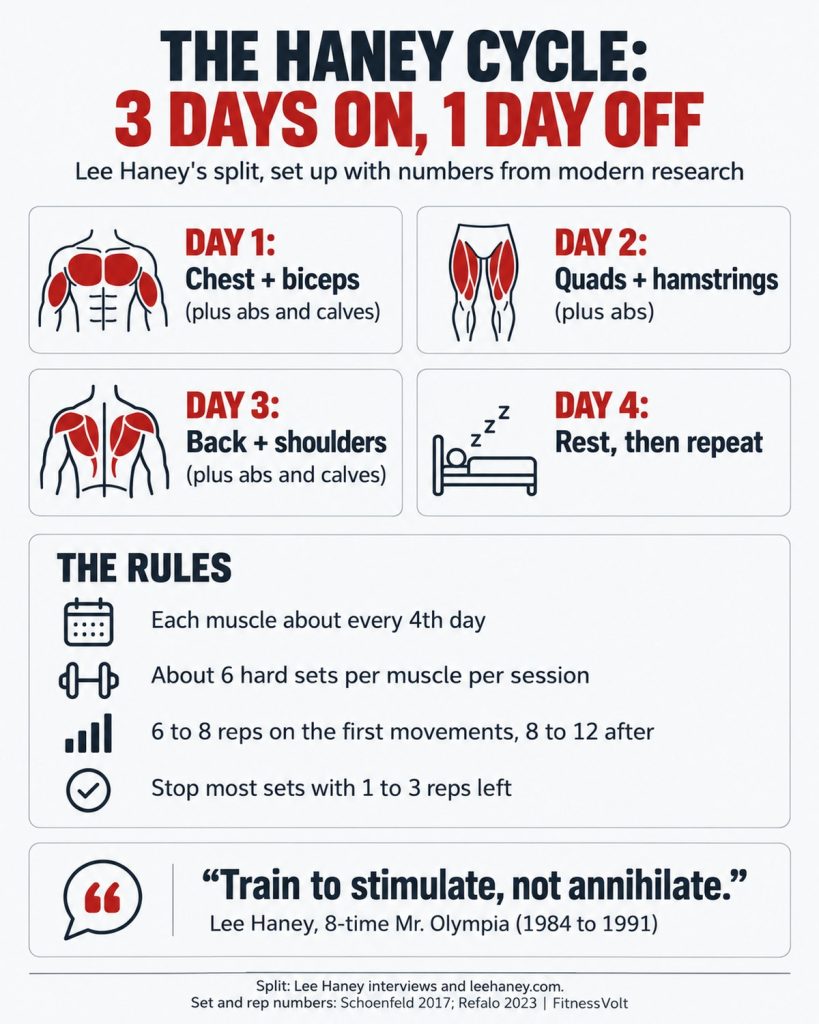
Give each muscle about six hard sets per session. Spread over a four-day cycle, that’s roughly 10 sets per muscle per week, the top category in the 2017 volume analysis. Use barbells and dumbbells for the first movements at six to eight reps, then move to machines or cables at eight to 12 reps for the rest. Finish most sets with one to three reps left, keep each session to about an hour or split a long day into two shorter sessions as Haney did, and add a set to a muscle only when the previous week’s sessions felt recovered.
The stimulate-or-annihilate check
Haney’s slogan works best as a test you run after each session. These four checks are ours, built from the grades above. Score one point for each:
- Reps in reserve. You finished most working sets with one to three reps still possible.
- Form held. The last rep of each set looked like the first, with no swinging or bouncing.
- Load in range. Your heavy sets stayed inside his six-to-eight band.
- Next-session test. Your first working set next time that muscle comes around matches or beats this one.
Four points means you stimulated. Two or fewer, two sessions in a row, means you’re drifting toward annihilation: cut a set per muscle or move the rest day up. Our guide to muscle recovery covers the rest of the recovery side.

Common questions
Did Lee Haney train to failure?
His interviews don’t settle it: he talks about load, session length and recovery, not about where his sets ended.
Does a three-on, one-off split fit a normal week?
Not neatly. A four-day cycle doesn’t line up with a seven-day calendar, so your training days drift through the week. In return, each muscle comes around about every fourth day, close to the twice-a-week floor, with a rest day built into every cycle.
How does this compare with Dorian Yates’s approach?
Dorian Yates, who won the next six Olympia titles after Haney, became known for low-volume training taken all the way to failure. That’s a very different reading of intensity from Haney’s slogan, and both approaches produced long winning streaks. Our piece on Dorian Yates and reps in reserve covers his side.
The bottom line
Lee Haney’s rule holds up better than most gym slogans from the 1980s. The one rule to update is “better to undertrain”: volume still drives growth, so train enough to progress and add more only when you’re recovering from what you already do.
Sources
- Lee Haney. About Lee and Hall of Fame Induction 2014. Official site, accessed November 1, 2026.
- Escape Fitness. (2023, May 12). Muscle Growth Science: Lee Haney and Dr. “Squat” Hatfield [Interview]. YouTube.
- Schoenfeld, B. J., Ogborn, D., & Krieger, J. W. (2016). Effects of resistance training frequency on measures of muscle hypertrophy: a systematic review and meta-analysis. Sports Medicine, 46(11), 1689-1697. DOI: 10.1007/s40279-016-0543-8. PMID: 27102172.
- Pelland, J. C., Remmert, J. F., Robinson, Z. P., Hinson, S. R., & Zourdos, M. C. (2026). The resistance training dose response: meta-regressions exploring the effects of weekly volume and frequency on muscle hypertrophy and strength gains. Sports Medicine, 56(2), 481-505. Published online December 4, 2025. DOI: 10.1007/s40279-025-02344-w. PMID: 41343037.
- Refalo, M. C., Helms, E. R., Trexler, E. T., Hamilton, D. L., & Fyfe, J. J. (2023). Influence of resistance training proximity-to-failure on skeletal muscle hypertrophy: a systematic review with meta-analysis. Sports Medicine, 53(3), 649-665. DOI: 10.1007/s40279-022-01784-y. PMID: 36334240.
- Refalo, M. C., Helms, E. R., Robinson, Z. P., Hamilton, D. L., & Fyfe, J. J. (2024). Similar muscle hypertrophy following eight weeks of resistance training to momentary muscular failure or with repetitions-in-reserve in resistance-trained individuals. Journal of Sports Sciences, 42(1), 85-101. DOI: 10.1080/02640414.2024.2321021. PMID: 38393985.
- Robinson, Z. P., Pelland, J. C., Remmert, J. F., Refalo, M. C., Jukic, I., Steele, J., & Zourdos, M. C. (2024). Exploring the dose-response relationship between estimated resistance training proximity to failure, strength gain, and muscle hypertrophy: a series of meta-regressions. Sports Medicine, 54(9), 2209-2231. DOI: 10.1007/s40279-024-02069-2. PMID: 38970765.
- Morán-Navarro, R., Pérez, C. E., Mora-Rodríguez, R., de la Cruz-Sánchez, E., González-Badillo, J. J., Sánchez-Medina, L., & Pallarés, J. G. (2017). Time course of recovery following resistance training leading or not to failure. European Journal of Applied Physiology, 117(12), 2387-2399. DOI: 10.1007/s00421-017-3725-7. PMID: 28965198.
- Damas, F., Phillips, S. M., Libardi, C. A., Vechin, F. C., Lixandrão, M. E., Jannig, P. R., et al. (2016). Resistance training-induced changes in integrated myofibrillar protein synthesis are related to hypertrophy only after attenuation of muscle damage. The Journal of Physiology, 594(18), 5209-5222. DOI: 10.1113/JP272472. PMID: 27219125.
- Damas, F., Libardi, C. A., & Ugrinowitsch, C. (2018). The development of skeletal muscle hypertrophy through resistance training: the role of muscle damage and muscle protein synthesis. European Journal of Applied Physiology, 118(3), 485-500. DOI: 10.1007/s00421-017-3792-9. PMID: 29282529.
- Schoenfeld, B. J., Grgic, J., Ogborn, D., & Krieger, J. W. (2017). Strength and hypertrophy adaptations between low- vs. high-load resistance training: a systematic review and meta-analysis. Journal of Strength and Conditioning Research, 31(12), 3508-3523. DOI: 10.1519/JSC.0000000000002200. PMID: 28834797.
- Schoenfeld, B. J., Ogborn, D. I., & Krieger, J. W. (2015). Effect of repetition duration during resistance training on muscle hypertrophy: a systematic review and meta-analysis. Sports Medicine, 45(4), 577-585. DOI: 10.1007/s40279-015-0304-0. PMID: 25601394.
- Schoenfeld, B. J., Ogborn, D., & Krieger, J. W. (2017). Dose-response relationship between weekly resistance training volume and increases in muscle mass: a systematic review and meta-analysis. Journal of Sports Sciences, 35(11), 1073-1082. DOI: 10.1080/02640414.2016.1210197. PMID: 27433992.