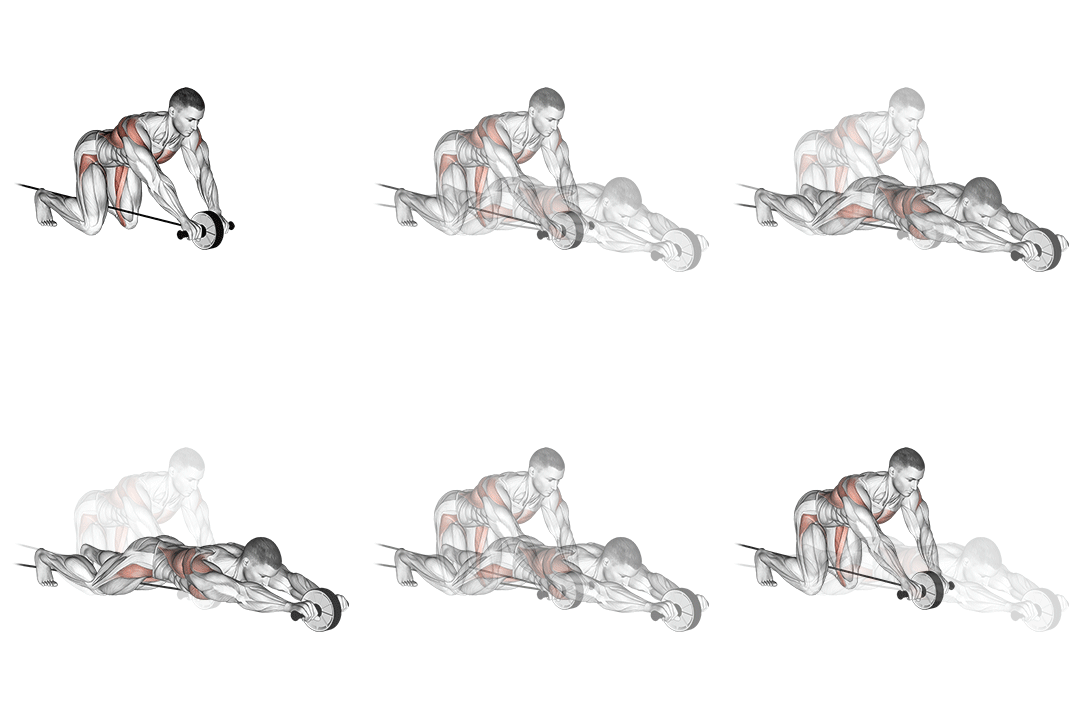
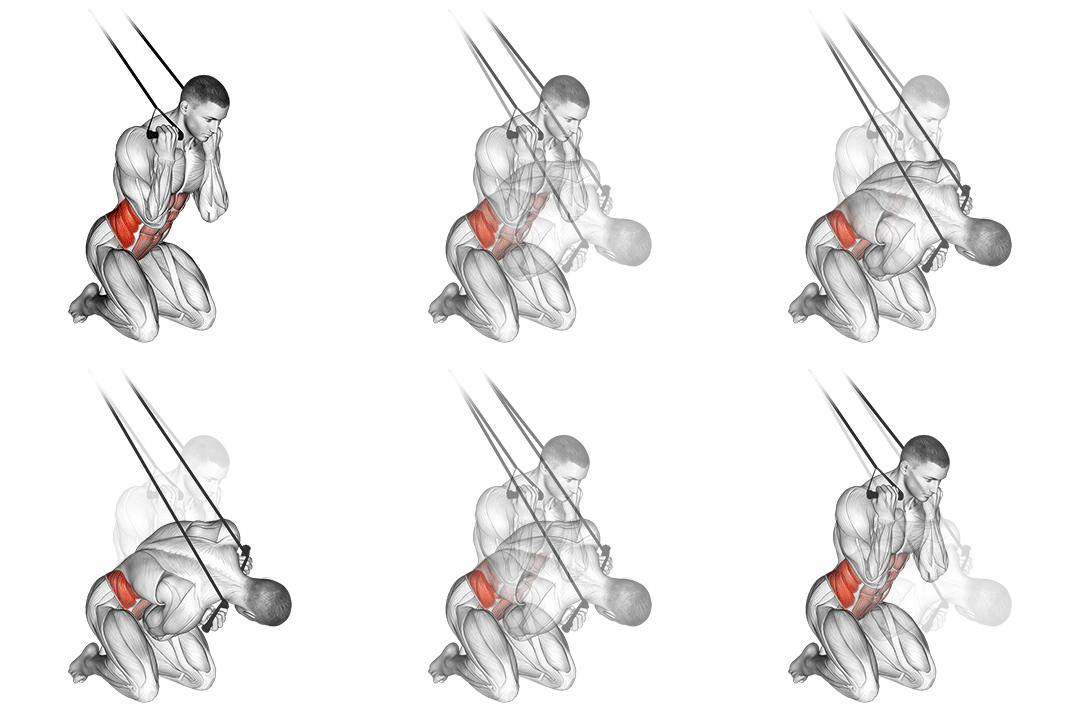
Band Bicycle Crunch vs Band Horizontal Pallof Press

Compare target muscles, equipment, difficulty, movement type, and secondary muscles for Band Bicycle Crunch and Band Horizontal Pallof Press.

Change comparison Share

Get comparison link

Select the link and use your device's Copy command.

Comparison overview

AI-generated
Band Bicycle Crunch vs Band Horizontal Pallof Press — two banded isolation moves that both target your abs but load them very differently. You’ll get clear guidance on how each exercise stresses the rectus abdominis and obliques, the movement and force-vector differences, set and rep recommendations, and technique cues so you perform each safely. Read this to decide which to prioritize for muscle growth, anti-rotation strength, or home workouts, and to learn exactly how to progress each one.

Exercise Comparison

Exercise A
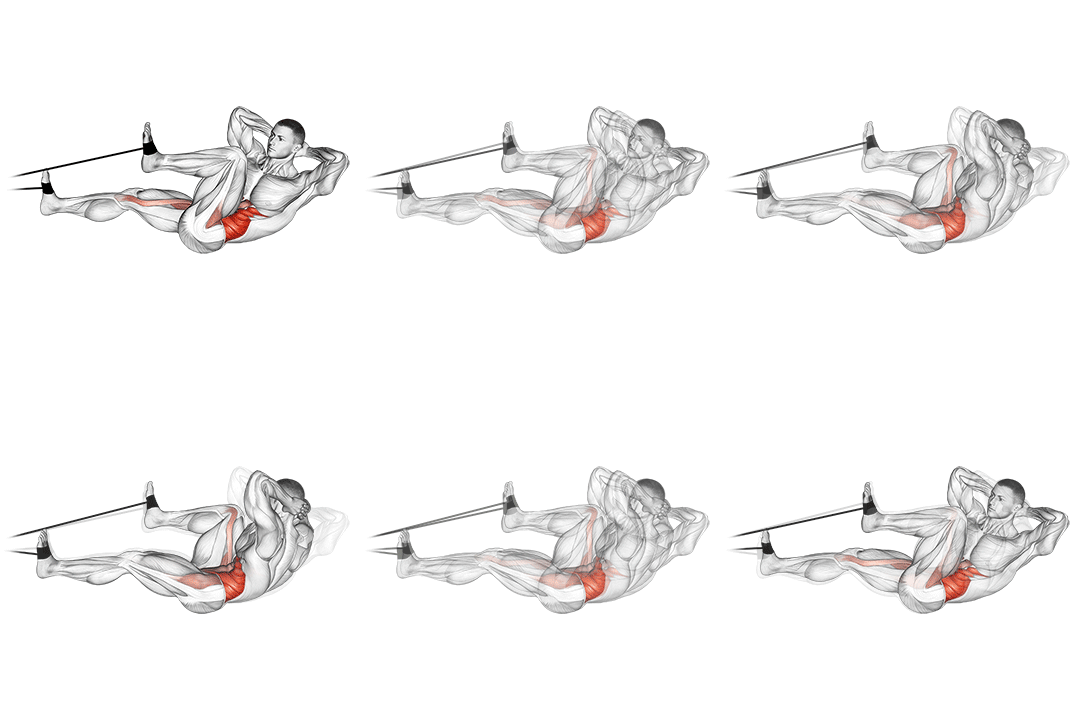
Band Bicycle Crunch demonstration

Band Bicycle Crunch

Target Abs
Equipment Band
Body Part Waist
Difficulty Intermediate
Movement Isolation
Secondary Muscles
Hip Flexors Obliques
VS
Exercise B
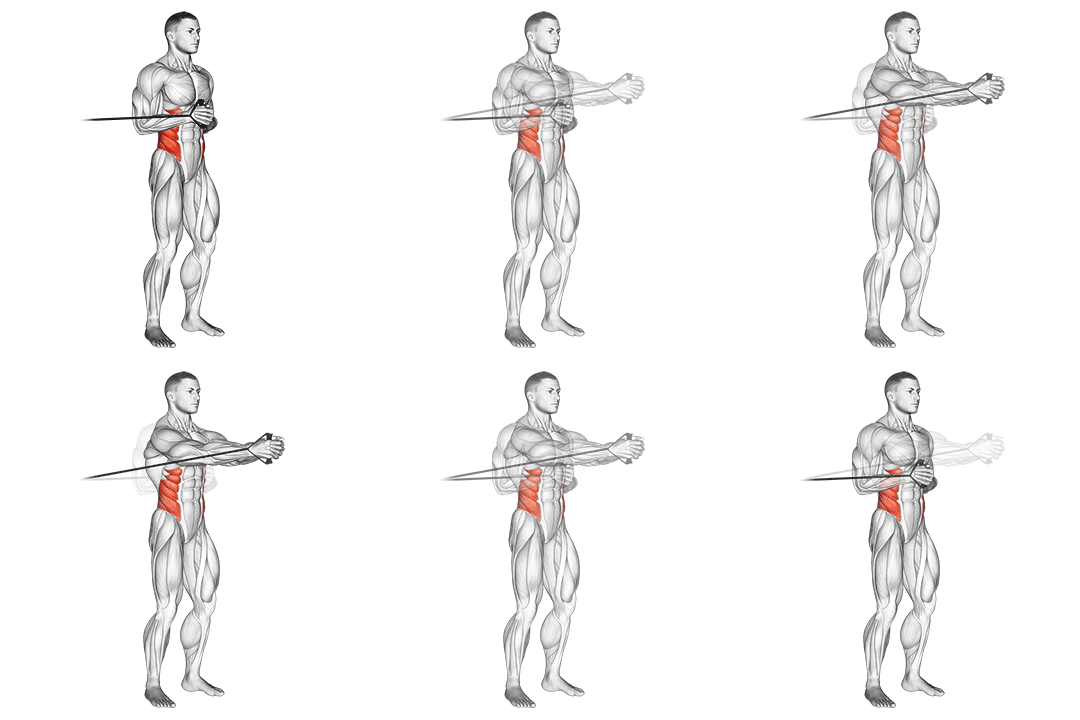
Band Horizontal Pallof Press demonstration

Band Horizontal Pallof Press

Target Abs
Equipment Band
Body Part Waist
Difficulty Intermediate
Movement Isolation
Secondary Muscles
Obliques Glutes

Head-to-Head Comparison

Different values are marked. These are catalogue attributes, not performance scores.

Muscles used

Listed target and secondary muscles, shown on the body. Locations, not activation or strength scores.

  • Target
  • Secondary
  • Not highlighted

Band Bicycle Crunch

Front
Band Bicycle Crunch: front muscle locationsSolid: listed target. Striped: listed secondary. Grey: not highlighted. Locations, not activation or strength scores. See the muscle names below.
Back
Band Bicycle Crunch: back muscle locationsSolid: listed target. Striped: listed secondary. Grey: not highlighted. Locations, not activation or strength scores. See the muscle names below.
Target
Abs
Secondary
Hip Flexors, Obliques

Not shown on diagram: Hip Flexors. These labels do not identify a precise region on this map.

Band Horizontal Pallof Press

Front
Band Horizontal Pallof Press: front muscle locationsSolid: listed target. Striped: listed secondary. Grey: not highlighted. Locations, not activation or strength scores. See the muscle names below.
Back
Band Horizontal Pallof Press: back muscle locationsSolid: listed target. Striped: listed secondary. Grey: not highlighted. Locations, not activation or strength scores. See the muscle names below.
Target
Abs
Secondary
Obliques, Glutes

Grey does not mean a muscle is unused. The diagrams show only the mapped catalogue labels.

Attribute Band Bicycle Crunch Band Horizontal Pallof Press
Target Muscle
Abs
Abs
Body Part
Waist
Waist
Equipment
Band
Band
Difficulty
Intermediate
Intermediate
Movement Type
Isolation
Isolation
Secondary Muscles Different
Hip Flexors, Obliques
Obliques, Glutes

Visual Comparison

An illustrative 1–10 profile derived from catalog difficulty, equipment, and listed-muscle fields—not measured performance or muscle activation.

Key Differences

  • Both exercises target the Abs using Band. The catalogue does not establish which exercise is better for an individual goal.

Muscle comparison

Shared target muscles

Both exercises primarily load the rectus abdominis. The Band Bicycle Crunch creates repeated trunk flexion and dynamic cross-body motion, producing high concentric activity in the rectus during the crunch phase (peak activity around 0–30° of trunk flexion). The Band Horizontal Pallof Press emphasizes isometric rectus and transverse abdominis activation to resist rotation, producing sustained tension rather than repeated shortening-lengthening cycles.

Secondary muscle differences

Band Bicycle Crunch recruits hip flexors (iliopsoas) strongly during the cycling leg drive and loads the external and internal obliques during cross-body rotation at roughly 15–30% greater activation compared with pure flexion. The Pallof Press shifts load to the obliques for anti-rotation, and to the glutes (mainly ipsilateral gluteus medius/gluteus maximus) to stabilize the pelvis when you brace and press the band away.

Muscle involvement analysis

Bicycle crunches produce phasic concentric-eccentric cycles: rectus and obliques spike during crunch/rotation then release, favoring time-under-tension via repeated reps (8–20 reps per side). Pallof presses produce near-constant isometric torque against a lateral force vector; obliques and transverse abdominis maintain ~80–95% of peak tension for the duration of the hold (10–30 seconds), with minimal hip flexor involvement.

Equipment and setup

Band Bicycle Crunch: setup

Band Bicycle Crunch requires a loop or long resistance band anchored under your back or held around feet, a flat surface, and minimal space to lie down and cycle legs. No anchor point is needed if you hold the band at the feet.

Band Horizontal Pallof Press: setup

Band Horizontal Pallof Press requires a fixed anchor at about chest height (a post, door anchor, or band loop), a single band with adjustable tension, and standing room for a 1–2 m radius to press away and resist rotation.

Access and practicality

Band Bicycle Crunch is more accessible because it needs no external anchor and can be done on any floor with a band. Pallof Press needs an anchor and slightly more equipment setup, so it’s less convenient for quick home sessions.

Learning and progression

Learning the movements

Band Bicycle Crunch is easier to learn for most lifters because it follows a familiar crunch/leg cycling pattern; master one side then alternate. Pallof Press has a steeper motor control demand: you must learn to brace isometrically, resist rotational torque, and maintain scapular and pelvic stability.

Progression considerations

Pallof Press offers broader progression: increase band tension, change lever arm (move anchor higher/lower), add slow eccentric/press holds, or extend hold time (from 10s to 60s). Bicycle Crunch progression comes from adding band tension, slowing tempo, or increasing reps (8–30 per side), but has less overload potential for pure anti-rotation strength.

Limitations and precautions

Bicycle Crunch carries higher risk of neck strain and lumbar flexion overload if you yank the head or exaggerate rapid spinal flexion; keep chin tucked and posterior pelvic tilt to lower risk. Pallof Press has lower spinal flexion risk but higher shoulder and scapular strain if you lack bracing or use excessive band tension; start light and focus on thoracic stability.

Pros & Cons

Band Bicycle Crunch

+ Pros

  • Direct dynamic rectus abdominis work with high concentric-eccentric cycles
  • Accessible—no anchor needed, low-equipment setup
  • Also trains hip flexors and cross-body oblique engagement for rotational power
  • Easy to load via higher rep ranges (8–30) for metabolic stress and hypertrophy

− Cons

  • Higher risk of neck pull and lumbar flexion if technique breaks down
  • Less effective for anti-rotation strength and bracing endurance
  • Can overwork hip flexors if you rely on leg drive instead of core

Band Horizontal Pallof Press

+ Pros

  • Excellent anti-rotation stimulus—builds bracing and transverse abdominis control
  • Sustained tension ideal for core endurance and spinal stability
  • Transfers well to resisting external rotation forces in sport
  • Easy to progress with band tension, lever arm, and hold duration

− Cons

  • Requires an anchor point and slightly more setup space
  • Less dynamic rectus shortening—limited concentric-eccentric hypertrophy stimulus
  • Can stress shoulders/scapula if bracing and band path are poor

When Each Exercise Wins

1
For muscle hypertrophy: Band Bicycle Crunch

Bicycle Crunches create repeated shortening and lengthening cycles in the rectus abdominis and increase metabolic stress with 8–30 rep ranges, which favors muscle growth more than static holds.

2
For strength gains: Band Horizontal Pallof Press

Pallof Press builds anti-rotation strength and high isometric torque under band tension; increasing band load or hold time (10–60s) produces stronger transfer to resisting external forces.

3
For beginners: Band Bicycle Crunch

The movement pattern is simpler to learn—lying position reduces balance demands, and you can start with light band tension and slow, controlled reps to learn core contraction.

4
For home workouts: Band Bicycle Crunch

No anchor is required and it needs minimal floor space; you can get meaningful abdominal work with one loop band and bodyweight setup.

Frequently Asked Questions

Can I do both Band Bicycle Crunch and Band Horizontal Pallof Press in the same workout?

Yes. Do Pallof Presses early as a stability primer (3–5 sets of 10–30s holds) to reinforce bracing, then add Band Bicycle Crunches for volume (3–4 sets of 12–20 reps per side) to tax the rectus through concentric-eccentric cycles.

Which exercise is better for beginners?

Band Bicycle Crunch is generally better for beginners because the lying position lowers balance demands and the pattern is easier to control. Start light, keep a tucked chin and posterior pelvic tilt, and progress band tension as your technique improves.

How do the muscle activation patterns differ?

Bicycle Crunches produce phasic peaks in rectus and oblique activity during each crunch/rotation (favoring concentric-eccentric loading). Pallof Presses create sustained isometric tension in obliques and transverse abdominis to resist a lateral band force vector, emphasizing bracing over repetition.

Can Band Horizontal Pallof Press replace Band Bicycle Crunch?

Not fully—Pallof Presses excel for anti-rotation strength and bracing but provide limited concentric-eccentric overload for rectus hypertrophy. Replace only if your priority is stability; otherwise pair them to cover both structural and hypertrophic goals.

Comparison Summary

Use Band Bicycle Crunch when your goal is dynamic abdominal muscle growth and metabolic conditioning—perform 3–4 sets of 12–20 reps per side, focus on a posterior pelvic tilt and slow 2:1:2 tempo to load the rectus abdominis without neck strain. Choose Band Horizontal Pallof Press when you need anti-rotation strength, core bracing, or sport-specific stability—do 3–5 sets of 8–20 presses or 3–6 sets of 10–40 second holds, increasing band tension or lever arm for progressive overload. Ideally, combine both: Pallof Presses early in the session for stability and Bicycle Crunches later for targeted abdominal volume.

Exercise instructions

Steps from the exercise catalogue. Read the full sequence before starting.

Band Bicycle Crunch

  1. Lie flat on your back with your hands behind your head and your knees bent.
  2. Lift your feet off the ground and bring your right knee towards your chest while simultaneously twisting your torso to bring your left elbow towards your right knee.
  3. Straighten your right leg while bringing your left knee towards your chest and twisting your torso to bring your right elbow towards your left knee.
Read remaining steps for Band Bicycle Crunch
  1. Continue alternating the twisting motion, as if you are pedaling a bicycle, while keeping your core engaged throughout the movement.
  2. Repeat for the desired number of repetitions.

Band Horizontal Pallof Press

  1. Attach the band to a sturdy anchor point at waist height.
  2. Stand perpendicular to the anchor point with your feet shoulder-width apart.
  3. Grasp the band handle with both hands and step away from the anchor point to create tension in the band.
Read remaining steps for Band Horizontal Pallof Press
  1. Bring your hands to your chest, keeping your elbows bent and close to your body.
  2. Engage your core and maintain a stable stance.
  3. Extend your arms straight out in front of you, pushing the band away from your body.
  4. Hold the extended position for a few seconds, focusing on maintaining tension in your core.
  5. Slowly bring your hands back to your chest, resisting the pull of the band.
  6. Repeat for the desired number of repetitions.

Also Compare

Compare another pair

Choose two exercises to see their differences side by side.

Compare Exercises