Band Horizontal Pallof Press vs Band Jack Knife Sit-up

Compare target muscles, equipment, difficulty, movement type, and secondary muscles for Band Horizontal Pallof Press and Band Jack Knife Sit-up.

Change comparison Share

Get comparison link

Select the link and use your device's Copy command.

Comparison overview

AI-generated
Band Horizontal Pallof Press vs Band Jack Knife Sit-up — two banded ab moves that look similar on paper but load your core very differently. You’ll get clear guidance on primary and secondary muscle activation, equipment and setup, technique cues, rep ranges (8–15 vs 6–12), injury risk, and which exercise to use depending on whether you want anti-rotation strength or high‑tension spinal flexion for muscle growth. Read on to learn exact setup cues, biomechanical reasoning, and practical progressions so you can pick the right move for your workouts.

Exercise Comparison

Exercise A
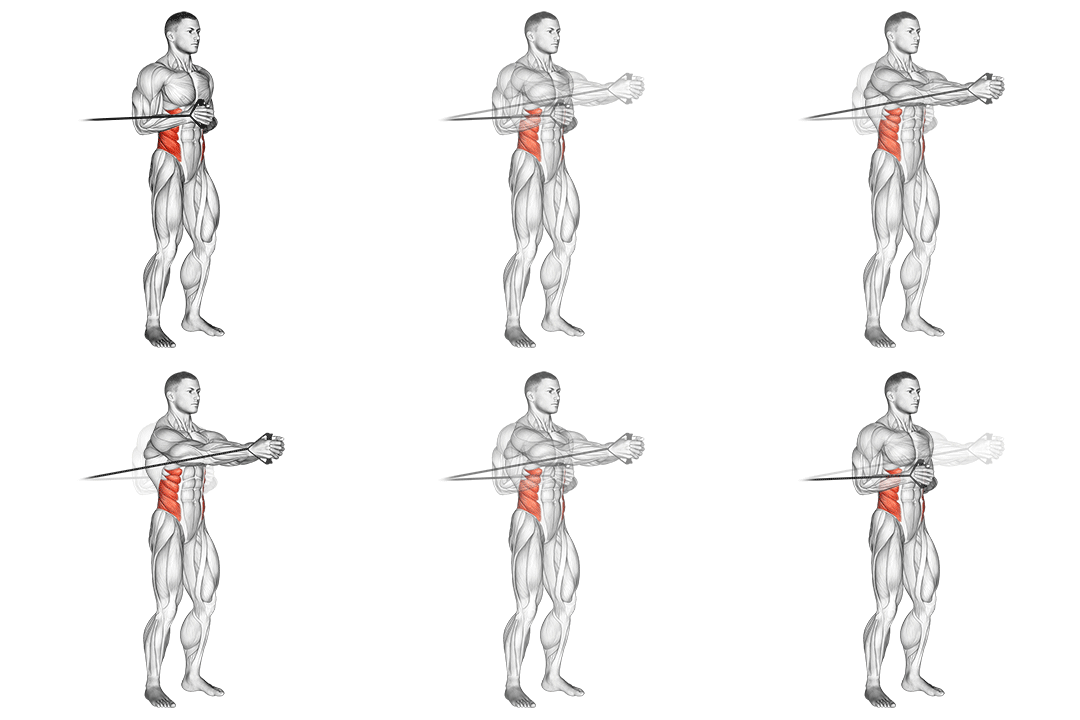
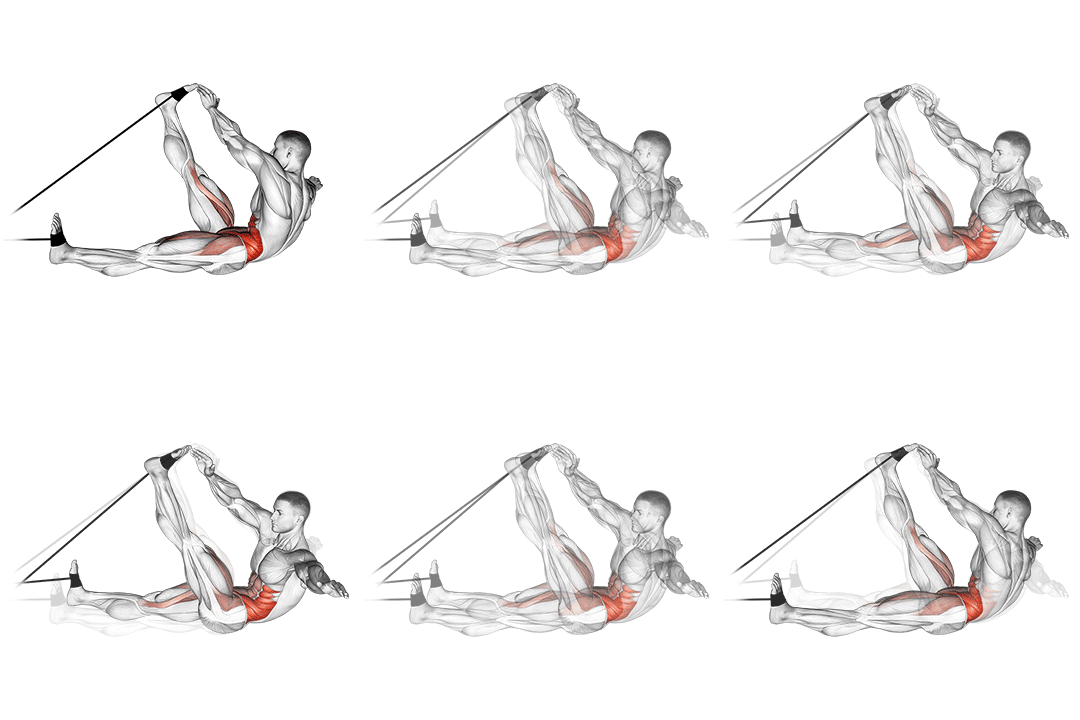
Band Horizontal Pallof Press demonstration

Band Horizontal Pallof Press

Target Abs
Equipment Band
Body Part Waist
Difficulty Intermediate
Movement Isolation
Secondary Muscles
Obliques Glutes
VS
Exercise B
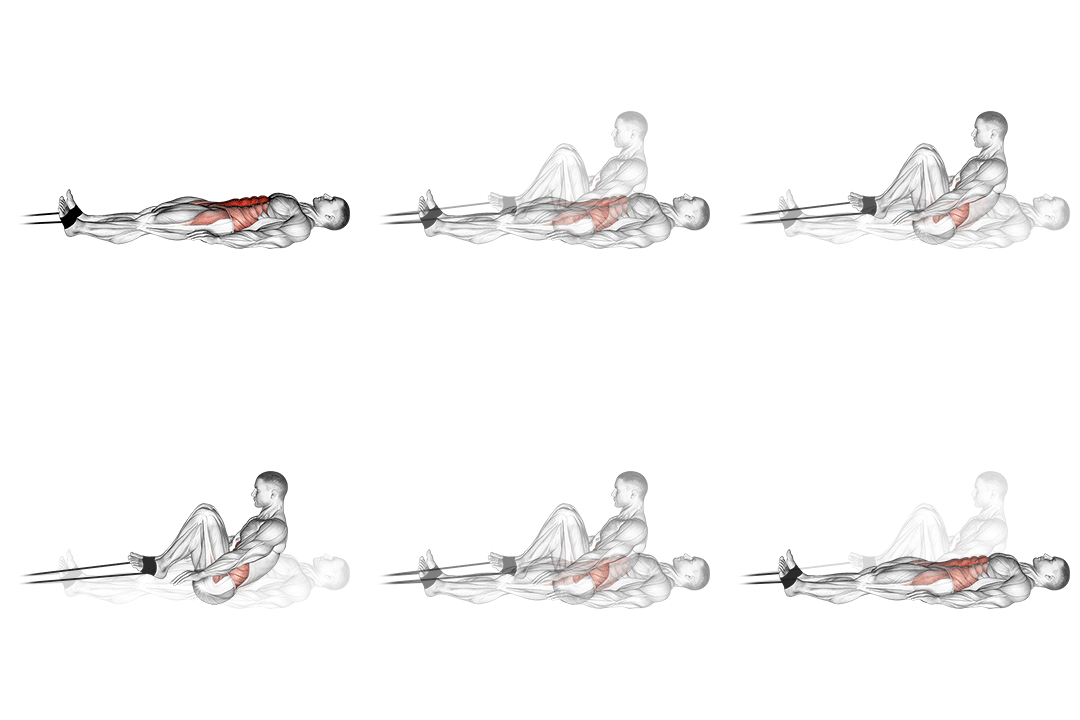
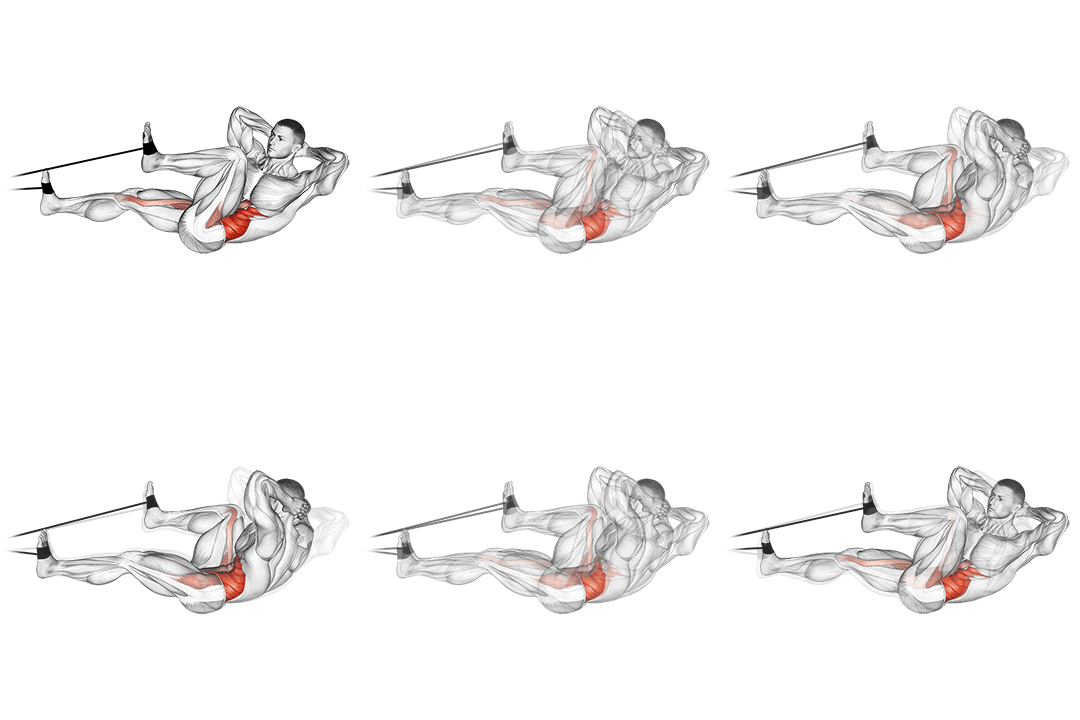
Band Jack Knife Sit-up demonstration

Band Jack Knife Sit-up

Target Abs
Equipment Band
Body Part Waist
Difficulty Advanced
Movement Isolation
Secondary Muscles
Hip Flexors

Head-to-Head Comparison

Different values are marked. These are catalogue attributes, not performance scores.

Muscles used

Listed target and secondary muscles, shown on the body. Locations, not activation or strength scores.

  • Target
  • Secondary
  • Not highlighted

Band Horizontal Pallof Press

Front
Band Horizontal Pallof Press: front muscle locationsSolid: listed target. Striped: listed secondary. Grey: not highlighted. Locations, not activation or strength scores. See the muscle names below.
Back
Band Horizontal Pallof Press: back muscle locationsSolid: listed target. Striped: listed secondary. Grey: not highlighted. Locations, not activation or strength scores. See the muscle names below.
Target
Abs
Secondary
Obliques, Glutes

Band Jack Knife Sit-up

Front
Band Jack Knife Sit-up: front muscle locationsSolid: listed target. Striped: listed secondary. Grey: not highlighted. Locations, not activation or strength scores. See the muscle names below.
Back
Band Jack Knife Sit-up: back muscle locationsSolid: listed target. Striped: listed secondary. Grey: not highlighted. Locations, not activation or strength scores. See the muscle names below.
Target
Abs
Secondary
Hip Flexors

Not shown on diagram: Hip Flexors. These labels do not identify a precise region on this map.

Grey does not mean a muscle is unused. The diagrams show only the mapped catalogue labels.

Attribute Band Horizontal Pallof Press Band Jack Knife Sit-up
Target Muscle
Abs
Abs
Body Part
Waist
Waist
Equipment
Band
Band
Difficulty Different
Intermediate
Advanced
Movement Type
Isolation
Isolation
Secondary Muscles Different
Obliques, Glutes
Hip Flexors

Visual Comparison

An illustrative 1–10 profile derived from catalog difficulty, equipment, and listed-muscle fields—not measured performance or muscle activation.

Key Differences

  • Difficulty levels differ: Band Horizontal Pallof Press is intermediate, while Band Jack Knife Sit-up is advanced.
  • Both exercises target the Abs using Band. The catalogue does not establish which exercise is better for an individual goal.

Muscle comparison

Shared target muscles

Both exercises target the rectus abdominis and the transverse abdominis as primary movers, but they emphasize different contraction types. The Band Horizontal Pallof Press stresses isometric anti-rotation torque across the oblique-lumbar system, with the abs producing ~60–80% of the stabilizing force to resist rotation at near‑constant length. The Band Jack Knife Sit-up loads the rectus abdominis through concentric spinal flexion over a large range of motion, producing higher time‑under‑tension in shortened and lengthened positions and favoring muscle growth.

Secondary muscle differences

The Pallof Press recruits the obliques and glutes more as stabilizers — obliques counter torque while glutes maintain hip alignment during single-leg or split-stance variations. The Jack Knife strongly loads the hip flexors (iliopsoas and rectus femoris) to bring the torso and legs together; if hip flexor strength is limited, they will take more of the load and reduce abdominal stimulus.

Muscle involvement analysis

Pallof Press: primarily isometric; force vector is lateral-to-medial resisting rotation, with peak anti-rotation torque near full press (elbow ~180°). Muscle activation rises quickly and plateaus during a 1–3 second hold. Jack Knife: dynamic concentric-eccentric pattern; rectus abdominis activation peaks near end range of flexion (~30–45° of trunk-leg closure) and during the eccentric return. Expect higher EMG bursts during the closing phase versus Pallof’s steady-state activation.

Equipment and setup

Band Horizontal Pallof Press: setup

Band Horizontal Pallof Press needs a single anchor point at chest height, a loop or long resistance band, and space to stand perpendicular to the anchor. Optional: anchor at hip height to vary torque vector.

Band Jack Knife Sit-up: setup

Band Jack Knife Sit-up requires an anchor behind your head or overhead and a long band you can hold or loop around your feet. You also need a flat surface and space to extend legs; ankle straps can help if you prefer the band around the feet.

Access and practicality

Band Horizontal Pallof Press — easier to set up and safer for most users. It needs only a single, low‑risk anchor and standing space, while the Jack Knife requires more mobility, a secure overhead anchor, and more precise band placement to avoid jerking the lumbar spine.

Learning and progression

Learning the movements

Pallof Press is easier to learn: basic stance, brace, and press cues allow novices to produce useful anti-rotation force within 1–3 sessions. Jack Knife has a steeper learning curve because it demands coordinated hip flexion and spinal flexion with proper breathing and eccentric control.

Progression considerations

Both scale well, but in different ways. Pallof progressions include increasing band tension, moving to single‑leg stance, changing anchor height, or adding slow eccentrics. Jack Knife progression goes from partial range (45°) to full jack knife, increasing band tension or adding tempo (3–4s eccentrics) to boost hypertrophy.

Limitations and precautions

Jack Knife Sit-up carries higher lumbar and hip‑flexor strain risk if performed with poor control or excessive band tension — risk increases when trunk flexion exceeds 60° under load. Pallof Press has lower acute injury risk but can stress the shoulder and thoracic spine if you overreach or rotate; maintain scapular stability and neutral spine.

Pros & Cons

Band Horizontal Pallof Press

+ Pros

  • Strong anti-rotation training that improves core stiffness and transfer to lifts
  • Low setup complexity and lower lumbar shear forces
  • Easy to scale tension and unilateral variations (single-leg stance)
  • Useful for rehabbing or preventing rotational instability

− Cons

  • Less direct spinal flexion work for rectus abdominis hypertrophy
  • Requires a stable external anchor at appropriate height
  • Can underload the abs if you use too light a band or poor bracing

Band Jack Knife Sit-up

+ Pros

  • High rectus abdominis and hip‑flexor loading for muscle growth
  • Large range of motion increases time under tension
  • Simple band-only setup if you have an overhead anchor
  • Effective single-movement compression of torso and legs for core shaping

− Cons

  • Greater lumbar and hip-flexor strain risk with poor technique
  • Harder to learn and control the eccentric phase
  • Requires precise band placement and a secure overhead anchor

When Each Exercise Wins

1
For muscle hypertrophy: Band Jack Knife Sit-up

Jack Knife produces greater concentric-eccentric loading of the rectus abdominis across a large ROM, increasing time under tension. Use 6–12 reps with 2–3s eccentrics to drive muscle growth.

2
For strength gains: Band Horizontal Pallof Press

Pallof Press builds anti-rotation strength and core stiffness that transfer to heavy lifts; you can load it progressively and train isometric holds (10–30s) to increase force output.

3
For beginners: Band Horizontal Pallof Press

Simpler setup and a lower risk profile let you learn bracing and anti-rotation mechanics quickly. Start with 8–15 reps and short 1–3s holds before adding single-leg variations.

4
For home workouts: Band Horizontal Pallof Press

Requires only a waist‑height anchor and standing space; you get useful core stimulus with minimal risk. Jack Knife needs a secure overhead anchor and more control, which can be harder at home.

Frequently Asked Questions

Can I do both Band Horizontal Pallof Press and Band Jack Knife Sit-up in the same workout?

Yes. Pairing them provides complementary stimuli: start with Pallof presses for anti-rotation stability (2–4 sets of 8–12 with 1–3s holds), then do Jack Knives for concentric abdominal overload (3–4 sets of 6–12). Schedule Pallofs earlier to prime stability and reduce fatigue during jack knife loading.

Which exercise is better for beginners?

Band Horizontal Pallof Press is better for beginners because it teaches bracing and anti-rotation control with lower lumbar stress. Begin with light bands and focus on hips square, chest up, and a full press with minimal torso rotation.

How do the muscle activation patterns differ?

Pallof Press emphasizes steady isometric activation to resist rotation, with obliques and transverse abdominis firing to maintain neutral spine. Jack Knife uses dynamic concentric-eccentric contractions, peaking near end-range spinal flexion and engaging hip flexors strongly during closure.

Can Band Jack Knife Sit-up replace Band Horizontal Pallof Press?

Not fully. Jack Knife targets spinal flexion and hypertrophy while Pallof trains anti-rotation stiffness and transfer to compound lifts. Replace only if your goal is exclusively abdominal hypertrophy; otherwise include both for balanced core development.

Comparison Summary

Use the Band Horizontal Pallof Press when your goal is core stiffness, anti-rotation strength, and low‑risk progression. It’s ideal for improving force transfer in carries, presses, and squats and for beginners or rehab clients. Choose the Band Jack Knife Sit-up when your goal is direct rectus abdominis hypertrophy and you can control spinal flexion and hip flexor involvement; program sets of 6–12 reps with controlled 2–3s eccentrics and moderate band tension. Both can coexist: Pallof for stability and transfer, Jack Knife for concentrated abdominal growth — pick based on whether you need anti-rotation torque or high ROM spinal flexion.

Exercise instructions

Steps from the exercise catalogue. Read the full sequence before starting.

Band Horizontal Pallof Press

  1. Attach the band to a sturdy anchor point at waist height.
  2. Stand perpendicular to the anchor point with your feet shoulder-width apart.
  3. Grasp the band handle with both hands and step away from the anchor point to create tension in the band.
Read remaining steps for Band Horizontal Pallof Press
  1. Bring your hands to your chest, keeping your elbows bent and close to your body.
  2. Engage your core and maintain a stable stance.
  3. Extend your arms straight out in front of you, pushing the band away from your body.
  4. Hold the extended position for a few seconds, focusing on maintaining tension in your core.
  5. Slowly bring your hands back to your chest, resisting the pull of the band.
  6. Repeat for the desired number of repetitions.

Band Jack Knife Sit-up

  1. Lie flat on your back with your legs straight and your arms extended overhead, holding the band.
  2. Engage your abs and lift your legs and upper body simultaneously, bringing your hands towards your feet.
  3. Pause for a moment at the top, then slowly lower your legs and upper body back down to the starting position.
Read remaining steps for Band Jack Knife Sit-up
  1. Repeat for the desired number of repetitions.

Also Compare

Compare another pair

Choose two exercises to see their differences side by side.

Compare Exercises