Band Assisted Wheel Rollerout vs Band Horizontal Pallof Press

Compare target muscles, equipment, difficulty, movement type, and secondary muscles for Band Assisted Wheel Rollerout and Band Horizontal Pallof Press.

Change comparison Share

Get comparison link

Select the link and use your device's Copy command.

Comparison overview

AI-generated
Band Assisted Wheel Rollerout vs Band Horizontal Pallof Press — two band-based core isolation moves that both target your abs but load them in different ways. You’ll get clear, actionable guidance on which exercise emphasizes rectus abdominis length-tension and anti-extension torque versus which one prioritizes anti-rotation stability and oblique recruitment. I’ll cover primary and secondary muscle activation, step-by-step technique cues, equipment needs, rep ranges (6–15 reps, tempo options), progression routes, and safety cues so you can pick the right move for your goals.

Exercise Comparison

Exercise A
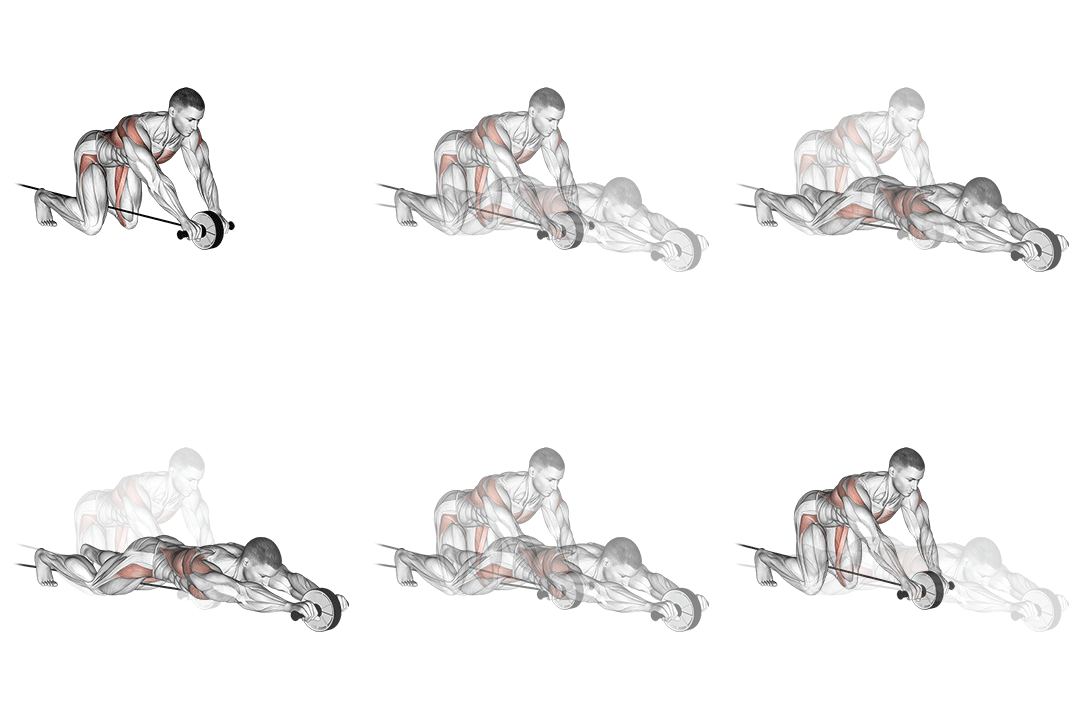
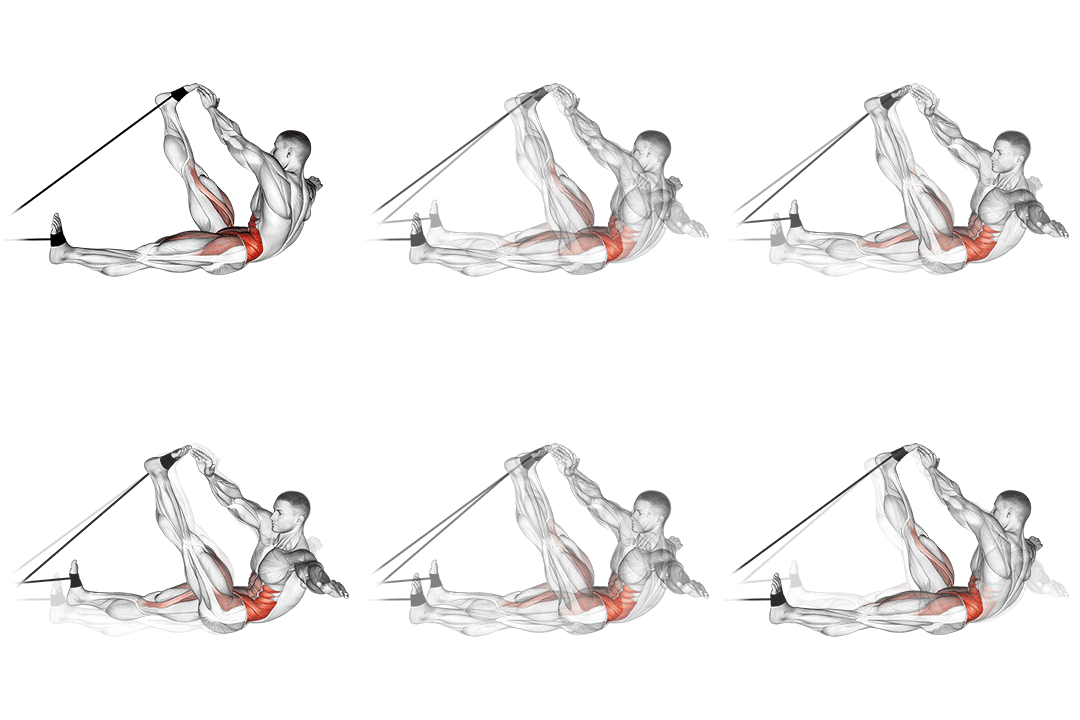
Band Assisted Wheel Rollerout demonstration

Band Assisted Wheel Rollerout

Target Abs
Equipment Band
Body Part Waist
Difficulty Intermediate
Movement Isolation
Secondary Muscles
Lower Back
VS
Exercise B
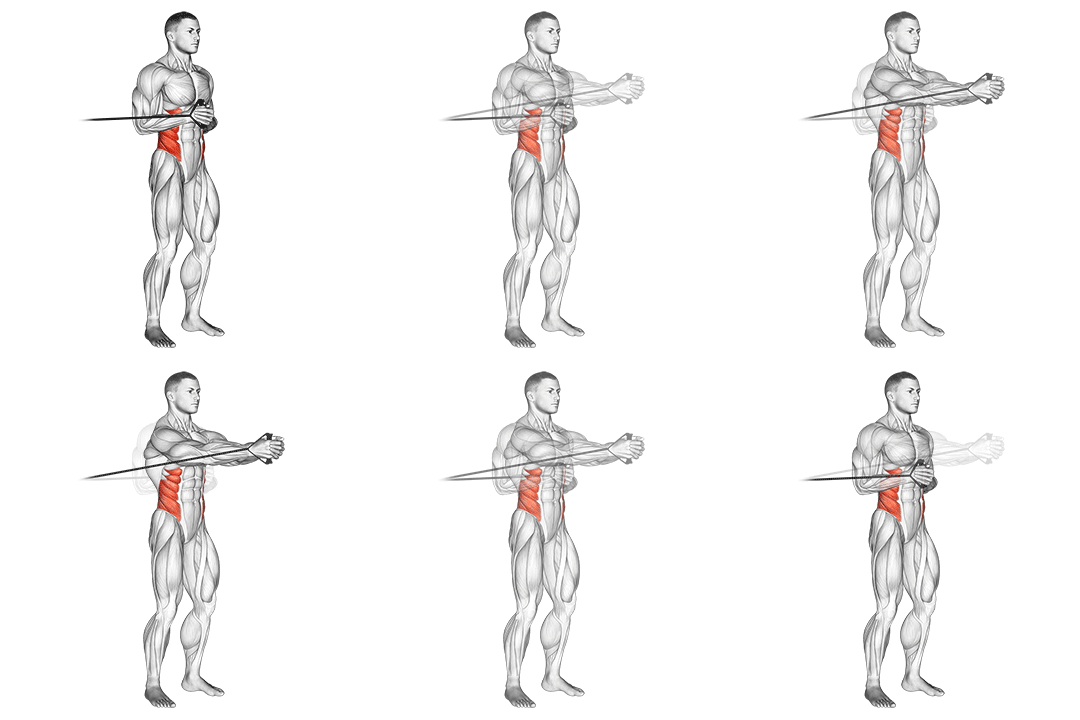
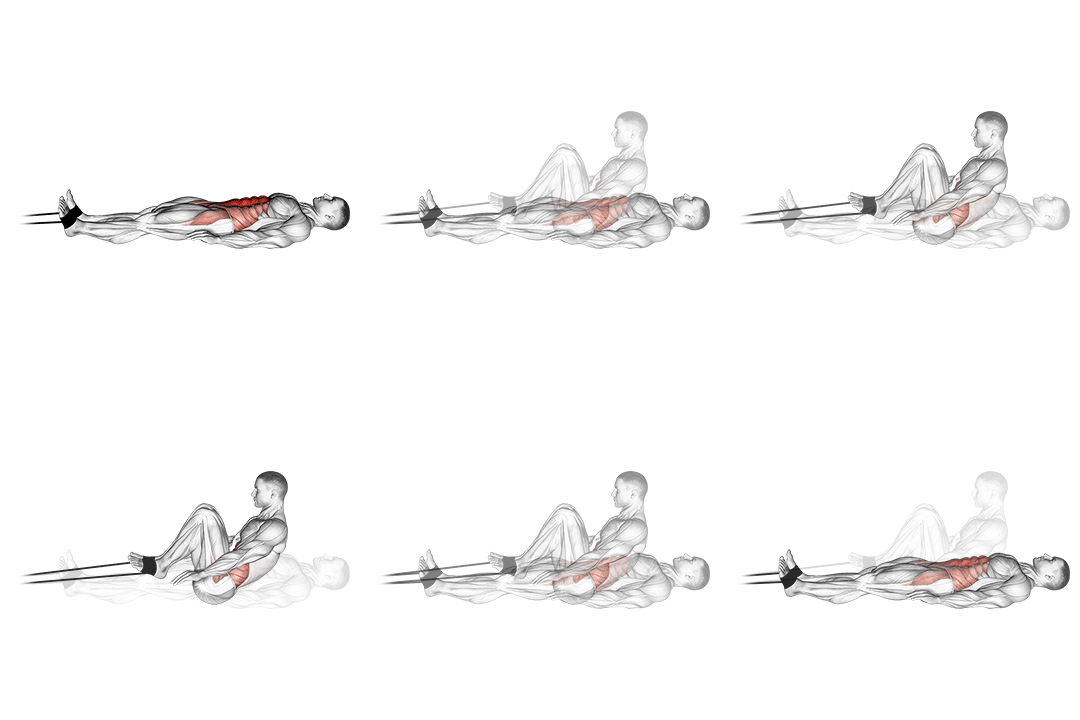
Band Horizontal Pallof Press demonstration

Band Horizontal Pallof Press

Target Abs
Equipment Band
Body Part Waist
Difficulty Intermediate
Movement Isolation
Secondary Muscles
Obliques Glutes

Head-to-Head Comparison

Different values are marked. These are catalogue attributes, not performance scores.

Muscles used

Listed target and secondary muscles, shown on the body. Locations, not activation or strength scores.

  • Target
  • Secondary
  • Not highlighted

Band Assisted Wheel Rollerout

Front
Band Assisted Wheel Rollerout: front muscle locationsSolid: listed target. Striped: listed secondary. Grey: not highlighted. Locations, not activation or strength scores. See the muscle names below.
Back
Band Assisted Wheel Rollerout: back muscle locationsSolid: listed target. Striped: listed secondary. Grey: not highlighted. Locations, not activation or strength scores. See the muscle names below.
Target
Abs
Secondary
Lower Back

Band Horizontal Pallof Press

Front
Band Horizontal Pallof Press: front muscle locationsSolid: listed target. Striped: listed secondary. Grey: not highlighted. Locations, not activation or strength scores. See the muscle names below.
Back
Band Horizontal Pallof Press: back muscle locationsSolid: listed target. Striped: listed secondary. Grey: not highlighted. Locations, not activation or strength scores. See the muscle names below.
Target
Abs
Secondary
Obliques, Glutes

Grey does not mean a muscle is unused. The diagrams show only the mapped catalogue labels.

Attribute Band Assisted Wheel Rollerout Band Horizontal Pallof Press
Target Muscle
Abs
Abs
Body Part
Waist
Waist
Equipment
Band
Band
Difficulty
Intermediate
Intermediate
Movement Type
Isolation
Isolation
Secondary Muscles Different
Lower Back
Obliques, Glutes

Visual Comparison

An illustrative 1–10 profile derived from catalog difficulty, equipment, and listed-muscle fields—not measured performance or muscle activation.

Key Differences

  • Both exercises target the Abs using Band. The catalogue does not establish which exercise is better for an individual goal.

Muscle comparison

Shared target muscles

Both exercises target the abs (rectus abdominis and deeper transverse abdominis) through sustained tension and anti-flexion control. The Band Assisted Wheel Rollerout drives higher sagittal-plane torque on rectus abdominis because the lever arm increases as you roll out, producing larger moment arms and greater isometric-eccentric loading at end range. The Band Horizontal Pallof Press produces less peak rectus peak force but emphasizes transverse abdominis and integrated core stiffness through anti-rotation torque.

Secondary muscle differences

Secondary recruitment differs: the rollerout taxes the lower back and spinal erectors to resist lumbar hyperextension, especially near full extension, and requires hip-hinge control. The Pallof press recruits obliques and glute medius/glute max for resisting rotation and maintaining hip/pelvic alignment; you’ll feel lateral bracing rather than a long-lever sagittal pull.

Muscle involvement analysis

The rollerout has a rising activation curve: low-to-moderate early, peaking at end-range where the band and lever produce high external torque (think 0° to ~170° trunk extension). Muscle action mixes eccentric control on the way out and powerful isometric hold at full extension. The Pallof press produces steady isometric anti-rotation activation across the set range, with peak oblique activation during maximal horizontal press and short holds (0–1.5s) as you resist band-driven rotation.

Equipment and setup

Band Assisted Wheel Rollerout: setup

Band Assisted Wheel Rollerout requires an ab wheel (or barbell with handles), a strong anchor point to loop the band (rack, pole), and a medium-to-heavy resistance band. A mat helps knee comfort. You need space to roll out roughly 1.5–2.5 m depending on body size.

Band Horizontal Pallof Press: setup

Band Horizontal Pallof Press requires a resistance band and an anchor at about chest height. No specialty handles needed—just a looped band or band with handle. You can perform it standing, half-kneeling, or braced against a wall.

Access and practicality

Band Horizontal Pallof Press — it needs only a band and a simple anchor and can be scaled by stepping further from the anchor. The rollerout demands an ab wheel and safe anchor setup, plus more open space and a higher technical threshold.

Learning and progression

Learning the movements

Pallof press is easier to learn: you can feel anti-rotation immediately with simple cues and low band tension. The Band Assisted Wheel Rollerout has a steeper learning curve because you must control long-lever trunk extension and avoid lumbar hyperextension.

Progression considerations

Rollerout offers high progression potential: move from knee-assisted to standing rollouts, reduce band assistance, increase range of motion, or add tempo pauses (6–12 reps for strength/hypertrophy). Pallof press progresses via heavier bands, single-arm variations, added holds (2–5 s), or anti-rotation chops for sport-specific carryover.

Limitations and precautions

Rollerout carries higher injury risk if performed with poor pelvic control — the lumbar spine can go into unsafe extension under load. Pallof press has lower acute injury risk when you keep a neutral spine and balanced feet, but overloading without hip stability can transfer stress to the shoulder or lower back.

Pros & Cons

Band Assisted Wheel Rollerout

+ Pros

  • High sagittal-plane mechanical tension on rectus abdominis
  • Excellent for building anti-extension strength and end-range control
  • Clear linear progression to standing rollouts and reduced band assistance
  • Powerful carryover to lifts that require stiff trunk (deadlift, overhead press)

− Cons

  • Higher technical demand and lumbar extension risk
  • Requires ab wheel and a safe anchor for the band
  • Less emphasis on anti-rotation/oblique isolation

Band Horizontal Pallof Press

+ Pros

  • Simple setup: only a band and anchor needed
  • Strong anti-rotation stimulus for obliques and transverse abdominis
  • Very scalable and low-risk for beginners
  • Works well in constrained spaces and for unilateral loading

− Cons

  • Lower peak rectus abdominis loading compared to rollerouts
  • Less direct lower-back eccentric strength development
  • Can be easy to cheat by shifting feet or using arm momentum

When Each Exercise Wins

1
For muscle hypertrophy: Band Assisted Wheel Rollerout

The rollerout produces higher mechanical tension on the rectus abdominis via a long lever and end-range loading; use 8–15 controlled reps with slow eccentric (3–4s) and short isometric holds to stimulate muscle growth.

2
For strength gains: Band Assisted Wheel Rollerout

For resisting trunk extension and building maximal anti-extension strength, the rollerout provides greater sagittal-plane torque and transfer to heavy lifts; progress from assisted to standing variants and work in 4–8 rep ranges with slower tempos.

3
For beginners: Band Horizontal Pallof Press

Pallof presses teach core bracing and anti-rotation control with minimal risk. Start with 10–20 reps per side at light tension and focus on neutral spine and equal foot pressure.

4
For home workouts: Band Horizontal Pallof Press

You only need a band and an anchor — no ab wheel or wide floor space. The Pallof press scales easily by distance from the anchor and works in small areas.

Frequently Asked Questions

Can I do both Band Assisted Wheel Rollerout and Band Horizontal Pallof Press in the same workout?

Yes. Pair Pallof presses early as a warm-up stability primer (2–3 sets of 10–15 reps) and follow with rollerouts as the higher-tension main core lift (3–4 sets of 6–12 reps). This sequencing primes anti-rotation control before you load end-range extension.

Which exercise is better for beginners?

The Band Horizontal Pallof Press is better for beginners because it teaches bracing and anti-rotation without exposing the lumbar spine to large extension moments. Start light, emphasize neutral spine, and increase distance from the anchor to progress.

How do the muscle activation patterns differ?

Rollerouts ramp rectus abdominis and erector spinae activity as the lever lengthens, mixing eccentric control and isometric holds at end-range. Pallof presses produce steady isometric anti-rotation activation, emphasizing transverse abdominis and obliques to resist torque from the band.

Can Band Horizontal Pallof Press replace Band Assisted Wheel Rollerout?

Only partially. If your goal is anti-rotation stability, the Pallof press can replace rollerouts. If you need high sagittal-plane tension and anti-extension strength for heavy lifts, the rollerout remains unique—so keep both in your program when possible.

Comparison Summary

Use the Band Assisted Wheel Rollerout when your priority is building sagittal-plane core strength, rectus abdominis tension, and end-range control—especially if you aim to support heavy compound lifts. Program it with controlled eccentrics (3–4s), short isometric holds, and 6–12 reps as you reduce band assistance. Choose the Band Horizontal Pallof Press when you want anti-rotation robustness, oblique development, and a low-risk, highly portable option. For balanced core development, alternate both: Pallof presses for daily stability work (10–20 reps or 2–4 x 20–40s holds) and rollerouts 1–2 times weekly for high-tension stimulus.

Exercise instructions

Steps from the exercise catalogue. Read the full sequence before starting.

Band Assisted Wheel Rollerout

  1. Kneel on the floor and hold the handles of the band with both hands, palms facing down.
  2. Place the band on the ground in front of you and position your hands shoulder-width apart.
  3. Engage your core and slowly roll the wheel forward, extending your body as far as you can while maintaining control.
Read remaining steps for Band Assisted Wheel Rollerout
  1. Pause for a moment at the furthest point, then slowly roll the wheel back towards your knees to return to the starting position.
  2. Repeat for the desired number of repetitions.

Band Horizontal Pallof Press

  1. Attach the band to a sturdy anchor point at waist height.
  2. Stand perpendicular to the anchor point with your feet shoulder-width apart.
  3. Grasp the band handle with both hands and step away from the anchor point to create tension in the band.
Read remaining steps for Band Horizontal Pallof Press
  1. Bring your hands to your chest, keeping your elbows bent and close to your body.
  2. Engage your core and maintain a stable stance.
  3. Extend your arms straight out in front of you, pushing the band away from your body.
  4. Hold the extended position for a few seconds, focusing on maintaining tension in your core.
  5. Slowly bring your hands back to your chest, resisting the pull of the band.
  6. Repeat for the desired number of repetitions.

Also Compare

Compare another pair

Choose two exercises to see their differences side by side.

Compare Exercises