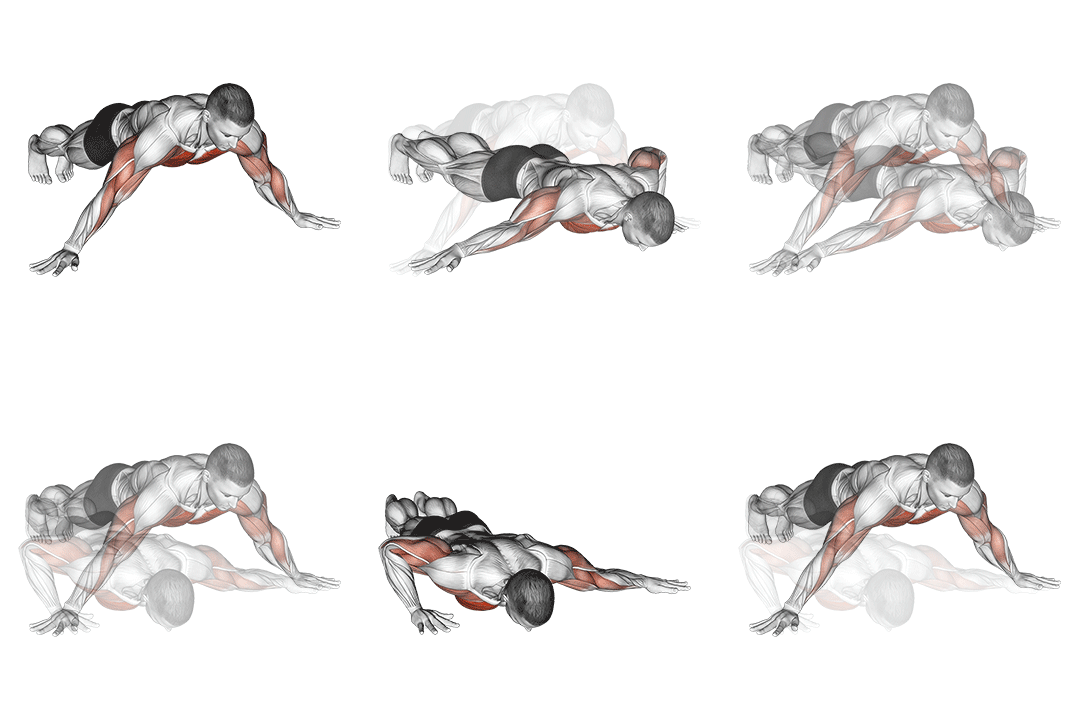
Band One Arm Twisting Chest Press vs Resistance Band Seated Chest Press

Compare target muscles, equipment, difficulty, movement type, and secondary muscles for Band One Arm Twisting Chest Press and Resistance Band Seated Chest Press.

Change comparison Share

Get comparison link

Select the link and use your device's Copy command.

Comparison overview

AI-generated
Band One Arm Twisting Chest Press vs Resistance Band Seated Chest Press — if you train chest with bands, you need to know which movement fits your goals. I’ll show you how each exercise loads the pectorals, how the line of pull and rotation change muscle stress, what equipment and setup you need, and give clear technique cues and rep ranges. You’ll get practical programming advice for hypertrophy, strength, and home workouts so you can pick the one that gives you the most measurable progress.

Exercise Comparison

Exercise A
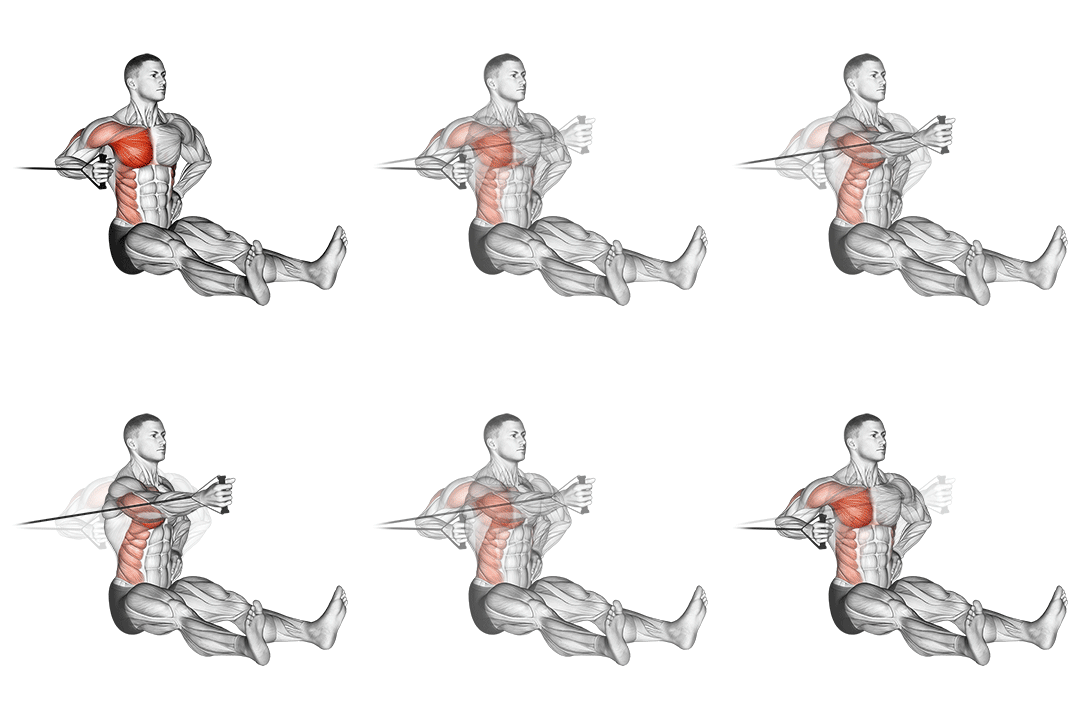
Band One Arm Twisting Chest Press demonstration

Band One Arm Twisting Chest Press

Target Pectorals
Equipment Band
Body Part Chest
Difficulty Intermediate
Movement Compound
Secondary Muscles
Shoulders Triceps
VS
Exercise B
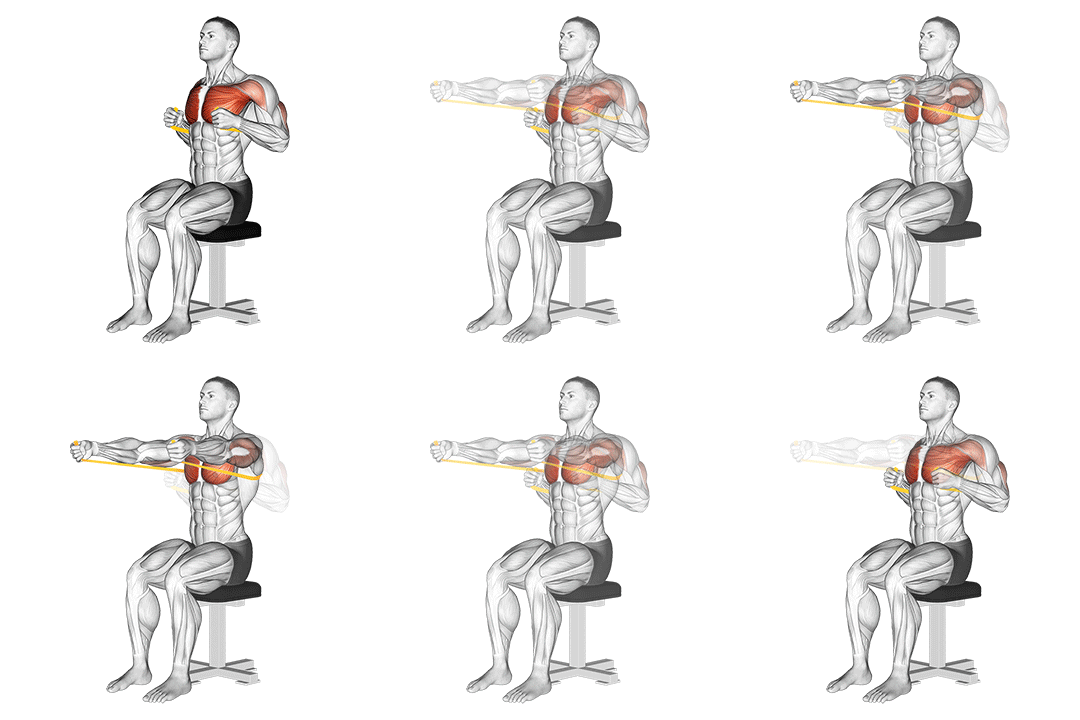
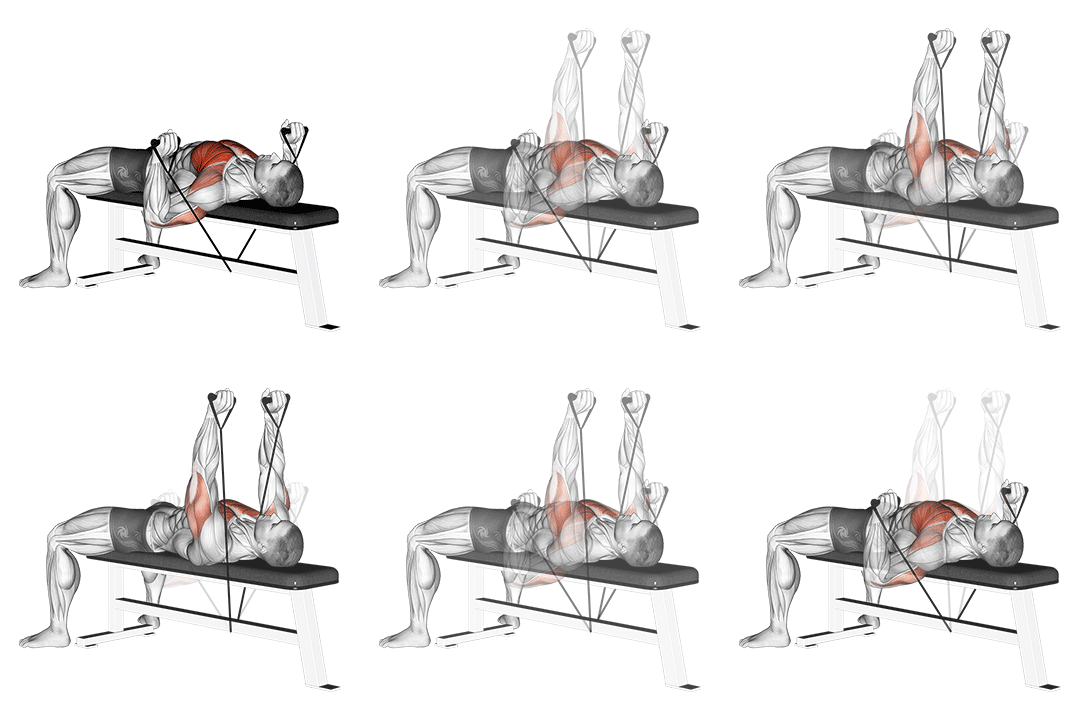
Resistance Band Seated Chest Press demonstration

Resistance Band Seated Chest Press

Target Pectorals
Equipment Band
Body Part Chest
Difficulty Intermediate
Movement Compound
Secondary Muscles
Shoulders Triceps

Head-to-Head Comparison

Different values are marked. These are catalogue attributes, not performance scores.

Muscles used

Listed target and secondary muscles, shown on the body. Locations, not activation or strength scores.

  • Target
  • Secondary
  • Not highlighted

Band One Arm Twisting Chest Press

Front
Band One Arm Twisting Chest Press: front muscle locationsSolid: listed target. Striped: listed secondary. Grey: not highlighted. Locations, not activation or strength scores. See the muscle names below.
Back
Band One Arm Twisting Chest Press: back muscle locationsSolid: listed target. Striped: listed secondary. Grey: not highlighted. Locations, not activation or strength scores. See the muscle names below.
Target
Pectorals
Secondary
Shoulders, Triceps

Not shown on diagram: Shoulders. These labels do not identify a precise region on this map.

Resistance Band Seated Chest Press

Front
Resistance Band Seated Chest Press: front muscle locationsSolid: listed target. Striped: listed secondary. Grey: not highlighted. Locations, not activation or strength scores. See the muscle names below.
Back
Resistance Band Seated Chest Press: back muscle locationsSolid: listed target. Striped: listed secondary. Grey: not highlighted. Locations, not activation or strength scores. See the muscle names below.
Target
Pectorals
Secondary
Shoulders, Triceps

Not shown on diagram: Shoulders. These labels do not identify a precise region on this map.

Grey does not mean a muscle is unused. The diagrams show only the mapped catalogue labels.

Attribute Band One Arm Twisting Chest Press Resistance Band Seated Chest Press
Target Muscle
Pectorals
Pectorals
Body Part
Chest
Chest
Equipment
Band
Band
Difficulty
Intermediate
Intermediate
Movement Type
Compound
Compound
Secondary Muscles
Shoulders, Triceps
Shoulders, Triceps

Visual Comparison

An illustrative 1–10 profile derived from catalog difficulty, equipment, and listed-muscle fields—not measured performance or muscle activation.

Key Differences

  • Both exercises target the Pectorals using Band. The catalogue does not establish which exercise is better for an individual goal.

Muscle comparison

Shared target muscles

Both exercises primarily target the pectoralis major through horizontal adduction and shoulder flexion. They load the sternal and clavicular fibers differently depending on arm angle: the seated chest press gives a more consistent bilateral horizontal force vector, while the one-arm twisting press emphasizes unilateral loading and slightly greater upper-pec engagement when you rotate the arm upward.

Secondary muscle differences

Secondary recruitment differs in stabilization demands: the twisting press increases rotator cuff and core (anti-rotation) involvement due to transverse-plane torque and unilateral load. The seated press recruits more symmetric anterior deltoid and triceps drive because both arms share a stable base and fixed range of motion.

Muscle involvement analysis

Activation patterns change with band tension and joint angle. In the seated press the pectoralis reaches optimal length-tension around mid-range (~30–60° elbow flexion) and sees steadily increasing tension as the band stretches. In the twisting press the transverse rotation adds a rotational moment arm, increasing eccentric control and peak activation near lockout as the band line of pull shifts 10–20° medially and upward.

Equipment and setup

Band One Arm Twisting Chest Press: setup

Band One Arm Twisting Chest Press needs a single resistance band anchored at chest height (door anchor or post), enough band length for a full press, and space to stand or stagger-step. Optional: a handle or short strap to secure the band to your hand for the twist.

Resistance Band Seated Chest Press: setup

Resistance Band Seated Chest Press requires a stable chair or bench, a band anchored behind the seat at mid-back height, and ideally a loop or handles. You need even band lengths for bilateral press and a non-slip surface for foot bracing.

Access and practicality

Resistance Band Seated Chest Press — it’s easier to set up in tight spaces, needs only a chair and a door anchor, and is more beginner-friendly because the bilateral set-up simplifies load management.

Learning and progression

Learning the movements

Seated Chest Press is easier to learn: fixed position, symmetric pressing, and straightforward band tension make motor patterns simpler. Band One Arm Twisting Chest Press has a steeper learning curve because you must coordinate trunk anti-rotation, scapular control, and timed forearm rotation.

Progression considerations

Band One Arm Twisting Chest Press offers greater unilateral progression options (tempo, pause at 0–20° of horizontal adduction, rotational end-range holds) and built-in core challenge. The seated press scales by band strength and reps but has slightly less scope for rotational overload.

Limitations and precautions

Relative injury risk is higher with the twisting press if setup or scapular stability is poor — risky for the anterior shoulder if you hyper-rotate or let the scapula protract uncontrolled. Seated press has lower acute risk if you keep shoulders retracted and avoid excessive band stretch beyond comfortable range.

Pros & Cons

Band One Arm Twisting Chest Press

+ Pros

  • High unilateral loading improves left-right balance and core anti-rotation strength
  • Increases transverse-plane torque for greater pec activation near lockout
  • Easy to load progressively with thicker bands or double-banding
  • Better carryover to athletic rotational movements

Cons

  • Requires more coordination and scapular stability
  • Higher technical demand increases injury risk if performed poorly
  • Takes longer to set up and balance, limiting heavy volume sessions

Resistance Band Seated Chest Press

+ Pros

  • Simple setup and consistent bilateral force vector for even pectoral loading
  • Lower technical demand — easier to teach and scale
  • Better for higher-volume hypertrophy sets (8–15 reps)
  • More accessible for limited space or beginners

Cons

  • Less core and anti-rotation stimulus compared with the twisting press
  • Can underload one side if you have unilateral weakness
  • Band tension rises quickly near lockout, making top-range overload inconsistent

When Each Exercise Wins

1
For muscle hypertrophy: Resistance Band Seated Chest Press

The seated press allows higher, more consistent training volume (8–15 reps) and symmetric loading of both pectoral heads, letting you accumulate tension under optimal length-tension conditions across sets.

2
For strength gains: Band One Arm Twisting Chest Press

Unilateral loading with rotational torque forces greater neural drive and stabilizer recruitment, letting you build raw pressing strength and improve force transfer in the transverse plane when you use heavier bands and low reps (4–8).

3
For beginners: Resistance Band Seated Chest Press

Seated setup reduces coordination demands and lets you focus on scapular retraction and prime mover activation, making it easier to learn proper chest pressing mechanics.

4
For home workouts: Resistance Band Seated Chest Press

Requires minimal gear (band + chair/door anchor), quick to set up, and produces reliable pectoral tension for hypertrophy without complex anchoring or balancing.

Frequently Asked Questions

Can I do both Band One Arm Twisting Chest Press and Resistance Band Seated Chest Press in the same workout?
Yes — pair them strategically: start with the twisting press for 3–4 sets of 4–8 reps to tax unilateral strength and core, then follow with 2–3 sets of seated presses for 8–12 reps to accumulate hypertrophy volume.

Which exercise is better for beginners?

The Resistance Band Seated Chest Press is better for beginners because it reduces coordination demands and helps you learn scapular retraction and stable pressing mechanics before adding unilateral rotation.

How do the muscle activation patterns differ?

The seated press produces symmetric pectoral activation with a steady horizontal force vector and peak mid-range tension, while the twisting press adds a rotational moment that elevates activation near lockout and increases rotator cuff and core recruitment due to anti-rotation demands.

Can Resistance Band Seated Chest Press replace Band One Arm Twisting Chest Press?

It can replace it for hypertrophy and simple strength work, but it won’t replicate the unilateral anti-rotation stimulus or transverse-plane overload the twisting press provides, so it’s a trade-off depending on whether you prioritize volume or rotational strength.

Comparison Summary

Use the Resistance Band Seated Chest Press when you want straightforward pectoral loading, consistent rep ranges (8–15), and an easy setup for volume work at home. Choose the Band One Arm Twisting Chest Press when you need unilateral strength, core anti-rotation carryover, and a bigger transverse-plane stimulus — aim for lower rep ranges (4–8) or tempo work. Both are solid band chest exercises; pick the seated press for volume and motor learning, and the twisting press when you want to target asymmetries, scapular control, and rotational power.

Exercise instructions

Steps from the exercise catalogue. Read the full sequence before starting.

Band One Arm Twisting Chest Press

  1. Attach the band to a sturdy anchor point at chest height.
  2. Stand with your side facing the anchor point and grab the band with one hand.
  3. Step away from the anchor point to create tension in the band.
Read remaining steps for Band One Arm Twisting Chest Press
  1. Position your feet shoulder-width apart and slightly bend your knees.
  2. Bring your hand holding the band across your body, towards the opposite shoulder.
  3. While maintaining tension in the band, push your hand forward and away from your body, extending your arm.
  4. Slowly return to the starting position and repeat for the desired number of repetitions.
  5. Switch sides and repeat the exercise with the other hand.

Resistance Band Seated Chest Press

  1. Sit on a chair or bench with your back straight and feet flat on the ground.
  2. Hold the resistance band handles in each hand, with your palms facing down and elbows bent at a 90-degree angle.
  3. Extend your arms forward, pushing the resistance band away from your chest.
Read remaining steps for Resistance Band Seated Chest Press
  1. Pause for a moment at the end of the movement, then slowly return to the starting position.
  2. Repeat for the desired number of repetitions.

Also Compare

Compare another pair

Choose two exercises to see their differences side by side.

Compare Exercises