Band One Arm Twisting Chest Press vs Cross Over - With Bands

Compare target muscles, equipment, difficulty, movement type, and secondary muscles for Band One Arm Twisting Chest Press and Cross Over - With Bands.

Change comparison Share

Get comparison link

Select the link and use your device's Copy command.

Comparison overview

AI-generated
Band One Arm Twisting Chest Press vs Cross Over - With Bands — you’ll get a clear head-to-head so you can pick the best move for your chest work. I’ll walk you through primary and secondary muscle activation, equipment and setup, technique cues (hand path, elbow angle, scapular control), and which exercise wins for hypertrophy, strength, beginners, and home training. Expect specific rep ranges (6–12 for strength/overload, 8–15 for hypertrophy), biomechanical notes on force vectors and length-tension, plus practical progression tips you can use next session.

Exercise Comparison

Exercise A
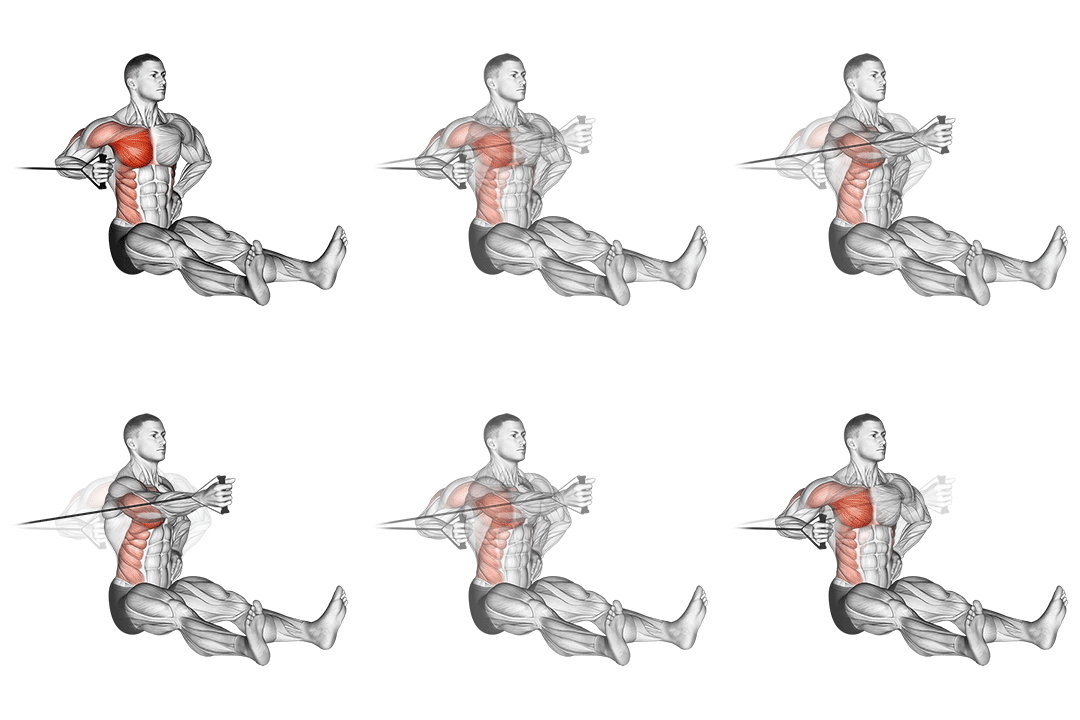
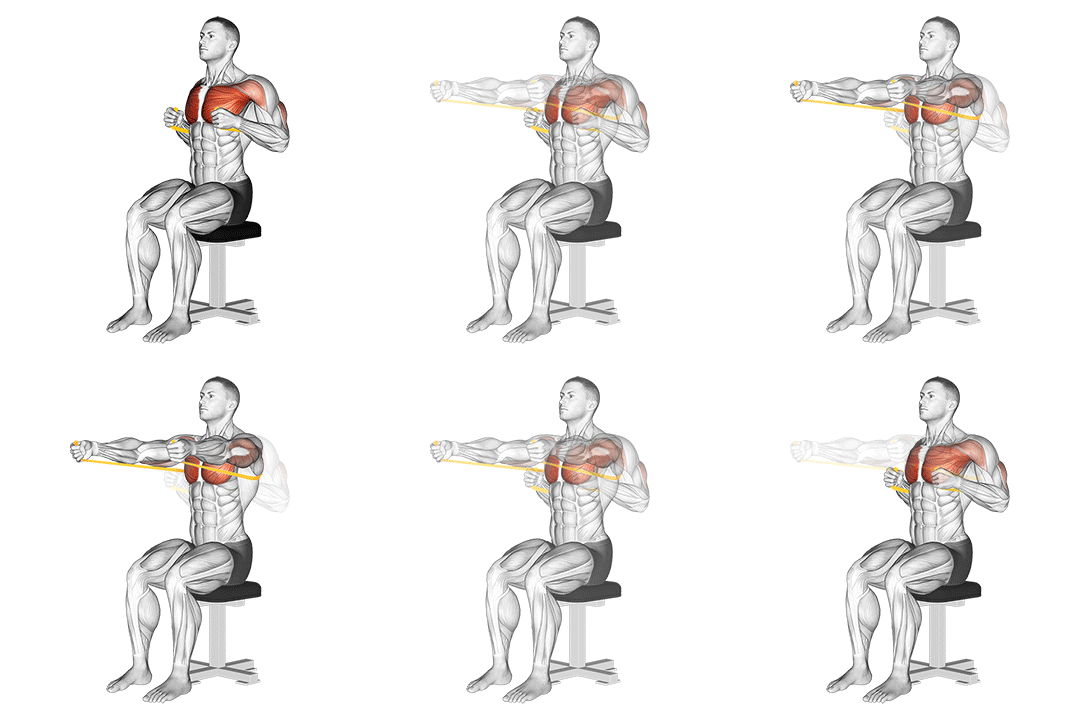
Band One Arm Twisting Chest Press demonstration

Band One Arm Twisting Chest Press

Target Pectorals
Equipment Band
Body Part Chest
Difficulty Intermediate
Movement Compound
Secondary Muscles
Shoulders Triceps
VS
Exercise B
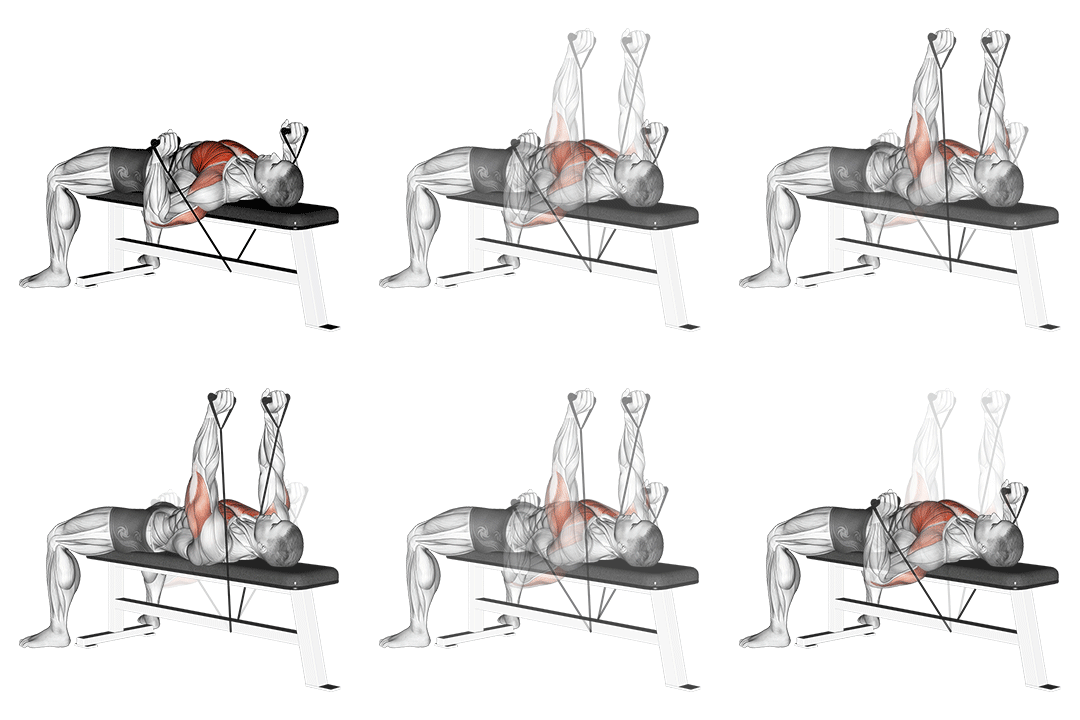
Cross Over - With Bands demonstration

Cross Over - With Bands

Target Pectorals
Equipment Band
Body Part Chest
Difficulty Intermediate
Movement Isolation
Secondary Muscles
Biceps Shoulders

Head-to-Head Comparison

Different values are marked. These are catalogue attributes, not performance scores.

Muscles used

Listed target and secondary muscles, shown on the body. Locations, not activation or strength scores.

  • Target
  • Secondary
  • Not highlighted

Band One Arm Twisting Chest Press

Front
Band One Arm Twisting Chest Press: front muscle locationsSolid: listed target. Striped: listed secondary. Grey: not highlighted. Locations, not activation or strength scores. See the muscle names below.
Back
Band One Arm Twisting Chest Press: back muscle locationsSolid: listed target. Striped: listed secondary. Grey: not highlighted. Locations, not activation or strength scores. See the muscle names below.
Target
Pectorals
Secondary
Shoulders, Triceps

Not shown on diagram: Shoulders. These labels do not identify a precise region on this map.

Cross Over - With Bands

Front
Cross Over - With Bands: front muscle locationsSolid: listed target. Striped: listed secondary. Grey: not highlighted. Locations, not activation or strength scores. See the muscle names below.
Back
Cross Over - With Bands: back muscle locationsSolid: listed target. Striped: listed secondary. Grey: not highlighted. Locations, not activation or strength scores. See the muscle names below.
Target
Pectorals
Secondary
Biceps, Shoulders

Not shown on diagram: Shoulders. These labels do not identify a precise region on this map.

Grey does not mean a muscle is unused. The diagrams show only the mapped catalogue labels.

Attribute Band One Arm Twisting Chest Press Cross Over - With Bands
Target Muscle
Pectorals
Pectorals
Body Part
Chest
Chest
Equipment
Band
Band
Difficulty
Intermediate
Intermediate
Movement Type Different
Compound
Isolation
Secondary Muscles Different
Shoulders, Triceps
Biceps, Shoulders

Visual Comparison

An illustrative 1–10 profile derived from catalog difficulty, equipment, and listed-muscle fields—not measured performance or muscle activation.

Key Differences

  • Band One Arm Twisting Chest Press is a compound movement, while Cross Over - With Bands is an isolation exercise.
  • Both exercises target the Pectorals using Band. The catalogue does not establish which exercise is better for an individual goal.

Muscle comparison

Shared target muscles

Both exercises target the pectorals via horizontal adduction of the humerus. The Cross Over - With Bands emphasizes peak contraction of the sternal and clavicular pec fibers through a near-pure horizontal adduction vector, keeping the pecs at longer lengths during the eccentric phase. The Band One Arm Twisting Chest Press blends horizontal press force with a transverse rotational component; this shifts force onto medial pec fibers during the twist and allows you to apply higher net horizontal force at shorter muscle lengths during the concentric phase.

Secondary muscle differences

Band One Arm Twisting Chest Press recruits the anterior deltoid and triceps strongly because you press against axial load and extend the elbow under rotation; it also demands ipsilateral core and scapular stabilizers. Cross Over - With Bands pulls in more biceps activity as a stabilizer of elbow flexion/forearm position and relies on the posterior scapular muscles to control retraction; the shoulders act isometrically rather than as prime movers.

Muscle involvement analysis

During the twisting press the concentric phase combines horizontal adduction and internal rotation — pec fibers shorten while triceps extend the elbow, producing a rising force curve useful for higher loads. In crossovers the peak tension occurs at end-range midline as the pecs shorten under adduction with a long eccentric stretch; force is more constant through the mid-ROM. Cue: keep scapula retracted and the humerus ~20–30° from the frontal plane for Cross Over to maximize pec loading; for the twisting press drive the elbow slightly down (10–20°) and rotate the hand 45° at lockout to bias pec insertion fibers.

Equipment and setup

Band One Arm Twisting Chest Press: setup

Band One Arm Twisting Chest Press needs a single strong anchor at chest-height (or behind you), one handle loop, and a medium-to-heavy band. You also benefit from a strap or door anchor for consistent line-of-pull.

Cross Over - With Bands: setup

Cross Over - With Bands normally requires two anchored points at or slightly above shoulder height, two handles, and either two bands or a long loop band you split midline. Setup takes more space and precise anchor symmetry to maintain balanced tension.

Access and practicality

Band One Arm Twisting Chest Press is more accessible because it uses a single anchor and one hand at a time, making it easier in small spaces and with limited gear. You can improvise the anchor (pole, heavy furniture, door anchor) more reliably than the dual-anchor setup Cross Overs typically require.

Learning and progression

Learning the movements

Cross Over - With Bands is easier to learn: it’s a single-plane motion (horizontal adduction) with simpler hand paths and less demand on anti-rotation stability. The twisting press has a steeper learning curve because you must coordinate unilateral pressing, timed forearm rotation, and core stabilization.

Progression considerations

Band One Arm Twisting Chest Press offers greater progression for strength and unilateral overload — increase band tension, change lever length, add tempo or pause at 90° elbow. Cross Over progression focuses on band tension, tempo, and increased time-under-tension to drive hypertrophy but has less carryover to maximal pressing strength.

Limitations and precautions

Twisting presses carry a slightly higher injury risk for the shoulder if you allow excessive horizontal abduction at end-range or lose scapular control; rotational torque can irritate the glenohumeral joint. Cross Overs risk overstretching the pecs if anchors are positioned too low or if you force a deep eccentric beyond your control. With proper scapular retraction and controlled ROM, both are safe for intermediate trainees.

Pros & Cons

Band One Arm Twisting Chest Press

+ Pros

  • Delivers unilateral pressing strength and anti-rotation stability
  • Easily increases load by using thicker bands or shortened lever arm
  • Builds pressing pattern transferable to push-ups and presses
  • Engages core and scapular stabilizers, improving functional control

Cons

  • Higher coordination demand — needs solid scapular control
  • Can place rotational torque on the shoulder if rushed
  • Less pure peak-pec isolation compared to fly-style crossovers

Cross Over - With Bands

+ Pros

  • Isolates pecs for strong peak contraction and stretch
  • Simple motor pattern — easy to teach and cue (bring hands to midline)
  • Excellent for hypertrophy via long eccentric tension
  • Lower triceps demand so pecs take primary load

Cons

  • Requires symmetrical dual anchors or careful band routing
  • Less transfer to horizontal pressing strength
  • Can overstretch pecs and stress anterior shoulder if anchor height is wrong

When Each Exercise Wins

1
For muscle hypertrophy: Cross Over - With Bands

Crossovers allow a longer eccentric length and stronger peak contraction of the pecs, which increases time under tension and mechanical tension — aim for 8–15 reps with 2–4 second eccentrics to maximize hypertrophy.

2
For strength gains: Band One Arm Twisting Chest Press

The twisting press is a compound, unilateral pattern that lets you apply higher net horizontal force and progressive overload. Use lower reps (6–10) and heavier band tension to build unilateral pressing strength and carryover to bilateral lifts.

3
For beginners: Cross Over - With Bands

Crossovers use a straightforward horizontal adduction path and lower coordination demand, making it easier to master scapular retraction and controlled ROM before progressing to rotational, unilateral presses.

4
For home workouts: Band One Arm Twisting Chest Press

The one-arm twisting press needs only a single anchor and one band, making it quicker to set up in tight spaces. It also trains multiple qualities (press strength + stability) in one movement, maximizing efficiency at home.

Frequently Asked Questions

Can I do both Band One Arm Twisting Chest Press and Cross Over - With Bands in the same workout?

Yes. Pair them by ordering compound first: start with Band One Arm Twisting Chest Press for 3–5 sets of 6–10 reps to tax pressing strength, then follow with Cross Over - With Bands for 2–3 sets of 10–15 reps to finish with focused hypertrophy work and metabolic stress.
Which exercise is better for beginners?

Cross Over - With Bands is better for beginners because it uses a simpler horizontal adduction pattern and lower stabilization demand, letting you learn scapular retraction and controlled ROM before advancing to unilateral twisting presses.

How do the muscle activation patterns differ?

The twisting press combines horizontal adduction with internal rotation and elbow extension, recruiting pecs plus triceps and anterior deltoid under a rising-force curve. Crossovers produce a more constant tension focused on pec fibers through a long eccentric stretch and peak midline contraction, with less triceps involvement.

Can Cross Over - With Bands replace Band One Arm Twisting Chest Press?

If your goal is pure pec hypertrophy, yes — crossovers can replace the twisting press. If you want to build unilateral pressing strength, rotary control, or transfer to compound pushes, keep the Band One Arm Twisting Chest Press in your program as it provides different force-vector and stability demands.

Comparison Summary

Use Cross Over - With Bands when you want targeted pec work, especially for hypertrophy phases. Its near-pure horizontal adduction gives a strong stretch and peak contraction — program 3–4 sets of 8–15 reps with controlled eccentrics. Choose Band One Arm Twisting Chest Press when you need compound pressing strength, unilateral balance, and anti-rotation control; load heavier, 3–5 sets of 6–10 reps, and focus on a controlled 45° forearm twist at lockout. Both have a place: pick Cross Over for isolation and shaping, pick the twisting press for functional pressing power and core integration. Rotate them across mesocycles to target both length-tension and force-vector adaptations.

Exercise instructions

Steps from the exercise catalogue. Read the full sequence before starting.

Band One Arm Twisting Chest Press

  1. Attach the band to a sturdy anchor point at chest height.
  2. Stand with your side facing the anchor point and grab the band with one hand.
  3. Step away from the anchor point to create tension in the band.
Read remaining steps for Band One Arm Twisting Chest Press
  1. Position your feet shoulder-width apart and slightly bend your knees.
  2. Bring your hand holding the band across your body, towards the opposite shoulder.
  3. While maintaining tension in the band, push your hand forward and away from your body, extending your arm.
  4. Slowly return to the starting position and repeat for the desired number of repetitions.
  5. Switch sides and repeat the exercise with the other hand.

Cross Over - With Bands

  1. Secure an exercise band around a stationary post.
  2. While facing away from the post, grab the handles on both ends of the band and step forward enough to create tension on the band.
  3. Raise your arms to the sides, parallel to the floor, perpendicular to your torso (your torso and the arms should resemble the letter "T") and with the palms facing forward. Have them extended with a slight bend at the elbows. This will be your starting position.
Read remaining steps for Cross Over - With Bands
  1. While keeping your arms straight, bring them across your chest in a semicircular motion to the front as you exhale and flex your pecs. Hold the contraction for a second.
  2. Slowly return to the starting position as you inhale.
  3. Perform for the recommended amount of repetitions.

Also Compare

Compare another pair

Choose two exercises to see their differences side by side.

Compare Exercises