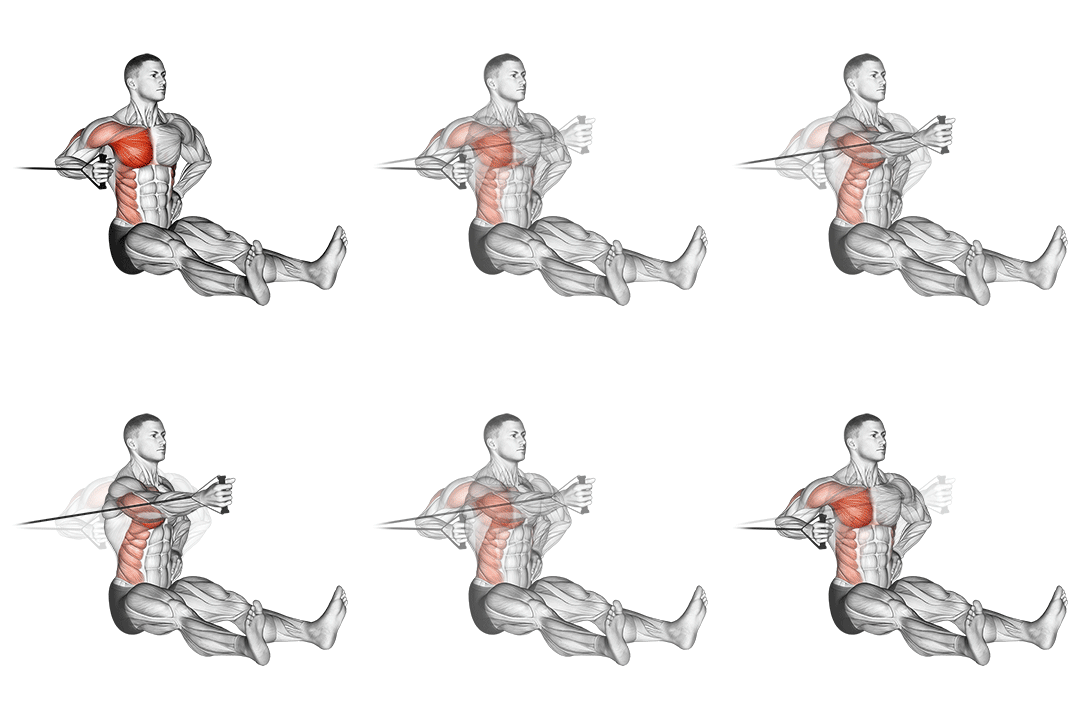
Cross Over - With Bands vs Resistance Band Seated Chest Press

Compare target muscles, equipment, difficulty, movement type, and secondary muscles for Cross Over - With Bands and Resistance Band Seated Chest Press.

Change comparison Share

Get comparison link

Select the link and use your device's Copy command.

Comparison overview

AI-generated
Cross Over - With Bands vs Resistance Band Seated Chest Press pits an isolation-focused, transverse-plane chest move against a compound, sagittal-plane press. You’ll get clear guidance on muscle targeting, technique cues, progression options, and injury considerations so you can pick the right tool for your goals. I’ll compare primary pectoral activation, secondary muscle involvement (triceps, shoulders, biceps), equipment needs, learning curve, and ideal rep ranges for hypertrophy and strength. Read on for practical setup and when to program each exercise in your routine.

Exercise Comparison

Exercise A
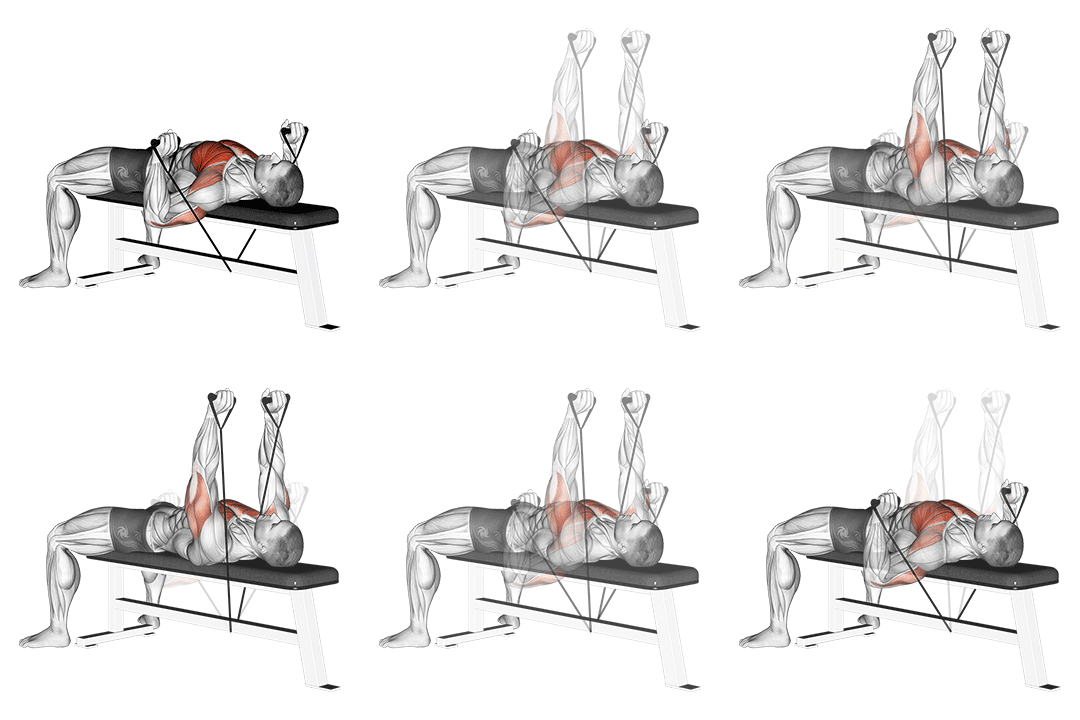
Cross Over - With Bands demonstration

Cross Over - With Bands

Target Pectorals
Equipment Band
Body Part Chest
Difficulty Intermediate
Movement Isolation
Secondary Muscles
Biceps Shoulders
VS
Exercise B
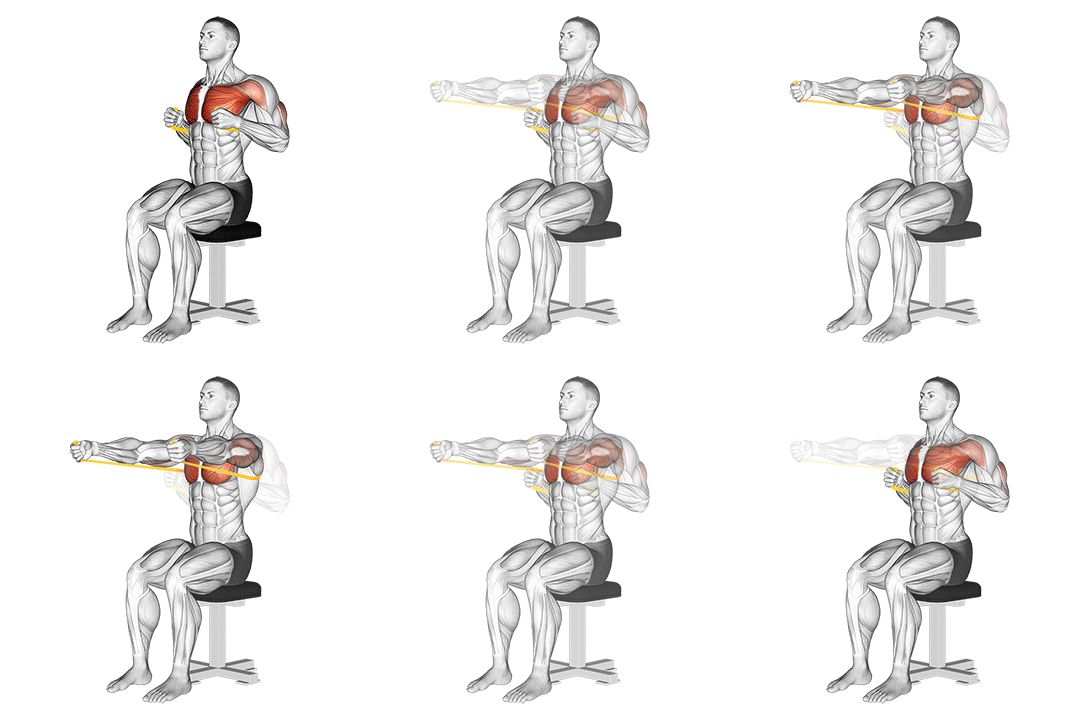
Resistance Band Seated Chest Press demonstration

Resistance Band Seated Chest Press

Target Pectorals
Equipment Band
Body Part Chest
Difficulty Intermediate
Movement Compound
Secondary Muscles
Shoulders Triceps

Head-to-Head Comparison

Different values are marked. These are catalogue attributes, not performance scores.

Muscles used

Listed target and secondary muscles, shown on the body. Locations, not activation or strength scores.

  • Target
  • Secondary
  • Not highlighted

Cross Over - With Bands

Front
Cross Over - With Bands: front muscle locationsSolid: listed target. Striped: listed secondary. Grey: not highlighted. Locations, not activation or strength scores. See the muscle names below.
Back
Cross Over - With Bands: back muscle locationsSolid: listed target. Striped: listed secondary. Grey: not highlighted. Locations, not activation or strength scores. See the muscle names below.
Target
Pectorals
Secondary
Biceps, Shoulders

Not shown on diagram: Shoulders. These labels do not identify a precise region on this map.

Resistance Band Seated Chest Press

Front
Resistance Band Seated Chest Press: front muscle locationsSolid: listed target. Striped: listed secondary. Grey: not highlighted. Locations, not activation or strength scores. See the muscle names below.
Back
Resistance Band Seated Chest Press: back muscle locationsSolid: listed target. Striped: listed secondary. Grey: not highlighted. Locations, not activation or strength scores. See the muscle names below.
Target
Pectorals
Secondary
Shoulders, Triceps

Not shown on diagram: Shoulders. These labels do not identify a precise region on this map.

Grey does not mean a muscle is unused. The diagrams show only the mapped catalogue labels.

Attribute Cross Over - With Bands Resistance Band Seated Chest Press
Target Muscle
Pectorals
Pectorals
Body Part
Chest
Chest
Equipment
Band
Band
Difficulty
Intermediate
Intermediate
Movement Type Different
Isolation
Compound
Secondary Muscles Different
Biceps, Shoulders
Shoulders, Triceps

Visual Comparison

An illustrative 1–10 profile derived from catalog difficulty, equipment, and listed-muscle fields—not measured performance or muscle activation.

Key Differences

  • Cross Over - With Bands is an isolation exercise, while Resistance Band Seated Chest Press is a compound movement.
  • Both exercises target the Pectorals using Band. The catalogue does not establish which exercise is better for an individual goal.

Muscle comparison

Shared target muscles

Both exercises load the pectoralis major and emphasize horizontal adduction, but they hit the muscle differently. Cross Over - With Bands emphasizes midline convergence and peak contraction of the sternal fibers across the transverse plane, allowing a longer time under tension at end-range. Resistance Band Seated Chest Press loads the pectorals through a more linear push in the sagittal plane, producing greater overall force through a longer concentric drive—better for moving higher total resistance.

Secondary muscle differences

Cross Over recruits biceps and anterior deltoids as stabilizers during the crossover path and places extra demand on scapular control. The Seated Chest Press shifts more load to the anterior deltoids and triceps, since elbow extension contributes directly to force production. That makes the seated press more triceps-dominant at lockout, while crossovers emphasize pec isolation at the midline squeeze.

Muscle involvement analysis

Crossovers place peak tension when the hands cross roughly 0–30° past the midline, stretching the pecs at the start of the pull and loading through horizontal adduction—this leverages length-tension to emphasize the eccentric-to-concentric transition. The seated press produces a rising force curve as the band stretches, so tension increases through the concentric phase; this favors higher force output near lockout and a different motor pattern that integrates elbow extension with shoulder horizontal adduction.

Equipment and setup

Cross Over - With Bands: setup

Cross Over - With Bands needs an anchor at chest height or slightly above, at least one medium-to-heavy band, and space to move across the midline. Optionally use handles or single-hand attachments to vary grip and line of pull.

Resistance Band Seated Chest Press: setup

Resistance Band Seated Chest Press requires a sturdy anchor behind you at chest height, a bench or chair to sit on, and one or more bands to create progressive resistance. You may use a backrest to limit torso lean and maintain a 90° hip angle.

Access and practicality

Resistance Band Seated Chest Press is more accessible because it requires minimal setup (a chair and band) and less precise anchor placement; seated position reduces balance and stabilization demands, making it easier to perform in small home spaces.

Learning and progression

Learning the movements

Resistance Band Seated Chest Press has a shallower learning curve: you sit, brace, and press in a familiar pushing pattern. Cross Over - With Bands is more technical because you must control a transverse-plane arc, coordinate scapular motion, and time the midline squeeze.

Progression considerations

Seated Chest Press offers clearer progression—add heavier bands, stack bands, or increase tempo for overload and work in 4–8 reps for strength or 6–12 for hypertrophy. Crossovers progress via increased band tension, unilateral variations, tempo, and partials to overload the peak contraction—ideal for refining muscle shape and time under tension.

Limitations and precautions

Crossovers carry higher shoulder risk if you overreach into extreme horizontal abduction (risking anterior cuff strain or impingement) or use excessive band tension without scapular control. Seated presses carry lower shoulder risk if you maintain 0–30° horizontal adduction and avoid excessive elbow flare; however, very heavy bands can stress the sternoclavicular joint if form breaks down.

Pros & Cons

Cross Over - With Bands

+ Pros

  • High pectoral isolation and peak midline contraction for targeted muscle growth
  • Greater control of end-range stretch to exploit length-tension relationships
  • Easy unilateral variations to correct asymmetries and focus mind-muscle connection
  • Low spinal loading—good when you want chest work without heavy axial load

Cons

  • Requires precise anchor placement and setup
  • Higher technical demand on scapular control and shoulder mechanics
  • Harder to progressively overload with very heavy resistance compared to compound presses

Resistance Band Seated Chest Press

+ Pros

  • Simple setup and seated stability make it beginner-friendly
  • Compound pattern recruits triceps and deltoids for greater total force
  • Easier to increase load by stacking bands for progressive overload
  • Minimal balance demand—good for controlled tempo work and strength blocks

Cons

  • Less peak pectoral isolation—triceps can dominate at lockout
  • Requires a stable anchor behind you; band recoil can pull torso forward if bracing is weak
  • Can underload mid-range pec contraction compared with crossover variations

When Each Exercise Wins

1
For muscle hypertrophy: Cross Over - With Bands

Crossovers let you maximize time under tension and peak contraction of the pectorals, especially in the 8–15 rep range. The transverse arc and end-range squeeze exploit length-tension mechanics to preferentially stress the chest fibers.

2
For strength gains: Resistance Band Seated Chest Press

The seated press is a compound lift that allows higher overall force output and clearer progressive overload—stack bands and train 4–8 reps to develop pressing strength. It recruits triceps and deltoids to help move heavier resistance.

3
For beginners: Resistance Band Seated Chest Press

Sitting provides trunk stability and a familiar push pattern, so novices learn pressing mechanics faster with lower risk. Use 8–12 reps, focus on bracing and a 0–30° horizontal adduction path to protect the shoulder.

4
For home workouts: Resistance Band Seated Chest Press

It needs only a chair and a band with a simple anchor, so setup is fast in small spaces. While crossovers work at home too, they require more room and a secure lateral anchor to be effective.

Frequently Asked Questions

Can I do both Cross Over - With Bands and Resistance Band Seated Chest Press in the same workout?

Yes. Start with Resistance Band Seated Chest Press for heavier compound loading (3–5 sets of 4–8 or 6–12 reps), then finish with Cross Over - With Bands for 2–4 sets of 10–15 reps to target peak contraction and increase time under tension.
Which exercise is better for beginners?

Resistance Band Seated Chest Press is better for beginners because the seated position reduces stabilization demands and teaches a straightforward press pattern. Keep elbows at roughly 45° from the torso and use light bands while you build bracing and scapular control.

How do the muscle activation patterns differ?

Crossovers load the pecs most at midline convergence and emphasize eccentric-to-concentric stretch, exploiting length-tension for a strong peak contraction. The seated press increases tension through the concentric as the band stretches, integrating elbow extension so triceps and anterior deltoids contribute more to force production.

Can Resistance Band Seated Chest Press replace Cross Over - With Bands?

It can replace crossovers for general chest development, especially when progressive overload is the priority, but you may lose some peak contraction and midline stretch that isolates the pecs. If your goal is muscle shape and target activation, keep crossovers in your program as an accessory.

Comparison Summary

Choose Cross Over - With Bands when your goal is targeted pectoral development, muscle shaping, and improving peak contraction. Use it for higher-rep sets (8–15), unilateral work, and tempo-controlled eccentrics to exploit length-tension at the midline. Choose Resistance Band Seated Chest Press when you want a simple, progressive pressing movement that builds overall pressing strength and involves triceps and deltoids; load it for 4–8 reps for strength or 6–12 for hypertrophy. Program both: use seated presses early in a session for heavy compound loading and finish with crossovers to fatigue and refine pectoral activation.

Exercise instructions

Steps from the exercise catalogue. Read the full sequence before starting.

Cross Over - With Bands

  1. Secure an exercise band around a stationary post.
  2. While facing away from the post, grab the handles on both ends of the band and step forward enough to create tension on the band.
  3. Raise your arms to the sides, parallel to the floor, perpendicular to your torso (your torso and the arms should resemble the letter "T") and with the palms facing forward. Have them extended with a slight bend at the elbows. This will be your starting position.
Read remaining steps for Cross Over - With Bands
  1. While keeping your arms straight, bring them across your chest in a semicircular motion to the front as you exhale and flex your pecs. Hold the contraction for a second.
  2. Slowly return to the starting position as you inhale.
  3. Perform for the recommended amount of repetitions.

Resistance Band Seated Chest Press

  1. Sit on a chair or bench with your back straight and feet flat on the ground.
  2. Hold the resistance band handles in each hand, with your palms facing down and elbows bent at a 90-degree angle.
  3. Extend your arms forward, pushing the resistance band away from your chest.
Read remaining steps for Resistance Band Seated Chest Press
  1. Pause for a moment at the end of the movement, then slowly return to the starting position.
  2. Repeat for the desired number of repetitions.

Also Compare

Compare another pair

Choose two exercises to see their differences side by side.

Compare Exercises