Deficit Deadlift vs Stiff Leg Barbell Good Morning

Compare target muscles, equipment, difficulty, movement type, and secondary muscles for Deficit Deadlift and Stiff Leg Barbell Good Morning.

Change comparison Share

Get comparison link

Select the link and use your device's Copy command.

Comparison overview

AI-generated
Deficit Deadlift vs Stiff Leg Barbell Good Morning — two advanced barbell variations that load the erector-spinae hard but do it differently. You’ll get clear guidance on how each moves the spine and hips, which secondary muscles take the load, exact technique cues, suggested rep ranges (1–5 for max strength vs 6–12+ for hypertrophy), and when to program each into your routine. Read on to learn biomechanical differences, equipment needs, and practical progressions so you can pick the right lift for your goals.

Exercise Comparison

Exercise A
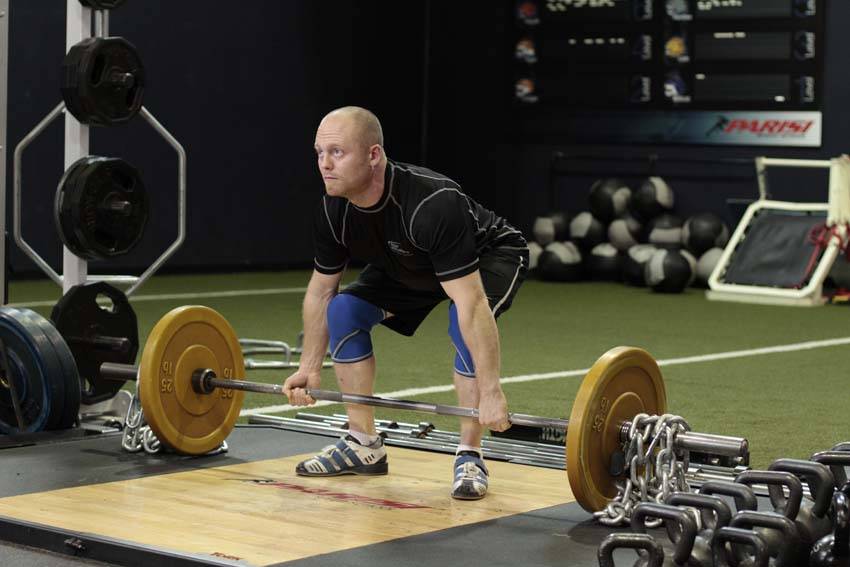
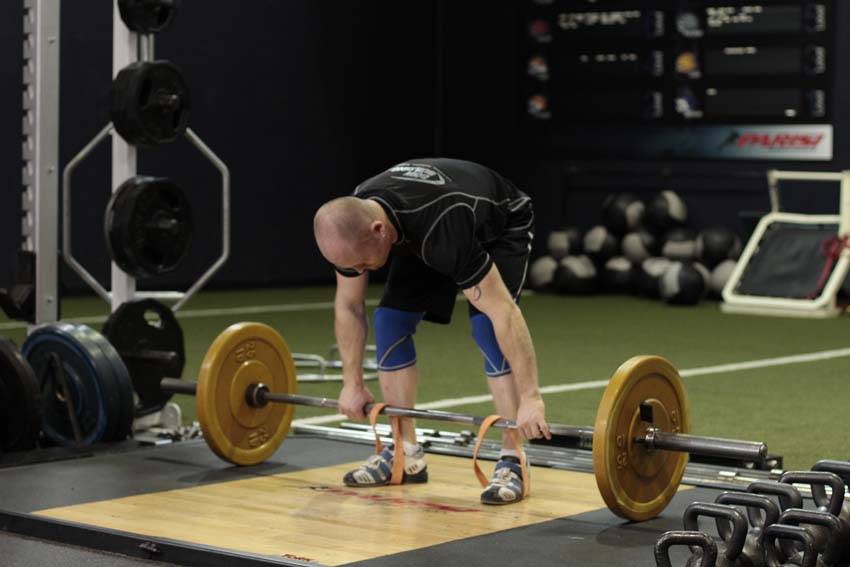
Deficit Deadlift demonstration

Deficit Deadlift

Target Erector-spinae
Equipment Barbell
Body Part Back
Difficulty Advanced
Movement Compound
Secondary Muscles
Forearms Glutes Hamstrings Middle Back Quadriceps Traps
VS
Exercise B
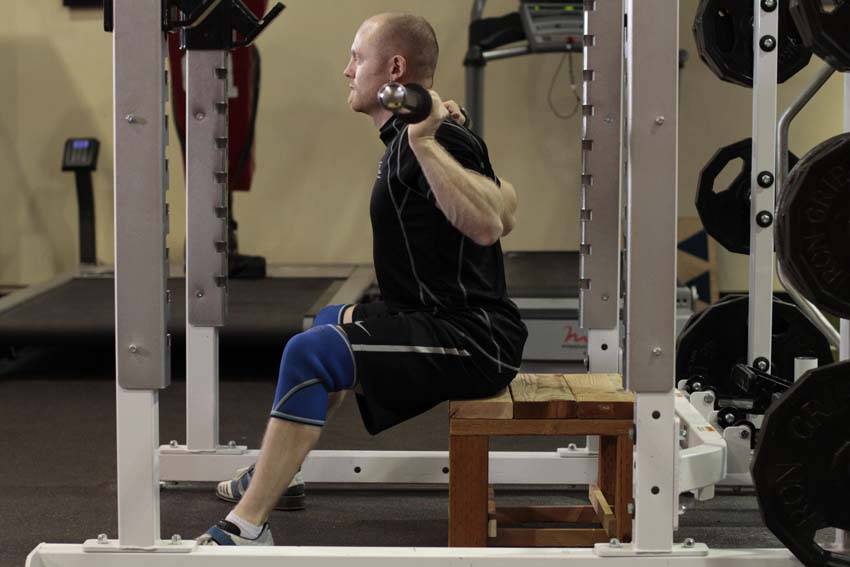
Stiff Leg Barbell Good Morning demonstration

Stiff Leg Barbell Good Morning

Target Erector-spinae
Equipment Barbell
Body Part Back
Difficulty Advanced
Movement Compound
Secondary Muscles
Glutes Hamstrings

Head-to-Head Comparison

Different values are marked. These are catalogue attributes, not performance scores.

Muscles used

Listed target and secondary muscles, shown on the body. Locations, not activation or strength scores.

  • Target
  • Secondary
  • Not highlighted

Deficit Deadlift

Front
Deficit Deadlift: front muscle locationsSolid: listed target. Striped: listed secondary. Grey: not highlighted. Locations, not activation or strength scores. See the muscle names below.
Back
Deficit Deadlift: back muscle locationsSolid: listed target. Striped: listed secondary. Grey: not highlighted. Locations, not activation or strength scores. See the muscle names below.
Target
Erector-spinae
Secondary
Forearms, Glutes, Hamstrings, Middle Back, Quadriceps, Traps

Not shown on diagram: Erector-spinae, Middle Back. These labels do not identify a precise region on this map.

Stiff Leg Barbell Good Morning

Front
Stiff Leg Barbell Good Morning: front muscle locationsSolid: listed target. Striped: listed secondary. Grey: not highlighted. Locations, not activation or strength scores. See the muscle names below.
Back
Stiff Leg Barbell Good Morning: back muscle locationsSolid: listed target. Striped: listed secondary. Grey: not highlighted. Locations, not activation or strength scores. See the muscle names below.
Target
Erector-spinae
Secondary
Glutes, Hamstrings

Not shown on diagram: Erector-spinae. These labels do not identify a precise region on this map.

Grey does not mean a muscle is unused. The diagrams show only the mapped catalogue labels.

Attribute Deficit Deadlift Stiff Leg Barbell Good Morning
Target Muscle
Erector-spinae
Erector-spinae
Body Part
Back
Back
Equipment
Barbell
Barbell
Difficulty
Advanced
Advanced
Movement Type
Compound
Compound
Secondary Muscles Different
Forearms, Glutes, Hamstrings, Middle Back, Quadriceps, Traps
Glutes, Hamstrings

Visual Comparison

An illustrative 1–10 profile derived from catalog difficulty, equipment, and listed-muscle fields—not measured performance or muscle activation.

Key Differences

  • Both exercises target the Erector-spinae using Barbell. The catalogue does not establish which exercise is better for an individual goal.

Muscle comparison

Shared target muscles

Both exercises primarily target the erector-spinae by resisting trunk flexion and producing hip extension torque. Each creates high eccentric and isometric demand on the spinal extensors, but the point on the range of motion where the erectors work hardest differs: the good morning stresses the erectors at longer muscle lengths through a large hip flexion angle, while the deficit deadlift increases initial range of motion and requires stronger spinal bracing at the floor-to-knee portion of the pull.

Secondary muscle differences

Deficit deadlifts recruit more quadriceps, traps, forearms (grip), and middle back because the increased range of motion forces a stronger knee drive and heavier external loads. Stiff-leg good mornings shift more load into the hamstrings and glutes via greater hip hinge range and maintain knee extension (small 5–15° bend), making hamstrings the dominant secondary mover with less quad contribution.

Muscle involvement analysis

Deficit deadlifts produce a mixed knee-and-hip extension pattern: early pull emphasizes hip and knee extension with a steep force vector through the midfoot, then transitions to hip lockout. Good mornings are a pure hip-hinge with a long-duration eccentric on the hamstrings and erectors; peak erector activity occurs near maximal hip flexion when the trunk angle typically sits 30–60° from vertical, increasing length-tension stress on the spinal extensors.

Equipment and setup

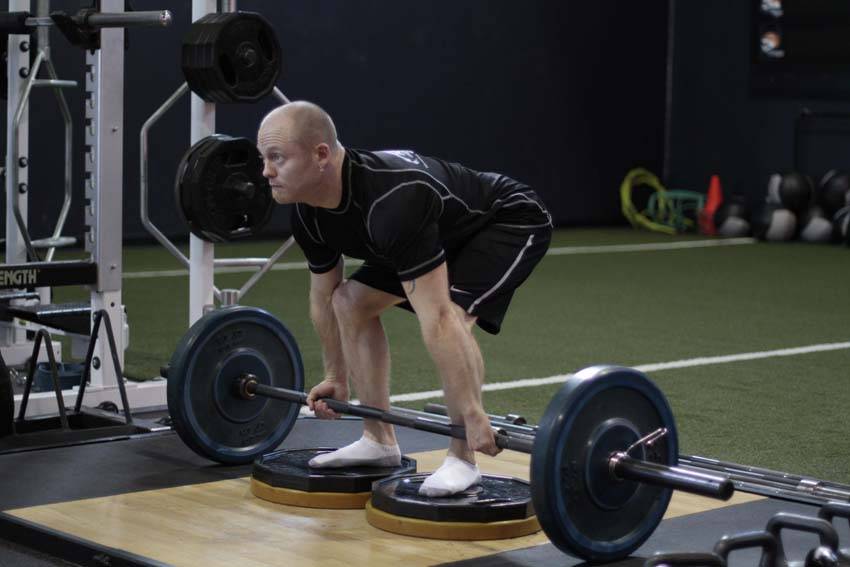
Deficit Deadlift: setup

Deficit Deadlift requires a barbell, sufficient loaded plates to create a 1–4 inch (2.5–10 cm) platform or dedicated deadlift blocks, and usually bumper or metal plates. A lifting platform or blocks that are stable and even are essential.

Stiff Leg Barbell Good Morning: setup

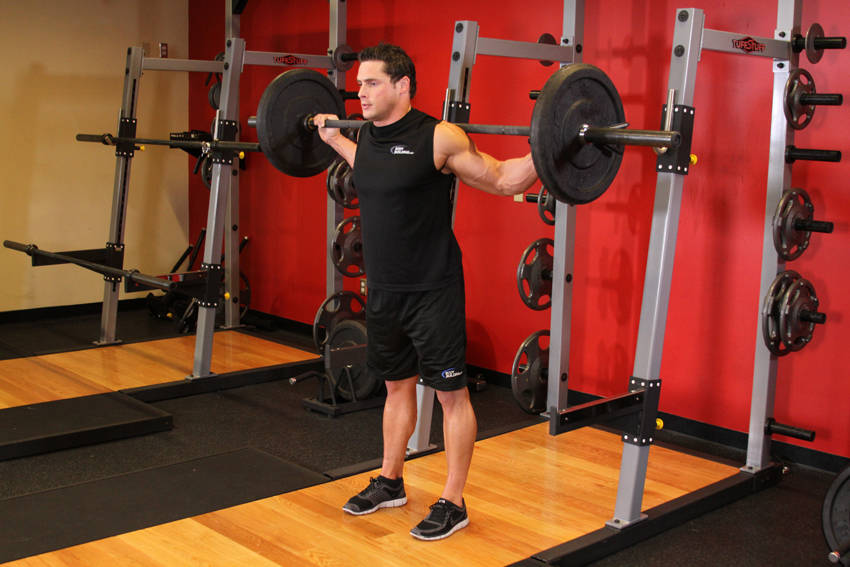
Stiff Leg Barbell Good Morning needs only a barbell and a rack to load/unload safely. You can perform it with the barbell across your upper back (high-bar placement) and no special platform.

Access and practicality

Stiff Leg Barbell Good Morning is more accessible because it requires only a barbell and rack, no raised platform. That makes it easier to program at most gyms and at home with limited equipment.

Learning and progression

Learning the movements

Stiff Leg Barbell Good Morning is easier to groove for most lifters because it isolates the hip hinge pattern and you can practice with light loads to train spinal bracing. Deficit deadlifts have a steeper learning curve due to the increased range of motion, heavier loads, and the need to synchronize knee and hip extension off the floor.

Progression considerations

Deficit Deadlift offers greater maximal strength progression since you can overload with heavier absolute loads and it transfers directly to conventional deadlift strength. Good mornings offer linear progression for hypertrophy and posterior chain endurance through increased volume, tempo, and range of motion.

Limitations and precautions

Deficit Deadlift carries higher acute injury risk because the greater ROM and heavier loads increase compressive and shear forces on the lumbar spine and knees if technique breaks down. Good mornings carry risk of lumbar flexion under load, but with conservative loading and strict bracing they are safer for progressive hypertrophy work.

Pros & Cons

Deficit Deadlift

+ Pros

  • Increases deadlift starting strength by 5–10% through extra ROM and stronger first pull
  • Recruits quads, traps, forearms, and middle back for more whole-body overload
  • Easily quantifiable progressive overload with heavier absolute loads
  • Improves bar path and drive-off-floor mechanics

− Cons

  • Higher lumbar and knee stress due to increased range of motion
  • Requires platform/blocks, limiting accessibility
  • Technique breakdown under heavy loads leads to shear forces on the spine

Stiff Leg Barbell Good Morning

+ Pros

  • Places constant tension on erectors and hamstrings for hypertrophy
  • Requires minimal equipment—barbell and rack only
  • Easier to practice hip hinge with light loads and higher reps
  • Lower demand on grip and traps compared to heavy deadlifts

− Cons

  • Less direct carryover to maximal deadlift lockout strength
  • Risk of lumbar flexion if you push load without solid bracing
  • Limited quad and knee-extension stimulus

When Each Exercise Wins

1
For muscle hypertrophy: Stiff Leg Barbell Good Morning

Good mornings create sustained tension at longer hamstring and erector lengths and suit 6–12+ rep ranges with controlled eccentrics, which maximizes time under tension and muscle growth in the posterior chain.

2
For strength gains: Deficit Deadlift

Deficit deadlifts allow heavier absolute loads and directly train the initial pull off the floor and knee extension mechanics, improving 1–5 RM deadlift strength and transfer to conventional deadlifts.

3
For beginners: Stiff Leg Barbell Good Morning

Good mornings let you learn and reinforce the hip hinge and spinal bracing with lighter loads and higher reps; deficits add ROM and heavy loads that increase technical demands for novices.

4
For home workouts: Stiff Leg Barbell Good Morning

Good mornings need only a barbell and rack, so you can program them at home without a dedicated platform or extra blocks required for safe deficit pulls.

Frequently Asked Questions

Can I do both Deficit Deadlift and Stiff Leg Barbell Good Morning in the same workout?

Yes—program them thoughtfully. Do deficits early when you’re fresh for heavy strength work (1–5 reps), and place good mornings later as an accessory at 6–12+ reps for hypertrophy and posterior chain volume, or alternate them across training days to avoid excessive lumbar fatigue.

Which exercise is better for beginners?

Stiff-leg good mornings are better for most beginners because they allow you to learn the hip hinge and spinal bracing with lighter loads and higher reps. Deficits introduce extra ROM and heavier loading that demand more technical consistency.

How do the muscle activation patterns differ?

Deficit deadlifts mix knee and hip extension so quads, glutes, hamstrings, and middle back contribute more during the initial pull; good mornings are a pure hip hinge with peak erector and hamstring activation at long muscle lengths, emphasizing eccentric control.

Can Stiff Leg Barbell Good Morning replace Deficit Deadlift?

It can replace deficits for hypertrophy and hinge practice, but not for maximal deadlift start strength. If your goal is a stronger conventional deadlift 1–3 RM, deficits are the better substitute; for size and hinge control, good mornings suffice.

Comparison Summary

Use deficit deadlifts when your primary goal is raw pulling strength and improving the deadlift start: program heavy sets in the 1–5 rep range, keep a flat back, bar over midfoot, and use a 1–4 inch platform to increase ROM. Choose stiff-leg barbell good mornings when you want targeted posterior chain hypertrophy, improved hip-hinge mechanics, or a safer home option: use 6–12+ reps, controlled 2–4 second eccentrics, and a slight knee bend (5–15°). Both target the erectors; rotate them cyclically—heavy deficits for 4–8 weeks of strength blocks, then 4–8 weeks of higher-volume good mornings for size and resilience.

Exercise instructions

Steps from the exercise catalogue. Read the full sequence before starting.

Deficit Deadlift

  1. Begin by having a platform or weight plates that you can stand on, usually 1-3 inches in height. Approach the bar so that it is centered over your feet. You feet should be about hip width apart. Bend at the hip to grip the bar at shoulder width, allowing your shoulder blades to protract. Typically, you would use an overhand grip or an over/under grip on heavier sets.
  2. With your feet, and your grip set, take a big breath and then lower your hips and bend the knees until your shins contact the bar. Look forward with your head, keep your chest up and your back arched, and begin driving through the heels to move the weight upward. After the bar passes the knees, aggressively pull the bar back, pulling your shoulder blades together as you drive your hips forward into the bar.
  3. Lower the bar by bending at the hips and guiding it to the floor.

Stiff Leg Barbell Good Morning

  1. This exercise is best performed inside a squat rack for safety purposes. To begin, first set the bar on a rack that best matches your height. Once the correct height is chosen and the bar is loaded, step under the bar and place the back of your shoulders (slightly below the neck) across it.
  2. Hold on to the bar using both arms at each side and lift it off the rack by first pushing with your legs and at the same time straightening your torso.
  3. Step away from the rack and position your legs using a shoulder width medium stance. Keep your head up at all times as looking down will get you off balance and also maintain a straight back. This will be your starting position.
Read remaining steps for Stiff Leg Barbell Good Morning
  1. Keeping your legs stationary, move your torso forward by bending at the hips while inhaling. Lower your torso until it is parallel with the floor.
  2. Begin to raise the bar as you exhale by elevating your torso back to the starting position.
  3. Repeat for the recommended amount of repetitions.

Also Compare

Compare another pair

Choose two exercises to see their differences side by side.

Compare Exercises