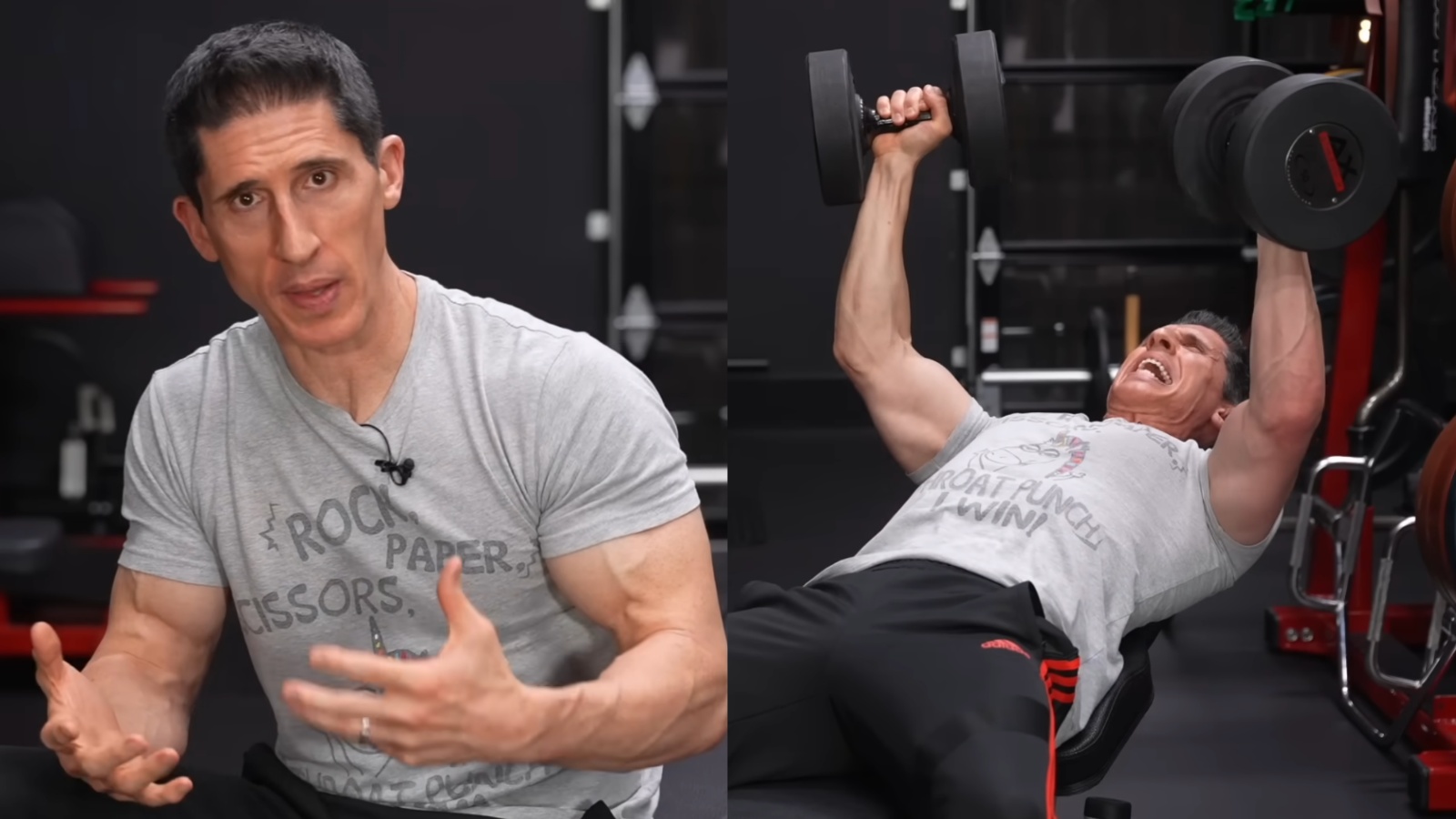
Fitness coach Jeff Cavaliere is breaking down a time-efficient strategy for growing muscle. On Nov. 24, 2025, he discussed how to train less for better results by reaching failure during workouts.
Cavaliere caters to over 14.2 million YouTube subscribers, helping lifters improve strength, muscle, and flexibility. Having served as the assistant strength and conditioning coach to the New York Mets, he’s familiar with guiding a broad range of individuals, from your average gym-goer to seasoned athletes.
We all have obligations outside the gym, which is why Cavaliere has made it his mission to offer training regimens that require less time. Similar to the training philosophy shared by Dorian Yates, a six-time Mr. Olympia, Cavaliere contends that training to failure is one of the biggest needle movers for gains.
Jeff Cavaliere Shares How to Grow Muscle In Less Time
Cavaliere highlighted why training to failure is critical to muscle growth. He said lifters will need to perform additional sets if they don’t go to failure to reach an adequate stimulus for change.
“For every one of those sets that you perform below failure, you’re going to need to perform more of them in order to reach an adequate level of volume or stimulus to change.”
“The weight that was in my hands created tension. The time that I was pushing in these elongated states, these more stretched positions of the pec, cause tension. There’s no magic to lengthened partials. That’s nonsense.”
He noted two important factors for growth, which are stretching the muscle and loading the muscle (tension).
“It’s a matter of accumulating total tension. Because you have two factors there: stretching a muscle, that’s tension, and loading a muscle, that’s tension; those are going to be more productive.”
“I can guarantee that you reach failure. That’s the key. I don’t know, subjectively looking at you, how short of failure you actually were; you thought one, I bet you it was four.”
As lifters increase the difficulty of their sets, the total workout time can decrease because less volume is needed.
“The fact is, there’s more in you. If you had the brain and willpower that knew what you’re capable of, you’d do and push more and get more out of that set. When you do that, the volume comes down. Remember this: you either train long, or you train hard, but you cannot do both.”
“As you increase the difficulty level of the sets, then you decrease the time you need to spend doing them,” he adds.
While time under tension has its place in workouts, Cavaliere explained that it won’t always produce gains if the weight isn’t optimal.
“You’ve probably heard of time under tension, but you have to be careful there too because slowing down or manipulating your time to an exaggerated amount, where it limits the amount of weight you can use on the exercise, is going to not really result in more muscle hypertrophy because you’re taking down both of those stimuli.”
“If you get too light in order to accommodate whatever technique you’re doing, then you’re not going to build muscle.”
In addition to Cavaliere, Yates has consistently pushed gym-goers to reach failure during workouts. He recently summarized the 1973 ‘The Colorado Experiment,’ where Casey Viator gained 63 pounds in just 28 days. Yates interpreted this as proof that reaching failure is a massive driver of muscle growth.
Cavaliere believes effort dictates results, not time. He is adamant that lifters can reach a new level of growth by consistently achieving failure.
RELATED: Jeff Cavaliere Reveals Top 2 Exercises to Transform Flat Biceps Into Peaks
Watch the full video from the ATHLEAN-X YouTube channel below:
 You can also follow us on Twitter, Facebook, Instagram, and
YouTube for even more content.
You can also follow us on Twitter, Facebook, Instagram, and
YouTube for even more content.Tip: If you're signed in to Google, tap Follow.