
The incline dumbbell curl is a biceps curl performed lying back on an incline bench, with your arms hanging straight down behind the line of your body. That position stretches the biceps before the rep begins, and the bench stops you from leaning or swinging to get the weights up.
Expect to use lighter dumbbells than you curl standing. There is no momentum to help, and every rep starts with the biceps fully stretched. Use it as a second curl, to train the biceps in a position a standing curl never reaches.
How to Do the Incline Dumbbell Curl

- Set the bench between 45 and 60 degrees. Sit back with your head, shoulders and hips against the pad and your feet flat on the floor. You should feel fully supported by the bench. Do not set it so low that the front of your shoulders hurts when your arms hang down.
- Let your arms hang straight down. Hold a dumbbell in each hand with your palms facing forward and your arms pointing at the floor. You should feel a stretch through your biceps and the front of your shoulders. Do not let your shoulders roll forward off the pad.
- Fix your upper arms in place. Press your shoulder blades into the bench and keep your upper arms vertical. You should feel that only your forearms are free to move. Do not start the rep by pulling your elbows forward.
- Curl without moving your upper arms. Breathe out and bend your elbows, keeping your palms up, until the dumbbells reach shoulder height. You should feel the biceps doing all of the work. Do not lift your head or shoulders off the bench to help.
- Pause at shoulder height. Hold for 1 second with your elbows still pointing at the floor. You should feel a hard squeeze in the biceps. Do not let your elbows swing up in front of you.
- Lower slowly into the stretch. Breathe in and take 3 seconds to straighten your arms completely, then pause for a moment at the bottom. You should feel the biceps lengthen under load. Do not drop into the bottom position or bounce out of it.
You can also curl one arm at a time. Alternating gives each arm a short rest between reps and makes it easier to watch your elbow position.
Muscles Worked in the Incline Dumbbell Curl
The incline curl trains the same three elbow flexors as any curl. The bench angle changes how the work is shared between them.
Biceps Brachii
The biceps brachii has two heads, and the long head crosses the shoulder as well as the elbow. When your upper arm hangs behind your torso, the long head is lengthened at both joints. That is the stretch you feel at the bottom of each rep.
Training from that position slightly favors the biceps. In a 12-week study, 21 untrained adults trained one arm with incline curls and the other with preacher curls. Biceps volume, measured by MRI, grew 22.1% in the incline arm and 18.9% in the preacher arm (Kobayashi et al., 2026). For how the two exercises compare in full, see incline dumbbell curl vs preacher curl.
The muscle also stays busy from start to finish. In recordings from 22 people, the incline curl kept the biceps working through the whole range of motion, as the standing curl did (Oliveira et al., 2009).
Brachialis and Brachioradialis
The brachialis, underneath the biceps, and the brachioradialis, on the thumb side of the forearm, also bend the elbow. In the same study they grew too, but less than the biceps did: 17.1% for the brachialis and 13.5% for the brachioradialis in the incline arm.
The incline curl is a biceps exercise first. To give the other two muscles more work, add a neutral-grip lift such as the dumbbell hammer curl.
Stabilizers
The front of the shoulder is stretched along with the biceps and holds your upper arm still as you curl. The forearm muscles grip the dumbbells and keep your wrists straight.
Common Incline Dumbbell Curl Mistakes
Letting the Elbows Swing Forward
The upper arms move forward as the weights rise, until the elbows are in front of the body. That removes the stretched position, which is the reason to use the bench, and turns the lift into a seated version of a standing curl. Keep your elbows pointing at the floor for the whole rep.
Rolling the Shoulders Off the Pad
The shoulders round forward and the head lifts as the set gets hard. The upper body is trying to shorten the lever, and the front of the shoulder takes strain it does not need. Keep your shoulder blades pressed into the bench. If you cannot, the dumbbells are too heavy.
Using Your Standing Curl Weight
The dumbbells you curl standing will be too heavy here, because the bench takes away momentum and the rep starts from a full stretch. Lifters who refuse to go lighter end up making the first two mistakes. Drop the weight until every rep starts from a dead hang.
Stopping Short of Straight Arms
The arms stay bent at the bottom of each rep. It makes the set easier by skipping the stretch, which is the part of the lift this exercise exists for. Straighten your arms fully every time.
Dropping Into the Bottom
The dumbbells fall through the last part of the lowering phase and the arms catch them at full stretch. That puts a sudden load on the biceps and the front of the shoulder in their longest position. Take 3 seconds to lower, and arrive at the bottom under control.
Incline Dumbbell Curl Variations
Each of these changes one thing: the grip, the side of the bench you lie on, or whether you use a bench at all.
Incline Hammer Curl
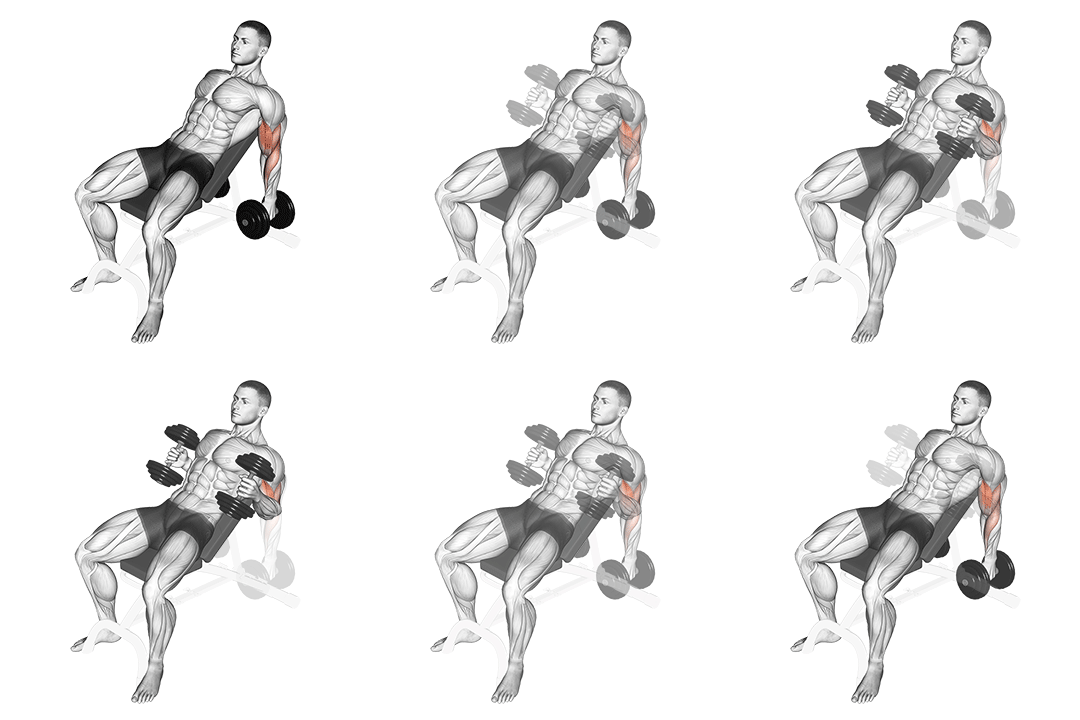
Keep the same setup and turn your palms to face each other. The neutral grip gives the biceps less leverage, so the brachialis and brachioradialis have more to do. Use it when you want the stretch of the incline bench with a forearm-friendly grip.
Prone Incline Curl
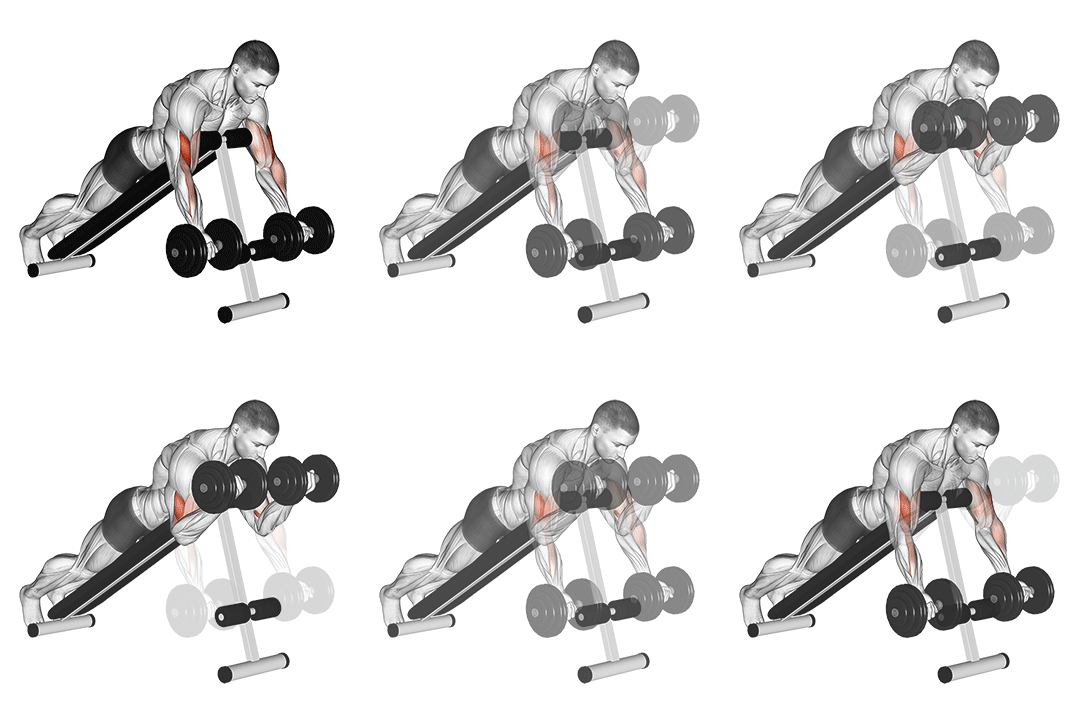
Turn around and lie with your chest on the pad, so your arms hang in front of you. Your upper arms now sit in front of your body, so the biceps works in a shortened position, the opposite of the incline curl. This is the dumbbell version of the lift covered in our spider curls guide.
Standing Dumbbell Curl
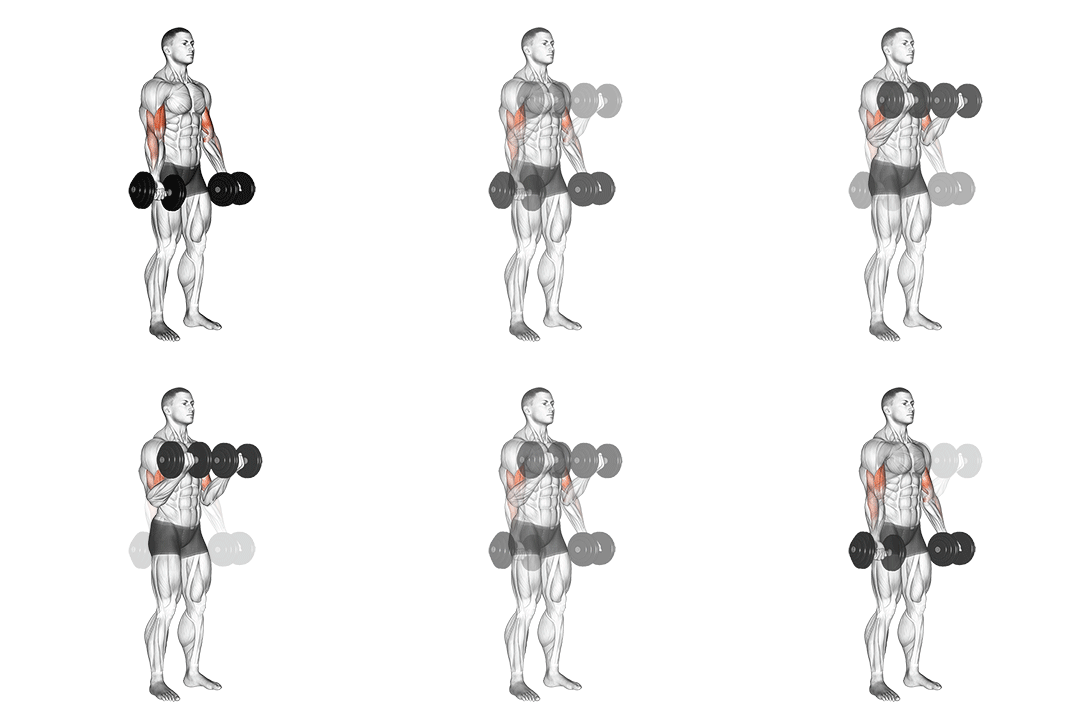
Without the bench, your arms start at your sides, and you can handle more weight. The standard dumbbell curl is the better choice for your heaviest sets. Use the incline curl after it.
Have a cable machine? The Bayesian curl also trains the biceps with the arm behind the body. No incline bench? Our incline dumbbell curl alternatives page lists swaps by equipment.
Incline Dumbbell Curl Sets and Reps
| Goal | Sets | Reps | Rest |
|---|---|---|---|
| Strength | 3-4 | 6-8 | 2-3 min |
| Hypertrophy | 3-4 | 8-12 | 1-2 min |
| Endurance | 2-3 | 12-15 | 30-60 sec |
Light and heavy weights both build muscle (Schoenfeld et al., 2021). On this lift, stay at 8 reps or more until you are sure of your form, because a heavy dumbbell hangs on a fully stretched shoulder at the bottom. Leave 1 to 2 reps in reserve on each set.
Start with dumbbells you can curl 10 times from a full hang, and move up a pair when every set reaches the top of the rep range. To check your numbers against lifters of your size, use our incline dumbbell curl strength standards.
Count these sets toward your weekly biceps total, since a muscle generally grows more when it gets more weekly sets (Schoenfeld et al., 2017). Place the incline curl second in your arm training, after a heavier standing curl or after your rows and pulldowns. Keep a lighter pair beside the bench and it also suits drop sets and the other methods in our guide to increasing training intensity.
Incline Dumbbell Curl FAQs
What angle should the bench be for incline curls?
Between 45 and 60 degrees. The lower the bench, the further your arms hang behind you and the stronger the stretch on the biceps and the front of the shoulder. Start at 60 degrees and lower it only if your shoulders stay comfortable.
Does the incline curl work the long head of the biceps?
It works both heads. The long head crosses the shoulder, so it is the one lengthened most when your arm hangs behind your body. The 12-week study measured the biceps as a whole. It did not separate the two heads.
Why are incline curls harder than standing curls?
You cannot use your hips or lean back, and the rep begins with the biceps at its longest. A standing curl lets a little body movement help when the set gets hard. The bench does not.
Why do I feel incline curls in the front of my shoulders?
The front of the shoulder is stretched in the bottom position, so some tension there is expected. If it is uncomfortable, raise the bench a notch and make sure your shoulders are not rolling forward. Pain in the joint is a reason to stop and choose a different curl.
Are incline dumbbell curls good for beginners?
They are safe to learn early, but the standing curl is the better first exercise. Learn to keep your elbows still while standing, then add the incline curl with light dumbbells.
References:
Kobayashi, Y. et al. (2026). Exercise-specific preferential hypertrophy of individual elbow flexor muscles after incline versus preacher dumbbell curl training. Journal of Sports Sciences, 44(23), 3288-3301. PubMed
Oliveira, L.F. et al. (2009). Effect of the shoulder position on the biceps brachii EMG in different dumbbell curls. Journal of Sports Science and Medicine, 8(1), 24-29. PubMed
Schoenfeld, B.J. et al. (2021). Loading recommendations for muscle strength, hypertrophy, and local endurance: A re-examination of the repetition continuum. Sports, 9(2), 32. PubMed
Schoenfeld, B.J. et al. (2017). Dose-response relationship between weekly resistance training volume and increases in muscle mass: A systematic review and meta-analysis. Journal of Sports Sciences, 35(11), 1073-1082. PubMed
Interested in measuring your progress? Check out our strength standards for Incline Dumbbell Curl, and more exercises.