

When it comes to training abs, sit-ups are the first exercise that comes to the mind of most people. I would go so far as to say that it has become an obsession at this point, with people doing 100+ reps of this exercise in hopes of achieving a cover photo-worthy six-pack.
As a personal trainer with almost two decades of hands-on experience, I can attest that there are better ways of carving a chiseled midsection than laboring through an endless set of sit-ups.
I leveraged my experience working with hundreds of clients across the fitness spectrum to devise a three-set core training routine that gets you better results than doing endless reps of the most popular ab exercises that you see people do in the gym.
These three exercises are programmed to train your core for stability, strength, and definition, ensuring overall development.
Plus, since you can do these three sets within five to 10 minutes, this routine is a perfect fit for busy individuals who cannot spare 15-30 minutes daily for exercise.
In this article, I pull back the curtain on this highly effective three-set core training routine comprising unique movements that will give you a Greek god-like midline without spending multiple hours in the gym every day. You’ll also learn how you can implement this workout into your daily routine to maximize results.
3-Set Core Plan: Step-by-Step Breakdown

Contrary to what most people think, core training isn’t just about looking good; it can significantly improve your performance in day-to-day activities and boost your overall work capacity and productivity.
Without further ado, here are the three moves that should be staples in your ab training regimen:
Hollow Body Hold (Sagittal Plane)
Many lifters relate training to constant movement. They leave massive gains on the table by doing this.
Your workouts should be a balance of isotonic and isometric exercises. The former comprises lifts like the bench press, which involve joint and muscle movement, whereas isometric exercises involve contracting a muscle without changing the muscle’s length or the angle of the joint. Basically, you are holding a position for as long as possible.
Hollow holds are a form of isometric training. They work your body in the sagittal plane (forward-backward motion) and target your rectus abdominis and transverse abdominis muscles, which are key for spinal stability.
How to Perform:
- Begin by lying on the floor with your arms extended overhead and legs straight.
- Lift your shoulders and legs slightly off the ground while pressing your lower back into the floor.
- Hold this position for as long as possible.
- Beginners should aim for 20 seconds and slowly increase it to 60 as they gain more experience.
Coach Tip: Brace your core while performing this exercise as if you are about to take a hit. This will maximize muscle activation and protect your spine. Also, avoid holding your breath and prioritize breathing normally.
Modifications:
This unassuming exercise is incredibly challenging to perform. Newbies can start by lifting their legs while keeping their arms at their sides. More experienced lifters can add and hold onto additional resistance, like a dumbbell or a weight plate, once they hit the 60-second mark.
Side Bridge with Reach Through (Frontal Plane)
This exercise combines isometric and isotonic movements to ensure maximum target muscle activation. It hits your obliques and quadratus lumborum, which are crucial for lateral stability. The frontal plane (side-to-side motion) supports movement, like lateral lunges or side-stepping.
Get into a side plank position with your elbow under your chest and your body in a straight line from your heels to your head. Then, raise your top arm straight toward the ceiling. This will be your starting position.
Slowly reach your top arm under your body and as far behind your midline as possible without losing your balance.
Complete the recommended reps before switching sides.
Making this exercise a part of your training regimen can help strengthen your side core muscles, which can boost balance and reduce the risk of injury during dynamic activities.
Beginners can perform this exercise without the dynamic movement and hold the side bridge for 20 seconds per side.
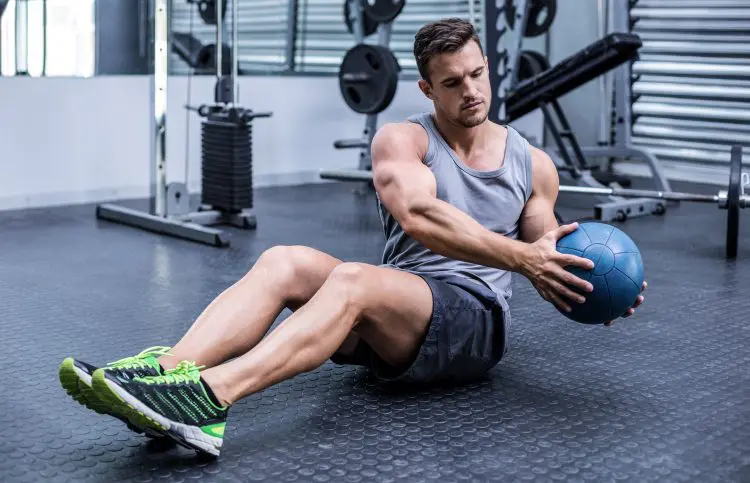
Russian Twist (Transverse Plane)
Russian twists are an incredibly effective exercise for enhancing rotational strength and coordination. Performing this exercise regularly can improve your athletic performance in sports like hockey, tennis, and baseball.
This move engages the obliques and transverse abdominis muscles as it works through the transverse plane (rotational motion).
Instructions:
- Set up: Sit with your knees bent, feet flat on the floor, and lean back slightly while keeping your spine straight.
- Resistance: Grab a dumbbell by its ends or hold a weight plate over your knees. Maintain slight elbow flexion to avoid straining your biceps or anterior delts.
- Rotation: Slowly turn to your left side while exhaling and hold the peak contraction for a second. Return to the starting position and repeat on the right side.
- Tip: Advanced lifters can raise their feet off the floor and use a heavier weight to challenge their core.
The Problem with 100 Sit-Ups a Day
You have probably read about the popular moment when a reporter asked Muhammad Ali how many sit-ups he performed in a day to stay in great shape.
Ali’s response: “I don’t know because I don’t start counting until it hurts.”
In my opinion, this short interview completely changed the trajectory of sit-ups’ popularity. Overnight, people went from performing three sets of 10-15 sit-ups to doing them until they got ab cramps.
Even today, there is no method to this madness.
Sit-ups can be a part of your routine, but you will be doing yourself a disservice by relying solely on them, as they don’t engage every core muscle and can increase the risk of exhaustion and overuse injuries.
Folks who preach sit-ups as a complete ab builder are oversimplifying core training. Your midline muscles comprise the rectus abdominis, obliques, and transverse abdominis muscles, which demand a variety of movement patterns to ensure optimal gains.
Limiting yourself to sit-ups targets a narrow slice of these muscles, leaving most of the other tissues untouched.
Why Sit-Ups Aren’t a Fool-Proof Solution
Sit-ups rely mainly on your hip flexor muscles, which connect your thighs to your pelvis. This dependence pulls focus from your abdominals, reducing the exercise’s core training effectiveness.
Furthermore, some of my clients report spinal strain due to the repetitive spinal flexion movement involved during the sit-up concentric phase.
It doesn’t end here. If you think about it, doing 100 sit-ups requires at least 15 minutes if you do them dedicatedly using the correct form. Basically, you are spending more time and effort on a suboptimal exercise, whereas you could have gotten better results with targeted training.
A study found that high-repetition exercises like sit-ups can lead to strength and muscle plateaus as your body gets used to the exercises over time and stops responding. (1)
3-Set Core Plan That Works Better Than 100 Sit-Ups a Day
Now that you know everything there is to understand about this three-set core plan, here is how to put this into action:
| Exercise | Repetitions/Duration | Rest |
| Hollow Body Hold | 30-60 seconds | 30 seconds |
| Side Bridge with Lateral Reach | 10 reaches per side | 30 seconds |
| Russian Twist | 20 twists (10 per side) | 30 seconds |
Each exercise in this workout should not take more than one minute, meaning you will be able to complete this entire workout in 4.5 minutes.
Beginners should stick to performing one round per workout while prioritizing a picture-perfect training form. Avoid rushing through the repetitions, as it limits target muscle fiber stimulation. Focus on contracting your muscles during each second of an exercise for the best results.
On the other hand, intermediate and advanced exercisers can aim for two rounds of this workout while holding onto additional resistance.
Since this workout targets your core from every angle, performing it twice or thrice a week is enough for optimal adaptations.
Combining It With Other Fitness Routines
The beauty of this three-set core plan is that it is short enough that it can be merged into your existing training routine without any major changes.
Below are my recommendations for different training routines:
- Cardio: If your main aim is to lose weight and you spend a lot of time in the gym on cardio equipment, I recommend starting your workouts with this core training routine. Once you have trained your abs, you will be mindful about keeping your core braced during your main cardio workout, which can help maintain better form and reduce the risk of injury.
- Strength Training: Lifters focused on building strength or muscle should save this workout for the end of their session, since doing it first can lead to fatigue and limit overall performance.
Why the 3-Set Core Plan Works

The crunching motion of sit-ups primarily trains your core in the sagittal plane. While this might target your upper abs, it leaves your oblique muscles and other core fibers untouched. If you are aiming for a well-balanced core, your ab workouts should prioritize movements that mimic real-world demands, such as lifting and twisting.
A well-balanced core workout must engage your deep stabilizers, like the transverse abdominals, to tighten your midsection and improve your posture. It should also hit the obliques and rectus abdominis effectively.
Unlike the 100 rep setup routine, we’ll be focusing on a low-rep, high-intensity workout to maximize muscle activation and growth.
I have never understood why people treat their core differently from other muscle groups, like biceps, chest, and legs. Muscle building and conditioning improvement principles remain the same, irrespective of which muscles you are training.
This three-exercise routine can also improve functional fitness, as you’ll be training your core muscles throughout the full range of motion.
Common Mistakes to Avoid
Like every other good thing in this world, sit-ups come with diminishing returns, meaning that extra reps don’t build strength or muscle definition after a certain point. All you are doing is stroking your ego.
Make no mistake, I am not dismissing your efforts. I am just saying that you need to redirect them to better and more effective exercises. Ditching sit-ups for these three exercises has helped several of my clients get over hip flexor and nagging lower back pain. There is no reason why you can’t replicate these results.
However, you must consider the following factors before adopting this routine:
Proper Warm-Up and Cool-Down
Although most people perform the bodyweight variations of these exercises, you should not overlook the importance of a proper warm-up routine before beginning your session. A light 5-10 minute dynamic stretching routine or performing partial reps of these three exercises can help boost blood flow to the target muscles and promote functionality and overall performance.
Similarly, end with a cool-down routine comprising static stretches to flush metabolites out of the muscle tissues, boost mobility, and kick-start recovery.
Overtraining and the Importance of Rest
It’s easy to go overboard when you are only doing three exercises and the workout only lasts around five minutes. However, you must understand that pushing yourself to the limit daily significantly increases the risk of exhaustion and overuse injuries.
Program your workouts depending on your current experience levels and recovery potential. Ensure that you are meeting your daily calorie and macronutrient goals and getting at least eight hours of sleep to maximize recovery.
Conclusion
Almost every fitness enthusiast has tried doing multiple sets of sit-ups every day. However, only a few achieved the goal of building a diced six-pack. This three-exercise core training plan, comprising hollow body holds, side bridges with lateral reach, and Russian twists, takes the guesswork out of building a stronger and more defined midsection.
Start small by performing one circuit of this routine and slowly increase the volume as you gain more experience. Focus on your form and contracting your core muscles with each rep. Best of luck!
References:
- Gelman R, Berg M, Ilan Y. A Subject-Tailored Variability-Based Platform for Overcoming the Plateau Effect in Sports Training: A Narrative Review. Int J Environ Res Public Health. 2022 Feb 2;19(3):1722. doi: 10.3390/ijerph19031722. PMID: 35162745; PMCID: PMC8834821.