
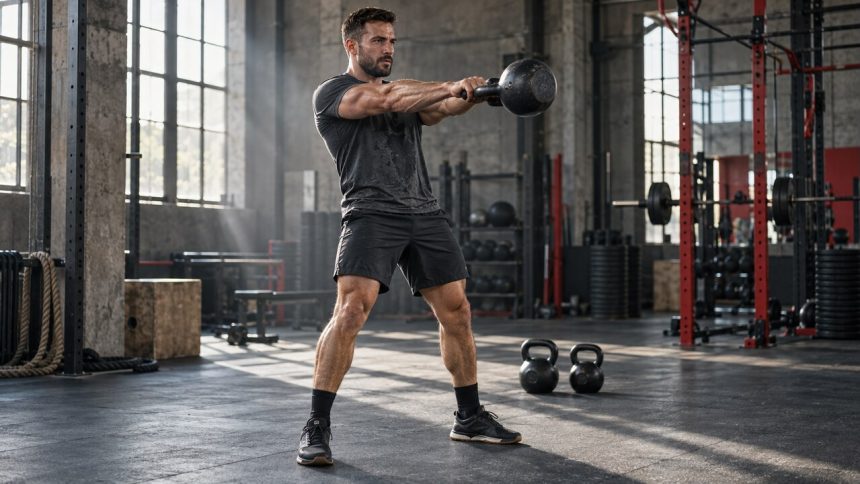
The appeal of the 7-7-7 kettlebell workout is obvious. Pick seven exercises, perform seven reps of each, repeat the circuit seven times, and walk away with a full-body session that fits neatly into about 30 minutes. On paper, it looks simpler than most gym programs.
The catch is the third seven. A seven-rep set is manageable. Seven exercises without much rest are harder. Repeating that sequence seven times turns a tidy circuit into 343 repetitions, and some versions climb well beyond that when unilateral exercises are counted per side. The workout stops being a casual strength session and becomes a test of local muscular endurance, conditioning, grip, and technique under fatigue.
The full 7-7-7 format is best treated as an intermediate conditioning workout, not a learn-as-you-go beginner circuit. New kettlebell users should first own the hinge, swing, front-rack position, squat, row, and overhead press. Start with three rounds, choose the load from your weakest weighted movement, and earn the seven-round version without turning the final rounds into survival reps.
What the 7-7-7 Kettlebell Workout Actually Is
There is no single official exercise list. The name describes a template:
- Choose seven exercises.
- Perform seven reps of each exercise.
- Rest after the seventh exercise.
- Repeat for seven total rounds.
That flexibility is useful, but it is also why two workouts carrying the same name can have very different demands. Seven deadlifts and seven push-ups are not equivalent to seven snatches per arm and seven overhead lunges per side. Exercise complexity, whether reps are total or per side, the weight used, and the rest period all matter more than the repeated number.
The Rep Math
- One round: 7 exercises × 7 reps = 49 reps.
- Seven rounds: 49 reps × 7 = 343 reps.
- The catch: if even one exercise is performed for seven reps per side, the true total is higher than 343.
For example, six bilateral exercises plus seven reverse lunges per leg produce 56 reps per round and 392 reps across seven rounds. Add a one-arm row and one-arm press at seven reps per side, and the total reaches 490. That does not automatically make the workout better. It changes the dose and makes fatigue management more important.
Why Seven Rounds Change the Training Goal
A kettlebell circuit can build fitness, but the 7-7-7 structure is not an ideal way to maximize every quality at once. The latest American College of Sports Medicine position stand found that resistance training improves strength, muscle size, power, endurance, and physical function. It also found that the prescription should match the goal: heavier loads favor strength, while power work benefits from moderate loads, fast intent, and relatively low volume.
That distinction matters here. A 343-rep session performed with short rests is mainly a density and muscular-endurance challenge. It may support general conditioning and provide useful resistance-training volume, but it is not a substitute for heavy strength work or low-fatigue power practice.
Kettlebells can also drive the heart rate up quickly. In a small study of continuous two-hand swings, participants averaged 86.8% of age-predicted maximum heart rate during a 12-minute bout. Their oxygen use averaged a lower 65.3% of measured VO2 max, which is a useful warning: kettlebell work can feel brutally cardiovascular, but heart rate alone can overstate its aerobic cost.
Shortening rest raises the difficulty further. Research comparing dense swing intervals with a more traditional rest structure found higher perceived effort, heart rate, oxygen consumption, and blood lactate in the compressed protocol. That is the real engine of 7-7-7. The number seven is memorable; accumulated fatigue is what makes the workout hard.
Pass This Readiness Test Before You Chase 343 Reps
Being generally fit does not guarantee that you are ready for a high-density kettlebell circuit. You should be able to perform each movement correctly while fresh and keep the same positions after your breathing rate climbs.
| Check | Pass Standard | If You Miss It |
|---|---|---|
| Hip hinge | 10 controlled kettlebell deadlifts with a braced, neutral trunk | Practice deadlifts before adding swings |
| Two-hand swing | 15 crisp reps driven by the hips, with no squatty pattern or back discomfort | Use deadlifts in the circuit and learn the swing separately |
| Front rack and press | 8 smooth double push presses with no wrist collapse or exaggerated back arch | Use one lighter bell or replace the press with a floor press |
| Lower-body control | 10 alternating reverse lunges without losing balance or knee position | Use bodyweight split squats or supported lunges |
| Repeatability | Three rounds with the last round looking like the first | Stay at three rounds until technique is stable |
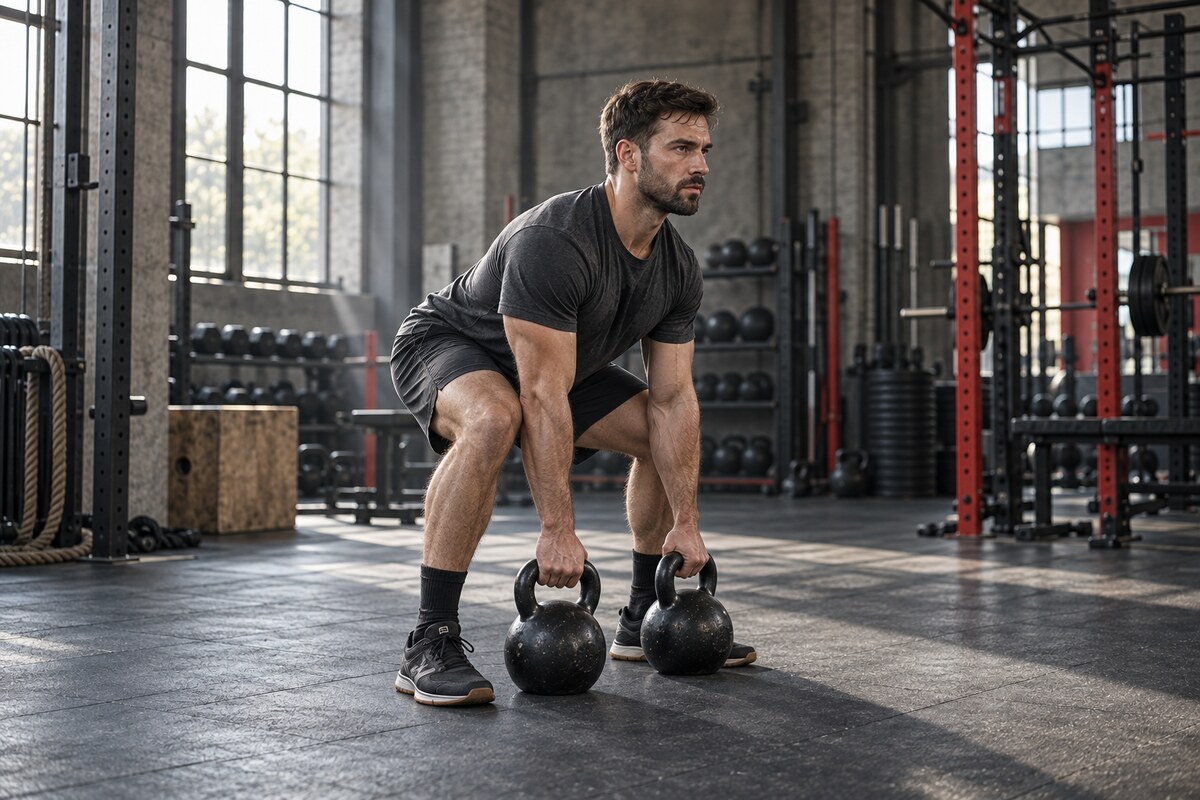
If you are new to kettlebells, begin with a simpler kettlebell workout built around fundamental movements. The 7-7-7 test will still be there after you develop the positions needed to do it well.
The FitnessVolt 7-7-7 Workout
This version uses a pair of matched kettlebells for the bilateral lifts and one bell for swings. It covers a hinge, squat, push, pull, lunge, and bodyweight press without relying on a snatch or Turkish get-up, two exercises that deserve focused practice rather than rushed fatigue reps.
Equipment: two matched kettlebells, enough floor space for push-ups and lunges, and a timer. Perform seven reps of each movement in order. Rest after the seventh exercise.
| Order | Exercise | Reps | Coaching Priority |
|---|---|---|---|
| 1 | Double kettlebell deadlift | 7 | Brace before each pull; finish tall without leaning back |
| 2 | Two-hand kettlebell swing | 7 | Hinge and snap the hips; let the bell float |
| 3 | Double front squat | 7 | Keep the bells settled and the torso controlled |
| 4 | Double push press | 7 | Use a short dip; finish with ribs stacked over pelvis |
| 5 | Double bent-over row | 7 | Hold the hinge; row without jerking the torso |
| 6 | Push-up | 7 | Keep a straight line from shoulders to heels |
| 7 | Alternating reverse lunge | 7 total | Switch the lead leg each round so the odd rep alternates |
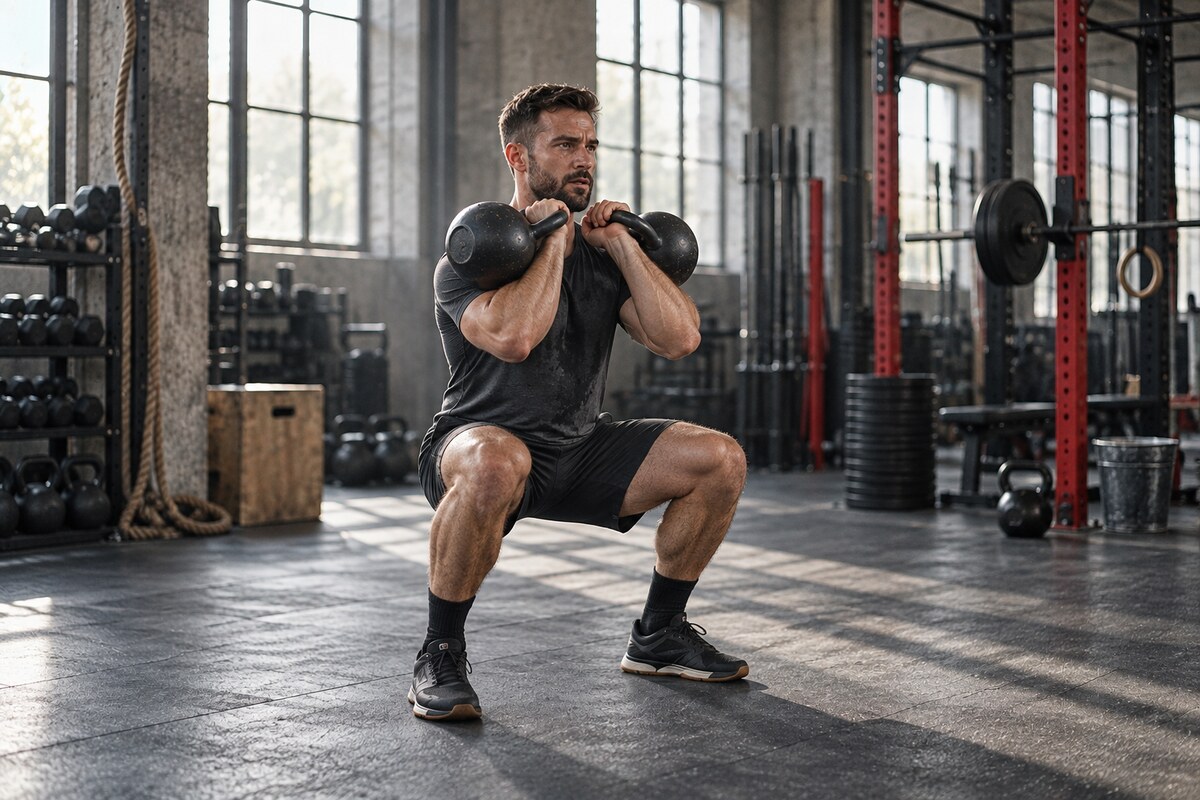
The swing is the most technical ballistic movement in the circuit. If your hinge is still uncertain, review our complete kettlebell swing guide and rehearse it before starting the clock.
Choose the Weight From Your Weakest Movement
The common mistake is choosing kettlebells from the deadlift or squat. Those movements can usually handle more weight than the push press, especially after swings and front squats have raised your breathing rate. If the bells are selected for your strongest exercise, the overhead movement becomes the failure point.
Use a pair you could double push press for about 12 clean reps while fresh. Seven reps should feel like an effort of roughly 6 out of 10 in round one, with several good reps still available. During the full workout, effort can rise toward 8 out of 10, but the load should not force grinding reps, an unstable rack, or a backward lean.
If your gym’s kettlebells jump in large increments, use one bell for the press while keeping the pair for deadlifts, squats, and rows. The transition costs a few seconds, but that is a better trade than using a weight your shoulders cannot control. Our kettlebell weight guide can help if you are building a home setup and need useful load increments.

Earn the Full Seven Rounds
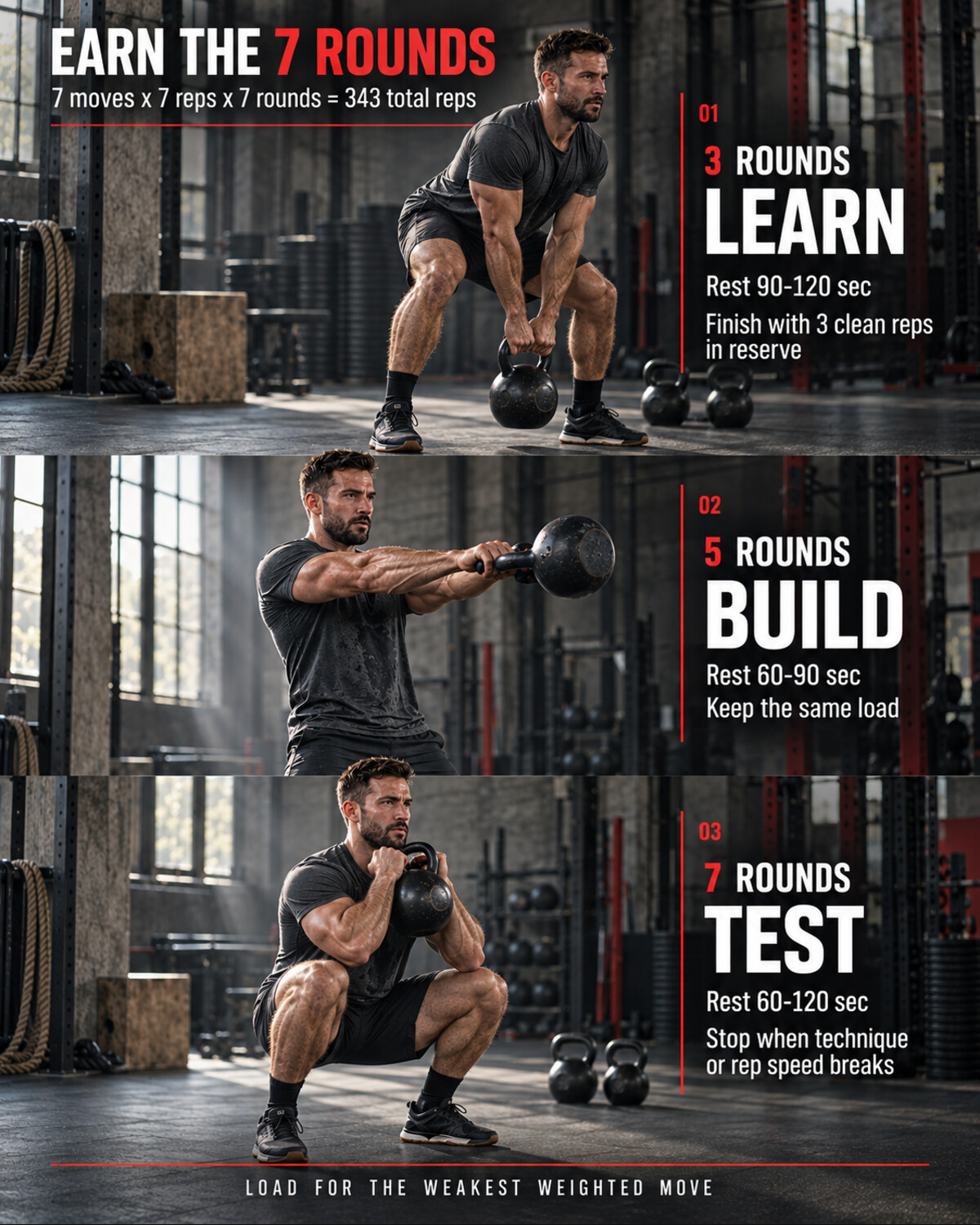
Do not make round count and rest time harder at the same time. First add rounds while keeping generous recovery. Once five rounds are clean, reduce rest modestly. Attempt seven rounds only when your positions and rep speed remain consistent.
| Stage | Rounds | Rest After Each Round | Advance When |
|---|---|---|---|
| Learn | 3 | 90-120 seconds | All exercises stay crisp with about three reps in reserve |
| Build | 5 | 60-90 seconds | Round five matches the positions and pace of round one |
| Test | 7 | 60-120 seconds | You can finish without missed reps or technical shortcuts |
There is no prize for finishing an ugly seventh round. A 2020 systematic review found that redistributing rest within resistance training can help preserve movement velocity and power while reducing fatigue and perceived effort. You do not need to turn this circuit into formal cluster training, but the lesson applies: planned rest protects output.
Use These Stop Rules
End the current exercise, extend the rest period, or stop the workout when any of the following appears:
- The swing turns into a front raise or a deep squat.
- Your lower back rounds during deadlifts, swings, or rows.
- The bells crash onto your forearms or pull your wrists backward.
- You lean back to finish the push press.
- Push-ups lose a rigid trunk position.
- Your lunge becomes unstable enough that you have to catch your balance.
- Rep speed slows sharply for two consecutive reps.
Breathing hard is expected. Chest pain, faintness, unusual shortness of breath, or sharp joint and back pain are not training targets. Stop and seek appropriate medical guidance if those symptoms occur. Anyone returning from a shoulder, back, knee, or cardiovascular problem should get individualized clearance rather than using a viral circuit as a readiness test.
Where It Fits in a Training Week
Treat 7-7-7 as a conditioning session or a short full-body workout, not as an everyday challenge. One weekly session is enough for most lifters who already squat, press, row, and hinge elsewhere in their program. A second session can work if it is separated by at least 48 hours, uses the three- or five-round version, and does not reduce performance in your main strength sessions.
Avoid placing the full seven-round test the day before heavy squats, deadlifts, or overhead work. The circuit creates fatigue in the same muscles and movement patterns you need for those lifts. A practical week might look like this:
| Day | Training | Reason |
|---|---|---|
| Monday | Heavy lower-body strength | High-skill strength work is done fresh |
| Wednesday | Upper-body strength | Leaves recovery after lower-body training |
| Friday | 7-7-7 kettlebell workout | Conditioning sits away from the heaviest sessions |
| Weekend | Easy cardio, walking, or mobility | Supports recovery without adding more dense lifting |
If you enjoy the format but want more control over exercise flow and loading, compare it with a traditional kettlebell complex. A complex uses one implement and one load throughout, while this circuit allows equipment changes and bodyweight movements.
What Results Should You Expect?
The strongest case for the 7-7-7 workout is efficiency. It combines resistance exercise and conditioning, gives you a clear progression target, and requires little equipment. Resistance circuit training has improved aerobic capacity and upper-body strength in research, although the studies used varied programs over several weeks rather than this exact viral protocol.
The kettlebell-specific evidence is less certain than social media makes it sound. A scoping review found that much of the long-term kettlebell literature was small, underpowered, or methodologically weak. Kettlebells are useful tools, but they are not uniquely superior to dumbbells, barbells, machines, or bodyweight training.
Do not use calorie burn as the score. A 2024 trial comparing a six-set kettlebell complex with high-intensity functional training found similar post-exercise oxygen use and about 55 additional calories expended during the measured recovery period. That is real, but modest. If fat loss is the goal, your weekly activity and calorie intake matter far more than trying to turn round seven into a punishment. You can estimate session expenditure with our kettlebell calorie calculator, but treat the result as an estimate rather than a performance target.
Questions Lifters Ask
How long does the 7-7-7 kettlebell workout take?
Most sessions take 25-40 minutes, depending on exercise transitions and rest. Seven rounds completed in 30 minutes allow about four minutes per round, including recovery. Do not shorten rest simply to match someone else’s time.
Can a beginner do the 7-7-7 workout?
A beginner can use the structure, but should not start with the full version. Learn each movement separately, replace swings with deadlifts if needed, complete three rounds, and rest 90-120 seconds. Progress only when the final round looks like the first.
Do I need two kettlebells?
No. The format can be built around one bell, but unilateral exercises make rep counting and side balance more complicated. The FitnessVolt version uses two matched bells for simple bilateral loading and one bell for swings. A single-bell version should state clearly whether seven reps means total or per side.
Is 7-7-7 good for building muscle?
It can contribute training volume and muscular-endurance work, especially for people who are not already doing much resistance training. It is less precise than a hypertrophy program that tracks hard sets per muscle group, load progression, and proximity to failure. Use it as a conditioning day, not your only muscle-building plan.
How often should I do it?
Once per week is a sensible starting point. Use a second, lower-volume session only if you recover well and your main strength work is not declining. Avoid doing the full seven-round version on consecutive days.
The Bottom Line
The 7-7-7 kettlebell workout succeeds because the rule is easy to remember, not because seven is a special training number. Its real feature is density: a large amount of full-body work compressed into a short session.
Use that density deliberately. Choose exercises you can already perform, select the load from the weakest movement, begin with three rounds, and protect technique with enough rest. When seven rounds finally look as controlled as the first three, the full workout becomes a useful conditioning test instead of a 343-rep form breakdown.
Sources
- Currier BS, D’Souza AC, Fiatarone Singh MA, et al. (2026). American College of Sports Medicine Position Stand: Resistance Training Prescription for Muscle Function, Hypertrophy, and Physical Performance in Healthy Adults. Medicine & Science in Sports & Exercise, 58(4), 851-872. doi:10.1249/MSS.0000000000003897.
- Farrar RE, Mayhew JL, Koch AJ. (2010). Oxygen Cost of Kettlebell Swings. Journal of Strength and Conditioning Research, 24(4), 1034-1036. doi:10.1519/JSC.0b013e3181d15516.
- Fortner HA, Salgado JM, Holmstrup AM, Holmstrup ME. (2014). Cardiovascular and Metabolic Demands of the Kettlebell Swing Using Tabata Interval Versus a Traditional Resistance Protocol. International Journal of Exercise Science, 7(3), 179-185.
- Jukic I, Garcia-Ramos A, Helms ER, McGuigan MR, Tufano JJ. (2020). Acute Effects of Cluster and Rest Redistribution Set Structures on Mechanical, Metabolic, and Perceptual Fatigue During and After Resistance Training. Sports Medicine, 50(12), 2209-2236. doi:10.1007/s40279-020-01344-2.
- Munoz-Martinez FA, Rubio-Arias JA, Ramos-Campo DJ, Alcaraz PE. (2017). Effectiveness of Resistance Circuit-Based Training for Maximum Oxygen Uptake and Upper-Body One-Repetition Maximum Improvements. Sports Medicine, 47(12), 2553-2568. doi:10.1007/s40279-017-0773-4.
- Meigh NJ, Keogh JWL, Schram B, Hing WA. (2019). Kettlebell Training in Clinical Practice: A Scoping Review. BMC Sports Science, Medicine and Rehabilitation, 11, 19. doi:10.1186/s13102-019-0130-z.
- Sturdy RE, Astorino TA. (2024). Post-Exercise Metabolic Response to Kettlebell Complexes vs. High-Intensity Functional Training. European Journal of Applied Physiology, 124(12), 3755-3766. doi:10.1007/s00421-024-05579-z.