Biceps curls look simple until the weight gets heavy. Then the elbows drift, the shoulders roll forward, the hips add momentum, and the biceps stop being the main limiter. That is why a curl can feel hard without being especially productive.
This rewrite turns an old thin mechanics post into a practical curl guide for lifters who want bigger arms without turning every set into a lower-back exercise. The goal is not to worship one curl variation. It is to make every curl variation pass the same test: stable body, useful range, controlled elbow flexion, and enough progression to force adaptation.
A good biceps curl keeps the upper arm mostly quiet while the elbow flexes against resistance. Use a load you can lift without hip drive, lower until the elbow is close to straight, and stop the set when shoulder swing replaces biceps tension. Most lifters grow better from cleaner reps, longer loaded ranges, and repeatable progression than from heavier sloppy curls.
What muscles does the biceps curl train?
The biceps curl primarily trains the biceps brachii, the two-headed muscle that flexes the elbow and helps turn the palm upward. It also trains the brachialis, which sits underneath the biceps, and the brachioradialis, which contributes more when the grip is neutral or semi-pronated.
Grip position changes emphasis, not ownership. A supinated curl usually feels more like a classic biceps movement. A hammer curl shifts more work toward the brachialis and brachioradialis. A reverse curl makes the forearm contribution more obvious. None of those variations replaces the need for clean elbow movement.
What is proper biceps curl form?
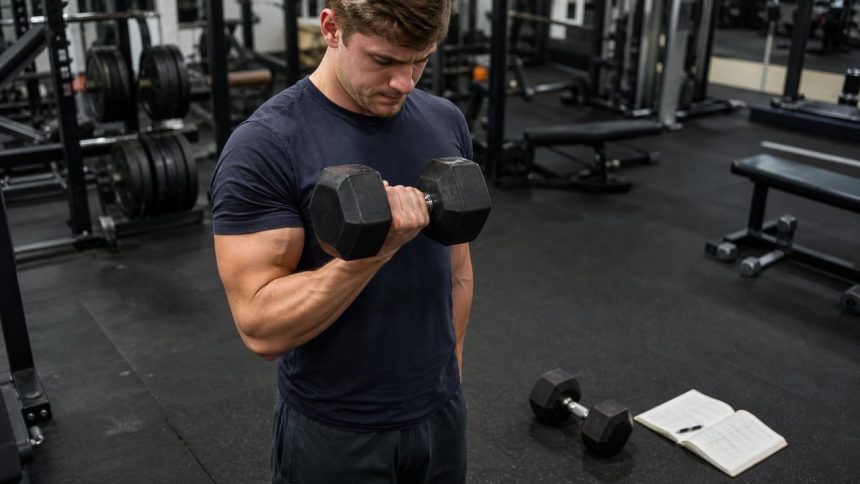
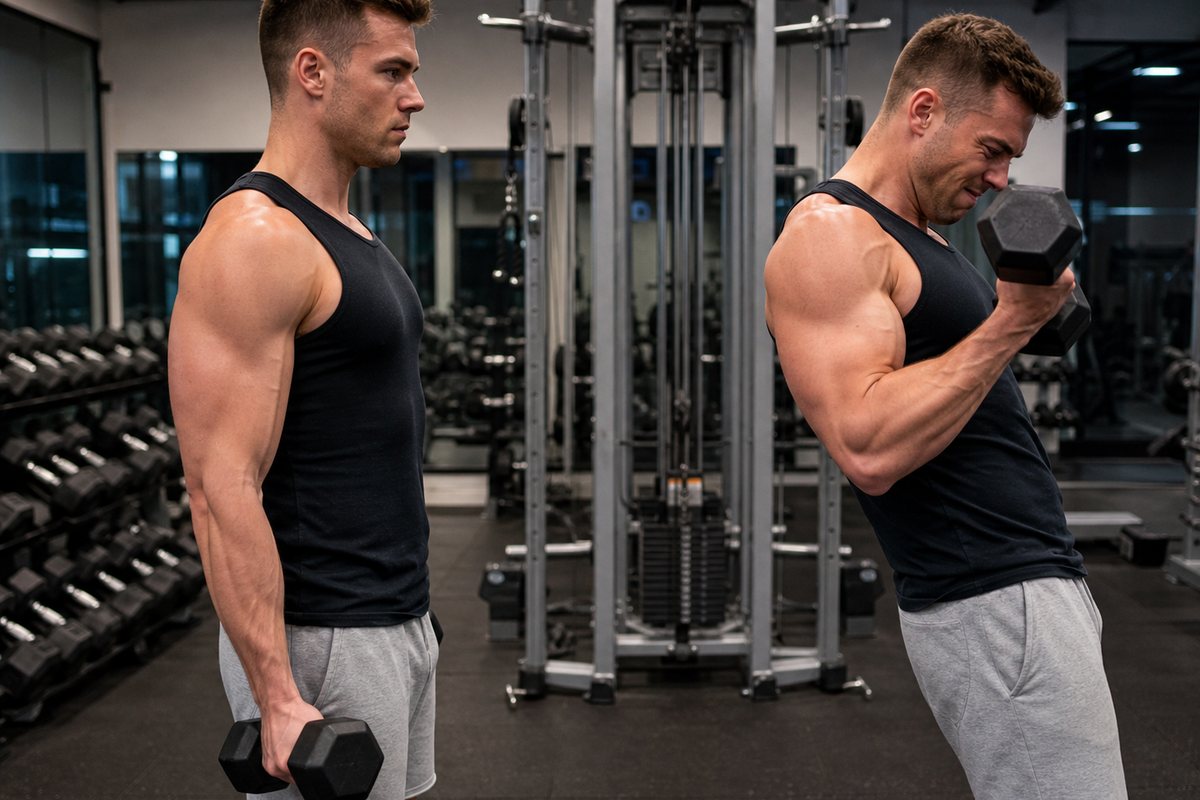
Proper biceps curl form starts with a stable torso, ribs down, elbows near the sides, wrists neutral, and shoulder blades set without over-pinning them. Curl the weight by bending the elbow, not by leaning back or driving the shoulder forward. Lower under control until the elbow is close to straight.
A useful cue is simple: the dumbbell moves, but the upper arm does not travel much. Some natural elbow motion is normal, especially with heavier free-weight curls, but the shoulder should not become the prime mover. If the elbow shoots forward every rep, the front delt is helping too much.
| Form Check | Good Rep | Fix If It Fails |
|---|---|---|
| Torso | Stays tall with no hip snap | Reduce load 10-20 percent |
| Elbows | Stay close to the ribs | Use a wall curl or preacher curl |
| Wrists | Neutral, not folded back | Grip lower in the palm and slow down |
| Lowering | Controlled to near-full extension | Use a 2-second eccentric |
| End of set | Biceps fail before posture fails | Stop one rep earlier |
Should you curl through a full range of motion?
Most lifters should curl through the longest range they can control without pain. That usually means lowering close to full elbow extension and curling until the biceps are strongly shortened, without relaxing at the bottom or turning the top into a shoulder shrug.
The lower half matters because the biceps are loaded at a longer muscle length. Research on resistance training range of motion and long-muscle-length loading suggests that meaningful tension in stretched positions can be useful for hypertrophy. You do not need to chase pain or force an extreme stretch. You do need to stop cutting every rep in half because the ego wants more weight.
Why do your shoulders take over during curls?
Your shoulders take over when the weight is too heavy, the elbow drifts forward, or the set turns into a front-raise pattern. This usually happens near the top of the rep, when the lifter tries to keep moving after the elbow flexors have already done their job.
Fix it by changing the constraint. Stand against a wall. Use an incline bench curl with lighter dumbbells. Try a preacher curl. Use cables so the resistance stays smoother. If a setup makes cheating harder, it tells you more about what the biceps can actually handle.
Are dumbbells, barbells, or cables better for curls?
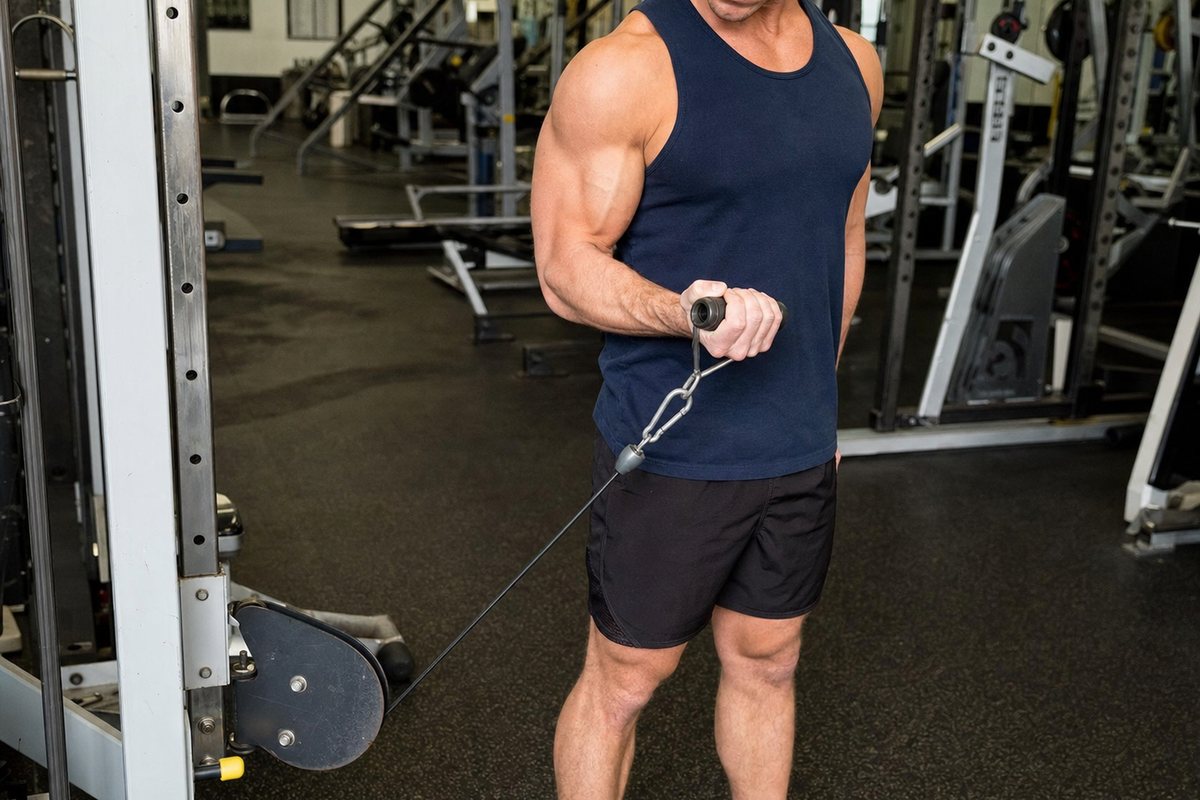
Dumbbells are best for joint freedom, barbells are best for simple loading, and cables are best for steady tension. None is automatically superior. The best option is the one that lets you train hard, progress, and keep your elbows and wrists happy.
Barbell curls can be efficient, but the fixed grip bothers some wrists and elbows. Dumbbells let each arm rotate naturally. Cables can make the bottom half more honest because the cable keeps pulling when a dumbbell would feel easier. Most lifters should rotate two curl patterns for 6 to 10 weeks instead of changing exercises every arm day.
How heavy should you go on biceps curls?
Use a weight that lets you complete 8 to 15 clean reps for most working sets. Heavy curls can work, but if your 6-rep curl looks like a hip hinge, it is no longer a biceps-focused set. For hypertrophy, the target is hard local tension, not the heaviest object you can move from thigh to chest.
A useful rule: if the first rep already needs body English, the weight is wrong. If only the final rep has a small amount of controlled grind, the load is probably fine. Keep one or two reps in reserve on most sets and save true failure for safer variations like cable curls or preacher curls.
How many curl sets do you need per week?
Most intermediate lifters do well with 6 to 12 direct biceps sets per week, split across two or three sessions. That is direct work on top of rows, pull-ups, pulldowns, and other pulling exercises that already train elbow flexion.
Start near the low end if your back training is heavy. Add volume only when recovery, elbow comfort, and performance support it. If your curls are flat, elbows ache, and rows are getting worse, more arm volume is not the smart fix.
| Goal | Weekly Direct Sets | Best Curl Mix | Progression Target |
|---|---|---|---|
| Beginner arm growth | 4-6 | Dumbbell curl + hammer curl | Add reps before load |
| Intermediate hypertrophy | 6-12 | Incline curl + cable curl + preacher curl | Same form, more reps or load |
| Elbow-friendly training | 4-8 | Cables and neutral grips | Pain-free range first |
| Strength focus | 4-6 | Barbell curl + strict dumbbell curl | Small load jumps |
What are the biggest biceps curl mistakes?
The biggest mistake is treating curls like a full-body lift. Swinging can move more weight, but it reduces the reason you chose curls in the first place. The biceps need to be the limiting tissue, not the hips, traps, or lower back.
The second mistake is avoiding the bottom range. Half reps can have a place when programmed deliberately, but most lifters cut range because the full rep is harder. The third mistake is chasing too many variations before progressing one or two of them long enough to matter.
Which curl variations are worth using?
Use variations that solve a specific problem. Incline curls make the long position harder. Preacher curls make shoulder cheating harder. Cable curls keep tension smoother. Hammer curls train the brachialis and brachioradialis. Reverse curls build forearms and grip tolerance.
A simple six-week block could use incline dumbbell curls for 3 sets of 8 to 12 and cable curls for 3 sets of 12 to 15 twice per week. Add reps until the top of the range is clean, then increase load slightly. That beats trying seven random curl styles with no progression record.
How should curls fit into a full program?
Place curls after your main pulling work or on a dedicated arm day. If you train back first, the biceps are already warm and direct curls do not interfere with rows or pull-ups. If arms are a priority, put curls earlier in one weekly session while still keeping heavy compounds in the program.
For full-body planning, use our training program guide. If you want more direct arm work, pair this with our arm training guide and use the one-rep max calculator only for big lifts, not curl ego tests.
How do you progress curls without ruining form?
Progress curls with a double-progression target before adding load. Pick a rep range such as 8 to 12. Keep the same weight until every set reaches the top of the range with the same elbow position, same lowering tempo, and no torso swing. Then increase the weight by the smallest jump available.
This matters because curls are easy to fake. A 5-pound jump per dumbbell can be a major increase for elbow flexors, especially after rows and pulldowns. Microloading, cable-stack jumps, or adding one rep per set often works better than chasing a heavier dumbbell every week. The logbook should show better biceps work, not just heavier compensation.
What should you do if one arm is weaker?
Train unilateral curls first when one arm lags. Start each set with the weaker side, match the stronger side to the same reps, and avoid letting the stronger arm accumulate extra work. Dumbbells and single-arm cables are better than a barbell for this problem because each side has to finish its own reps.
A small asymmetry is normal. A widening gap usually means the stronger side is stealing work during compound pulls or barbell curls. Use the same range, same tempo, and same rest period on both sides for 6 to 8 weeks before deciding the gap is stubborn.
FAQ
Should I squeeze at the top of a biceps curl?
Yes, but do not turn the squeeze into a shoulder roll. Pause briefly when the elbow is fully flexed, keep the wrist neutral, and lower with control. The squeeze is useful only if the biceps, not the front delt, are doing the work.
Are cheat curls ever useful?
Cheat curls can be useful for advanced lifters when programmed deliberately, usually with a controlled eccentric. They are a poor default for beginners because they hide whether the biceps are actually progressing.
Why do curls hurt my elbows?
Elbow pain can come from too much volume, fixed-grip bars, excessive wrist extension, fast lowering, or doing curls after heavy pulling fatigue. Switch to dumbbells or cables, reduce volume, and rebuild with controlled reps.
Do hammer curls build biceps?
Hammer curls train the elbow flexors, especially the brachialis and brachioradialis. They still help arm size, but they do not replace supinated curls if your goal is maximal biceps emphasis.
Bottom line
The best biceps curl is the one you can repeat, load, and feel in the target muscle without turning the rep into a shrug or hip swing. Use full controlled reps, keep the upper arm quiet, and progress a small menu of curl variations for several weeks.
If your curls have not changed your arms in months, do not add a trick variation first. Film one set, check your range and elbow position, drop the load if needed, and make the biceps earn every inch of the rep.
Sources
- Schoenfeld, B. J. (2010). The mechanisms of muscle hypertrophy and their application to resistance training. Journal of Strength and Conditioning Research. PMID: 20847704.
- Schoenfeld, B. J., Grgic, J., Ogborn, D., & Krieger, J. W. (2017). Strength and hypertrophy adaptations between low- vs. high-load resistance training. Journal of Strength and Conditioning Research. PMID: 27433992.
- Pedrosa, G. F., et al. (2023). Partial range of motion and long-muscle-length resistance training research. PubMed indexed literature search. Accessed June 25, 2026.