
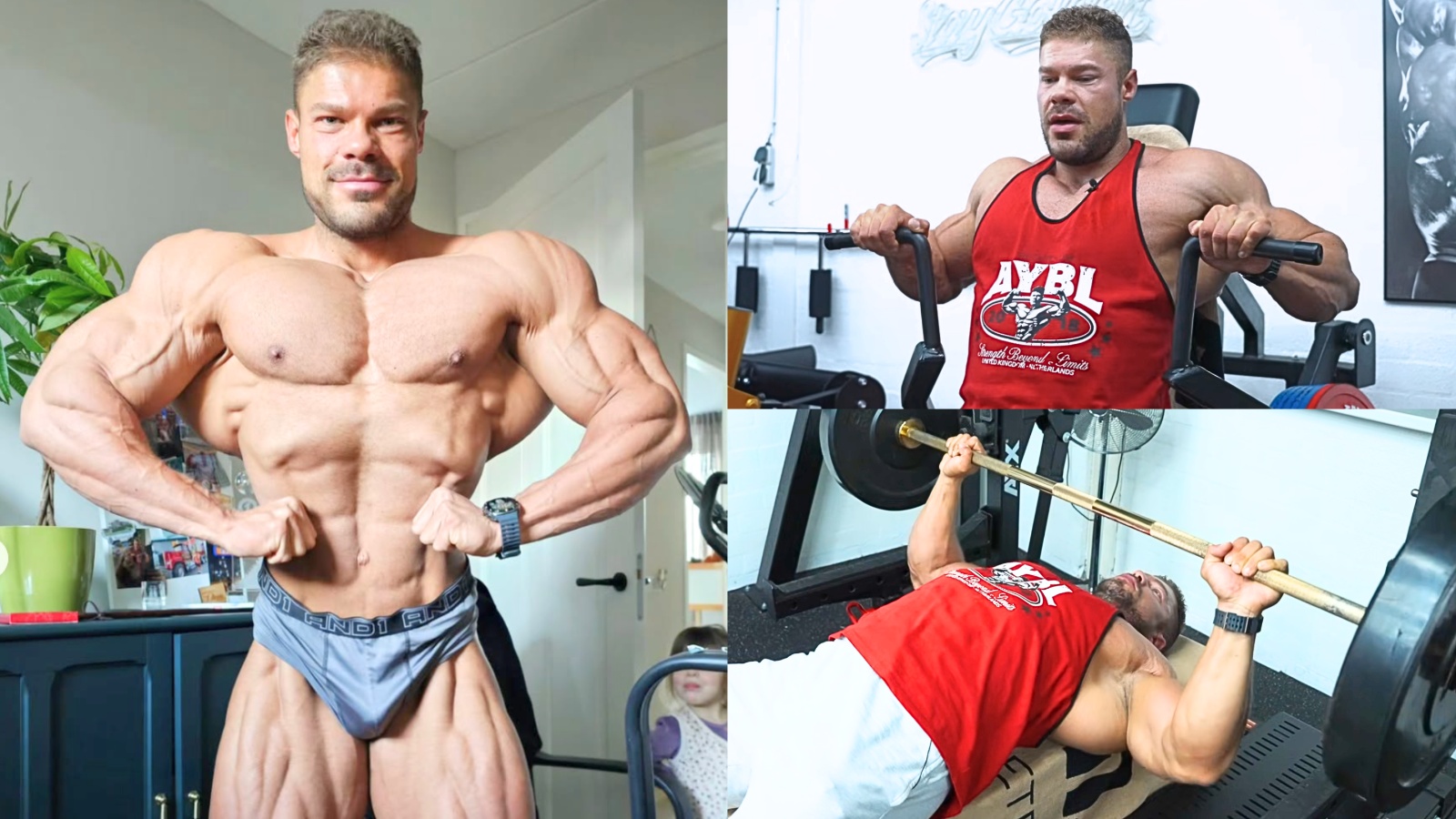
Bodybuilder Wesley Vissers is in the midst of growing season with plans to bring more size and detail than ever before. In a recent YouTube video published on July 13, 2025, he broke down why he is no longer traditional bench pressing and offered his top three alternatives for optimal pec growth.
Vissers leapt onto the IFBB Pro League map thanks to his Classic era physique and impressive symmetry. In 2024, he shocked the world, cementing himself as the Arnold Classic champion after pulling off a massive upset over favorite Ramon Queiroz.
However, when it was time to test himself against the best, Vissers ran into some speed bumps. Ultimately, the Dutch native lacked the mass in his legs needed to push into title contention at the 2024 Mr. Olympia. Judges took notice and awarded him eighth place.
While Vissers aimed to bounce back by defending his title at the 2025 Arnold Classic, he fell to fourth, unable to conquer the shape and condition of Mike Sommerfeld. He made a detour at the Detroit Pro in second place before deciding to take the rest of the year off to make improvements.
Why Wesley Vissers Stopped Doing Heavy Bench Press and What He Recommends Now
Here are Vissers’ barbell bench press alternatives, which were presented in his YouTube video:
- Smith Machine Bench Press
- Dumbbell Bench Press
- Machine Bench Press
First and foremost, Vissers explained where the traditional barbell bench press falls short. He notes that at the top of each repetition, there’s only tension on the triceps and elbows instead of the pecs.
“Number one reason is shoulder impingements and the inability to actually engage the chest in the contraction part. This video will be all about when is the bench press a viable option for you to grow your chest and when should you probably skip it.”
“The chest wants to be able to contract at the top. There’s a natural way that a chest likes to move. However, if you do the bench press, this is a bar, obviously you cannot bend, so you’re going down, this is pretty good but the moment you go up, there’s nothing here, there’s only tension on the elbows and triceps and you can’t contract the chest here [at the top].”
Smith Machine
The first alternative Vissers advocated for was the Smith machine. Its safety mechanisms allow lifters to chase failure without having to worry about injuries.
“I’m not saying the bench press sucks in general, it’s still an amazing movement but one of the biggest disadvantages that I didn’t mention yet is that you cannot train alone and go to failure on the bench press because you need a spotter to save yourself from that heavy weight. The solution to this is, of course, the Smith machine,” he said.
Dumbbell Bench Press
His next go-to is the dumbbell bench press, though he cautions that the one key thing missing here is the lack of a peak contraction.
“The next best thing from the bench press is going to be the dumbbell press. Just as old school as a bench press. This, in my opinion, is one of the best chest builders in the universe.
There’s still one thing missing, however, the contraction part. But at least the converging pattern the chest wants to go inwards, that is still happening but there’s no peak contraction. It’s still an amazing movement.
Machine Bench Press
He also favors the machine bench press for its stretch and contraction.
“Simply do the press, also here, it has a very nice stretch and a very nice contraction. That is the most important difference between a chest press and a bench press. They both are called a press, but they work in drastically different ways.”
Vissers, a decorated IFBB Pro, believes the machine bench press suits high-level lifters who could be more prone to injuries.
“As a beginner, bench press is totally fine. I grew my chest with it a lot myself, but as a more advanced person, you get stronger, more injury risk prone, you do feel the joints so then you want to move to movements that allow your chest and other muscles to move in a natural way.”
In addition to the chest, Vissers has opened up on how anyone can achieve a more accentuated v-taper. He credits t-bar rows, narrow grip pulldowns, and seated bilateral rows for not only helping with v-taper development, but also with back thickness and width.
Vissers believes there’s a time and place for traditional barbell rows. For those aiming to build a well-rounded chest, he is confident these three pressing alternatives are key for balanced development.