
The PSMF calculator sets daily calories, protein, fat and carbohydrate for a protein-sparing modified fast: a very-low-calorie diet built mostly on lean protein, with little carbohydrate or fat. It also estimates your weekly fat loss and a maximum duration from your body fat. Chang and Kashyap describe the PSMF as a medically supervised diet, so talk to a physician before you start.
Last verified 6 Oct 2026 against the calculator’s own macro settings, the revised Harris-Benedict equation (Roza and Shizgal, 1984), the 3,500-calories-per-pound rule (Wishnofsky, 1958), Helms and colleagues’ 2014 review of protein during calorie restriction and Chang and Kashyap’s 2014 review of the PSMF.
PSMF Calculator
Calculate your Protein Sparing Modified Fast macros for rapid fat loss
Related Calculators
Medical Disclaimer: This calculator provides estimates for educational purposes only and does not constitute medical advice. Intermittent fasting is not appropriate for everyone. Do not fast if you are pregnant or breastfeeding, under 18 years of age, have a history of eating disorders, or have been diagnosed with Type 1 diabetes. If you take medications (especially insulin or blood pressure medication), have any chronic health conditions, or are recovering from surgery, consult your physician before beginning any fasting protocol. If you experience chest pain, fainting, persistent dizziness, or heart palpitations during a fast, stop immediately and seek medical attention.
How your result is worked out
The calculator works in four steps. The fat factor and the duration limits are its own settings, so treat the result as a starting plan to review with your physician.
1. Lean body mass
Your weight times (1 minus your body fat percentage) gives your lean body mass in pounds. With Metric selected, the calculator works in pounds and converts the result back to kilograms.
2. Macros and calories
| Part | How the calculator sets it |
|---|---|
| Protein | 1.4 g per lb of lean body mass, rounded |
| Fat | 0.1 g per lb of lean body mass, rounded |
| Carbohydrate | 20 g a day, from vegetables, for everyone |
| Daily calories | Protein x 4 + fat x 9 + carbohydrate x 4, never below 800 |
The calculator sets protein at 1.4 g per lb of lean body mass, about 3.1 g per kg. That is the top of the 2.3 to 3.1 g per kg of lean mass a day that Helms and colleagues found for lean, resistance-trained athletes cutting calories. Clinical PSMF protocols use about 1.2 to 1.5 g per kg of ideal body weight and under 800 calories a day, under medical supervision (Chang and Kashyap, 2014). This calculator never sets fewer than 800 calories.
The 20 g of carbohydrate sits inside the under 20 to 50 g a day that Chang and Kashyap give for the PSMF. If your macros add up to less than 800 calories, the calculator raises the target to 800 and warns you not to add or change macros to reach it without guidance from a clinician.
3. Daily deficit and weekly fat loss
Your weight, height, age and sex go into the revised Harris-Benedict equation, which estimates the calories you burn at rest (BMR).
Men: 88.362 + (13.397 x weight in kg) + (4.799 x height in cm) – (5.677 x age)
Women: 447.593 + (9.247 x weight in kg) + (3.098 x height in cm) – (4.330 x age)
The calculator multiplies your BMR by 1.2 for Sedentary, 1.375 for Light or 1.55 for Moderate to estimate your daily energy use (TDEE). Your daily deficit is TDEE minus your PSMF calories. Weekly fat loss is that deficit times 7, divided by 3,500 calories per pound.
Roza and Shizgal found the Harris-Benedict equation estimates resting energy use to within about 14%, so your real deficit can differ. The 3,500-calorie rule also ignores the way your energy use falls as you lose weight (Hall and colleagues, 2011), so read the weekly figure as an estimate for the first weeks.
4. Maximum duration
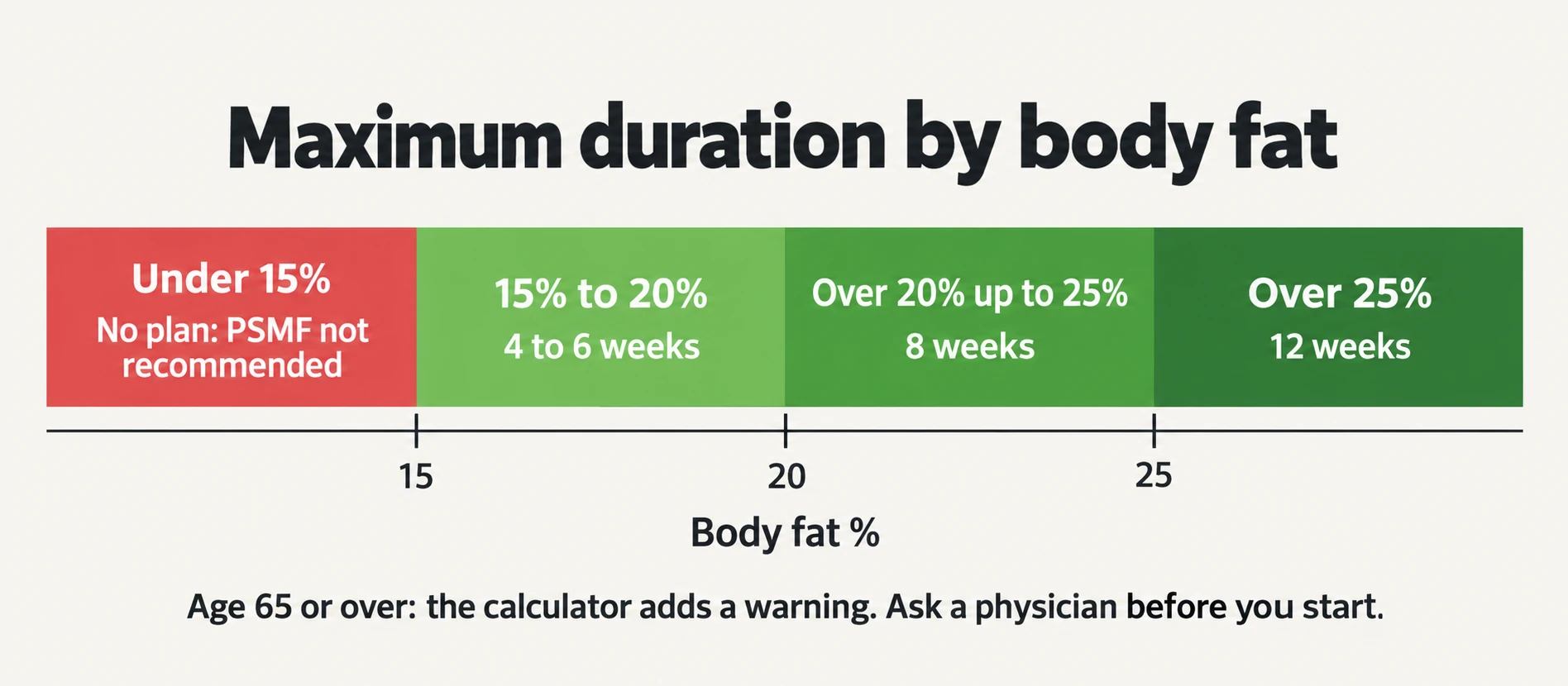
| Body fat | Maximum duration shown |
|---|---|
| Over 25% | 12 weeks |
| Over 20%, up to 25% | 8 weeks |
| 15% to 20% | 4 to 6 weeks |
| Under 15% | No plan: only a warning that a PSMF is not recommended |
These limits are the calculator’s own settings. Below 15% body fat it gives no calories, macros or duration: it tells you a PSMF is not recommended and suggests talking to a clinician or using the weight loss calculator. If you enter an age of 65 or over, it adds a warning that Chang and Kashyap do not recommend a PSMF after 65.
Worked example: the default inputs
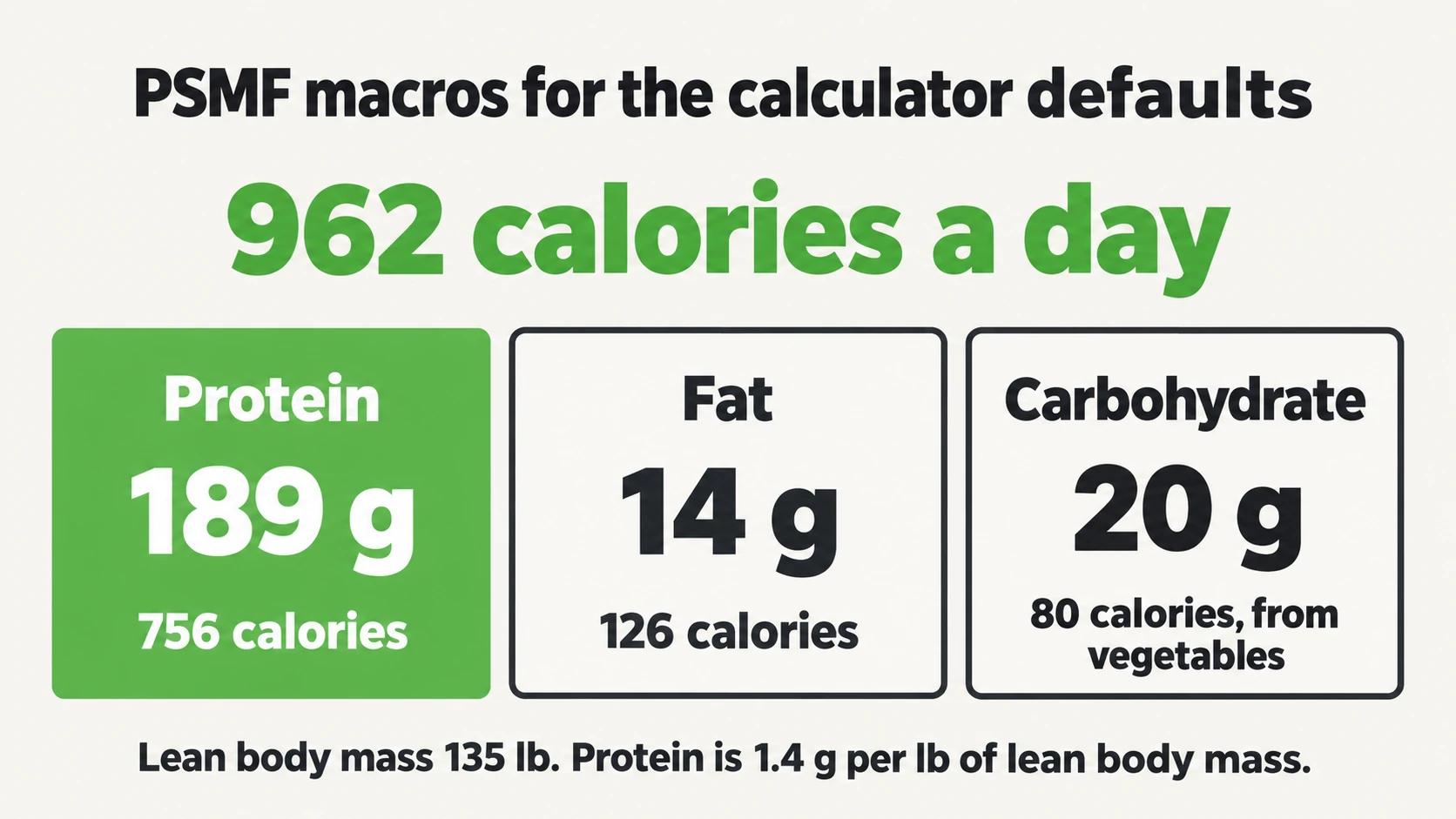
The calculator starts with a 30-year-old man, 180 lb, 25% body fat, 5 ft 8 in and Light activity. These are the numbers it shows before you change anything.
| Step | Result |
|---|---|
| Lean body mass (180 x 0.75) | 135 lb |
| Protein (135 x 1.4) | 189 g |
| Fat (135 x 0.1) | 14 g |
| Carbohydrate | 20 g |
| Daily calories (756 + 126 + 80) | 962 calories |
| BMR | About 1,841 calories a day |
| TDEE (x 1.375) | About 2,531 calories a day |
| Daily deficit | 1,569 calories |
| Weekly fat loss (1,569 x 7 / 3,500) | 3.1 lb |
| Maximum duration (25% body fat) | 8 weeks |
PSMF questions
How much weight can I expect to lose on a PSMF?
The calculator shows its estimate under Weekly Fat Loss: 3.1 lb a week at the defaults. In the supervised program Chang and Kashyap describe, patients typically lose 1 to 3 kg a week, with more in the first 2 weeks, partly because glycogen leaves the body with the water bound to it.
Who should not do a PSMF?
Chang and Kashyap list a BMI under 27, a recent heart attack, angina, significant arrhythmia, decompensated heart failure, recent stroke, end-stage kidney disease, liver failure, cancer, major psychiatric illness, pregnancy or breastfeeding, and wasting disorders. They do not recommend it under age 16 or over 65, and the calculator shows that warning for ages 65 and over. The calculator’s own guidelines add a history of eating disorders and body fat below 15%. Ask a physician before you start, and do not try a PSMF without medical supervision.
What foods fit the macros?
The calculator’s guidelines build meals on lean protein such as chicken breast, white fish and egg whites, fill up on non-starchy vegetables such as spinach and broccoli, and use zero-calorie seasonings for flavor. Plan every meal ahead so the day stays inside your targets.
Do I need supplements on a PSMF?
In the program Chang and Kashyap describe, patients take a multivitamin and mineral supplements that their care team sets. Ask your clinician about a multivitamin, fish oil and electrolytes before you start, as the calculator’s guidelines say.
How often should I do refeeds on a PSMF?
The calculator does not plan refeeds or the return to normal eating. In Chang and Kashyap’s program, calories come back gradually over a refeeding phase of about 6 to 8 weeks. Agree a plan with your physician or dietitian before you start, and stop at the maximum duration the calculator shows.
Sources
- The protein-sparing modified fast for obese patients with type 2 diabetes: what to expect. Chang J, Kashyap SR. Cleveland Clinic Journal of Medicine, 2014; 81: 557-565.
- A systematic review of dietary protein during caloric restriction in resistance trained lean athletes: a case for higher intakes. Helms ER, Zinn C, Rowlands DS, Brown SR. International Journal of Sport Nutrition and Exercise Metabolism, 2014; 24: 127-138.
- The Harris Benedict equation reevaluated: resting energy requirements and the body cell mass. Roza AM, Shizgal HM. American Journal of Clinical Nutrition, 1984; 40: 168-182.
- Caloric equivalents of gained or lost weight. Wishnofsky M. American Journal of Clinical Nutrition, 1958; 6: 542-546.
- Quantification of the effect of energy imbalance on bodyweight. Hall KD, Sacks G, Chandramohan D, Chow CC, et al. The Lancet, 2011; 378: 826-837.
More fasting tools
- IF macro calculator: compare a less restrictive calorie and macro plan for training and rest days.
- Fasting electrolyte calculator: check the daily reference ranges for sodium, potassium and magnesium.
- Fasting weight loss calculator: estimate how many weeks your fasting plan takes to reach a goal weight.
- All fasting calculators: every fasting calculator in one list.