Fasted cardio is not fake. You can wake up, walk, ride, jog, or do an easy conditioning session before breakfast and get a perfectly useful workout. The mistake is turning fasted cardio into a fat-loss rule that must be followed even when the session feels flat.
If your pace drops, your lifting session suffers, or intervals turn into survival mode, the fix may be tiny: 10 to 25 grams of carbohydrate before training. That is not “ruining fat loss.” It is fueling the work so the workout can actually do its job.
What Should You Eat Before Fasted Cardio?
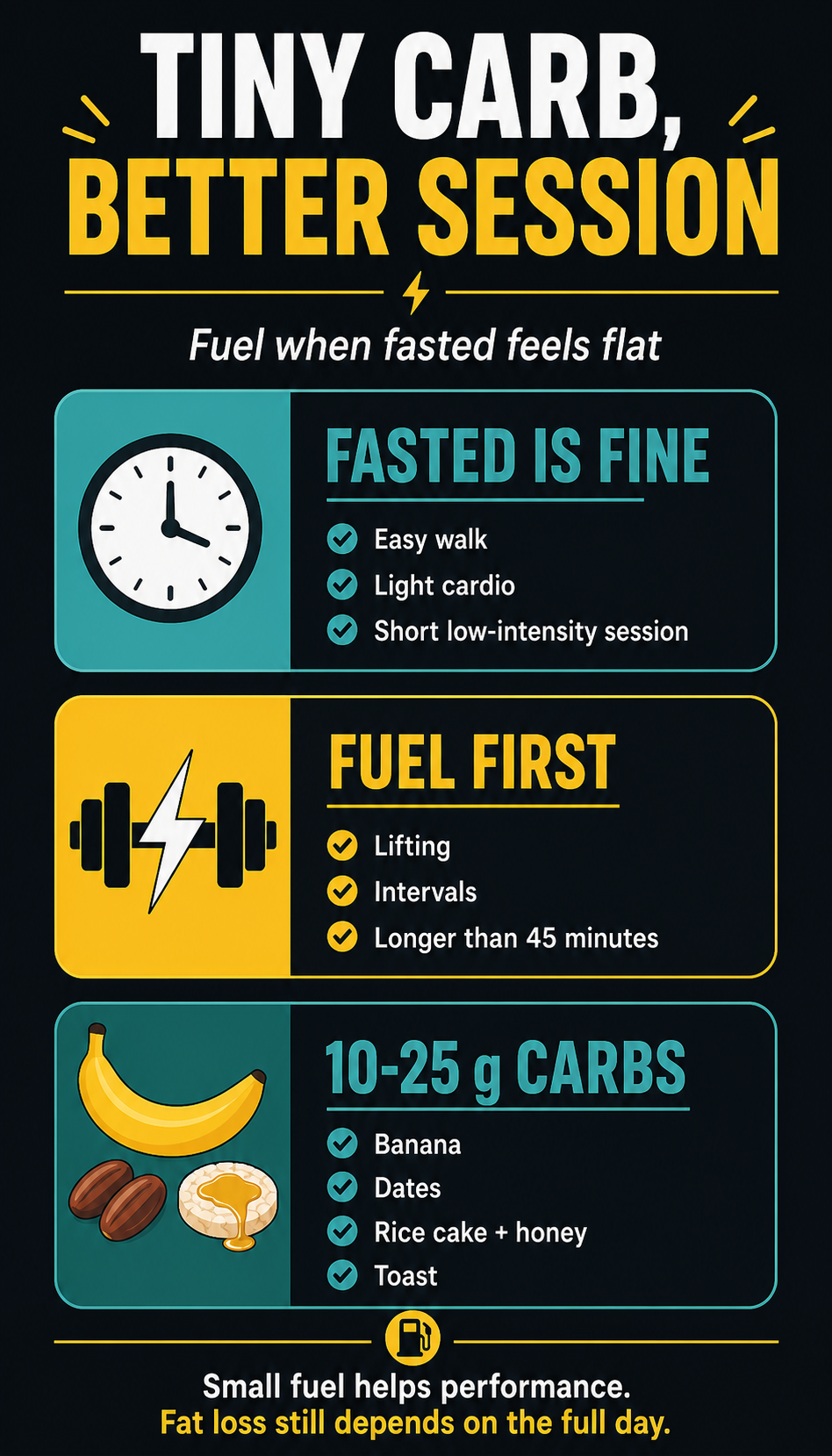
For easy low-intensity cardio, staying fasted is fine if you feel good. For lifting, intervals, harder cardio, or sessions longer than about 45 minutes, try 10 to 25 grams of carbs 15 to 30 minutes before training: half a banana, one or two dates, toast, a rice cake with honey, or sports drink.
Why Forget Fasted Cardio as a Fat-Loss Hack?
Fasted cardio can increase fat oxidation during the session, but that does not automatically mean more body fat lost over weeks. Body composition changes still depend on total energy balance, protein, training consistency, sleep, and adherence. The practical question is not “does fasted cardio burn fat while I do it?” It is “does this setup help me train consistently and recover well?”
Fasted cardio is not useless, but it is not a fat-loss shortcut. Fed and fasted cardio can both work when weekly calories and training are controlled. If fasted training lowers intensity or makes you ravenous later, a small pre-workout carb is the smarter choice.
What Does the Research Say?
The best evidence does not support treating fasted cardio as a special fat-loss lever. In a controlled body-composition study, fasted and fed aerobic training produced similar changes when calories were controlled. A later systematic review found that fasted exercise changes fuel use during the session, but that is not the same as proving superior fat loss over time.
The practical takeaway is simple: fasted cardio is a preference tool, not a physiology loophole. If training fasted helps you stay consistent, keep it. If it lowers output, makes hard workouts worse, or triggers overeating later, fuel the session and judge progress by weekly body composition trends.
Fasted cardio may increase fat use during a workout, but studies do not show it reliably beats fed cardio for body-fat loss when total calories are controlled. The better choice is the one that preserves performance, recovery, and consistency across the week.
Use This Decision Tree
| Session | Fasted? | Better move |
|---|---|---|
| 20-30 minute easy walk | Usually fine | Water, coffee if tolerated |
| Hard lifting | Often worse | 10-25 g carbs before |
| Intervals or hills | Risky for output | Fuel first |
| Long cardio over 45 minutes | Depends | Start with carbs and fluids |
Five Tiny Carb Options
| Option | Approx carbs | Best use |
|---|---|---|
| Half banana | 12-15 g | Early gym sessions |
| Two dates | 12-18 g | Quick energy |
| Rice cake + honey | 15-22 g | Intervals |
| Small toast square | 12-20 g | Lifting |
| Sports drink sip | 10-25 g | Longer cardio |
For readers who train early, FitnessVolt’s what to eat before an early morning workout guide pairs well with this approach. If stomach comfort is your limiter, use the workout-after-eating timing guide to choose the right window.
Who Should Stay Fasted?
Stay fasted when the session is easy, short, and feels good. A gentle walk, mobility flow, or low-intensity bike ride does not need a banana by default. Some people also prefer fasted cardio because it simplifies the morning.
Fasted cardio is a reasonable choice for easy sessions when energy, mood, and recovery are normal. It becomes a problem when it turns every workout into a low-output slog. Performance is a useful signal: if fueled training is clearly better, use the fuel.

Who Should Fuel First?
Fuel first if you lift, sprint, do intervals, get dizzy, have poor sleep, are dieting hard, or tend to overeat after fasted sessions. People with diabetes, blood-sugar concerns, pregnancy, or medical conditions should individualize this with a clinician.
For snack ideas beyond the tiny carb list, see FitnessVolt’s pre-workout snack guide. For fat loss, keep the main lever honest with the calorie deficit calculator.
Reader Scenarios
| Reader | Problem | Best test |
|---|---|---|
| Early-morning walker | Feels fine fasted | Stay fasted, hydrate |
| Morning lifter | First sets feel weak | Half banana before warm-up |
| Interval athlete | Pace collapses | Rice cake + honey 20 min before |
| Dieting hard | Overeats after cardio | Fuel first and track hunger |
| Long-cardio reader | Energy fades late | Start fueled and sip carbs if needed |
Timing Rules That Keep It Simple
Use the smallest dose that solves the problem. Ten grams may be enough for a short lift. Twenty-five grams may be better for intervals, hills, or longer cardio. If you have 15 minutes, use something small and easy to digest. If you have an hour, a slightly larger snack with some protein can work.
Do not turn the tiny-carb strategy into a second breakfast by accident. Nut butters, granola bars, big smoothies, and coffee drinks can add hundreds of calories quickly. The point is targeted fuel, not a free-for-all. For body composition, the whole day still counts.
A tiny pre-workout carb should solve a performance problem without becoming a large meal. Start with 10 to 25 grams of carbs 15 to 30 minutes before training, then adjust based on energy, stomach comfort, hunger, and the total calories for the day.
What Not to Do
- Do not force fasted intervals if your output falls apart.
- Do not claim fasted cardio is useless when it works well for easy sessions.
- Do not confuse fat oxidation with fat loss over weeks and months.
- Do not copy someone else’s blood-sugar strategy if you use glucose-lowering medication.
- Do not add fuel and ignore calories if fat loss is the goal.
FAQ
Does fasted cardio burn more fat?
It can burn more fat during the session, but that does not guarantee more body fat loss over time.
Will 20 grams of carbs stop fat loss?
No. Fat loss depends on the full day and week. A tiny carb can improve training without breaking a deficit.
Is coffee enough before cardio?
For easy cardio, maybe. For hard sessions, coffee is not a carbohydrate source.
What if I get nauseous?
Use smaller portions, liquids, or more time before training.
Sources
- Schoenfeld, B. J., Aragon, A. A., Wilborn, C. D., Krieger, J. W., and Sonmez, G. T. (2014). Body composition changes associated with fasted versus non-fasted aerobic exercise. Journal of the International Society of Sports Nutrition, 11, 54.
- Vieira, A. F., Costa, R. R., Macedo, R. C. O., Coconcelli, L., and Kruel, L. F. M. (2016). Effects of aerobic exercise performed in fasted v. fed state on fat and carbohydrate metabolism in adults: a systematic review and meta-analysis. British Journal of Nutrition, 116(7), 1153-1164.
- Kerksick, C. M., Arent, S., Schoenfeld, B. J., et al. (2017). International society of sports nutrition position stand: nutrient timing. Journal of the International Society of Sports Nutrition, 14, 33.